secondary
Jerusalem artichoke
Helianthus tuberosus
International hardiness
- USDA 3-9
- RHS H7
- AU: Cool temperate, Warm temperate
Where it grows — regional guide
| Zones / rating | Regional notes |
|---|---|
USDA 3-9 | Overwinters easily across northern and midwestern states; grow in dedicated beds with root barriers to prevent aggressive subterranean spread. |
| Zones / rating | Regional notes |
|---|---|
H7 (below -20C) | Thrives across England and Scotland in open ground; lift tubers from November to March and contain roots to prevent persistent garden spread. |
| Zones / rating | Regional notes |
|---|---|
Cool temperate, Warm temperate | Plant in late winter or early spring across Victoria, Tasmania, and cooler areas of New South Wales; provide summer irrigation and contain rhizomes. |
| Zones / rating | Regional notes |
|---|---|
USDA 3-9 (USDA scale) Canada uses its own zone system; Canadian zones run roughly one lower than USDA. | Extremely reliable in Canadian prairies and eastern provinces down to Zone 3; sow tubers in spring within contained beds to limit spread. |
| Zones / rating | Regional notes |
|---|---|
No region-specific data yet | No region-specific data yet |
Jerusalem artichoke (Helianthus tuberosus) is an erect, tuber-bearing perennial herb in the daisy family (Asteraceae). Widely known as sunchokes, these plants are cultivated primarily for their knobbly underground tubers, which deliver a sweet, nutty crunch reminiscent of water chestnuts when eaten raw or globe artichokes when cooked. Unlike the annual sunflower grown for oilseed and cutting blooms, the Jerusalem artichoke is a resilient carbohydrate reserve and high-biomass shelterbelt in homestead agriculture.
The species is native to central and eastern North America, where Indigenous peoples cultivated and traded the tubers extensively long before European exploration. French explorer Samuel de Champlain transported specimens to Europe in the early seventeenth century, where the crop spread into temperate vegetable plots and livestock systems. In a diversified food forest or permaculture design, Jerusalem artichoke is a robust secondary-layer perennial. The fibrous stems provide an annual windbreak, the deep root network draws subsoil minerals, and the autumn-blooming flowers sustain native bees and late-season pollinators.
Cultivated tubers offer an alternative to the common potato, storing energy as inulin rather than starch. This botanical characteristic makes the crop valuable for cold-climate homesteads seeking dependable autumn and winter yields with minimal annual cultivation.
Growing Jerusalem artichoke
Jerusalem artichoke adapts to a wide array of soil conditions but performs best in loose, fertile, well-drained sandy loams with a soil pH between 6.0 and 7.5. Heavy clay soils reduce tuber expansion and make lifting difficult, while excessively rich soils encourage excessive stem height at the expense of tuber development. Full sunlight is necessary for substantial tuber production; plants grown in partial shade develop spindly stalks and produce smaller, less clustered tubers.
The crop requires regular moisture during the midsummer tuber-initiation phase. While established plantings exhibit moderate drought tolerance due to their extensive root architecture, prolonged dry spells cause premature leaf drop and reduce final tuber size. In arid or Mediterranean climates, supplementary drip irrigation ensures consistent yields. In high-rainfall temperate regions, raised planting beds prevent waterlogging and reduce the risk of tuber rot in saturated ground.
Propagation relies on dormant tubers rather than true seed. Plant whole, disease-free tubers weighing roughly 50 to 60 g (1.8 to 2.1 oz), or cut large tubers into blocky pieces ensuring each section possesses at least two prominent eyes. In temperate zones, set tubers into the soil in early spring as soon as the ground can be worked, planting 10 to 15 cm (4 to 6 in) deep. Space individual plants 30 to 45 cm (12 to 18 in) apart within rows spaced 75 to 90 cm (30 to 36 in) apart to allow adequate airflow and easy weeding during early development.
Stems emerge rapidly once spring temperatures rise, developing thick, coarse stalks that reach 1.5 to 3 m (5 to 10 ft) in height. Rapid canopy closure shades out most competing annual weeds by midsummer. Tubers begin swelling in late summer as day lengths shorten and flowering commences. No specialised fertilisation is necessary; an initial dressing of well-rotted compost at planting supplies adequate nutrition for the entire season.
Harvest and uses
Harvest begins in late autumn after the first hard frosts kill the aerial foliage. Freezing temperatures trigger the breakdown of storage inulin into fructose, sweetening the flavour and softening the tuber flesh. Cut the withered stems back to a stub of 10 to 15 cm (4 to 6 in) to mark row locations. Gently loosen the surrounding soil with a broadfork or digging fork, lifting the cluster of tubers from beneath the crown.
Unlike potatoes, Jerusalem artichoke tubers possess very thin, delicate skins lacking a protective suberised cork layer. Consequently, tubers lose moisture quickly and shrivel if stored in standard dry room air. The most effective storage technique is leaving tubers undisturbed in the ground, digging fresh quantities as needed throughout the winter whenever the soil is unfrozen. In regions with severe soil freezing, mulch the beds heavily with 20 to 30 cm (8 to 12 in) of straw to keep the soil workable, or lift the crop in late autumn and store clean, unwashed tubers in boxes of damp sand or peat moss at 0 to 2 °C (32 to 36 °F) with 90 to 95 percent relative humidity.
In the kitchen, the tubers offer culinary flexibility. Scrub the knobbly skins with a stiff brush rather than peeling to minimise waste and retain nutrients. Sliced thin, raw tubers add a water-chestnut crunch to salads. When roasted, steamed, pureed, or simmered in soups, the flesh turns silky and delicate. Beyond human consumption, the aerial stalks and leaves yield high-fibre green forage for goats, sheep, and cattle, while raw tubers provide winter feed for pastured pigs.
Identifying Jerusalem artichoke
Jerusalem artichoke is readily identified by its robust, sunflower-like architecture and characteristic underground anatomy:
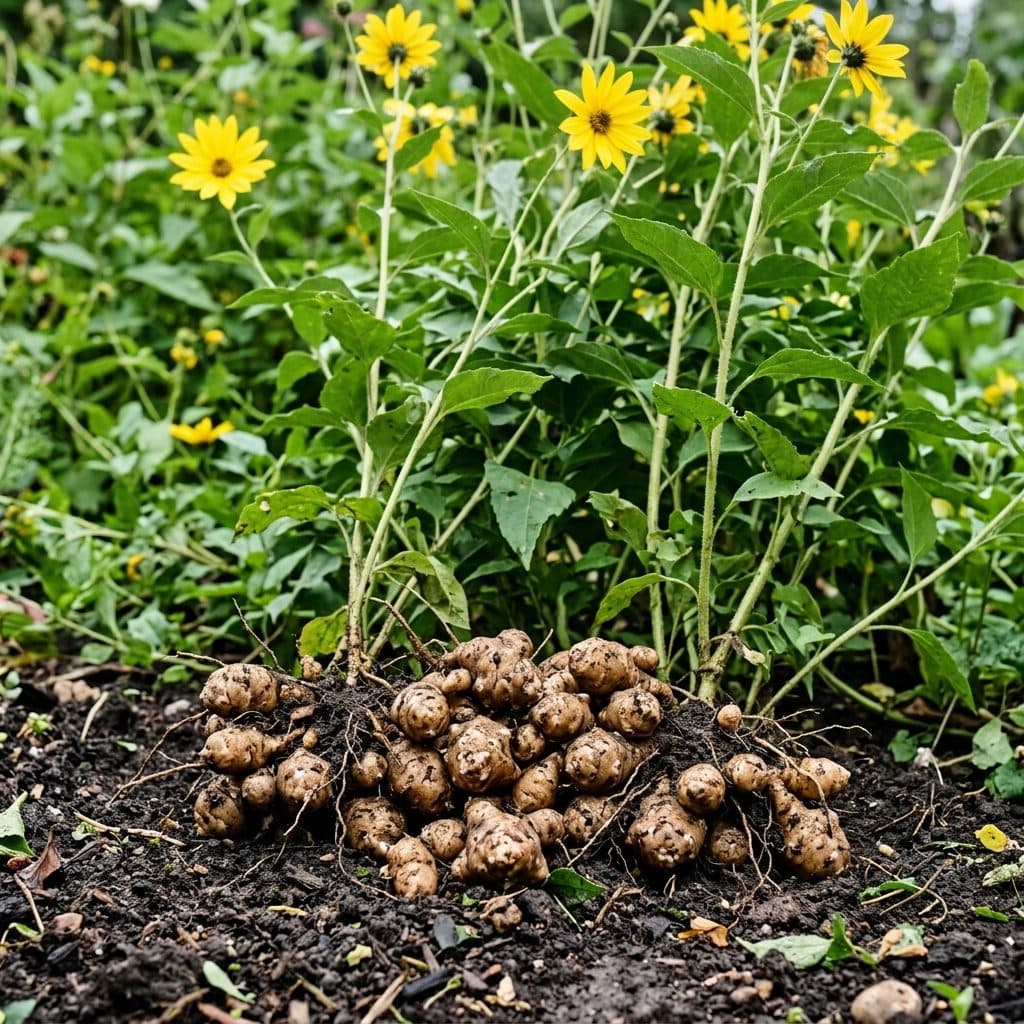
- Stems: Erect, stout, fibrous, reaching 1.5 to 3 m (5 to 10 ft) in height, covered in stiff, bristly hairs that feel distinctly rough to the touch.
- Leaves: Lower leaves are opposite while upper leaves alternate along the stem; blades are ovate to lanceolate, 10 to 25 cm (4 to 10 in) long, with serrate margins and coarse, sandpaper-textured surfaces.
- Flowers: Bright yellow composite heads, 5 to 8 cm (2 to 3 in) across, featuring 10 to 20 ray florets surrounding a yellow central disc, produced in terminal branched clusters from late August into October.
- Tubers: Irregular, elongated, or knobbly underground fleshy stems ranging from 7 to 15 cm (3 to 6 in) in length, with thin tan, pale yellow, or reddish skins and crisp white internal flesh.
The plant is distinguished from the annual common sunflower (Helianthus annuus) by its perennial tuberous root system, multi-flowered branched terminal stalks, and smaller flower heads. It differs from saw-tooth sunflower (Helianthus grosseserratus) by its rough, hairy stems, whereas the latter displays smooth, glaucous stalks.
Cautions
Jerusalem artichoke requires deliberate management in garden and agricultural landscapes due to several specific liabilities:
- Spread and persistence: The species spreads vigorously through underground rhizomes and tubers. Any small tuber fragment left in the ground during harvest will sprout the following spring, causing the planting to persist indefinitely. Without physical containment, it can quickly invade adjacent vegetable beds or cultivated fields. Establish plantings in dedicated borders, install root barriers, or graze the area heavily with livestock to eliminate unwanted regrowth.
- Invasiveness and regulation: The plant is regulated in some jurisdictions; check your local list before planting. In parts of Europe and riparian habitats, escaped populations outcompete native vegetation along waterways and disturbed meadows.
- Digestive tolerance: The principal storage carbohydrate is inulin, a non-digestible fructan oligosaccharide. Human gastric and pancreatic enzymes cannot hydrolyse inulin; it passes intact to the large intestine, where resident colonic bacteria ferment it rapidly. In sensitive individuals, this fermentation causes substantial flatulence, intestinal cramping, and abdominal bloating. Introducing small portions gradually, pickling in acidic brine, or slow-roasting tubers helps hydrolyse inulin into digestible sugars and reduces gastrointestinal distress.
- Wildlife and pest damage: The sweet, nutritious tubers attract voles, field mice, and wild boars, which can tunnel through entire beds and consume the subterranean crop over winter.
Sources
- Royal Botanic Gardens, Kew. Helianthus tuberosus L. Plants of the World Online.
- NC State Extension Plant Toolbox. Helianthus tuberosus
- Plants For A Future. Helianthus tuberosus - L.
- Missouri Botanical Garden. Helianthus tuberosus
- University of Minnesota Extension. Growing Jerusalem artichokes