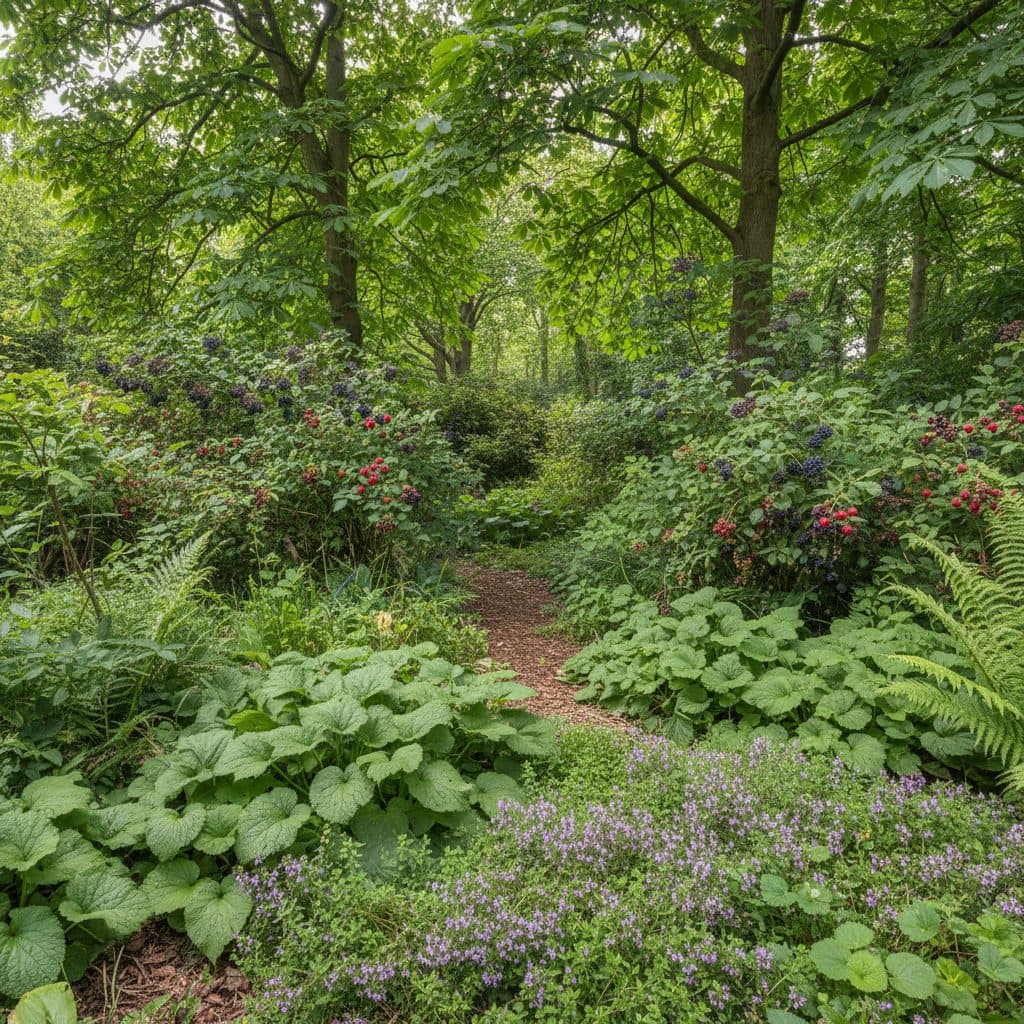
Key takeaways
- A temperate food forest mimics natural woodland architecture across seven distinct vertical vegetation layers.
- Overstory canopy trees establish the macro-framework, providing shade, wind protection, and massive nut crops.
- Understory fruit trees, berry shrubs, and perennial vegetables occupy microclimate niches beneath the upper canopy.
- Herbaceous perennials such as comfrey generate rapid, nutrient-rich biomass for chop-and-drop mulching around fruit trees.
- Nitrogen-fixing shrubs like goumi berry and sea buckthorn support fruit trees, provided you check local regulations and plant male/female pairs where needed.
Quick answer: A successful food forest integrates perennial species across seven vertical layers: overstory canopy (chestnuts, walnuts), understory (apples, pears, persimmons), shrub layer (currants, elderberries, blueberries), herbaceous layer (comfrey, lovage), ground cover (woodland strawberry, clover), rhizosphere (Jerusalem artichoke, garlic), and vertical climbers (grapes, hardy kiwi).
A food forest, also known as a forest garden, is a low-maintenance, perennial polyculture designed to emulate the structure, ecological relationships, and resilience of a natural woodland ecosystem. Unlike conventional agricultural monocultures that require constant tillage, synthetic spraying, and seasonal re-planting, a forest garden relies on perennial plants that yield food, medicine, fuel, and ecological fertility year after year. Understanding how to select the best food forest plants for each canopy niche is the cornerstone of sustainable permaculture design.
Every species in a forest garden serves more than one purpose. A tree may provide edible nuts while casting dappled shade for tender berries, mining trace minerals with deep taproots, and sheltering beneficial insect predators. By stacking plants in three-dimensional vertical space, you multiply total food yields per square foot while building self-renewing soil biology.
The seven-layer food forest architecture
Organizing plants into vertical tiers maximizes solar capture, conserves soil moisture, and creates diverse wildlife habitats.
+-----------------------------------------------------------------------------------+
|  [The 7 Vertical Layers of a Food Forest]                                         |
|                                                                                   |
|   1. Canopy Layer (Tall Trees: 30-50+ ft)      ===> Chestnut, Walnut, Oak         |
| 2. Sub-Canopy / Understory (15-25 ft)         ===> Apple, Pear, Persimmon, Pawpaw |
|  3. Shrub Layer (4-10 ft)                     ===> Currant, Elderberry, Hazelnut  |
|  4. Herbaceous Layer (1-4 ft)                 ===> Comfrey, Lovage, Fennel, Yarrow|
|  5. Ground Cover (0-6 inches)                 ===> Woodland Strawberry, Clover    |
|  6. Rhizosphere / Root Layer (Subterranean)   ===> Jerusalem Artichoke, Garlic    |
|  7. Vertical / Vining Layer (Climbers)        ===> Hardy Kiwi, Grape, Passionvine |
+-----------------------------------------------------------------------------------+
To explore foundational site layout rules, consult what is a food forest and our deep-dive into permaculture design.
Layer 1: The overstory canopy (tall trees)
The overstory forms the ecological umbrella of your food forest. On large properties, these mature giants provide structural shelter, drop tons of autumn leaf litter, and yield staple carbohydrate and protein crops.
- Chinese Chestnut (Castanea mollissima): Blight-resistant, heavy-yielding tree providing sweet, starchy nuts that can be ground into gluten-free flour.
- Black Walnut and Persian Walnut (Juglans spp.): Premium timber and rich nut crops. (Note: place juglone-sensitive plants outside walnut drip lines).
- Sugar Maple (Acer saccharum): Excellent overstory tree for cold temperate regions, providing spring sap for syrup and rich leaf mould.
Layer 2: The understory sub-canopy (small fruit trees)
Occupying the sunny openings and dappled shade beneath tall canopy trees, the understory produces the primary fresh fruit harvest.
- Standard and semi-dwarf apples (Malus domestica): Select disease-resistant heirloom cultivars (Liberty, Enterprise, Freedom).
- European and Asian Pears (Pyrus spp.): Upright, productive trees that handle heavier soils well.
- American Persimmon (Diospyros virginiana): Incredibly hardy native fruit tree producing rich, honey-sweet autumn fruit.
- Pawpaw (Asimina triloba): North America's largest native edible fruit, thriving in woodland understory shade and yielding creamy, tropical-tasting custard fruit.
Layer 3: The shrub layer (berries and bush nuts)
Shrubs fill the space between tree trunks, intercepting mid-level sunlight and producing nutrient-dense berries.
- Blackcurrants and Redcurrants (Ribes nigrum / rubrum): Exceptionally shade-tolerant shrubs that produce heavy crops beneath fruit trees. Note that Ribes are alternate hosts for white pine blister rust and blackcurrant planting is still restricted or banned in parts of the US. Check with your state department of agriculture before planting, and look for rust-immune cultivars where they are permitted.
- American Elderberry (Sambucus canadensis): Fast-growing native shrub providing medicinal berries and edible blossoms. Elderberry flowers are safe raw, but the berries must be cooked before eating, and the leaves, stems and roots are not edible at all.
- American Hazelnut (Corylus americana): Multi-stemmed native bush yielding sweet nuts and coppice poles.
- Goumi Berry (Elaeagnus multiflora): Goumi (Elaeagnus multiflora) is a nitrogen-fixing shrub that is far less aggressive than its relative autumn olive (E. umbellata), but it does naturalise in parts of the eastern US and some states regulate Elaeagnus species as a group. Check your state noxious-weed list before planting.
- Sea Buckthorn (Hippophae rhamnoides): Rugged nitrogen-fixer packed with bright orange, medicinal berries. Sea buckthorn is dioecious, so you need at least one male plant to pollinate a group of females, and it suckers hard enough to need a root barrier or regular removal.
For broader perennial integration methods, review permaculture gardening.
Layer 4: The herbaceous layer (dynamic accumulators and herbs)
Herbaceous perennials die back to the ground each winter, returning each spring with lush foliage that suppresses grass and feeds soil life.
+---------------------+-----------------------+---------------------------------------+
| Plant Species       | Botanical Role        | Ecological Function                   |
+---------------------+-----------------------+---------------------------------------+
| Russian Comfrey     | Nutrient Mulch Biomass| Fast-growing chop-and-drop mulch      |
| Yarrow              | Insectary Perennial   | Attracts predatory wasps & hoverflies |
| Lovage & Fennel     | Aromatic Culinary     | Parasitoid wasp host; umbrella blooms |
| Horseradish         | Root & Insect Repellent| Persistent root crop; container spot  |
+---------------------+-----------------------+---------------------------------------+
The role of comfrey (Symphytum officinale / x uplandicum)
Russian comfrey (cultivar Bocking 14) is the workhorse of the food forest. It is a deep-rooted, sterile cultivar whose large, hairy leaves can be cut back three to four times per season and dropped directly around fruit trees as an on-site "chop-and-drop" nutrient mulch, without the weed risk of self-seeding wild comfrey.
Learn more about succession biomass tactics in syntropic farming.
Layer 5: Ground covers (living mulch)
Living ground covers carpet the forest floor, locking in soil moisture, preventing soil erosion, and smothering persistent weed grasses.
- Woodland Strawberry (Fragaria vesca): Spreads via runners in partial shade, producing sweet, tiny wild strawberries.
- White Dutch Clover (Trifolium repens): Low-growing nitrogen-fixing legume that feeds honeybees and blankets pathways.
- Creeping Thyme (Thymus serpyllum): Fragrant, drought-tolerant aromatic mat that deters pests.
Guild assembly and companion planting dynamics
In a functioning food forest, plants are rarely positioned at random. Instead, species are grouped into localized polycultures called plant guilds centered around a primary canopy or understory fruit tree.
A classic apple tree guild, for example, combines a central apple tree with comfrey planted on the drip line for chop-and-drop mulch, nitrogen-fixing clover as a ground cover to feed the root zone, aromatic herbs like dill and fennel to host predatory hoverflies and parasitic wasps, and alliums like garlic or chives planted around the trunk to deter fungal pathogens and grazing rodents. This synergistic arrangement reduces weeding, eliminates synthetic fertilizer requirements, and creates resilient micro-ecosystems.
Layer 6 & 7: Root crops and vertical climbers
- Layer 6 (Rhizosphere): Jerusalem Artichokes (sunchokes) produce massive yields of nutty tubers. Sunchokes are close to permanent once planted, since any fragment of tuber left in the ground regrows; site them where you are happy for them to stay, or grow them in a sunken container (the same applies to horseradish). Perennial walking onions and garlic bulbs fill root niches without disturbing tree roots.
- Layer 7 (Vertical Climbers): Hardy Kiwi (Actinidia arguta) yields smooth-skinned, grape-sized fruit, but it is a very heavy vine that needs its own strong trellis or arbour rather than a living tree to climb, requires roughly one male pollinator per six to eight female vines, and has escaped cultivation in the northeastern US, where several states list it as invasive. Check your state list first. For native climbers, Muscadine grapes suit the southeastern US and are not hardy in most of the northern temperate range (use hardy American or hybrid bunch grapes there instead), while Maypop passionflower (Passiflora incarnata) thrives in warmer microclimates.
By assembling these seven layers into synergistic plant guilds, your food forest creates an abundance of diverse crops with minimal external inputs.
Soil fungi and mycorrhizal networks in forest gardens
A key difference between a conventional annual vegetable garden and a mature food forest is the shift in soil microbiology. Annual crops prefer bacterial-dominated soils, whereas perennial trees and woodland shrubs thrive in fungal-dominated soils rich in mycorrhizal hyphae.
Establishing thick arborist woodchip mulch layers and minimizing all soil disturbance helps beneficial ectomycorrhizal and endomycorrhizal fungi thrive. These fungi extend the effective root surface of each plant and improve access to water and phosphorus. Claims that they shuttle warning signals between plants are still debated and worth treating cautiously.