
Key takeaways
- Respect the 15° OSHA/extension riding-mower tip ceiling (~3.7:1) and abandon turf completely above 3:1 (18.4° / 33.3%): string-trimming scalps weak grass crowns, opening rill channels that accelerate topsoil washouts.
- Call 811 before trenching or pinning blankets, hand-dig inside the 18–24 inch tolerance zone, and map private septic drainfields separately—wastewater saturation lubricates slip planes while woody roots rupture perforated pipes.
- Stop and bring in a licensed civil or geotechnical engineer on >2:1 (>26.6° / >50%) banks displaying curved crest tension cracks, leaning fence posts or 'pistol-butt' tree trunks, hummocky slump blocks, or toe springs.
- Ban all polypropylene, nylon, or 'photodegradable' plastic erosion netting: U.S. Fish & Wildlife Service and USDA Forest Service studies document severe entanglement mortality in snakes, birds, and toads alongside persistent microplastics.
- Install 400–900 gsm leno-weave coir blankets anchored in a 6×6 inch crest trench, add countersunk contour straw wattles and dormant live stakes, plant in staggered contour triangles, and lock soil with double-shredded bark or angular wood chips rather than slick pine nuggets.
- Ban shallow-rooted invasive slope vines—English ivy (Hedera helix), periwinkle (Vinca minor), wintercreeper (Euonymus fortunei), Japanese honeysuckle (Lonicera japonica), and crown vetch (Securigera varia)—in favor of regional US natives with 3–8 foot structural roots.
Quick answer: Any hillside steeper than a 3:1 grade (18.4° or 33.3% slope) belongs off-limits to mowers and string-trimmers: OSHA safety guidelines cap riding mowers at 15° (~3.7:1), and string-trimming scalps shallow 2–4 inch grass roots into mudslides. Before driving pins or digging pockets, call 811 two to three business days ahead, locate private septic drainfields (septic effluent raises subsurface pore-water pressure and triggers slips), and hire a licensed civil engineer on >2:1 (>26.6°) banks showing headscarp tension cracks, tilted trees, or seeping toe bulges. On stable banks, divert upslope runoff, pin 100% biodegradable loose-weave coir or jute blankets (banning wildlife-trapping plastic mesh) with countersunk straw wattles and live stakes, and plant US native grasses and woody shrubs in staggered contour pockets mulched with interlocking shredded bark or wood chips.
P0 Safety Gate: Mower Rollovers, Call 811, Septic Drainfields & >2:1 Geotechnical Slips
Whereas a general slope ground cover guide addresses manageable `<=3:1` lawn banks alongside steeper embankments, unmowable slopes steeper than 3:1 (`>18.4°` or `>33.3%` grade—more than 1 vertical foot per 3 horizontal feet) pose immediate physical injury and structural failure hazards. Attempting to mow or string-trim turf on these grades combines equipment rollover danger with chronic surface erosion.
Under OSHA and Penn State Extension mower safety standards, standard riding mowers and zero-turn tractors must never traverse slopes exceeding 15° (roughly a `3.7:1` run-to-rise ratio or `26.8%` grade), where lateral center-of-gravity shifts and damp morning grass trigger sudden side rollovers. Even walking an unmowable `>3:1` bank with a string trimmer damages the slope: nylon line scalps grass crowns down to bare mineral dirt, exposing weak `2–4 inch` lawn roots so the next 2-inch thunderstorm carves rills and triggers shallow mudslides.
Unmowable Steep-Slope Hazard Tiers, Equipment Limits & Stabilization Gates
Slope Grade & Angle | Equipment & Foot Safety | Soil Failure Mechanism | Required Stabilization & Engineering Gate |
|---|---|---|---|
15° to 18.4° (~3.7:1 to 3:1; 27–33%) | Exceeds OSHA 15° riding-mower ceiling; push mowing hazardous on wet clay | Wheel-rut compaction and string-trimmer crown scalping initiate rill gullies | Decommission turf in place without tilling; install leno jute (~500 gsm) + fibrous native groundcovers |
3:1 to 2:1 (18.4°–26.6°; 33%–50%) | Strictly unmowable; footing unsafe without contour steps or anchored work paths | Sheet wash strips topsoil; shallow lawn or English ivy mats slide on saturated clay | Call 811 + check septic; woven coir (400–900 gsm), contour wattles, live stakes & 3–8 ft US native roots |
>2:1 (>26.6°; >50% grade) | High fall risk; manual work requires safety lines or stepped access | Deep rotational slump or planar slide exceeds unreinforced soil shear angle | Inspect for tension cracks, leaning trees & toe seeps; hire licensed civil/geotechnical engineer before planting |
Mandatory Underground & Geotechnical Pre-Checks Before You Dig: First, call 811 (or file an online one-call ticket) 2 to 3 business days before trenching `6×6 inch` anchor cuts, driving `6–12 inch` landscape staples, or augering live-stake holes, and hand-dig strictly within the 18–24 inch tolerance zone around flags. Second, locate private septic drainfields separately—public 811 crews do NOT mark septic tanks, distribution boxes, or lateral lines. Wastewater raises subsurface pore-water pressure, cutting soil shear strength and turning steep banks into rotational slide hazards; never site woody shrubs over or directly downslope of septic trenches. Third, inspect `>2:1` slopes for curved headscarp tension cracks, pistol-butt or leaning trees, bulging toes, or groundwater seeps—plants alone cannot arrest an active deep rotational slip without licensed civil engineering.
Check internal soil drainage on the bank using a simple soil drainage percolation test and inspect any concentrated roof gutters, sump outlets, or driveway sheets dumping over the crest. As state stormwater manuals stress, diverting upslope water via a rock-lined contour swale or French drain system before installing blankets eliminates over half of first-year washouts.
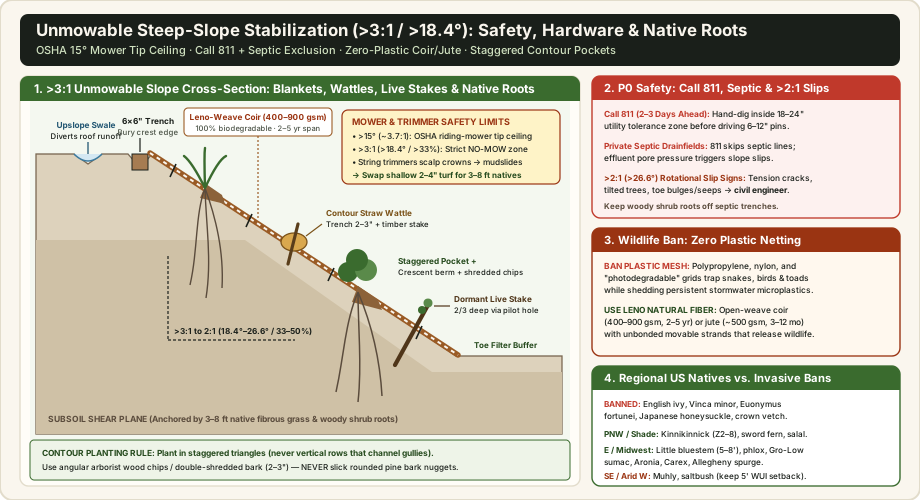
Zero-Plastic Slope Hardware: Coir Blankets, Wattles, Live Stakes & Interlocking Mulch
On steep `>3:1` terrain, roots take 18 to 36 months to form a cohesive shear mat. During that establishment gap, choosing the right slope hardware determines whether soil locks in place or ends up in municipal storm sewers—and whether local reptiles, amphibians, and ground-nesting birds survive the project.
Why non-biodegradable and 'photodegradable' plastic netting must be banned
Many hardware-store straw blankets look natural at a glance yet bind straw between welded squares of polypropylene, nylon, or polyethylene netting marketed as "photodegradable." Research from the USDA Forest Service (Correlates of snake entanglement in erosion control blankets) and guidance from the U.S. Fish & Wildlife Service (USFWS) and Minnesota Stormwater Manual show that fixed-joint plastic meshes persist long after straw rots, strangling snakes, frogs, toads, turtles, and foraging songbirds while fragmenting into microplastics washed straight into creeks.
Specify 100% biodegradable natural fiber blankets woven without plastic—such as leno-weave coir or loose-weave jute whose unbonded natural twines flex and shift so wildlife wiggles free unscathed. Even with natural netting, bury all outer seams inside anchor trenches so snakes and small mammals cannot wedge underneath edge gaps.
Steep-Slope Stabilization Hardware & Mulch Performance Matrix
Material / Hardware | Engineering Spec & Lifespan | Best Slope Application | Critical Failure or Ban Rule |
|---|---|---|---|
100% Woven Coir Blanket (leno weave) | 400–900 gsm coconut fiber; lasts 2–5 years | Unmowable 3:1–2:1 clay, sand & long slopes with slow woody natives | Bury top edge in 6×6" crest trench; overlap edges 4–6" & ends 6–12" shingle-style |
Open-Weave Natural Jute Mesh | ~500 gsm biodegradable yarn; lasts 3–12 months | Moderate 3:1 banks seeded or plugged with fast-rooting grasses | Decays too quickly for 2:1 clay slopes; must sit flush over prep with zero air tunnels |
Countersunk Straw Wattles / Timber Terraces | 8–9" straw logs in 2–3" trenches staked every 3–4 ft on contour | Long >3:1 faces over 20 ft tall needing slope-length breaks | Must lie dead-level on contour; sloped wattles funnel runoff into concentrated blowouts |
Dormant Live Stakes (willow, dogwood, elderberry) | 18–24" dormant cuttings (0.5–1" caliper); 2–3 ft grid | Moist 3:1–2:1 lower banks, swale outlets & toe zones | Pre-drill pilot holes with iron bar or auger; stripping bark kills cambium before rooting |
Double-Shredded Bark / Angular Wood Chips | 2–3" interlocking fibrous strands over or between blankets | Pocket rings & moderate 3:1 banks around woody plugs | NEVER use rounded pine bark nuggets or 4"+ loose layers that float downhill into gutters |
Plastic-Netted Straw Blankets (PP / PE / Nylon) | Fixed welded mesh (even labeled 'photodegradable') | NONE — banned across wildlife-safe residential slopes | Entangles snakes, birds & toads and sheds persistent microplastics into waterways |
Contour wattles, live-staked terraces & why slick pine nuggets fail
When a `>3:1` slope runs taller than 15 to 20 vertical feet, water velocity multiplies exponentially toward the bottom toe. Break that unbroken run into 8-to-12-foot intervals using countersunk straw wattles or timber-pinned contour check logs. Set each wattle snugly inside a `2–3 inch` contour trench so runoff cannot tunnel beneath it, and pin through (or tightly against) the log with rough-sawn `24-inch` wooden stakes angled perpendicular to the hill.
Along damp mid-to-lower toes, supplement wattles with dormant live stakes harvested in late winter from native shrub willow (Salix spp.), red osier dogwood (Cornus sericea), or elderberry. Drive `18–24 inch` basal-cut stakes `2/3 to 3/4` of their length deep through pilot holes in staggered rows (`2–3 ft` spacing), leaving two live buds above ground. For surface protection inside pockets, spread 2–3 inches of double-shredded hardwood bark or angular arborist wood chips, whose fibrous hooks mat together like felt; avoid smooth rounded pine bark nuggets, which roll and hydroplane straight into storm drains—detailed further in our no-dig mulch materials and free wood chips guide.
Staggered Contour Pocket Planting Sequence (Step-by-Step Without Tilling)
Never rototill or strip existing hillside grass down to loose powder. Purdue Consumer Horticulture stresses killing existing lawn in place using targeted smothering or spot control so dead turf roots stay anchored inside the upper soil profile while new deep-rooted hillside plants establish.
- Divert upslope runoff first: Redirect roof downspouts and driveway sheet flow cleanly around the bank using pipe extensions or a rock-armored rain garden or bioswale before cutting the slope face.
- Rake loose cobbles and build dry-laid access steps: Remove stones larger than 1.5 inches so coir hugs the grade flush. Set flat stone stepping pads wherever you must climb for weeding or gutter maintenance.
- Trench and roll blankets downhill: Bury the upper coir edge inside a `6×6 inch` compacted crest trench, unroll strips vertically down the slope (never horizontally), overlap sides `4–6 inches`, and drive `6–8 inch` steel U-pins (or `12–18 inch` pins in loose sand) at 1–2 staples per square yard.
- Countersink contour wattles: On long faces, carve shallow `2–3 inch` dead-level contour trenches every 8–12 feet of vertical drop and stake straw wattles firmly against the soil.
- Cut staggered triangular pockets—never vertical rows: Planting directly downslope in straight columns creates vertical chutes that carve gullies between plants. Space X-slits in a staggered triangular contour grid (`12–18 in` on center for plugs, `3–4 ft` for shrubs), fold blanket flaps back, amend only the small planting pocket if needed for heavy clay or sandy banks, and pack excavated dirt into a crescent downhill berm at each stem to catch rainfall.
- Lock pockets with interlocking chips and contour drip: Tuck coir flaps snug against the root crown, add a 2-inch collar of double-shredded bark or angular wood chips, and snake inline drip irrigation horizontally along contours rather than running overhead sprinklers that trigger surface wash.
Regional US Fibrous & Woody Native Groundcovers vs. P0 Invasive Bans
Strong `>3:1` slope stabilization pairs two functional root layers: dense, spreading evergreen mats or bunchgrasses that absorb kinetic raindrop energy, and deep woody or rhizomatous shrubs whose `3–8 ft` roots mechanically cross shallow slip zones. Compare structural root classes in our slope stabilization shrubs, erosion control plants, and native grasses by region guides.
P0 Invasive Species Bans — Five Vines You Must Never Plant on Steep Slopes: State noxious weed boards and university extensions strictly warn against five legacy slope covers: *English ivy (Hedera helix) forms shallow top-heavy mats under which saturated clay slides while climbing vines girdle mature canopy trees whose taproots hold the bank; common periwinkle (Vinca minor) escapes into woodlands with weak vertical root shear; wintercreeper (Euonymus fortunei) and Japanese honeysuckle (Lonicera japonica) smother native understory regeneration; and crown vetch (Securigera varia) drops heavy winter-killed mats that slump down wet cuts and invade prairies. Likewise, avoid aggressive exotic Trachelospermum asiaticum* (Asian jasmine) near natural woods in the Southeast.
Regional US Native Steep-Slope Groundcovers, Root Systems & Invasive Replacements
US Region & Light | Recommended Native Species | USDA Zones & Habit | Root Stabilization & Replaces Which Invasive |
|---|---|---|---|
Pacific Northwest (Sun / Part Shade) | Kinnikinnick (Arctostaphylos uva-ursi) & coastal strawberry (Fragaria chiloensis) | Zones 2–8 (PNW coast inclusive); 4–12" evergreen mat × 6–12 ft | Woody rooting stems + drought tolerance once set; swaps out English ivy on sunny gravel cuts |
Pacific Northwest (Shade / Woodland) | Western sword fern (Polystichum munitum), salal (Gaultheria shallon) & creeping Oregon grape (Mahonia repens) | Zones 5–9; 1–4 ft evergreen layered carpets | Tough rhizomatous mats + canopy splash buffer; replaces Hedera helix and Vinca minor |
Northeast & Appalachia (Full Sun) | Creeping phlox (Phlox subulata), 'Gro-Low' fragrant sumac (Rhus aromatica) & black chokeberry | Zones 3–9; 4"–2 ft layered mat × 2–8 ft | Dense surface needle carpet over suckering woody thicket roots; replaces crown vetch & wintercreeper |
Northeast & Appalachia (Dry/Moist Shade) | Pennsylvania sedge (Carex pensylvanica), Allegheny spurge (Pachysandra procumbens) & ostrich fern | Zones 3–8 / 4–9; 6–36" spreading colonies | Fibrous shade sods and rhizomes under oaks/maples; replaces Vinca minor & Japanese pachysandra |
Midwest & Plains (Hot Sun / Clay-Loam) | Little bluestem (Schizachyrium scoparium), buffalograss & serviceberry | Zones 3–9; 6"–6 ft prairie grass + shrub layer | 5–8 ft fibrous prairie root curtains interlock subsoil; replaces Securigera varia & smooth brome |
Southeast (Sun / Part Shade Clay) | Pink muhly grass (Muhlenbergia capillaris), Cherokee sedge (Carex cherokeensis) & Carolina jessamine | Zones 6–9; 1–3 ft dense evergreen/clumping mats | High-rainfall clay root lock without invading woods; replaces Japanese honeysuckle & Asian jasmine |
Arid West & Southwest (Sun / Fast Drain) | Fourwing saltbush, blue grama (Bouteloua gracilis), creeping thyme & ice plant | Zones 4–10; 4"–5 ft deep xeric mix | Deep xeric roots hold dry cuts; keep resinous rosemary or junipers >=5 ft off home siding in WUI zones |
Regional matching prevents expensive first-winter die-offs. Notice how *kinnikinnick (Arctostaphylos uva-ursi) spans USDA Zones 2–8 (thriving across coastal PNW Zone 8 gravel banks as long as soil drains sharply, despite outdated Zone 6 cutoffs), while creeping juniper (Juniperus horizontalis)* and rosemary require strict 5-foot noncombustible Zone 0 setbacks away from wooden decks and siding in Western Wildland-Urban Interface (WUI) counties. Browse additional low-light and xeric picks in our shade ground covers, evergreen ground covers, drought-tolerant shrubs, native shade plants, coastal dune grasses, fast-spreading slope groundcovers, arid vs. PNW erosion plants, and ground cover plants hubs, or filter selections by hardiness via our plant finder.
Years 1–3 Establishment, Dry-Spell Watering & Low-Intervention Care
Even drought-hardy natives need steady root moisture through their first two summers before roots clear the upper 12 inches of dry slope crust. Run contour drip lines for slow 45-to-60-minute soak cycles twice weekly during hot spells rather than blasting steep faces with impact sprinklers.
Walk only on pre-set stepping stones during Years 1 and 2 to hand-pull tall weeds before they seed, cutting stems at soil level rather than yanking thick taproots that rip coir fibers loose. Never broadcast soluble nitrogen over steep banks, which fuels leggy top growth at the expense of deep anchor roots. Check coir U-pins after major winter storms, replace dead plugs promptly, and thin old shrub canes every 3–4 winters once thickets close—pairing slope buffers with our native groundcover weed-control and lawn alternatives guides.