pioneer
Siberian pea shrub
Caragana arborescens
International hardiness
- USDA 2-7
- RHS H7
- AU: Cool temperate
Where it grows — regional guide
| Zones / rating | Regional notes |
|---|---|
USDA 2-7 | Flourishes across the northern Great Plains, Upper Midwest, and Rockies (Zones 2 to 7); declared invasive in Minnesota and Wisconsin woodland edges. |
| Zones / rating | Regional notes |
|---|---|
H7 (below -20C) | Fully hardy across RHS H7; planted in upland shelterbelts and food forests in free-draining sites; boil mature seeds before eating. |
| Zones / rating | Regional notes |
|---|---|
Cool temperate | No region-specific data yet |
| Zones / rating | Regional notes |
|---|---|
USDA 2-7 (USDA scale) Canada uses its own zone system; Canadian zones run roughly one lower than USDA. | Exceptionally hardy across the Canadian Prairies (Zones 2 to 5); widely used in shelterbelts, though restricted in some parkland conservation zones. |
| Zones / rating | Regional notes |
|---|---|
No region-specific data yet | No region-specific data yet |
Siberian pea shrub (Caragana arborescens), also known as the Siberian peatree or caragana, is a rugged, cold-hardy deciduous shrub or small tree in the legume family (Fabaceae). Indigenous to the continental climates of Siberia, Mongolia, and north-western China, the plant has been cultivated across northern Europe and North America since the eighteenth century. In cold-temperate permaculture, agroforestry, and prairie homesteading, Caragana arborescens is a pioneer species capable of surviving sub-zero winters, summer drought, and relentless winds while actively restoring fertility to depleted soils.
The defining characteristic of Caragana arborescens is its extraordinary resilience. Where sensitive nitrogen-fixing trees succumb to freezing temperatures, caragana thrives in conditions down to -45 °C (-50 °F), corresponding to USDA Hardiness Zone 2. Its root system forms productive symbioses with nitrogen-fixing rhizobia, enabling it to convert atmospheric nitrogen into biological soil fertility and establish barriers in barren, rocky subsoils alongside hardy associates like fourwing saltbush and mountain milkvetch. For homesteaders on windswept plains, caragana forms the classic outer rampart of shelterbelts, lifting freezing arctic gales over orchards, fields of oats, and pastures while providing a recurring yield of edible cooked seeds and poultry browse.
Growing Siberian pea shrub
Caragana arborescens is an ultra-hardy species engineered for cold continental and boreal climates. It is fully hardy in USDA Zones 2 to 7 and rated RHS H7, enduring severe sub-zero winter temperatures without winterkill. It requires a distinct cold winter dormancy to break bud properly in spring and performs poorly in humid subtropical zones where winter chilling is absent. It is exceptionally tolerant of desiccating prairie winds, heavy snow loads, and urban air pollution.
Soil adaptability is outstanding across marginal substrates. The shrub thrives in coarse sands, rocky gravels, heavy subsoils, and alkaline loams with pH values ranging from 6.0 to 8.5. It tolerates moderate soil salinity, making it an excellent choice for windbreaks along salted roadsides. However, the plant has one absolute requirement: free internal drainage. It cannot tolerate saturated or waterlogged soils. In poorly drained clay hollows with standing winter water, the root system suffocates, predisposing the shrub to fatal fungal root rot.
Site the shrub in full sun. While established bushes can endure light partial shade, maximum flowering, seed set, and tight branch density require full solar radiation. Under heavy shade, caragana becomes sparse, leggy, and unproductive.
Propagation is achieved primarily by seed. Seeds have a tough outer coat that benefits from scarification. Immerse seeds in near-boiling water, allow them to soak in cooling water for twenty-four hours, and sow into nursery containers or directly into prepared outdoor seedbeds in spring. Seeds germinate within ten to fourteen days at 18 to 22 °C (64 to 72 °F). Seedlings grow rapidly, adding 40 to 60 cm (16 to 24 in) of growth per year during their first three seasons, reaching maturity at 3 to 6 m (10 to 20 ft) in height and 2 to 4 m (6.5 to 13 ft) in width.
To establish a dense windbreak or hedge, plant seedlings in single or double rows at an in-row spacing of 60 to 90 cm (24 to 35 in). The shrub responds exceptionally well to shearing and coppicing, readily regenerating dense new growth from the base when pruned back in late winter.
Harvest and uses
Caragana arborescens yields several valuable harvests across cold-climate homesteads:
- Edible cooked peas and poultry forage: In mid to late summer, mature seed pods ripen, dry, and twist open elastically, expelling small seeds. These seeds contain approximately 20 to 25% crude protein and valuable amino acids. In permaculture designs, caragana shrubs are planted directly along chicken runs. As the summer sun causes dry pods to twist and pop with an audible snap, seeds are propelled directly onto the ground, providing an automated supply of high-protein forage that free-range hens consume greedily. For human culinary use, dry mature seeds can be cooked as a lentil substitute, while young tender green pods harvested in early summer can be cooked like snow peas. Crucially, mature seeds must always be thoroughly cooked before human consumption to deactivate mild lectins.
- Prairie windbreaks and shelterbelts: For over a century, conservation agencies distributed millions of caragana seedlings across the Great Plains to combat soil erosion. Its dense twiggy growth habit, flexible wood, and wind-firm root structure make it the ideal windward row in multi-row prairie shelterbelts. It slows high-velocity winds, traps drifting snow, and creates a protected microclimate for delicate fruit trees.
- Nitrogen fixation and soil reclamation: Symbiotic root nodules enrich surrounding soils with nitrogen. When pruned as living mulch, the foliage decomposes to build topsoil organic matter. Caragana is widely utilised to stabilise steep sand dunes and highway roadcuts.
- Bee forage: In late spring (May to June), the shrub erupts in thousands of bright yellow, pea-like flowers. The flowers secrete high-sugar nectar that attracts honeybees and native bumblebees, providing an early-season nectar flow.
Identifying Siberian pea shrub
Caragana arborescens is identified by the following botanical characteristics:
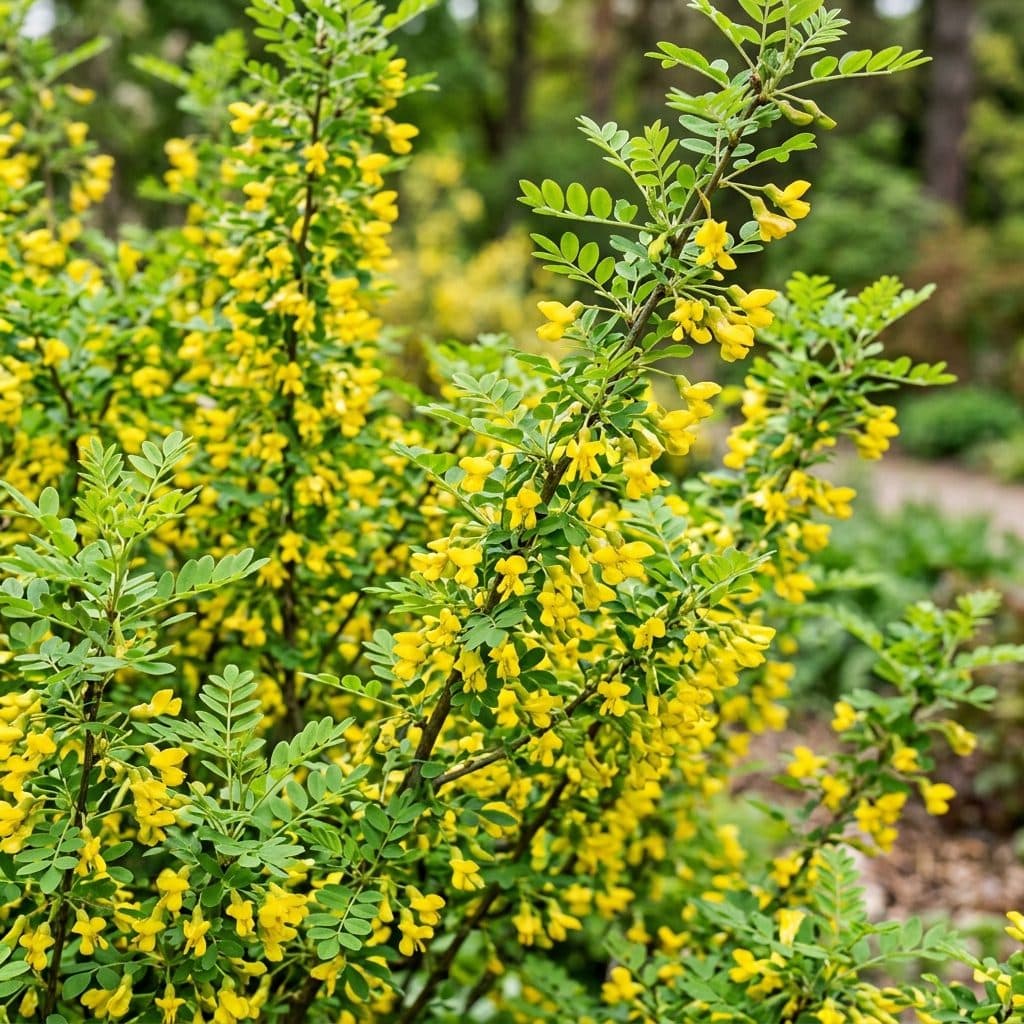
- Habit: An upright, multi-stemmed deciduous shrub or small vase-shaped tree reaching 3 to 6 m (10 to 20 ft) in height with smooth, olive-green to grey-green bark marked by prominent lenticels.
- Foliage: Alternate, even-pinnately compound leaves 5 to 10 cm (2 to 4 in) long, lacking a terminal leaflet. Each leaf consists of 4 to 8 pairs of small, oval to obovate, bright emerald-green leaflets measuring 1.5 to 2.5 cm (0.6 to 1 in) long. Leaflet margins are entire, terminating in a tiny, sharp, bristle-like point (mucronate).
- Stipules: The stipules at the base of each leaf are small, slender, and frequently persist as tiny, stiff spines measuring 2 to 5 mm long on older twigs.
- Flowers: Borne singly or in small clusters of 2 to 4 in leaf axils on slender stalks. The flowers are pea-like, 1.5 to 2.5 cm (0.6 to 1 in) long, with brilliant canary-yellow petals.
- Fruit: Smooth, cylindrical, yellowish-green pods turning dark reddish-brown at maturity, measuring 3.5 to 5 cm (1.4 to 2 in) long and 4 to 6 mm wide. When dry, the pod valves twist open elastically with an audible snap, expelling 4 to 6 small seeds several metres away.
The plant is distinguished from Laburnum anagyroides (golden chain tree), which has trifoliate leaves, pendulous flower chains, and is highly toxic, and from Colutea arborescens (bladder senna), which bears large, inflated, papery seed pods.
Cautions
Growers managing Caragana arborescens must adhere to key ecological and food safety precautions:
- Invasiveness in northern grasslands and savannas: While valued for prairie windbreaks, Caragana arborescens has escaped cultivation across the Upper Midwest (Minnesota, Wisconsin) and parts of Canada. It invades native oak savannas, dry prairie remnants, and woodland borders, where it forms dense thickets that outcompete native grasses and wildflowers. It is officially listed as a restricted or invasive terrestrial plant in Wisconsin and Minnesota. Avoid planting caragana in close proximity to native prairie reserves, and monitor windbreak perimeters for volunteer seedlings.
- Raw seed anti-nutritional compounds: While thoroughly cooked seeds and young pods are edible, raw mature seeds contain mild phytohaemagglutinins (lectins) and trypsin inhibitors typical of raw legumes. Ingestion of raw seeds in quantity can cause nausea, vomiting, and abdominal cramping. Always boil dry seeds thoroughly before eating.
- Intolerance of wet, heavy soils: Planting in waterlogged, poorly drained sites causes rapid root suffocation and fungal decay. Ensure site drainage is adequate before establishing windbreaks.
- Pest liability: Can occasionally suffer defoliation from blister beetles (Epicauta species) or caragana aphids in midsummer, though healthy established plants recover rapidly.
- Regulatory note: Regulated in some northern conservation jurisdictions as an invasive terrestrial shrub; verify regional environmental weed lists before planting near natural ecosystems.
Sources
- Royal Botanic Gardens, Kew. Caragana arborescens Lam. Plants of the World Online.
- Plants For A Future. Caragana arborescens - Lam.
- Missouri Botanical Garden. Caragana arborescens
- USDA PLANTS Database. Caragana arborescens Lam.
- Minnesota Department of Natural Resources. Siberian Peashrub (Caragana arborescens)