Key takeaways
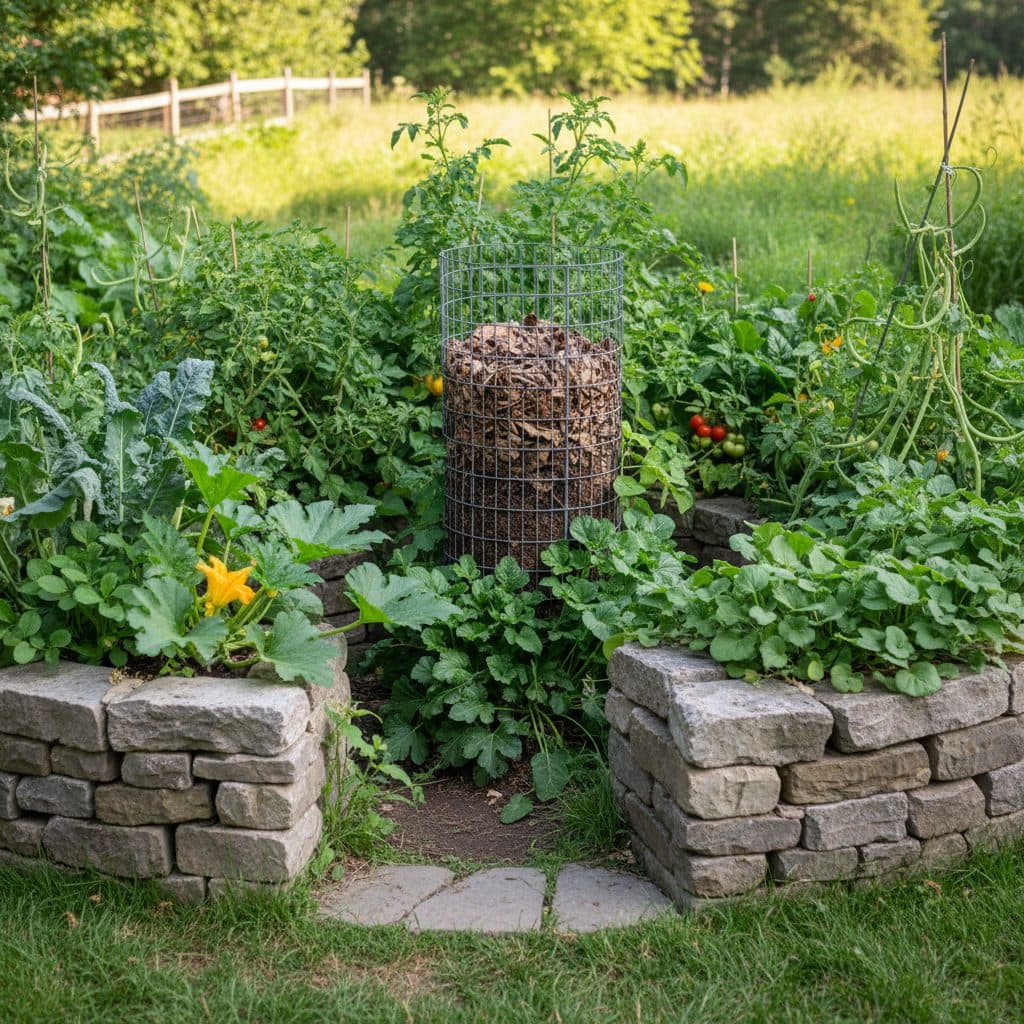
- Construct a standard circular keyhole garden 6 feet (1.8 m) in diameter and 3 feet (0.9 m) high with a recessed wedge notch for central access.
- Build a central 1-foot (30 cm) diameter wire mesh basket lined with burlap or straw to receive daily kitchen scraps and greywater.
- Fill the outer growing ring with a layered hugelkultur-style substrate: cardboard and rotten logs at the base, followed by straw, aged manure, compost, and topsoil.
- Slope the upper soil layer outward from the central basket to distribute moisture and dissolved compost tea throughout the root zone.
- Plant moisture-loving and heavy-feeding vegetables (tomatoes, squash) near the central basket, and drought-tolerant herbs around the perimeter.
Quick answer: A keyhole garden is a circular, waist-high raised bed roughly 6 feet (1.8 m) in diameter featuring a wedge-shaped access notch and an active composting basket at its center. Kitchen scraps and irrigation water added directly into the central basket decompose, slowly releasing moisture and nutrients into the surrounding soil. This self-fertilizing, drought-resilient design is ideal for arid, rocky, or space-constrained landscapes.
Developed originally by humanitarian agronomists in Lesotho and sub-Saharan Africa to ensure household food security during severe droughts, the keyhole garden has become a cornerstone of permaculture design worldwide.
Its circular shape maximizes growing area while minimizing path space. The waist-high stone or timber perimeter makes planting and harvesting accessible without bending, while the integrated compost core continuously enriches the soil.
Understanding structural dimensions, wall masonry, layered organic filling, and basket management allows you to construct a productive, low-water garden bed that thrives through intense summer heat.
Anatomy and dimensions of a classic keyhole garden
The geometry of a keyhole garden is designed so that a gardener can reach every plant from either the outer perimeter or the central access notch without stepping onto and compacting the soil.
+-------------------------------------------------------------------+
|                  KEYHOLE GARDEN TOP-DOWN LAYOUT                   |
|                                                                   |
|                       .---''''''---.                              |
|                    .-'   Planting   '-.                           |
|                  .'       Soil         '.                         |
|                 /         Ring           \                        |
|                |        +-------+         |                       |
|                |        |Compost|         |                       |
|                |  <---> | Basket|         |                       |
|                 \ 2 ft  +---+---+        /                        |
|                  '.     |   |          .'                         |
|                    '-.  |   | Notch .-'                           |
|                       '---+-+------'                              |
|                           [Walkway]                               |
+-------------------------------------------------------------------+
+------------------------+-----------------------------------+-------------------------+
| Dimension Feature | Imperial Measurement | Metric Measurement |
+------------------------+-----------------------------------+-------------------------+
| Total Bed Diameter | 6.0 feet | 1.8 metres |
| Bed Wall Height | 2.5 to 3.0 feet | 0.75 to 0.9 metres |
| Central Basket Diameter| 1.0 to 1.2 feet | 30 to 35 cm |
| Central Basket Height | 3.5 to 4.0 feet (extends above) | 1.0 to 1.2 metres |
| Access Notch Width | 1.5 to 2.0 feet | 45 to 60 cm |
| Planting Ring Reach | 2.0 to 2.2 feet from any edge | 60 to 65 cm |
+------------------------+-----------------------------------+-------------------------+A 6-foot overall diameter ensures that the distance from the outer perimeter wall to the central basket never exceeds 2 feet, keeping the entire growing area within comfortable arm reach.
Materials for wall construction
The outer perimeter wall must support significant soil weight and resist lateral hydrostatic pressure during saturation.
+------------------------+-----------------------------------+-------------------------+
| Wall Material          | Advantages                        | Considerations          |
+------------------------+-----------------------------------+-------------------------+
| Dry-Stacked Fieldstone | Natural thermal mass; free drainage| Requires stable footing |
| Cinder Blocks / Bricks | Fast assembly; plantable holes    | Needs bottom weep holes |
| Cedar / Redwood Planks | Warm appearance; easy fastening   | Decomposes over 7-10 yrs|
| Corrugated Galvanised  | Lightweight; long lifespan        | Sharp edges need trim   |
| Earthbags / Cob Mortar | Ultra-low cost; thick insulation  | Labor-intensive build   |
+------------------------+-----------------------------------+-------------------------+
Dry-stacked native fieldstone or concrete pavers provide excellent thermal mass, absorbing daytime solar heat and radiating it into the root zone on cool nights. When building with mortar or solid masonry, always install drainage weep holes at 2-foot intervals along the base course to release lateral hydrostatic pressure caused by saturated soil and heavy rains.
The wedge-shaped access notch should be built 1.5 to 2.0 feet (45 to 60 cm) wide at the outer rim, tapering to the 1-foot central basket, allowing easy standing access to the compost core without stepping into the bed.
Compare circular permaculture masonry layouts with the vertical design in herb spiral.
Building the central composting basket
The central composting basket is the functional engine of the keyhole garden.
+-------------------------------------------------------------------+
|               CENTRAL COMPOST BASKET CONSTRUCTION                |
|                                                                   |
|   1. Mesh Cylinder: Roll 1/2-inch hardware cloth or chicken wire  |
|                     into a cylinder 12 inches (30 cm) wide.       |
|  2. Support Stakes: Drive 4 wooden stakes or rebar rods into      |
|                     ground to anchor the wire cylinder vertically.|
|   3. Drainage Base: Layer 6 inches of coarse gravel/stones at base|
|   4. Permeable Liner: Line inside with burlap, straw, or shade net|
|                     to prevent soil from washing into basket.     |
+-------------------------------------------------------------------+
The top of the basket should extend 6 to 8 inches above the surrounding soil level. This elevation prevents soil from tumbling into the compost chamber and creates positive hydraulic pressure when watering through the top.
Layering the hugelkultur-style organic fill
Filling a 3-foot-deep keyhole garden with bagged potting soil is prohibitively expensive and agronomically unnecessary. Using a layered, bio-intensive hugelkultur filling technique builds long-term soil carbon and sponge-like water retention.
+-------------------------------------------------------------------+
|                 KEYHOLE GARDEN CROSS-SECTION LAYERS               |
|                                                                   |
|   [================ Topsoil + Rich Compost Layer (8 in) =========]|
|   [------------ Well-Rotted Manure + Worm Castings (6 in) -------]|
|   [~~~~ Straw / Dry Leaves / Grass Clippings (8 in) ~~~~~]|
|   [##### Coarse Twigs, Sticks, and Semi-Rotten Logs (10 in) #####]|
|   [===== Heavy Unprinted Corrugated Cardboard (2 Layers) ========]|
|   ===================== Native Subsoil Base ===================== |
+-------------------------------------------------------------------+
+------------------------+-----------------------------------+-------------------------+
| Layer Depth | Material Description | Functional Benefit |
+------------------------+-----------------------------------+-------------------------+
| Bottom (10 in) | Decaying hardwood logs & branches | Hugelkultur water sponge|
| Lower-Mid (8 in) | Straw, shredded leaves, hay | High-carbon aeration |
| Upper-Mid (6 in) | Aged cow/horse manure & vermicompost| Slow-release nitrogen |
| Top Soil (8-10 in) | 50% rich topsoil + 50% compost | Planting seedbed tilth |
+------------------------+-----------------------------------+-------------------------+Slope the topsoil layer slightly downward from the center basket toward the outer stone wall at a 5-degree angle. This gentle grade ensures that nutrient-rich compost tea generated during watering flows outward through gravity into the root zone.
Review traditional aerobic heat management in hot composting method and compare container composting in how to use a compost tumbler.
Operating and feeding the central basket
Managing a keyhole garden differs fundamentally from standard raised bed gardening.
+-------------------------------------------------------------------+
|               COMPOST BASKET FEEDING PROTOCOL                     |
+-------------------------------------------------------------------+
| - Daily:   Add raw vegetable scraps, coffee grounds, eggshells    |
| - Weekly:  Add a layer of dry straw or shredded cardboard (browns)|
|- Watering: Pour all garden water directly into the central basket |
| - Worms:   Introduce 200 red wiggler composting worms to basket   |
+-------------------------------------------------------------------+
How moisture and nutrients distribute
When you pour water (or chemical-free household rinse greywater) into the central basket, it filters through the decomposing organic materials. The water leaches soluble nitrogen, potassium, and beneficial microbes out through the wire mesh liner, infusing the surrounding root zone with organic liquid fertilizer. Ensure any greywater is free of boron, sodium, bleach, or synthetic detergents.
Avoid adding meat, bones, greasy oils, or pet waste to the central basket to prevent raccoons, rodents, and foul odors. For odor-free indoor waste processing, see small space composting no odor.
Crop placement and guild planting
Maximizing keyhole productivity requires zoning plants by their moisture and nutrient demands.
+------------------------+-----------------------------------+-------------------------+
| Zone                   | Plant Species                     | Horticultural Rationale |
+------------------------+-----------------------------------+-------------------------+
| Inner Ring (Near Basket)| Tomatoes, Squash, Chard, Cucumbers| High water & nitrogen   |
| Middle Ring            | Carrots, Onions, Bush Beans, Beets| Moderate moisture needs |
| Outer Wall Ring        | Thyme, Rosemary, Oregano, Salvia  | Drier soil; drape walls |
+------------------------+-----------------------------------+-------------------------+
Vining squash and indeterminate cherry tomatoes planted near the center can be trained outward over the stone walls or up vertical trellises, while compact root crops fill the middle tier.
For sub-surface water management comparisons, explore wicking beds self watering.
Seasonal maintenance and soil rejuvenation
Over the course of a full growing season, the buried hugelkultur logs and organic matter naturally settle by 4 to 6 inches as they decompose into rich humus.
+-------------------------------------------------------------------+
|               ANNUAL KEYHOLE REJUVENATION CYCLE                   |
+-------------------------------------------------------------------+
| - Early Spring: Dig out finished compost from center basket       |
| - Top-Dressing: Spread basket compost across outer planting bed   |
| - Soil Re-Top:  Add 3 inches of fresh compost to restore height   |
| - Basket Liner: Replace worn burlap or mesh lining before planting|
+-------------------------------------------------------------------+
Emptying finished compost from the core basket each spring provides several wheelbarrows of dark, biologically active top-dressing for your outer planting rings. It keeps the beds fertile without commercial fertilizers.
By building a closed fertility loop into the center of the bed, a keyhole garden produces abundant vegetables with a fraction of the water demanded by conventional garden rows.