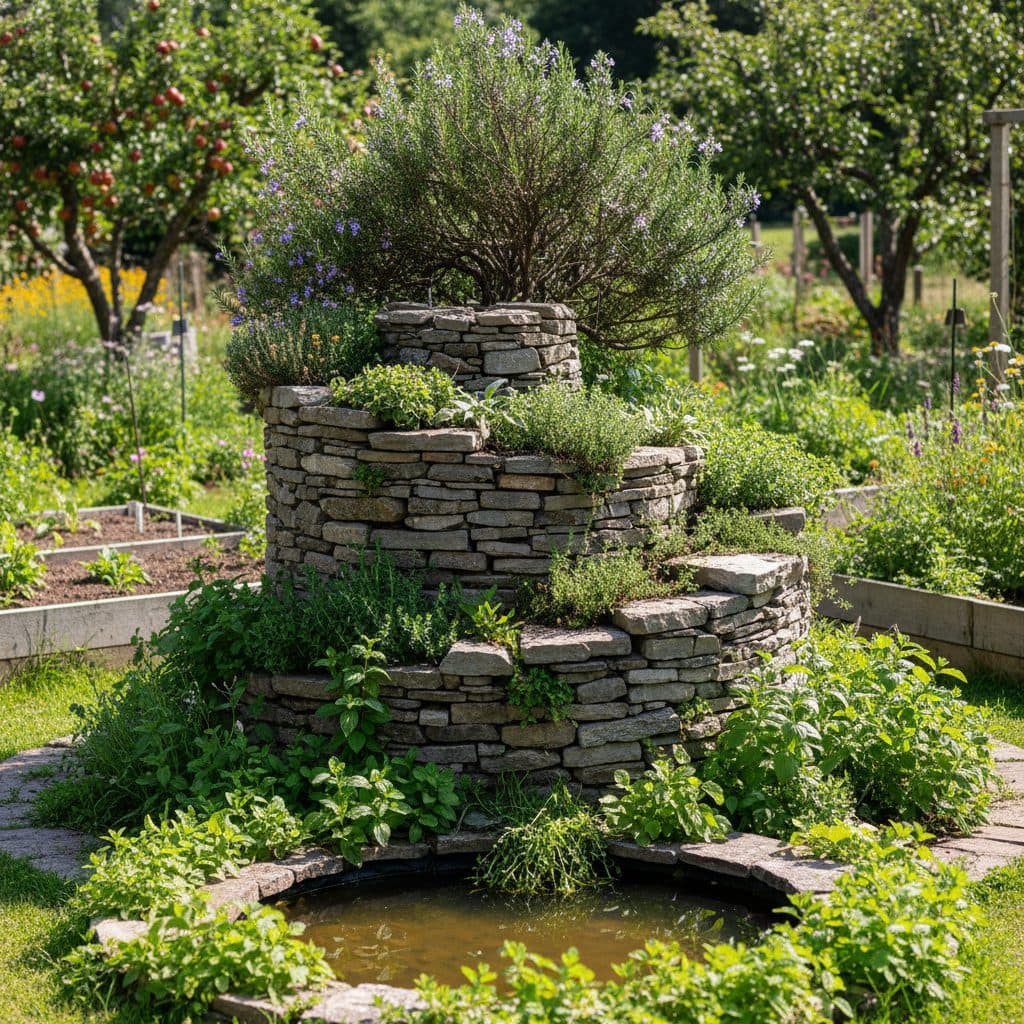
Key takeaways
- Construct a standard permaculture herb spiral 5 to 6 feet (1.5 to 1.8 m) in diameter and 3 feet (1 m) high at the central peak.
- Create distinct vertical microclimates across a compact footprint: hot and arid at the top, moderate on the mid-slope, and cool and damp at the base.
- Use natural fieldstone, brick, or urbanite (recycled concrete) to build thermal mass that stores solar warmth during the day and radiates it at night.
- Zone Mediterranean woody herbs (rosemary, thyme, oregano) at the apex, moisture-loving culinary herbs in the middle, and bog plants at the base.
- Sink invasive herbs like peppermint into submerged containers at the base to prevent aggressive rhizomes from overtaking the spiral.
Quick answer: An herb spiral is a three-dimensional, spiraling raised garden bed roughly 5 to 6 feet (1.5 to 1.8 m) wide and 3 feet (1 m) tall that stacks diverse microclimates into a compact footprint. Designed by permaculture pioneer Bill Mollison, the spiral features a central rocky peak that drains rapidly for drought-tolerant Mediterranean herbs, while gravity directs water downward to a moist, shaded base pond for leafy culinary herbs.
Growing a diverse collection of culinary and medicinal herbs often poses a horticultural dilemma. Mediterranean perennials like rosemary and lavender demand dry, rocky, alkaline soil with sharp drainage, whereas chives, parsley, and mint require rich, moisture-retentive ground with partial shade.
Attempting to grow these species in a flat garden bed inevitably compromises the health of one group or the other.
The permaculture herb spiral solves this problem by using vertical elevation and solar geometry. The spiral creates distinct moisture gradients and sun-to-shade aspects across five vertical feet of ramp, letting you cultivate over a dozen culinary herbs in a single two-metre circle right outside your kitchen door.
Principles of microclimates in a vertical spiral
The elegance of an herb spiral lies in how vertical topography interacts with gravity, moisture drainage, and sunlight.
+-------------------------------------------------------------------+
|               HERB SPIRAL MICROCLIMATE GRADIENT                   |
|                                                                   |
|              [TOP APEX: 3 ft High]                                |
|              - Hot, dry, gravelly, maximum sun, fast drainage     |
|              - Species: Rosemary, Thyme, Oregano, Lavender        |
|                                                                   |
|          [MID-SLOPE: 1.5 ft High]                                 |
|          - Moderate moisture, rich loam, partial afternoon shade  |
|          - Species: Basil, Parsley, Cilantro, Chives, Tarragon    |
|                                                                   |
|      [BASE & POND: Ground Level]                                  |
|      - Damp, cool, nutrient-rich silt, shade, water collection    |
|      - Species: Mint (contained), Lemon Balm, Watercress, Chervil |
+-------------------------------------------------------------------+
+------------------------+-------------------+-------------------+-------------------------+
| Spiral Zone | Elevation / Aspect| Moisture Level | Soil Drainage Character |
+------------------------+-------------------+-------------------+-------------------------+
| Apex (Peak) | 3.0 ft / Full Sun | Low / Dry | Rapid (sandy / gravel) |
| Upper South Slope | 2.0 ft / Warm Sun | Moderate-Low | Free-draining loam |
| Mid North/East Slope | 1.5 ft / Dappled | Moderate-High | Moisture-retentive loam |
| Lower Base (Foot) | 0.5 ft / Sheltered| High / Moist | Rich compost silt |
| Base Bog / Pond Basin | 0.0 ft / Full Wet | Saturated / Water | Aquatic / Submerged |
+------------------------+-------------------+-------------------+-------------------------+Thermal mass provided by the perimeter masonry walls absorbs midday solar radiation and slowly releases heat into the soil overnight, protecting cold-sensitive perennial herbs from sudden temperature drops. In the Northern Hemisphere, orient the highest point of the spiral to the north so the ramp curves south into full sun. In the Southern Hemisphere, orient the highest point to the south so the lower ramp faces north toward the sun.
Compare vertical soil mechanics and space-efficient layouts in vertical vegetable gardening small spaces and circular designs in keyhole garden.
Dimensions and site selection
Proper placement and sizing ensure easy maintenance and long-term durability.
+------------------------+-------------------------------------------------------------+
| Dimension Metric       | Standard Permaculture Benchmark                             |
+------------------------+-------------------------------------------------------------+
| Diameter (Footprint)   | 5.0 to 6.0 feet (1.5 to 1.8 metres)                         |
| Height at Central Apex | 2.5 to 3.0 feet (0.8 to 1.0 metre)                          |
| Pathway Ramp Width     | 1.0 to 1.3 feet (30 to 40 cm) of planting bed               |
| Total Spiral Length    | 25 to 30 linear feet of planting surface                    |
| Proximity (Permaculture)| Zone 1: Within 10 to 20 feet of the kitchen doorway         |
+------------------------+-------------------------------------------------------------+
A 5-foot overall diameter ensures that an adult gardener can reach every single plant from the outer perimeter without ever stepping onto the raised bed or compacting root zones.
Locate your herb spiral in Zone 1—the high-traffic area immediately adjacent to your kitchen door. When fresh herbs are within ten steps of the stove, you will use them daily in cooking.
Materials for wall masonry and internal core
Constructing an herb spiral utilizes reclaimed, low-cost masonry materials that supply high thermal mass.
+------------------------+-----------------------------------+-------------------------+
| Masonry Material       | Advantages                        | Structural Note         |
+------------------------+-----------------------------------+-------------------------+
| Native Fieldstone      | Natural rustic aesthetic; durable | Dry-stack with soil chink|
| Red Clay Bricks        | Uniform shape; easy clean curves  | Stagger joints smoothly |
| Urbanite (Broken Conc) | Free; thick chunky thermal mass   | Lay rough side inward   |
| River Rocks / Cobbles  | Smooth round look                 | Requires mortar to hold |
+------------------------+-----------------------------------+-------------------------+
+-------------------------------------------------------------------+
| INTERNAL HERB SPIRAL CROSS-SECTION |
| |
| [ Rosemary ] |
| +------------+ |
| | Gritty Loam| |
| [ Basil ] | & Sand | |
| +------------+ | |
| | Rich Loam | Coarse Rubble (Upper 2/3 Only) |
| [ Mint ] | & Compost | & Gravel Core |
| +-----------+ | (Sharp Drainage for Apex) |
| | Damp Silt | Rich Soil | |
| +===========+============+=======================================+
| [================ Sheet Cardboard Weed Barrier ==================]
| ------------------------ Native Subsoil -------------------------
+-------------------------------------------------------------------+Filling the core under the upper two-thirds of the spiral with coarse rubble, broken bricks, and gravel creates sharp internal drainage for Mediterranean herbs and reduces the topsoil volume needed. Do not place rubble under the bottom tier or bog outlet, where moisture retention is required.
Explore low-water landscape planning in xeriscape productive garden design.
Step-by-step construction guide
Building a stone herb spiral takes a single weekend with basic garden tools.
+-------------------------------------------------------------------+
|               HERB SPIRAL CONSTRUCTION WORKFLOW                   |
|                                                                   |
| Step 1: Layout & Foundation: Stake center point; scribe a 5-foot  |
|         circle. Lay double thick corrugated cardboard as barrier. |
|                                                                   |
| Step 2: Lay Base Outline: Place the outer ring of stones,         |
|         leaving an open exit notch for the moist base or pond.    |
|                                                                   |
| Step 3: Build the Spiral Ramp: Curve the wall inward, stepping    |
|         upward in height until reaching 3 feet at the center.     |
|                                                                   |
| Step 4: Fill Drainage Core: Dump coarse rubble/gravel into the    |
|         central upper 2/3 to establish rapid vertical drainage.   |
|                                                                   |
| Step 5: Add Soil Mixtures: Fill top with gritty sandy loam; fill  |
|         mid tier with rich loam; fill base with compost and silt. |
|                                                                   |
| Step 6: Settle with Water: Soak thoroughly to eliminate voids.    |
+-------------------------------------------------------------------+
Allow the filled spiral to settle for 48 hours after heavy watering before setting plants into the soil.
Herb placement: matching species to microclimates
Positioning herbs in their ideal ecological niches ensures vigorous growth with minimal ongoing care.
+--------------------+-------------------------+--------------------+------------------------+
| Spiral Zone        | Recommended Herb        | Botanical Name     | Kitchen Utility        |
+--------------------+-------------------------+--------------------+------------------------+
| Top Apex (Dry)     | Rosemary                | *Salvia rosmarinus*| Roasts, breads, oils   |
| Top Apex (Dry)     | Common Thyme            | *Thymus vulgaris*  | Soups, stews, meats    |
| Upper Tier         | Greek Oregano           | *Origanum vulgare* | Pizza, tomato sauces   |
| Upper Tier         | Culinary Sage           | *Salvia officinalis| Stuffing, poultry      |
| Mid-Tier (Warm)    | Sweet Genovese Basil    | *Ocimum basilicum* | Pesto, fresh salads    |
| Mid-Tier (Morning) | Flat-Leaf Parsley       | *Petroselinum*     | Garnishes, sauces      |
| Mid-Tier (Morning) | French Tarragon         | *Artemisia dracunculus*| Chicken, dressings |
| Lower Tier (Moist) | Garlic Chives           | *Allium tuberosum* | Salads, stir-fries     |
| Lower Tier (Moist) | Cilantro / Coriander    | *Coriandrum sativum| Salsas, curries        |
| Base / Pond Edge   | Spearmint / Peppermint  | *Mentha* spp.      | Teas, drinks, desserts |
+--------------------+-------------------------+--------------------+------------------------+
The mint containment rule
Never plant mint directly into the soil of your herb spiral. Mint spreads aggressively via subterranean runners (stolons) that will quickly colonize the entire structure, choking out thyme and oregano roots. Always plant mint inside a 2-gallon plastic nursery pot with drainage holes and bury the pot flush with the soil at the moist base of the spiral.
Learn about companion planting dynamics and pest deterrent properties in tomato companion plants.
Irrigation and seasonal maintenance
Watering an herb spiral is intuitive and efficient.
+-------------------------------------------------------------------+
|               HERB SPIRAL WATERING DYNAMICS                       |
|                                                                   |
|   1. Water from the Top: Apply water with a hose or drip ring     |
|                          directly at the top apex.                |
|   2. Downward Percolation: Gravity draws water downward through   |
|                          the spiral path to the base.             |
|   3. Self-Regulating:    Top dries within hours; base stays moist |
+-------------------------------------------------------------------+
In early spring, prune back woody perennial herbs (thyme, oregano, sage) by one-third to encourage bushy new vegetative shoots. Top-dress the middle and lower planting ramps with 2 inches of aged compost each spring to replenish nutrients leached by winter rains.
For sub-surface water reservoir options, explore wicking beds self watering.
Packing diverse microclimates into a small vertical footprint gives an herb spiral its main advantage: a continuous supply of fresh kitchen herbs from one bed near the door.