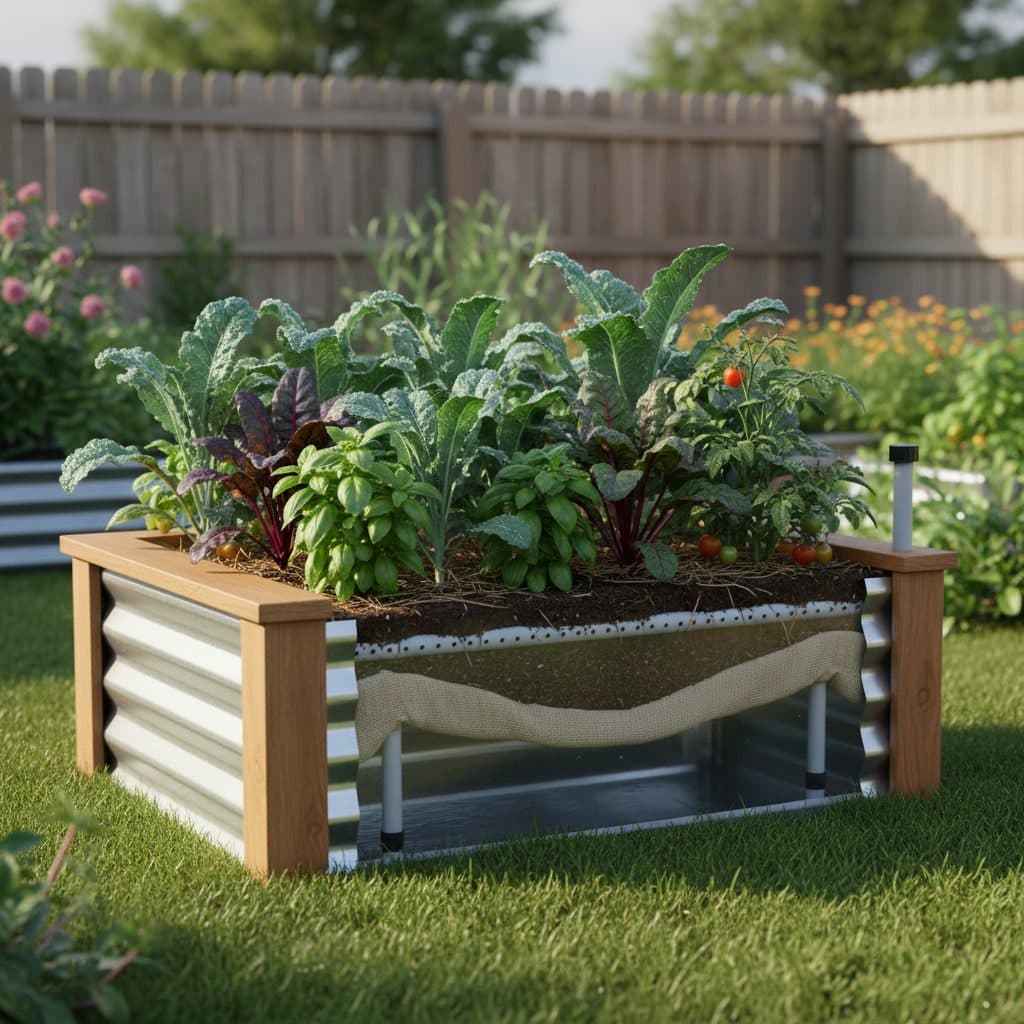
Key takeaways
- Wicking beds reduce water consumption by 50% or more compared to conventional gardening.
- A durable liner, like 45 mil EPDM, prevents water loss and helps the system last for 10+ years.
- The gravel reservoir provides a consistent water supply, typically 6-12 inches deep, allowing capillary action to hydrate soil.
- An overflow pipe set 2-4 inches below the soil surface prevents waterlogging and maintains aeration in the root zone.
- Optimal soil depth, usually 10-12 inches, balances moisture availability with root development for most vegetables.
- Capillary action, the core principle, allows water to move upward against gravity through soil pores, often up to 12 inches high.
Quick answer: Wicking beds significantly reduce irrigation water use by drawing water upwards from a reservoir through capillary action, providing consistent moisture directly to plant roots. This method can decrease water consumption by 50% or more compared to traditional surface watering.
In the arid climates of USDA zones 8-10, like much of California or Arizona, water conservation is essential for successful growing. Wicking beds, a form of sub-irrigation, can reduce water consumption by 50% or more compared to traditional surface watering, leading to significant savings for home growers. For instance, a 4 ft by 8 ft wicking bed can use as little as 10-15 gallons per week, even during peak summer heat, compared to 30-40 gallons for a conventionally irrigated bed of the same size.
This passive irrigation system works by drawing water upwards from a reservoir through capillary action, providing a consistent moisture level directly to plant roots. Understanding the main components (the liner, gravel reservoir, overflow pipe, and optimal soil depth) helps build a system that performs reliably for 10 years or more. This guide will walk you through each step, ensuring your garden thrives with less effort and less water, whether you’re in the humid Southeast or the dry Southwest.
The case for sub-irrigation: conserving water and effort
Wicking beds offer a straightforward solution for gardeners aiming to reduce water use and simplify their irrigation routines. These self-watering systems operate on the principle of capillary action, where water is drawn upwards from a reservoir into the growing medium, mimicking how a sponge absorbs liquid [1]. This method can decrease water usage by up to 70% in some climates compared to overhead watering, as reported by growers in Texas during dry spells. A typical 4 ft by 8 ft wicking bed might only need refilling every 7-14 days, depending on plant size and local temperatures, saving considerable time and labor.
Beyond water savings, wicking beds provide a consistent moisture level for plant roots, which can lead to healthier, more vigorous growth. Plants experience less stress from fluctuating soil moisture, which is particularly beneficial for thirsty crops like tomatoes or cucumbers. In a study conducted in parts of USDA zone 7, wicking beds yielded 20% more produce per square foot than conventionally watered beds. This steady hydration also means fewer instances of blossom end rot in tomatoes, a common issue linked to inconsistent watering. The sealed nature of the bed also helps retain soil nutrients, reducing fertilizer runoff by as much as 30%.
- Reduced water consumption by 50-70%.
- Consistent soil moisture for optimal plant health.
- Less frequent watering, saving time and effort.
- Reduced nutrient leaching and fertilizer use by up to 30%.
Choosing a durable liner
The liner is arguably the most critical component of a wicking bed, as it forms the watertight reservoir that holds your water supply. A failure here means a failed system, so investing in a high-quality, UV-stabilized material is essential. For most home garden applications, a 45 mil EPDM (ethylene propylene diene monomer) pond liner is the gold standard, offering excellent flexibility, puncture resistance, and a lifespan of 20 years or more. This material is commonly used in water features across the US, from small backyard ponds to large commercial installations.
While cheaper alternatives like 6 mil polyethylene sheeting are available, they often degrade within 1-3 years, especially when exposed to sunlight or root penetration. For a typical 4 ft by 8 ft wicking bed, a 10 ft by 14 ft piece of 45 mil EPDM might cost around $100-$150, a worthwhile investment for decades of use. Ensure the liner is food-grade or specifically rated for potable water contact if you have concerns about chemical leaching, though EPDM is generally considered inert. When installing, aim for at least 12 inches of overlap around the edges of your bed to prevent any water seepage.
- 45 mil EPDM pond liner for longevity (20+ years).
- Avoid thin polyethylene sheeting (1-3 year lifespan).
- Consider food-grade liners for sensitive applications.
- Ensure at least 12 inches of liner overlap for a secure seal.
Building the water reservoir for consistent moisture
Below your soil, the water reservoirA 4 ft by 8 ft bed with a 10-inch deep reservoir can hold approximately 200 gallons of water, enough to sustain plants for one to two weeks in many climates.
The material chosen for the reservoir should be inert and provide good void space for water storage. Washed river gravel, with particles ranging from 0.5 to 1.5 inches, is a common and effective choice, offering about 35% void space. Avoid fine sands or silts, as these will compact and reduce water storage capacity. Some growers in regions like the Pacific Northwest use a layer of geotextile fabric, often 6 oz per square yard, directly above the gravel to prevent soil from migrating downwards, though this is not always necessary if the soil mix is coarse enough. This fabric allows water to pass through freely while keeping the soil separate. You can learn more about site preparation and soil considerations at agripure.org/articles/land-for-homesteading.
- Reservoir depth of 6-12 inches for optimal water storage.
- Use coarse, inert materials like washed river gravel (0.5-1.5 inches).
- Avoid fine sands or silts that reduce void space.
- Consider a geotextile fabric (6 oz/sq yd) to prevent soil migration.
Preventing waterlogging with a strategic overflow
The overflow pipe prevents your wicking bed from becoming waterlogged, helping plant roots receive adequate oxygen. Without it, continuous heavy rain or overfilling could saturate the entire soil column, leading to root rot and plant death, especially in regions like Florida with high annual rainfall exceeding 50 inches. The pipe should be positioned so its opening is 2-4 inches below the top surface of your growing medium, allowing a consistent air gap between the water reservoir and the root zone.
A standard 1.5-inch or 2-inch PVC pipe works well for the overflow. It should extend from the bottom of the reservoir, through the gravel layer, and out the side of the bed, creating an exit point for excess water. This design ensures that the soil above the overflow level remains moist but not saturated, essential for aerobic root development. For larger beds, such as those exceeding 10 ft in length, consider installing two overflow pipes, one at each end, to ensure even drainage. You can use a standard garden hose to fill your wicking bed through a dedicated fill pipe.
- Position overflow 2-4 inches below soil surface.
- Use 1.5-inch or 2-inch PVC pipe for durability.
- Ensures an air gap for root oxygenation.
- Consider two pipes for beds over 10 ft long.
Crafting the ideal growing medium for capillary action
The final layer is your growing medium, and its composition is key to effective wicking. A good soil mix for a wicking bed needs to be light, well-aerated, and have excellent capillary properties to draw water upwards from the reservoir [2]. A common blend includes 30-40% compost, 30-40% coco coir or peat moss, and 20-30% perlite or vermiculite. This mix provides both nutrients and the necessary pore space for water movement. The ideal soil depth for most vegetables, such as leafy greens or root crops, is between 10-12 inches, allowing sufficient space for root development while maximizing the wicking effect. For instance, carrots typically need 8-10 inches of loose soil to grow well.
To ensure consistent wicking, especially in larger beds, a dedicated wicking column or ‘sock’ is often installed. This can be a perforated PVC pipe, 4 inches in diameter, filled with the same soil mix, extending from the bottom of the reservoir up into the growing medium. Alternatively, a column of geotextile fabric filled with soil can serve the same purpose. This column acts as a direct conduit for water, so capillary action is maintained across the entire bed, even in dry conditions. Water can wick upwards against gravity for 8-12 inches in a typical soil mix [3]. Consider collecting rainwater for your wicking beds; you can explore options at agripure.org/articles/rainwater-harvesting.
- Mix 30-40% compost, 30-40% coco coir, 20-30% perlite.
- Maintain a soil depth of 10-12 inches for most crops.
- Install a wicking column (4-inch PVC or fabric) for consistent moisture.
- Capillary action can lift water 8-12 inches in suitable soil.
Wicking bed vs. traditional raised bed
Feature | Wicking Bed | Traditional Raised Bed |
|---|---|---|
Water Use | 50-70% less | Higher, prone to evaporation |
Watering Frequency | Every 7-14 days | Daily or every other day |
Soil Moisture | Consistent, sub-surface | Fluctuates, surface dries quickly |
Nutrient Retention | High, minimal leaching | Moderate, some leaching |
Cost (initial) | Higher (liner, reservoir) | Lower (lumber, soil) |
Maintenance | Lower, less frequent watering | Higher, constant monitoring |
Water Savings: Wicking beds can reduce water consumption by 50% to 70% in dry climates compared to conventional irrigation, saving hundreds of gallons annually.
Liner Lifespan: A 45 mil EPDM liner, a common choice, offers a durable, waterproof barrier with a projected lifespan of 20 years or more.
Frequently asked questions
How often do I need to fill a wicking bed?
The frequency depends on plant size, weather, and bed volume, but typically a well-built wicking bed in a USDA zone 7 garden needs refilling every 7 to 14 days. A 4 ft by 8 ft bed might hold 100 gallons.
What kind of soil is best for a wicking bed?
An ideal mix is light and well-aerated, often containing 30-40% compost, 30-40% coco coir, and 20-30% perlite, allowing water to wick upwards effectively for 8-12 inches.
Can I build a wicking bed directly on the ground?
Yes, you can build a wicking bed directly on the ground, but you must ensure the liner is completely sealed and protected from punctures. Many growers use a layer of sand, 2-3 inches deep, beneath the liner for protection.
What is the purpose of the overflow pipe?
The overflow pipe, typically 1.5-2 inches in diameter, prevents waterlogging by draining excess water, maintaining a 2-4 inch air gap between the water reservoir and the soil to ensure root oxygenation.
How deep should the water reservoir be?
For most applications, a water reservoir depth of 6-12 inches is recommended. This provides sufficient water storage, often 100-120 gallons for a 4 ft by 8 ft bed, to sustain plants for extended periods.
Are wicking beds suitable for all climates?
Wicking beds are particularly beneficial in dry climates like USDA zones 8-10, where water conservation is critical, but they can be adapted for any climate. In high rainfall areas, the overflow pipe becomes even more important to prevent oversaturation, especially with annual rainfall exceeding 50 inches.
References
- – Evaporation and Wicking (2012). – Evaporation and Wicking.
- Wicking in Absorbent Swelling Porous Materials (2012). Wicking in Absorbent Swelling Porous Materials.
- – Traditional Theories of Wicking: Capillary Models (2012). – Traditional Theories of Wicking: Capillary Models.
- – A Fractal-Based Approach to Model Wicking (2012). – A Fractal-Based Approach to Model Wicking.
- wicking (2023). wicking.
- USDA Natural Resources Conservation Service (2024). USDA Natural Resources Conservation Service.