Key takeaways
- Food forests mimic natural ecosystems, offering perennial yields with less input than annual gardens, especially in the Pacific Northwest’s temperate climate.
- Plant guilds, like the apple-currant-comfrey combination, improve nutrient cycling, pest control, and overall plant health.
- Swales matter for water management in regions with 30-60 inches of annual rainfall, capturing and slowly releasing water to prevent runoff and improve soil moisture.
- Designing by permaculture zones helps optimize placement to ensure high-traffic plants are close to the home and less-frequently visited areas are further out.
- Selecting appropriate species for USDA zones 6-8, such as ‘Liberty’ apples and ‘Titania’ black currants, ensures resilience and productivity in the PNW.
- Integrating dynamic accumulators like comfrey can improve soil fertility, drawing up nutrients from 10-foot deep taproots and making them available to other plants.
Quick answer: A Pacific Northwest food forest guild for USDA Zone 7 can be designed using an apple tree, currants, and comfrey, mimicking natural ecosystems to improve nutrient cycling and pest control. This system integrates water management techniques like swales and permaculture zoning for optimal productivity and resilience.
In the Pacific Northwest, from the fertile valleys of Oregon to the temperate rainforests of Washington, growers face unique opportunities and challenges. An average of 30-60 inches of rain falls annually across much of this region, creating lush landscapes but also requiring careful water management. For those looking to establish a resilient, productive garden, a food forest offers a compelling approach. This system, inspired by natural forest ecosystems, focuses on perennial plants that provide food, fiber, and medicine with minimal human intervention once established.
Building a food forest involves thoughtful design, including the strategic placement of plants in guilds and the use of earthworks like swales. By understanding the principles of permaculture design and applying them to a specific climate, such as USDA zones 6-8 prevalent in the PNW, we can create abundant systems. This article will explore a specific plant guild centered around apples, currants, comfrey, and shade-tolerant berries, tailored for the conditions found across much of the Pacific Northwest, offering a blueprint for a productive and low-maintenance edible landscape.
Understanding the pacific northwest climate and its opportunities
The Pacific Northwest is a region defined by its distinct climate, characterized by mild, wet winters and warm, dry summers. Historically, this area has been rich in forest resources, a fact documented as early as 1938 [1]. This natural abundance provides a strong foundation for food forest design. Average annual rainfall can range from 30 inches in drier eastern valleys to over 100 inches on the Olympic Peninsula, with most populated areas receiving 40-60 inches. Winter lows in the populated lowlands usually stay above 20°F, and summers are mild by US standards, but inland valleys regularly run past 90°F and recent heat events have pushed well past 100°F, so plan shade and summer water for young trees accordingly.
selecting resilient species for the region
When planning a food forest in this area, selecting species adapted to USDA zones 6-8 is critical. For instance, many parts of the Willamette Valley in Oregon fall squarely into USDA zone 8. The region’s soil types vary, from rich volcanic loams to glacial tills, but most benefit from organic matter additions to improve water retention and drainage. The USDA Natural Resources Conservation Service (NRCS) publishes detailed soil survey maps for the region, and the silt and clay loams they show hold considerably more plant-available water than sandy soils. This moisture-holding capacity is a significant asset for perennial systems. Understanding these local conditions helps ensure plant success and reduces the need for constant intervention. You can learn more about site analysis in our article on permaculture design: how to read a site before you plant it.
- Choose disease-resistant apple varieties like ‘Liberty’ or ‘Chehalis’ for better success.
- Select currant varieties known for vigor and yield, such as ‘Titania’ black currant.
- Incorporate native shade-tolerant berries like Salal (Gaultheria shallon) or Oregon Grape (Mahonia aquifolium).
- Buy comfrey as Bocking 14, a sterile cultivar of Russian comfrey (Symphytum x uplandicum) - not common comfrey (Symphytum officinale), which sets viable seed and self-sows. Bocking 14 will not seed around, but it regrows from any root fragment, so site it where you want it permanently.
- Consider the mature size of each plant to prevent overcrowding in five to ten years.
Designing with plant guilds: the apple-currant-comfrey core
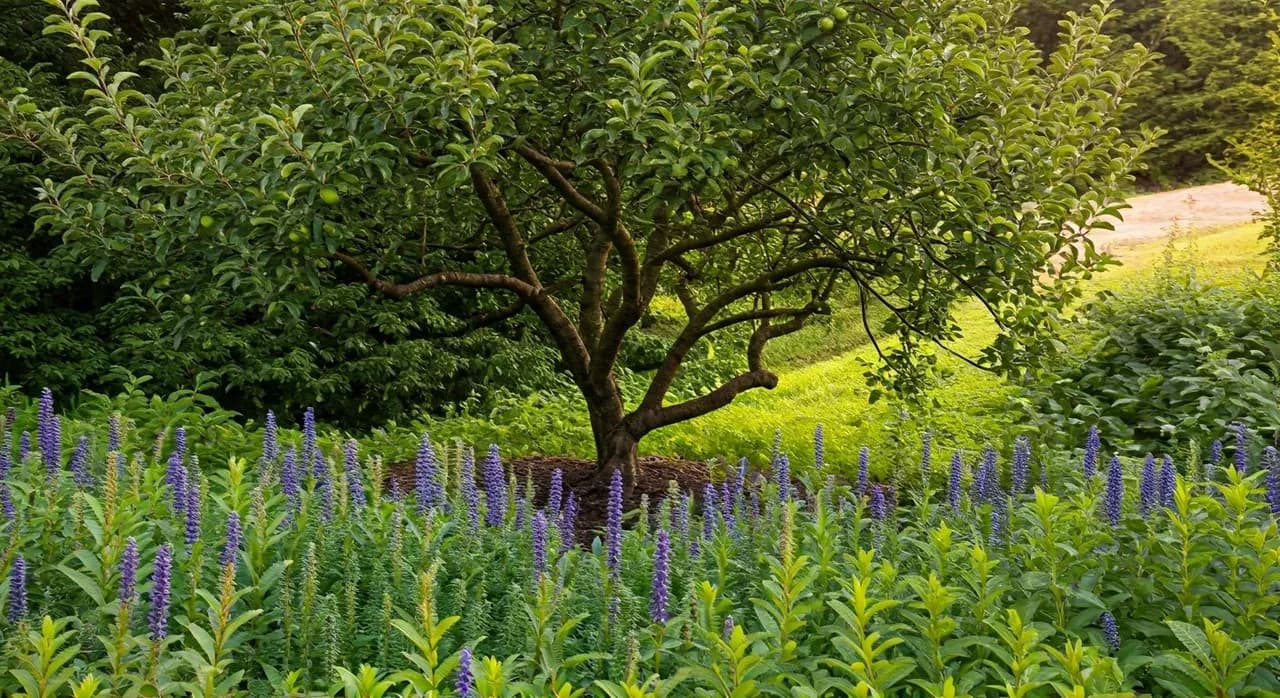
A plant guild is a community of plants that support each other, mimicking natural forest layers and functions. For a Pacific Northwest food forest, a well-chosen guild can significantly improve productivity and resilience. Our core guild features an apple tree as the canopy layer, currants as the shrub layer, and comfrey as a dynamic accumulator and groundcover. This combination works well in USDA zone 7, common in areas like Puget Sound. A mature apple tree can produce 100-200 pounds of fruit annually, while a well-established currant bush can yield 5-10 pounds of berries.
the role of each guild member
The apple tree (Malus domestica), particularly a scab-resistant variety like ‘Liberty’ or ‘Chehalis’, forms the central element, providing shade, fruit, and structure. Planting a semi-dwarf rootstock, which grows to 12-15 feet tall, is often practical for home gardens. Below the apple, currants (Ribes spp.) thrive in the partial shade, offering early summer fruit. Some states and counties still restrict Ribes planting, black currant in particular, because of white pine blister rust, so check local rules and pick a rust-immune cultivar. Red, white, and black currants are all suitable, with black currants like ‘Titania’ being particularly vigorous and yielding up to 10 pounds per bush. Comfrey (Bocking 14, a sterile cultivar of Russian comfrey, Symphytum x uplandicum) is an important support plant, grown for mulch rather than food - its pyrrolizidine alkaloids are hepatotoxic. Its deep taproot, which can reach 10 feet into the soil, draws up nutrients like potassium and phosphorus from subsoil layers, making them available to other plants when its leaves are chopped and dropped as mulch. This practice steadily adds organic matter to the topsoil. For more on this approach, consider exploring what is a food forest: a beginner’s guide to perennial edible ecosystems.
- Position the apple tree as the central canopy element, allowing 15-20 feet spacing from other trees.
- Plant 2-3 currant bushes in the partial shade drip line of the apple, about 3-5 feet from the trunk.
- Establish comfrey plants around the outer edge of the guild, 2-3 feet from the currants.
- Consider adding chives or garlic as pest deterrents in the groundcover layer, planting 6-8 inches apart.
- Mulch heavily with wood chips or straw, applying a 4-6 inch layer annually, to conserve moisture and suppress weeds.
Integrating shade-tolerant berries and support plants
Beyond the core guild, incorporating other shade-tolerant berries and support plants improves biodiversity and productivity, especially in the understory. Many native Pacific Northwest berries thrive in the dappled light beneath larger trees. Salal (Gaultheria shallon) and Oregon Grape (Mahonia aquifolium) are excellent choices, providing edible berries and evergreen foliage. Salal, typically growing 2-5 feet tall, produces dark purple berries that are tart but edible, and it forms a dense groundcover. Oregon Grape, reaching 3-10 feet, offers edible berries and striking yellow flowers in early spring. These plants are well-suited for USDA zones 6-8 and require minimal care once established.
adding diverse layers to the understory
Other valuable additions include huckleberries (Vaccinium parvifolium or V. ovatum), which prefer acidic soil conditions common in many PNW forest soils, with a pH range of 4.5-5.5. These plants can yield 1-2 pounds of berries per bush. For groundcover, consider wild strawberries (Fragaria vesca) or clover (Trifolium repens), which fix nitrogen in the soil, reducing the need for external nitrogen inputs over time. These plants also attract pollinators, increasing fruit set for the apple and currants. When planning your layout, consider the principles discussed in permaculture gardening: no-dig beds, guilds, and zones to optimize plant relationships and resource flow. A well-designed understory can fill out the seven layers of a food forest, maximizing space and yield.
- Plant Salal and Oregon Grape on the northern side of the apple tree for more consistent shade.
- Intersperse huckleberries where the soil is naturally acidic, and lower pH with elemental sulfur if it is not - peat gives only a short-lived shift in open ground. Red huckleberry (Vaccinium parvifolium) is hard to establish outside rotting wood, so evergreen huckleberry (V. ovatum) is the more reliable of the two in a garden bed.
- Use wild strawberries or clover as living groundcovers, planting them 6-12 inches apart.
- Consider adding native ferns like sword fern (Polystichum munitum) for aesthetic and ecological benefits, planting them 1-2 feet apart.
- Ensure a diverse mix of flowering plants to attract beneficial insects throughout the growing season, aiming for 10-15% of the guild area.
Water management with swales and permaculture zones
Effective water management is paramount in the Pacific Northwest, especially during the dry summer months. While the region receives significant rainfall, much of it occurs outside the primary growing season. Swales are passive earthworks designed to capture rainwater runoff and allow it to slowly infiltrate the soil, recharging groundwater and providing consistent moisture to plants. A properly constructed swale, with a level contour and a berm on the downhill side, can hold thousands of gallons of water from a single rain event. For a 100-foot long swale, a 2-foot deep and 4-foot wide ditch can hold over 500 cubic feet of water, translating to approximately 3,700 gallons.
strategic placement using permaculture zones
Integrating swales into a permaculture design also involves understanding and applying the concept of zones. Permaculture zones categorize areas based on frequency of human interaction and intensity of cultivation. Zone one, closest to the home, might contain herbs and frequently harvested vegetables. Our apple-currant-comfrey guild would typically be placed in zone two or three, where regular but not daily visits are expected. This placement ensures easy access for harvesting and occasional pruning, while still benefiting from the water retention of a nearby swale. The Pacific Northwest’s varied terrain, from flat river plains to steep hillsides, means swale design needs to be site-specific. A permaculture garden plan: zones, guilds, and a first-year layout offers more detailed guidance on zone planning.
- Design swales on contour lines to maximize water capture and even distribution across the landscape.
- Build swales dead level along their length and handle big storms with a level spillway at one end, set a few inches below the top of the berm. A swale that slopes lengthwise concentrates water at the low end and blows the berm out.
- Plant water-loving trees or shrubs on the berms of swales to benefit from the increased moisture.
- Place the apple guild in Zone two (frequent visits) or Zone three (less frequent visits) for optimal care and harvest access.
- Consider a small pond or rain garden in Zone one for additional water storage and aesthetic appeal, holding 50-100 gallons of water.
Long-term care and maintenance for a thriving food forest
Once established, a food forest requires significantly less input than an annual garden, but some maintenance is still necessary to ensure its long-term health and productivity. Regular observation matters; walking through your food forest for 15-30 minutes each week can help identify issues early. Mulching is one of the most important tasks, as it conserves soil moisture, suppresses weeds, and builds soil organic matter. Apply a 4-6 inch layer of wood chips or straw around all plants annually, especially before the dry summer months in the Pacific Northwest.
pruning, pest management, and soil fertility
Pruning apple trees is essential for fruit production and tree health, typically done in late winter when the tree is dormant. Remove about 10-20% of the canopy each year to maintain an open structure and promote air circulation, which reduces fungal diseases common in the PNW’s humid climate. Currants also benefit from annual pruning, removing older, less productive stems to encourage new growth and better yields. Pest management in a food forest relies on biodiversity, attracting beneficial insects that prey on pests. For example, a diverse understory supports far more beneficial insects than a single-species planting. Comfrey’s chop-and-drop function continuously feeds the soil, reducing the need for external fertilizers. Over several years, this practice returns potassium and other nutrients to the topsoil. For monitoring soil health, a soil moisture meter can be a useful tool to gauge water needs during dry spells. This holistic approach supports a resilient system, much like the extensive forest resources of the Pacific Northwest that have sustained ecosystems for centuries [2].
- Apply a 4-6 inch layer of organic mulch around all plants annually, refreshing as needed.
- Prune apple trees in late winter, removing dead, diseased, or crossing branches to maintain tree health.
- Prune currants by removing the oldest 2-3 stems each year to encourage new, productive growth.
- Monitor for pests and diseases weekly, addressing issues early with organic solutions if necessary.
- Harvest comfrey leaves 3-4 times per growing season, chopping and dropping them as mulch around guild members.
Comparison of Guild Members in a Pacific Northwest Food Forest
Plant | Primary Function | Typical Height (ft) | USDA Zone | Yield Potential |
|---|---|---|---|---|
Apple Tree (‘Liberty’) | Canopy, Fruit | 12-15 | 4-8 | 100-200 lbs/year |
Black Currant (‘Titania’) | Shrub Layer, Fruit | 3-5 | 3-7 | 5-10 lbs/bush |
Comfrey (‘Bocking 14’) | Dynamic Accumulator, Groundcover | 2-3 | 3-9 | Biomass for mulch |
Salal | Understory, Fruit, Groundcover | 2-5 | 6-9 | 1-2 lbs/bush |
Oregon Grape | Understory, Fruit, Pollinator | 3-10 | 5-9 | 1-3 lbs/bush |
PNW Rainfall: The Pacific Northwest receives an average of 30-60 inches of rainfall annually, requiring strategic water management.
Comfrey Root Depth: Comfrey’s taproot can extend up to 10 feet deep, drawing up subsoil nutrients for other plants.
Apple Yield: A single mature apple tree can produce 100-200 pounds of fruit per year in optimal conditions.
Frequently asked questions
What USDA hardiness zones are best for this Pacific Northwest food forest guild?
This specific food forest guild, featuring apples, currants, comfrey, and shade-tolerant berries, is ideally suited for USDA hardiness zones 6-8. These zones encompass much of the Pacific Northwest, providing the mild winters and moderate summers that these temperate plants require to thrive and produce consistent yields.
How do swales help in the Pacific Northwest climate?
Swales matter for water management in the Pacific Northwest, where rainfall is seasonal. They capture and slowly infiltrate rainwater into the soil, preventing runoff and ensuring that plants have access to moisture during the typically dry summer months. A well-designed swale can store thousands of gallons of water, reducing the need for supplemental irrigation during the dry summer months.
Why is comfrey included in this plant guild?
Comfrey (‘Bocking 14’ variety) is included as a dynamic accumulator. Its deep taproots, which can reach 10 feet, mine subsoil nutrients like potassium and phosphorus, making them available to other plants when its leaves are chopped and dropped as mulch. This practice can improve soil fertility, steadily build organic matter in the topsoil, and suppress weeds around the apple and currant plants.
What are the benefits of planting shade-tolerant berries?
Shade-tolerant berries like Salal and Oregon Grape fill the understory layer of the food forest, maximizing productivity in areas that receive less direct sunlight. They provide additional edible yields, contribute to biodiversity, and offer habitat for beneficial insects. These plants are often native to the PNW, making them well-adapted and low-maintenance, needing very little attention once established.
How much space does this apple-currant-comfrey guild require?
A single apple-currant-comfrey guild typically requires a circular area with a diameter of 15-20 feet for optimal growth and air circulation. This allows sufficient space for the apple tree to reach its mature spread of 12-15 feet and for the currant bushes and comfrey to establish without overcrowding. Proper spacing helps prevent disease and supports good fruit production, yielding up to 200 pounds of fruit from the apple alone.
References
- Forest resources of the Pacific Northwest (1938). Forest resources of the Pacific Northwest.
- Competition for national forest timber in the Northern, Pacific Southwest, and Pacific Northwest regions / (1980). Competition for national forest timber in the Northern, Pacific Southwest, and Pacific Northwest regions /.
- Tentative ecological provinces within the true fir-hemlock forest areas of the Pacific Northwest / (1965). Tentative ecological provinces within the true fir-hemlock forest areas of the Pacific Northwest /.
- A 3-year pattern of dispersed recreation and forest fires in Pacific Northwest forests / (1979). A 3-year pattern of dispersed recreation and forest fires in Pacific Northwest forests /.
- Wilderness land allocation in a multiple use forest management framework in the Pacific Northwest / (1965). Wilderness land allocation in a multiple use forest management framework in the Pacific Northwest /.