Key takeaways
- Understand the narrow, vertical water percolation pattern in sandy soil compared to the wide horizontal spread in clay.
- Space drip emitters closely at 6 to 8 inches (15 to 20 cm) to create a continuous overlapping wetted strip.
- Use pulse irrigation (multiple short 5 to 8 minute cycles daily) instead of single long soaking runs.
- Select lower emitter flow rates (0.25 to 0.5 GPH / 1 to 2 LPH) to prevent water from plunging past active root zones.
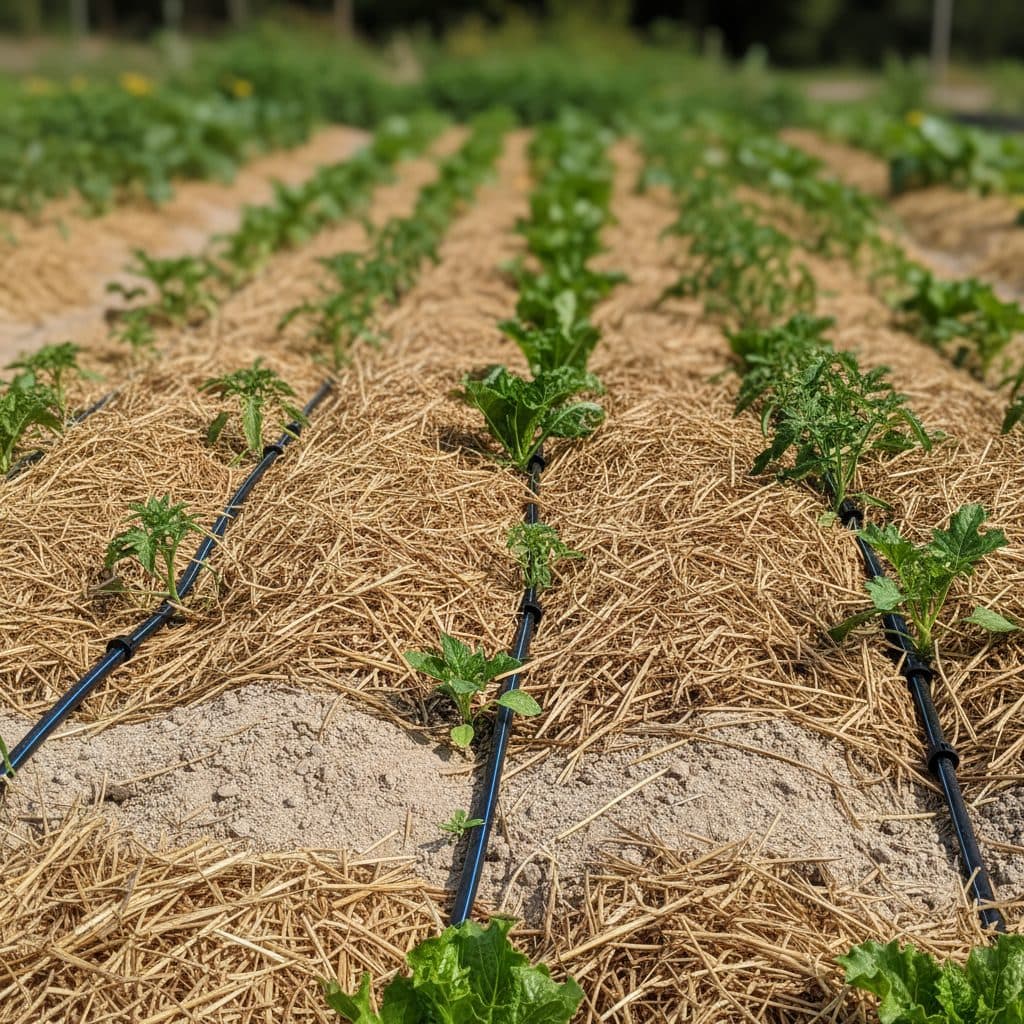
- Cover irrigated sand with a 3-inch (7 cm) organic mulch layer to reduce evaporative losses and improve lateral moisture spread.
Quick answer: Drip irrigation for sandy soil requires closer emitter spacing (6 to 8 inches / 15 to 20 cm) and pulse watering schedules—short 5 to 8 minute cycles run several times daily. Because coarse sand has high gravity drainage and little lateral capillary action, closely spaced low-flow emitters prevent water and nutrients from plunging uselessly below the crop root zone.
Gardening in sandy soil offers several distinct advantages, including effortless digging, rapid spring warming, and outstanding aeration. However, managing irrigation in coarse sand is notoriously difficult. Sand particles are large and rounded, creating massive macropores that allow water to drain straight downward under the pull of gravity with virtually no horizontal spread.
When growers install standard drip systems designed for loamy or clay soils, they often watch their plants wilt despite running the system for hours. Standard emitter spacing leaves wide, bone-dry gaps between plants, while prolonged watering cycles simply flush expensive soluble nutrients and water deep into the subsoil beyond the reach of shallow vegetable roots.
Designing drip irrigation for sandy soil requires altering emitter spacing, choosing appropriate flow rates, and switching to high-frequency pulse irrigation schedules. By aligning your drip hydraulics with the physical properties of sand, you can maintain continuous root-zone hydration while cutting overall water consumption.
Soil physics: drip irrigation clay vs sand
To design an effective drip layout, you must understand how water moves through different soil textures:
+-------------------------------------------------------------------------------+
|                      WETTING PATTERNS: SAND VS CLAY LOAM                      |
|                                                                               |
|   SANDY SOIL (Gravitational Dominated):                                       |
|          [Emitter]                                                            |
|             ||                                                                |
|             ||  --> Narrow vertical cylinder / chimney                        |
|             ||  --> Rapid downward plunge, negligible lateral capillary pull  |
|             \/                                                                |
|                                                                               |
|   CLAY / LOAM SOIL (Capillary Dominated):                                     |
|          [Emitter]                                                            |
|          /       \                                                            |
|        (  Wetted   )  --> Wide, horizontal onion-shaped bulb                  |
|          _**_**_/    --> Strong capillary suction draws water outward        |
+-------------------------------------------------------------------------------+
+-------------------+-------------------+-------------------+-------------------------------------------+
| Soil Property | Coarse Sandy Soil | Silt Loam Soil | Heavy Clay Soil |
+-------------------+-------------------+-------------------+-------------------------------------------+
| Infiltration Rate | 1.0 to 3.0+ in/hr | 0.5 to 1.0 in/hr | 0.1 to 0.25 in/hr |
| Capillary Action | Weak (vertical) | Moderate | Strong (broad horizontal spread) |
| Available Water | 0.5 to 1.0 in/ft | 2.0 to 2.5 in/ft | 1.5 to 2.0 in/ft (extra held unavailable) |
| Wetted Diameter | 6 to 10 inches | 14 to 20 inches | 24 to 36 inches |
| Leaching Hazard | Severe (Nitrates) | Moderate | Low (Runoff hazard instead) |
+-------------------+-------------------+-------------------+-------------------------------------------+Because capillary tension in sand is negligible, water does not spread sideways. If emitters are spaced 12 inches (30 cm) apart, a 4- to 6-inch dry zone will remain between every wetting column.
To compare how soil texture dictates overall irrigation volume across your property, review our field guide on watering zone soil type.
Drip emitter spacing and flow rates for sand
To eliminate dry gaps in sandy garden beds, you must place emitters close enough together that their narrow vertical wetting columns overlap near the soil surface.
+-------------------------------------------------------------------------------+
|                       OVERLAPPING WET STRIP CONFIGURATION                     |
|                                                                               |
|       [Emitter 1]       [Emitter 2]       [Emitter 3]       [Emitter 4]       |
|          |   |             |   |             |   |             |   |          |
|         ( Overlap )       ( Overlap )       ( Overlap )       ( Overlap )     |
|   =========================================================================   |
|   [Continuous wetted root strip maintained 2 to 8 inches below surface]       |
+-------------------------------------------------------------------------------+
1. Emitter spacing: 6 to 8 inches (15 to 20 cm)
Use drip tubing with in-line emitters spaced 6 to 8 inches (15 to 20 cm) apart along the lateral line. In dense vegetable plantings (such as carrots, onions, or salad greens), install dual parallel lines spaced 8 to 10 inches (20 to 25 cm) apart per 30-inch (75 cm) raised bed.
2. Emitter flow rate: 0.25 to 0.5 GPH (1.0 to 1.9 LPH)
Avoid high-flow 1.0 or 2.0 GPH emitters. High discharge rates overwhelm the immediate contact area, causing water to channel rapidly straight down into deep sand. Using low-flow (0.25 to 0.5 GPH / 1.0 to 1.9 LPH) pressure-compensating emitters allows water to spread gradually, maximizing the limited lateral capillary potential of the sand.
For growers comparing point-source irrigation against subterranean clay vessels, explore our comparative test on ollas vs drip irrigation.
The pulse irrigation strategy: schedules and run times
The most common mistake on sandy soil is running a drip system for 60 to 90 minutes in a single continuous block once a day. In coarse sand, the soil reaches saturation within the first 15 minutes; the remaining 45 to 75 minutes of irrigation simply washes water and soluble fertilizers straight past the root zone into the water table.
The solution is pulse irrigation (cycling short, frequent water applications):
+-------------------+-------------------+-------------------+-------------------------------------------+
| Season & Weather  | Total Daily Water | Cycle Duration    | Daily Pulse Schedule (10-12 in row spacing)|
+-------------------+-------------------+-------------------+-------------------------------------------+
| Cool Spring       | 0.15 to 0.20 in   | 5 to 6 minutes    | 2 pulses: 8:00 AM, 1:00 PM                |
| (65°F to 75°F)    | (4 to 5 mm)       | per pulse         |                                           |
| Moderate Summer   | 0.25 to 0.35 in   | 6 to 8 minutes    | 3 pulses: 7:30 AM, 12:00 PM, 4:30 PM      |
| (75°F to 88°F)    | (6 to 9 mm)       | per pulse         |                                           |
| Peak Heatwave     | 0.40 to 0.50 in   | 7 to 8 minutes    | 4 pulses: 7:00 AM, 11:00 AM, 2:30 PM, 6 PM|
| (90°F+ / 32°C+)   | (10 to 13 mm)     | per pulse         |                                           |
+-------------------+-------------------+-------------------+-------------------------------------------+
Pulse irrigation holds moisture continuously in the top 6 to 12 inches (15 to 30 cm) of soil where most of an annual vegetable's feeder roots sit, preventing drought stress during hot afternoon hours. To calibrate exact run times: catch one emitter's output for 5 minutes, multiply by 12 and by the number of emitters per square foot, divide by 0.62 to get inches per hour, then split your target daily total across your pulses.
To automate multi-start pulse irrigation cycles when you are away from the garden, read our guide on choosing and programming a long absence drip timer.
Boosting lateral water spread with mulch and compost
While drip engineering solves hydraulic delivery, improving the soil itself amplifies water retention:
- Heavy Surface Mulching: Apply a 3- to 4-inch (7 to 10 cm) layer of coarse straw, woodchips, or shredded leaves over the drip lines. Mulch shades the sand surface, sharply reducing evaporation from the sand surface and encouraging moisture to diffuse sideways across the topsoil interface.
- Top-Dressing Compost: Incorporate 2 inches (5 cm) of well-aged compost into the top 6 inches (15 cm) of sand each spring. Organic matter acts like a sponge, dramatically boosting cation exchange capacity and water holding capacity.
- Subsurface Placement: Subsurface drip (SDI) can cut evaporation further, but use tubing sold with root-intrusion-resistant emitters, bury it 6 to 12 inches deep, and mark the runs so cultivation misses them. In sand a buried line will not wet the surface, so water direct-sown seed and fresh transplants from above until roots reach the wetted zone.
For simple localized watering options in container gardens and isolated plantings, check our instructions on passive irrigation globes spikes drip bottles.
Filtration and pressure regulation for low-flow tubing
Because sandy soil requires closely spaced, low-flow emitters, protecting your system from clogging is vital:
- Disc or Screen Filter: Always install a minimum 150-mesh (or 120-mesh) filter at the headworks before the manifold to catch fine silt and algae.
- Pressure Regulator: Regulate line pressure to 15 to 25 PSI (1.0 to 1.7 bar). Excessive pressure causes emitters to spray and dislodge emitter fittings, while under-pressurized lines fail to deliver uniform flow along the full row length.
- End-Line Flush Valves: Install automatic or manual flush valves at the end of every lateral drip line to clear sediment buildup every month.