Key takeaways
- Implement a four-family rotation plan for raised beds, moving crops to a new bed or section each year to prevent disease buildup and nutrient depletion.
- Practice succession planting by replanting areas within 2-3 weeks of harvesting a short-season crop, maximizing the use of limited space.
- Regularly amend container and raised bed soil with 1-2 inches of compost annually to replenish nutrients and support microbial life, especially after heavy feeders.
- Group plants by their nutrient needs and susceptibility to pests, such as rotating legumes after brassicas to naturally fix nitrogen in the soil.
- Utilize a USDA-zone planting calendar to time planting and harvesting precisely, allowing for multiple crops per season in many regions.
- Refresh container mix each year rather than relying on fertilizer alone — the physical structure and the biology of a spent mix both decline.
Quick answer: To maximize yields in small raised beds, implement a four-family crop rotation plan and practice succession planting. Regularly amend soil with compost and utilize a USDA-zone planting calendar to optimize harvests and maintain soil health.
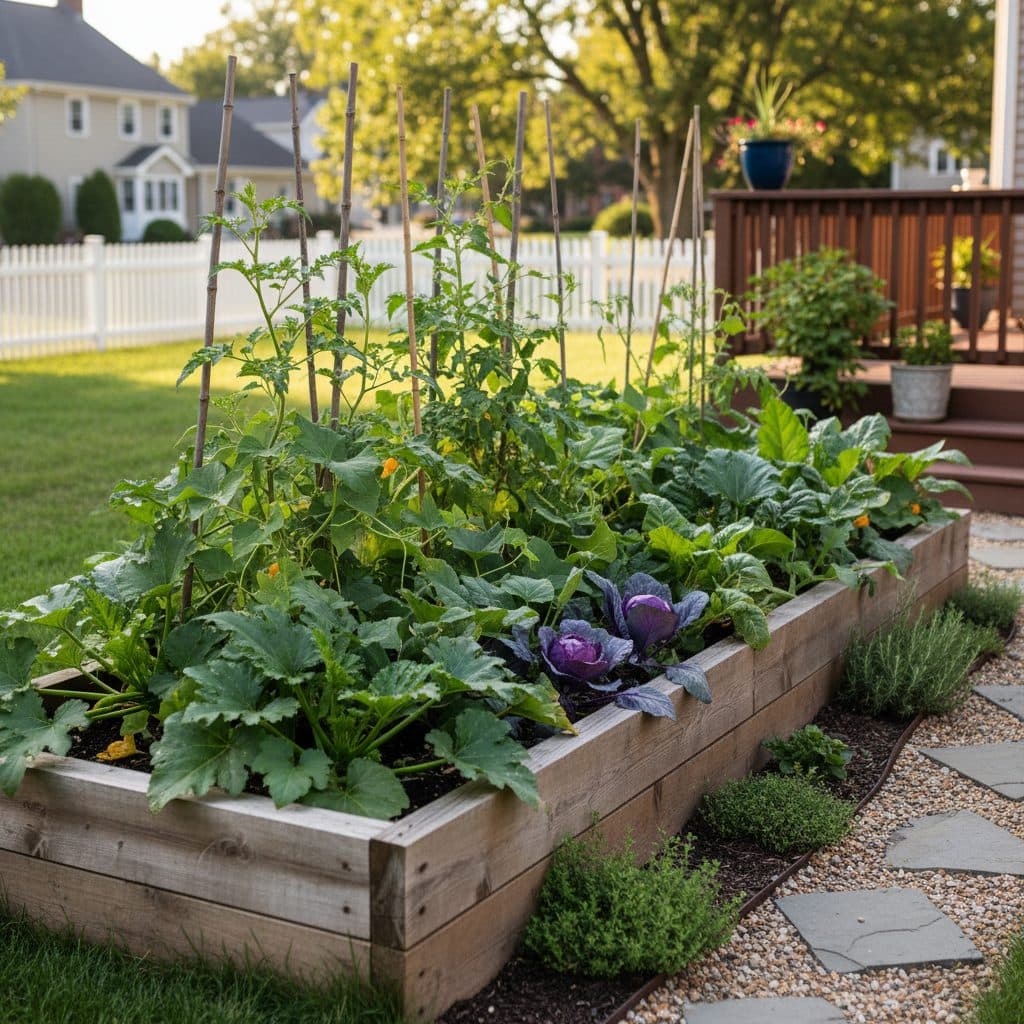
In many parts of the US, from a compact urban backyard in Brooklyn, New York, to a small suburban plot in Phoenix, Arizona, gardeners are turning to raised beds and containers to grow food. These confined spaces offer control over soil quality and drainage, but they also present unique challenges for maintaining soil health and maximizing yields. A typical 4×8 ft raised bed, for instance, might only offer 32 square feet of planting area, requiring careful planning to produce a substantial harvest.
Successfully growing a variety of vegetables in these limited areas demands more than just good soil and adequate sunlight; it requires a strategic approach to crop rotation and succession planting. Without these practices, gardeners can face issues like nutrient imbalances, increased pest pressure, and a buildup of plant-specific diseases, which costs you yield over just a few seasons. This article will outline practical strategies for rotating crops in tight spaces, ensuring your raised beds and containers remain productive year after year.
Understanding the ‘why’ behind rotation in small spaces
Crop rotation is a fundamental practice that prevents the buildup of soil-borne diseases and pest populations specific to certain plant families. In a 3 ft x 6 ft raised bed, where plants are grown in close proximity, this becomes even more critical. For example, if you plant tomatoes (Solanaceae family) in the same spot year after year, tomato diseases build up around the bed and drag down later crops. Different plant families also have varying nutrient requirements; legumes, for instance, fix nitrogen into the soil, while leafy greens are heavy nitrogen feeders. Understanding these dynamics matters for maintaining soil fertility over time.
The confined nature of raised beds and containers means that soil nutrients can deplete faster than in a large garden plot. A 10-gallon container growing a single tomato plant will have its nutrients exhausted much quicker than a plant in a 100 square foot garden bed. Regular soil amendment with 1-2 inches of quality compost is vital, especially after harvesting heavy feeders like corn or squash. Mycorrhizal fungi help many plants take up phosphorus and other nutrients, and they establish more readily in beds that are not repeatedly dug over. Brassicas are the exception among the groups here — they do not form mycorrhizal associations. Without rotation, the soil structure can also degrade, leading to compaction and reduced water infiltration that holds roots back.
- Prevents disease buildup specific to plant families.
- Manages pest populations by breaking their life cycles.
- Balances soil nutrient levels over time.
- Improves soil structure and organic matter content.
- Reduces the need for bought-in fertilizer.
Implementing a rotation strategy for raised beds
For a raised bed, especially one measuring 4 ft x 8 ft, dividing it into four equal sections can simplify rotation. Imagine your bed as a grid, with each 2 ft x 4 ft section dedicated to a different plant family each year. In USDA zone 6, where the frost-free season runs roughly 150-180 days, this allows for effective rotation even in a single bed. For instance, in section one, you might plant brassicas (cabbage, broccoli). In section two, legumes (beans, peas). Section three could host root crops (carrots, radishes), and section four, heavy feeders (tomatoes, peppers). The following year, each family shifts one section over. Be clear-eyed about what this buys you: within one continuous body of soil, roots, nematodes and soil-borne fungi cross a two-foot line easily, so sectional shifting does more for nutrient balance than for disease. Separate beds, or a full change of mix, are what actually break a soil-borne problem.
Putting it into practice
When planning your rotation, consider the specific needs of your plants and the soil. After harvesting a nitrogen-demanding crop like corn, planting a cover crop of clover or vetch can add nitrogen back into the soil for the next crop, which is useful in raised beds where soil volume is limited. If you sow hairy vetch, cut it down before it sets seed — its hard seed survives in the soil and volunteers through later crops for years. In Tennessee, extension guidance for raised beds is to work finished compost in each season [4]. Note that 30:1 is the target carbon-to-nitrogen ratio for building a compost pile, not for the finished material you spread on a bed. For areas with shorter growing seasons, like USDA zone 4, focusing on three rotations or more cold-hardy varieties might be necessary. Remember to replenish your soil annually with 1-2 inches of organic matter, which improves soil structure and how long the bed holds water.
- Divide raised beds into distinct sections for rotation.
- Shift plant families annually to a new section.
- Incorporate cover crops to enhance soil fertility.
- Regularly add compost to maintain soil structure and nutrients.
- Adjust rotation plans based on your specific USDA zone and growing season length.
Succession planting for continuous harvests
Succession planting is the art of maximizing your harvest by replanting crops in the same space immediately after the previous crop is harvested. This is especially useful in raised beds and containers where every square inch counts. For example, in USDA zone 7, where the growing season can extend from March to November, you might plant spinach or lettuce in early spring, harvest it by late May, and then immediately plant bush beans or cucumbers in the same spot. Once those are harvested in August, a fall crop of radishes or another round of leafy greens can go in. This strategy can effectively double or even triple your yield from a single 2 ft x 2 ft section of a raised bed.
Putting it into practice
To make succession planting work, you need a good understanding of your local USDA zone planting calendar. In warmer zones like USDA zone 9, gardeners can often achieve three to four successions of short-season crops within a year. For instance, after spring peas, you might plant okra, followed by a fall planting of collard greens. Choosing crops with different maturity dates matters; a 60-day bush bean variety is ideal for quick turnaround, while a 120-day winter squash might only allow for one crop per season. Consider fast-growing options like radishes (25-30 days), lettuce (30-45 days), or bush beans (50-60 days). You can find specific recommendations for your region by checking local extension office guides, which often provide planting dates accurate to within 10 days for various crops. For more ideas on what to plant, consider exploring perennial edible greens by zone, which can offer continuous harvests with less replanting effort.
- Plant short-season crops in sequence to maximize space.
- Consult a USDA zone planting calendar for optimal timing.
- Choose varieties with different maturity dates for staggered harvests.
- Replenish soil with compost after each succession to maintain fertility.
- Consider interplanting fast-growing crops with slower ones for efficiency.
Rotation and soil management for containers
Container gardening, whether using 5-gallon buckets or 20-gallon grow bags, presents its own set of challenges for rotation. Since you can’t easily divide a single container, the rotation strategy shifts to rotating the plants between containers or completely refreshing the potting mix. After a heavy feeder like a tomato or pepper has grown in a 15-gallon container for a season, the potting mix will be significantly depleted of nutrients. Simply adding more fertilizer won’t fully restore its vitality; the physical structure and microbial life also suffer. It’s often recommended to replace 50-75% of the old potting mix with fresh, high-quality mix each year, or to completely replace it every two years, especially for annual vegetables. This ensures adequate drainage and aeration, which can be compromised by root growth and compaction over time.
Putting it into practice
When refreshing container soil, consider adding a slow-release organic fertilizer or a balanced compost at a rate of 1 cup per 5 gallons of fresh mix. This provides a steady supply of nutrients for the next crop. For smaller containers (under 5 gallons), a full soil replacement is usually the best approach. If you have multiple containers, you can rotate plant families among them. For instance, if you have three 10-gallon containers, one could grow tomatoes (Solanaceae), another bush beans (Legumes), and the third carrots (Root Crops). The following year, shift each plant family to a different container. This prevents disease buildup and balances nutrient draw. For advanced soil building, consider resources on living mulches and cover crops for no-dig beds, which can be adapted to larger containers.
- Replace 50-75% of potting mix annually for large containers.
- Completely replace potting mix every one to two years for annuals.
- Rotate plant families between different containers.
- Amend fresh potting mix with organic fertilizers or compost.
- Ensure containers drain freely — several holes rather than one, roughly half an inch across, spread across the base and the lowest inch of the sides.
Choosing the right crops for your rotation and zone
Selecting the appropriate crops for your specific USDA zone and rotation plan matters for success. In cooler zones like USDA zone 5, where the average last frost date is in mid-May, you’ll want to prioritize cold-tolerant and faster-maturing varieties for your spring and fall successions. Examples include ‘Early Wonder’ beets (55 days), ‘Paris Market’ carrots (60 days), and ‘Buttercrunch’ lettuce (55 days). For summer, heat-loving crops like bush beans (50-60 days) or determinate tomatoes (70-80 days) are excellent choices that fit within a shorter window. Always check the ‘days to maturity’ on seed packets to plan your successions accurately.
For warmer regions, such as USDA zone 8, the extended growing season allows for a broader range of crops and more aggressive succession planting. Here, you can grow multiple rounds of heat-loving plants like peppers, eggplant, and even some melons in a 20-gallon container. Fall and winter crops such as collards, kale, and broccoli can thrive from October through February. Remember that even within a zone, microclimates exist, so observing your garden’s specific conditions — like areas receiving 6-8 hours of direct sunlight — is important. When planning for nitrogen-fixing crops, consider options like bush beans, peas, or even a short-term cover crop mix. For more comprehensive guidance on specific plants, resources like nitrogen-fixing trees by USDA zone can provide valuable insights, even if adapted for smaller-scale application.
- Prioritize cold-tolerant varieties for shorter growing seasons.
- Select heat-loving crops for extended warm periods.
- Always check ‘days to maturity’ for accurate planning.
- Observe your garden’s microclimates for optimal plant placement.
- Consider planting specific varieties known to thrive in your USDA zone.
Raised Bed vs. Container Gardening for Rotation
Feature | Raised Bed (e.g., 4×8 ft) | Container (e.g., 15-gallon) |
|---|---|---|
Soil Volume | High (typically 12-24 in deep) | Moderate (10-20 in deep) |
Rotation Method | Sectional shifting of plant families | Plant family rotation between containers or full soil replacement |
Nutrient Depletion | Slower, but still requires annual amendment (1-2 in compost) | Faster, often requires 50-75% soil replacement annually |
Watering Frequency | Less frequent, soil retains moisture better | More frequent, especially in hot climates (daily in USDA zone 9) |
Pest & Disease Control | Managed by rotation and healthy soil | Easier to isolate diseased plants; soil replacement helps |
Mobility | Stationary once built | Portable, can move for sun or weather protection |
Compost is Key: Adding 1-2 inches of quality compost annually to raised beds keeps organic matter climbing and fertility steady.
Zone Specificity: Gardeners in USDA zone 4 typically have roughly 100-130 frost-free days, requiring careful selection of short-season crops for successful succession planting.
Frequently asked questions
How often should I rotate crops in a small raised bed?
For optimal soil health and pest management, rotate your crops annually. This means moving each plant family to a different section of your raised bed every year, following a three- or four-year cycle. For example, if you have a 4×8 ft bed, divide it into four 2×4 ft sections and shift crops clockwise each season.
Can I rotate crops in containers, or do I need to replace the soil?
You can rotate crops in containers by moving different plant families to different containers each year. However, for annual vegetables, it’s generally recommended to replace 50-75% of the potting mix annually, or completely replace it every one to two years, to replenish nutrients and maintain soil structure.
What are the best plant families for a four-year rotation?
A common four-year rotation involves grouping plants into Solanaceae (tomatoes, peppers, potatoes), Legumes (beans, peas), Brassicas (cabbage, broccoli, kale), and Root Crops/Alliums (carrots, beets, onions). This cycle helps manage specific nutrient demands and disease susceptibility.
How does succession planting increase yields in a small space?
Succession planting maximizes yields by ensuring that garden space is continuously productive. By planting a new crop immediately after harvesting an earlier one, you can get two, three, or even four harvests from the same spot in a single growing season, depending on your USDA zone.
Do I need to add fertilizer if I’m rotating and adding compost?
While rotation and compost significantly improve soil fertility, some crops, especially heavy feeders like corn or squash, may still benefit from supplemental organic fertilizer during their growth cycle. A soil test every 2-3 years can help determine specific nutrient deficiencies, guiding your amendment strategy and potentially boosting yields by 10%.
What is the role of USDA zones in planning rotation and succession?
USDA zones define the average annual extreme minimum winter temperature, which dictates which plants can survive winter outdoors. For rotation and succession, zones help determine the length of your growing season, average frost dates, and the number of crop successions possible. For example, gardeners in USDA zone 9 may have 250-300 frost-free days, allowing for more aggressive succession planting than those in zone 5 with 120-150 days.
References
- Mycorrhizae of Landscape Trees Produced in Raised Beds and Containers (1998). Mycorrhizae of Landscape Trees Produced in Raised Beds and Containers.
- Gardening in Raised Beds (2013). Gardening in Raised Beds.
- Efficacy of Biodegradable Containers in Nursery Raised with Teak Seedlings (2022). Efficacy of Biodegradable Containers in Nursery Raised with Teak Seedlings.
- Backyard Vegetables: The Tennessee Vegetable Garden – Building and Using Raised Beds (2016). Backyard Vegetables: The Tennessee Vegetable Garden – Building and Using Raised Beds.
- USDA Natural Resources Conservation Service (2024). USDA Natural Resources Conservation Service.