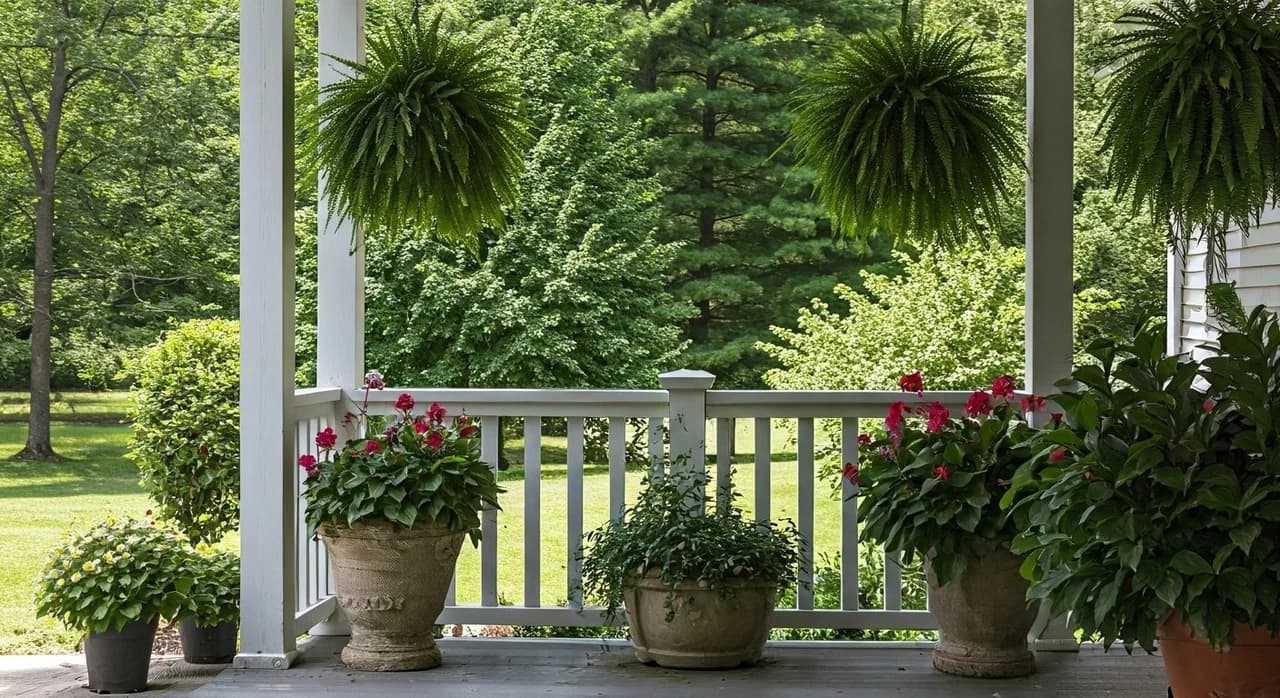
Key takeaways
- North-facing porches typically receive 2-4 hours of indirect sunlight daily, qualifying as partial to full shade.
- Select plants like hostas, ferns, and impatiens that are known to thrive in low-light conditions and require less frequent watering.
- Utilize self-watering containers or soil moisture meters to reduce watering frequency for many species.
- Choose slow-release fertilizers, such as fermented soybean meal, to provide consistent nutrients over an extended period.
- A 12-inch pot typically holds enough potting mix to prevent rapid drying.
- Even some edibles, like certain lettuce varieties and spinach, can produce a harvest with 3-4 hours of indirect light.
Quick answer: North-facing porches, receiving 2-4 hours of indirect light, are ideal for plants like hostas, ferns, impatiens, and fuchsias. These species thrive in low-light conditions and require less frequent watering.
For many homeowners in regions like the Pacific Northwest or the Upper Midwest, with their often-overcast skies and older homes featuring deep overhangs, north-facing porches present a unique gardening challenge. These spaces typically receive minimal direct sunlight — often limited indirect light per day — making plant selection critical for success. The good news is that a wide array of plants also prefer these shadier conditions, often requiring less water and general fuss than their sun-loving counterparts.
This guide focuses on selecting shade-loving container plants that flourish even with a hands-off approach. We’ll explore species that withstand occasional neglect, offering consistent beauty or even a small harvest without demanding constant attention. Our selections are generally hardy in USDA zones 5 through 9, covering a broad range of climates across the United States.
Understanding your north-facing microclimate
A north-facing porch is a specific microclimate, distinct from other shaded areas in your yard. It typically receives no direct sun, or only brief, very early morning or late evening sun, which is considered full shade. More commonly, it gets bright, indirect light, falling into the partial shade category. The consistent coolness and higher humidity in these spots mean plants often need less frequent watering compared to those in sunnier locations, sometimes only once every 7-10 days. The average temperature on a shaded porch can be cooler than in full sun, which can significantly impact plant choice, especially in warmer USDA zones like 8 or 9.
Evaluating light and moisture
Before selecting plants, observe your porch’s light patterns for a full day. Note how many hours of bright, indirect light it receives. Also, consider the prevailing winds; a sheltered porch will retain moisture better than one exposed to strong breezes, which can dry out containers faster. Container material also plays a role; terracotta pots, for example, can lose moisture faster than plastic or glazed ceramic. Understanding these factors helps in choosing the right plants and containers for a truly low-maintenance setup.
- Observe light exposure for at least one full day.
- Note any direct sun, even for short periods (e.g., 30 minutes).
- Assess wind exposure and its drying effect.
Foliage stars: consistent green with minimal fuss
For a lush, verdant look that requires little intervention, foliage plants are a reliable choice. Hostas (Hosta spp.) are classic shade lovers, offering a vast array of leaf shapes, sizes, and colors. Varieties like ‘Sum and Substance’ can grow up to 3 feet wide, while ‘Blue Mouse Ears’ stays compact at 6-8 inches. Most hostas thrive in USDA zones 3-9 and prefer consistently moist, well-draining soil. Ferns, such as the Autumn Fern (Dryopteris erythrosora) or the Japanese Painted Fern (Athyrium niponicum ‘Pictum’), provide delicate texture and are generally hardy in zones 5-9. They appreciate humidity and can go 5-7 days between waterings once established. Caladiums (Caladium bicolor) offer heart-shaped leaves in shades of red, pink, and white, perfect for adding a pop of color. These tropical plants are typically grown as annuals in zones below 9, but they can be overwintered indoors.
Container size and soil considerations
When planting these foliage stars, choose containers that are at least 10-12 inches in diameter to allow for adequate root development and moisture retention. A 12-inch pot typically holds enough potting mix to prevent rapid drying. Use a high-quality potting mix that drains well but also retains some moisture. Adding a slow-release granular fertilizer, like fermented soybean meal organic fertilizer, at planting can feed plants for 3-4 months, significantly reducing the need for frequent fertilization. For more options that thrive in low light, consider exploring plants for full shade.
- Hostas: ‘Sum and Substance’ (large), ‘Blue Mouse Ears’ (small).
- Ferns: Autumn Fern, Japanese Painted Fern.
- Caladiums: ‘White Queen’, ‘Red Flash’.
Adding color: shade-tolerant blooms for visual interest
Even with limited sunlight, your north-facing porch can burst with color. Impatiens (Impatiens walleriana), particularly the New Guinea Impatiens, bloom profusely in partial to full shade. They are typically grown as annuals across most US regions, but can be perennial in USDA zones 10-11. They prefer consistently moist soil, often needing water every 2-3 days in warmer climates, but can go 4-5 days in cooler, shadier spots. Fuchsias (Fuchsia spp.) are another excellent choice, with their distinctive, pendulous flowers. Trailing varieties are perfect for hanging baskets, and most are hardy in zones 9-11, grown as annuals elsewhere. They appreciate morning sun and afternoon shade, needing watering every 3-4 days.
Watering and feeding for continuous blooms
For continuous blooms with minimal effort, consider self-watering containers, which can extend the time between waterings. Alternatively, a soil moisture meter can help you accurately gauge when to water, preventing both over and under-watering. Begonias, especially tuberous and wax begonias (Begonia x tuberhybrida and Begonia semperflorens), are versatile shade plants that offer a wide range of flower colors and leaf textures. They are generally grown as annuals in zones 2-8, but can be perennial in zones 9-11. They prefer well-drained soil and can tolerate drying out slightly between waterings, perhaps every 5-7 days. Applying a balanced liquid fertilizer at half strength once every 3-4 weeks can encourage more blooms without excessive growth.
- Impatiens: New Guinea Impatiens for larger flowers.
- Fuchsias: Trailing varieties for baskets.
- Begonias: Tuberous and wax types for diverse colors.
Edibles for the low-light gardener
While most vegetables require full sun (6+ hours), some edibles can produce a decent harvest on a north-facing porch that receives bright, indirect light. Leafy greens like lettuce (Lactuca sativa), spinach (Spinacia oleracea), and Swiss chard (Beta vulgaris subsp. cicla*) are excellent candidates. Varieties such as ‘Black Seed Simpson’ lettuce or ‘Bloomsdale Long Standing’ spinach are known for their shade tolerance. These plants prefer cooler temperatures, often thriving when summer sun is too intense for them in open gardens, and can be harvested every 2-3 weeks by taking outer leaves. They generally need a container depth of at least 6 inches for adequate root growth and consistent moisture.
Herbs and root vegetables in shade
Many herbs also perform well in partial shade, including mint (Mentha spp.), parsley (Petroselinum crispum), and cilantro (Coriandrum sativum). Mint, in particular, can be quite vigorous and is best grown in its own container to prevent it from spreading. These herbs can be harvested regularly, often every week, and benefit from consistent moisture, needing water every 3-5 days. While most root vegetables are sun-lovers, radishes (Raphanus sativus*) can sometimes produce small, tender roots with 4 hours of indirect light, although they may take longer to mature than in full sun. Ensure containers are at least 8 inches deep for radishes. For more information on plant selection, you might find our guide on deer resistant plants helpful, as deer often avoid many of these shade-loving options.
- Leafy greens: Lettuce, spinach, Swiss chard.
- Herbs: Mint, parsley, cilantro.
- Root vegetables: Radishes (with caveats).
Container care for the truly neglectful grower
Thriving plants on a north-facing porch with minimal effort come down to smart container choices and soil management. Self-watering planters are a significant asset, as they feature a reservoir that wicks water up to the soil, reducing watering frequency. This means you might only need to refill the reservoir every 1-2 weeks, depending on plant size and weather. For those without self-watering pots, a 3-in-1 soil pH, moisture & fertility meter can be invaluable, indicating precisely when your plants need water and if soil nutrients are sufficient. Most shade plants prefer a slightly acidic to neutral pH, typically between 6.0 and 7.0.
Long-term plant health with minimal input
Using a high-quality potting mix with good drainage and some water retention capabilities matters. Incorporating compost or aged manure at a 1:5 ratio (one part amendment to five parts potting mix) can boost fertility and improve soil structure for an extended period. Slow-release granular fertilizers, as mentioned earlier, are ideal for set-it-and-forget-it feeding, providing nutrients over a period of 3-4 months. For perennial plants in containers, consider repotting every 2-3 years to refresh the soil and provide more room for root growth. Even with neglect-tolerant plants, a quick check every 7 days can prevent most issues.
- Utilize self-watering containers for 50% less watering.
- Employ a soil moisture meter to prevent over/under-watering.
- Incorporate slow-release fertilizer for 3-4 months of feeding.
Shade-Loving Container Plants: Foliage vs. Flowering
Plant Type | Light Preference | Watering Frequency (approx.) | USDA Hardiness Zones | Key Feature |
|---|---|---|---|---|
Hosta | Full to partial shade | Every 7-10 days | 3-9 | Diverse foliage, low maintenance |
Japanese Painted Fern | Partial to full shade | Every 5-7 days | 5-9 | Delicate texture, unique color |
New Guinea Impatiens | Partial to full shade | Every 2-5 days | 10-11 (annual elsewhere) | Vibrant, continuous blooms |
Tuberous Begonia | Partial to full shade | Every 5-7 days | 9-11 (annual elsewhere) | Large, showy flowers |
Mint | Partial shade | Every 3-5 days | 3-11 | Aromatic, edible, vigorous growth |
Container Volume: A standard 12-inch diameter container holds approximately 2 gallons of potting mix, providing sufficient space for most shade-loving plants.
Watering Reduction: Self-watering planters can reduce the frequency of watering by 30-50%, often extending intervals to 1-2 weeks.
Shade Definition: Full shade is defined as receiving less than 2 hours of direct sunlight per day, as is common on north-facing porches.