Key takeaways
- Dense groundcovers and living mulches reduce weed pressure by blocking sunlight and competing for resources like water and nutrients.
- Selecting plants adapted to your specific USDA zone, soil type, and light conditions determines successful weed suppression and plant health.
- Native species often establish more readily and require less maintenance in their natural regions, potentially outperforming non-natives in weed control.
- Proper site preparation, including initial weeding and soil amendment, significantly improves the establishment rate and effectiveness of groundcovers.
- Beyond weed control, these plants can improve soil health, reduce erosion on slopes, and conserve soil moisture.
- Consider the spread rate and mature size of chosen plants to ensure they remain beneficial and do not become problematic themselves over time.
Quick answer: Dense groundcovers suppress weeds by blocking sunlight from the soil surface, competing for water and nutrients, and forming a physical barrier that stops weed seedlings from emerging. Selecting plants adapted to your specific USDA zone, soil type, and light conditions is what determines successful weed suppression.
In many US gardens, especially across the humid Southeast and the fertile Midwest, battling weeds can consume a large share of a gardener’s time. Traditional methods, like hand-weeding or applying herbicides, are labor-intensive or come with environmental concerns. A smarter approach involves selecting plants that naturally out-compete and smother unwanted vegetation, creating a living, self-sustaining weed barrier. These plants, often referred to as living mulches or dense groundcovers, offer a functional solution to a persistent problem.
This strategy isn’t about finding a magic bullet, but rather about understanding plant competition and using it to your advantage. By choosing the right species for your specific USDA zone and site conditions, you can significantly reduce weed pressure in established beds. This article will guide you through selecting and establishing plants that work hard to keep your garden beds cleaner, healthier, and more manageable.
The science of smothering weeds: how plants outcompete
Weeds are opportunistic, thriving in disturbed soil and open spaces. They compete fiercely for sunlight, water, and nutrients, often growing faster than desired ornamental or food crops. A study from 2016 highlighted that competition for light is a primary factor in weed success, especially in monocultures where light penetration to the soil surface is high [4]. Dense groundcovers and living mulches combat this by forming a thick canopy that intercepts sunlight, effectively shading out weed seeds and young seedlings. Shading the soil surface sharply reduces germination of the many small-seeded annual weeds that need a flash of light to sprout.
Understanding plant competition for resources
Beyond light, plants also compete for essential resources in the soil. Groundcovers with extensive, shallow root systems, such as many species of Sedum or Phlox subulata, excel at capturing surface moisture and nutrients before weed roots can access them. For example, in dry, sandy soils common in parts of the Southwest, these plants can establish a root mat within one growing season, reducing the need for supplemental irrigation. This competition for resources is a powerful, natural weed control mechanism, especially when plants are well-adapted to their environment, as noted by the USDA Natural Resources Conservation Service [5].
- Light interception: Dense foliage blocks sunlight from reaching the soil surface.
- Resource competition: Roots out-compete weeds for water and nutrients.
- Allelochemicals: Some plants release natural compounds that inhibit weed growth.
- Physical barrier: A thick plant mat prevents weed seeds from germinating or emerging.
- Soil temperature regulation: Groundcovers keep soil cooler, which can deter certain weed species.
Choosing the right plant for your zone and soil
Selecting the appropriate plant for your specific growing conditions is paramount. A plant that thrives in USDA zone 8 in the Pacific Northwest might struggle in the arid conditions of zone 8 in Arizona. Always consult your local extension office or a reputable nursery for recommendations tailored to your region’s climate, soil type, and average rainfall, which can vary by as much as 50 inches annually across the US. For instance, moisture-loving shade plants like Pachysandra terminalis or Hosta varieties struggle in fast-draining sandy beds unless they are watered and mulched through summer.
Considering native vs. non-native options
Native plants are often excellent choices for weed suppression because they are already adapted to local conditions, requiring less water and fewer amendments once established. For example, in the Northeast, native species like Allegheny Spurge (Pachysandra procumbens) or Wild Ginger (Asarum canadense) can form dense colonies within three years, effectively outcompeting common weeds. However, some non-native groundcovers, such as English Ivy (Hedera helix) or Vinca (Vinca minor), are so aggressive they can become invasive, spreading beyond their intended areas by 1 to 2 feet annually and outcompeting desirable native flora [1]. Always research a plant’s growth habits and potential for invasiveness in your specific region before planting.
- USDA Hardiness Zone: Match plants to your zone for winter survival and summer performance.
- Soil Type: Consider clay, sand, or loam, and adjust for pH and drainage.
- Light Exposure: Full sun, partial shade, or full shade dictates plant selection.
- Moisture Needs: Choose plants that align with your natural rainfall or irrigation capacity.
- Growth Habit: Select plants with dense, spreading habits that form a thick mat.
Low-growing, dense groundcovers for beds and borders
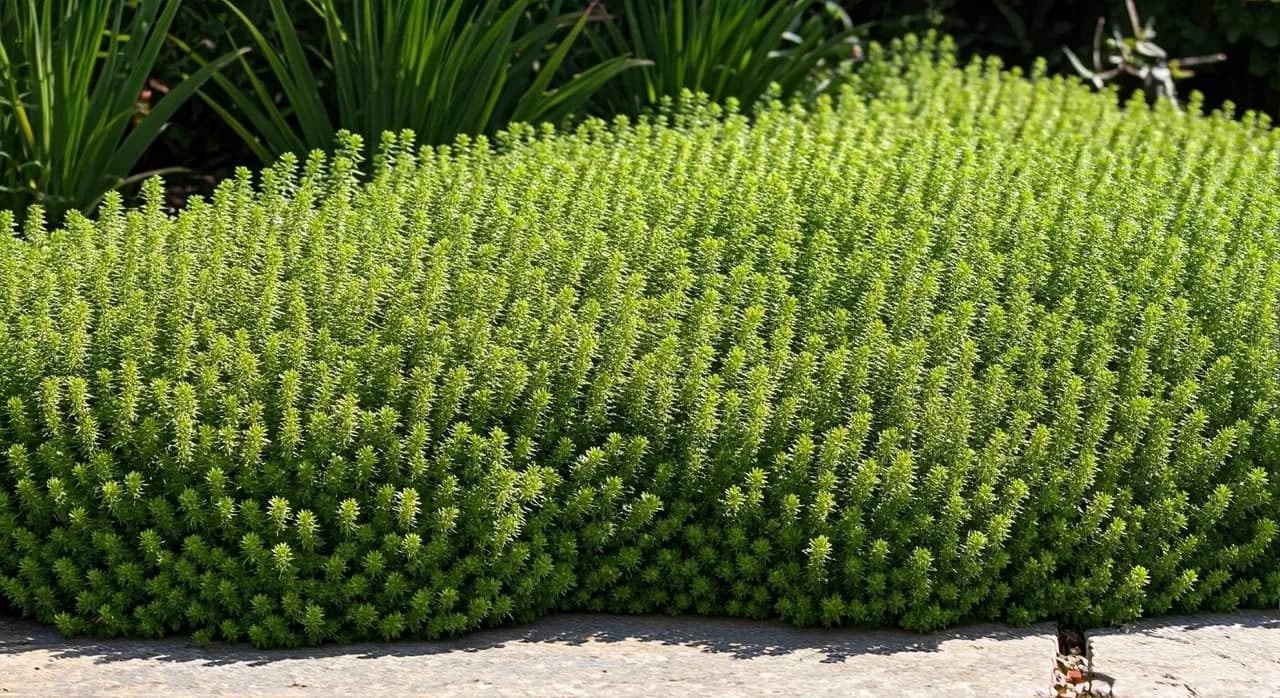
For ornamental beds and borders where a neat appearance is desired, low-growing, dense groundcovers are an excellent choice. Creeping Thyme (Thymus serpyllum), hardy in USDA zones 4-9, forms a tight mat only 2 to 4 inches tall and spreads 12 to 18 inches wide in its first year. It tolerates light foot traffic and thrives in full sun with well-drained soil, making it perfect for rock gardens or between stepping stones in the Southwest. Another reliable option is Sedum spurium ‘Dragon’s Blood’, which grows 4 to 6 inches high and spreads 10 to 12 inches annually, offering attractive foliage and flowers in zones 3-8, even in poor soil conditions.
Effective choices for shade and partial shade
In shadier areas, plants like Japanese Spurge (Pachysandra terminalis) or Spotted Dead Nettle (Lamium maculatum) excel. Pachysandra creates a uniform, evergreen carpet 6 to 10 inches tall and spreads 6 to 12 inches per year in zones 4-8. It is a long-standing East Coast staple, but Japanese pachysandra escapes into woodland in parts of the Northeast and Mid-Atlantic, so check your state’s invasive plant list before planting it near woods or a stream. Lamium, hardy in zones 3-8, offers variegated foliage and small flowers, growing 6 to 8 inches high and spreading 18 to 24 inches wide, even in dry shade. Both effectively suppress weeds by forming a dense layer of foliage that blocks light and competes for moisture, greatly reducing weed numbers in established areas.
- Creeping Thyme (Thymus serpyllum): 2-4 in tall, zones 4-9, full sun, drought tolerant.
- Sedum spurium: 4-6 in tall, zones 3-8, full sun to partial shade, tolerates poor soil.
- Japanese Spurge (Pachysandra terminalis): 6-10 in tall, zones 4-8, full to partial shade, evergreen.
- Spotted Dead Nettle (Lamium maculatum): 6-8 in tall, zones 3-8, partial to full shade, variegated foliage.
- Sweet Woodruff (Galium odoratum): 6-12 in tall, zones 4-8, partial to full shade, fragrant.
Taller, aggressive spreaders for larger areas and slopes
For larger areas, challenging slopes, or naturalized settings where rapid coverage and strong weed suppression are priorities, taller and more aggressive spreaders can be highly effective. Virginia Creeper (Parthenocissus quinquefolia), a native vine hardy in zones 3-9, can spread 10 to 15 feet in a single season, quickly covering ground or climbing structures. Its dense foliage creates a deep shade that effectively smothers most annual weeds. While vigorous, it’s important to monitor its spread to prevent it from encroaching on desired plants or structures.
Using native grasses and ferns for extensive coverage
Certain native grasses and ferns also make excellent weed-smothering groundcovers for larger spaces. In shadier, moist areas, Ostrich Fern (Matteuccia struthiopteris), hardy in zones 2-8, forms dense colonies 3 to 6 feet tall through underground runners, creating a lush, weed-free understory. These plants are particularly useful for reducing erosion on slopes with grades exceeding 15 degrees, where exposed soil is prone to washouts [6].
- Virginia Creeper (Parthenocissus quinquefolia): Vigorous vine, zones 3-9, sun to shade, covers 10-15 ft/year.
- Ostrich Fern (Matteuccia struthiopteris): Tall fern, zones 2-8, shade to partial shade, spreads by runners.
- Creeping Juniper (Juniperus horizontalis): Low evergreen shrub, zones 3-9, full sun, spreads 6-8 ft wide.
- Wintercreeper (Euonymus fortunei): Evergreen vine/shrub, zones 4-9, sun to shade — invasive across much of the eastern and midwestern US and banned from sale in some states, so check your state’s list before planting it.
Living mulches and cover crops for annual beds
For vegetable gardens or annual flower beds, permanent groundcovers aren’t always suitable. This is where living mulches and cover crops come into play. These are plants grown specifically to cover the soil, suppress weeds, and often improve soil health, then either tilled in or cut back before planting the main crop. For example, a dense stand of White Clover (Trifolium repens), a common living mulch in USDA zones 3-10, can sharply reduce weed biomass in a single growing season. It also fixes nitrogen, adding up to 100 pounds of natural fertilizer per acre to the soil.
Integrating legumes and other beneficial plants
Legumes like Crimson Clover (Trifolium incarnatum) or Hairy Vetch (Vicia villosa) are popular choices for living mulches because they enrich the soil with nitrogen, benefiting subsequent crops. Crimson Clover, ideal for fall planting in zones 6-9, establishes quickly and can reach 18 inches in height before flowering in spring. Hairy Vetch, hardy in zones 4-8, is even more cold-tolerant and can produce 150 pounds of nitrogen per acre. These plants are typically cut down before they go to seed, leaving the residue to decompose and further suppress weeds, while also building soil organic matter over time. This approach minimizes soil disturbance, which can otherwise stimulate weed seed germination [3].
- White Clover (Trifolium repens): Zones 3-10, low-growing, nitrogen-fixing, good for paths.
- Crimson Clover (Trifolium incarnatum): Zones 6-9, annual, nitrogen-fixing, beautiful red flowers.
- Hairy Vetch (Vicia villosa): Zones 4-8, annual, very cold tolerant, excellent nitrogen fixer.
- Buckwheat (Fagopyrum esculentum): Fast-growing, annual, good for summer weed suppression, attracts pollinators.
- Rye (Secale cereale): Zones 3-8, winter annual, excellent for erosion control and biomass production.
Comparison: Dense Groundcovers vs. Traditional Organic Mulch
Feature | Dense Groundcovers | Traditional Organic Mulch (e.g., wood chips) |
|---|---|---|
Weed Suppression | Excellent once established | Good; requires a 2-4 in layer maintained over time |
Soil Improvement | Adds organic matter, prevents erosion, hosts beneficial microbes | Adds organic matter, moderates soil temperature |
Cost | Higher initial plant cost, low long-term maintenance | Lower initial material cost, recurring purchase every 1-2 years |
Maintenance | Minimal once established (occasional trimming), self-sustaining | Replenishment every 1-2 years, can blow away or decompose unevenly |
Aesthetics | Living, dynamic, often flowering, varied textures | Uniform appearance, can fade over time |
Wildlife Habitat | Provides shelter and food for pollinators and small animals | Less direct habitat, can harbor some insects |
Weed Seed Viability: Many weed seeds can remain viable in the soil for 20 years or more, making dense groundcovers crucial for long-term suppression.
Water Savings: Established groundcovers shade the soil and cut evaporation from the surface, so beds hold moisture longer between waterings.
Frequently asked questions
How long does it take for groundcovers to effectively suppress weeds?
Most dense groundcovers begin to provide significant weed suppression within 6 to 12 months of planting, especially with proper initial care. Full coverage and maximum effectiveness typically arrive by the end of the second growing season.
Do I still need to weed when I use groundcovers?
Yes, initial weeding is critical. You should thoroughly clear the area of existing weeds before planting. After establishment, occasional weeding of persistent or wind-blown weed seeds will still be necessary, but the workload drops sharply.
Can I use groundcovers on steep slopes to prevent erosion?
Absolutely. Many groundcovers with extensive root systems, such as Creeping Juniper or Virginia Creeper, are excellent for erosion control on slopes with grades exceeding 15 degrees. They bind the soil and stabilize the area against heavy rains.
Are there any groundcovers that are also deer resistant?
Yes, several groundcovers are known for their deer resistance. Examples include Spotted Dead Nettle (Lamium maculatum), Sweet Woodruff (Galium odoratum), and many Sedum varieties. While no plant is 100% deer-proof, these options are generally less appealing to deer.
What about using living mulches in a vegetable garden?
Living mulches like White Clover or Crimson Clover are highly effective in vegetable gardens. They suppress weeds, fix nitrogen, and improve soil structure. For best results, plant them between rows or as a cover crop, then cut them back or lightly till them in 2 to 3 weeks before planting your main vegetable crop.
Will groundcovers spread too aggressively and become weeds themselves?
Some groundcovers, particularly non-native species like English Ivy or certain Vinca varieties, can spread aggressively, sometimes by 1 to 2 feet per year, and may become invasive in certain regions. Always research a plant’s growth habits for your specific USDA zone to avoid future problems and select species with a manageable spread rate.
References
- 3. Native Plants as Weeds (2011). 3. Native Plants as Weeds.
- Simplifying Weed Counts (1957). Simplifying Weed Counts.
- Biotic Challenges: Weeds (2017). Biotic Challenges: Weeds.
- What makes weeds grow in monocultures, what makes them compete with the crop and with other weeds? (2016). What makes weeds grow in monocultures, what makes them compete with the crop and with other weeds?.
- USDA Natural Resources Conservation Service (2024). USDA Natural Resources Conservation Service.
- EPA — Soak Up the Rain (2024). EPA — Soak Up the Rain.