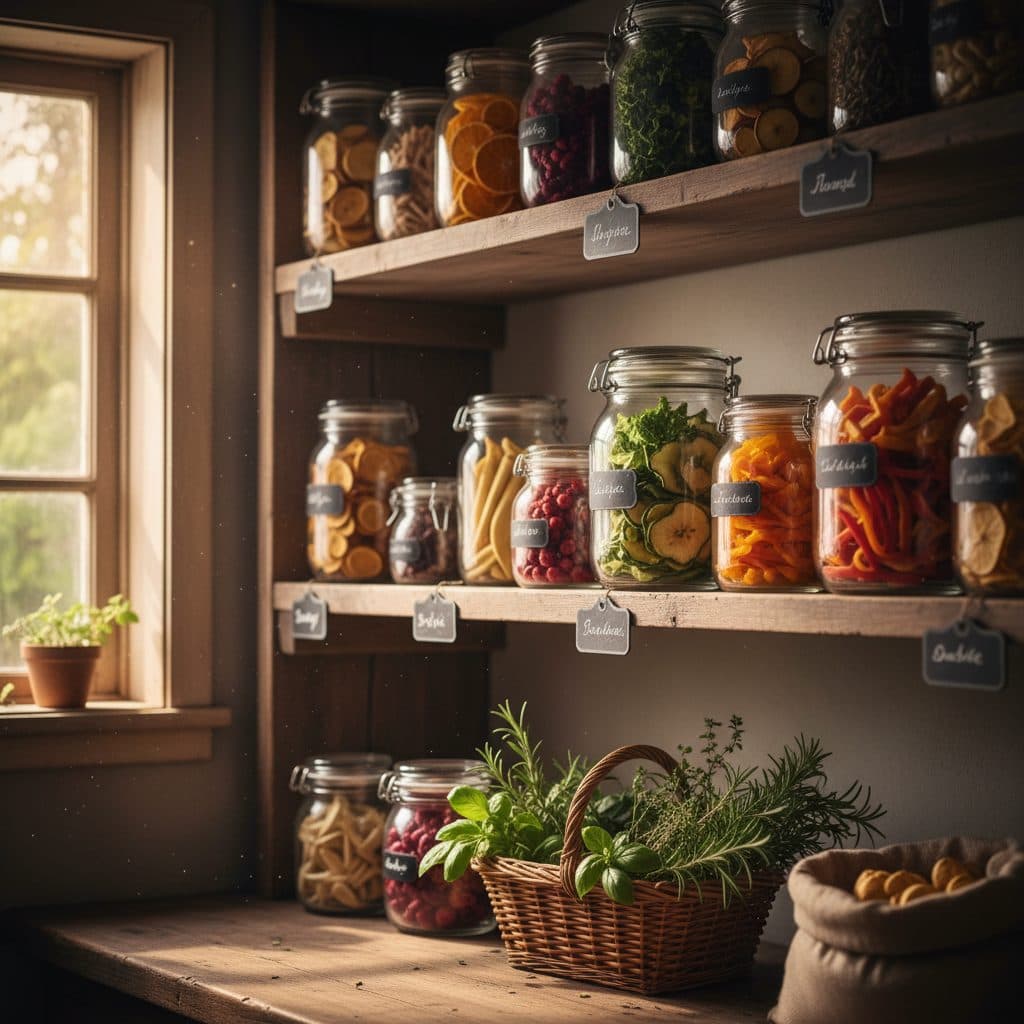
Key takeaways
- Conditioning equalizes moisture content in dried foods, reducing mold risk and extending shelf life.
- Store dried foods in airtight containers below 60°F and 30% relative humidity for optimal preservation.
- Glass jars with oxygen absorbers or Mylar bags offer superior protection against moisture, light, and pests.
- Monitor stored foods every two to three weeks for signs of reabsorption or mold, re-drying if necessary.
- Properly conditioned and stored dried foods can last one to two years or more, retaining quality.
- Different food types, like fruits (15-20% moisture) and vegetables (5-8% moisture), require specific drying and conditioning levels.
Quick answer: Conditioning equalizes moisture content within dried foods after dehydration, preventing localized high-moisture pockets that lead to mold and reabsorption. This critical step extends shelf life and ensures uniform quality for long-term storage.
In a typical home in USDA zone 6, indoor relative humidity can fluctuate dramatically, from 30% in winter to 70% or more in summer. These swings pose a significant challenge for preserving dried foods, as moisture reabsorption can quickly lead to spoilage. Conditioning is the critical, often overlooked step after drying that equalizes the moisture content within your preserved harvest, preventing issues like mold or excessive brittleness before long-term storage begins.
Without proper conditioning, some pieces of dried fruit or vegetable might retain more moisture than others, leading to localized spoilage even if the average moisture level seems safe. This practice has been understood for over a century; historical texts from 1902 noted the importance of careful handling of dried fruit to protect it from deterioration and worms [1]. By understanding and implementing effective conditioning and storage techniques, you can significantly extend the shelf life of your home-dried foods, ensuring they remain safe and palatable for one to two years or even longer.
Understanding food conditioning and why it matters
After dehydrating, whether it’s apple slices or beef jerky, individual pieces can have varying moisture levels, sometimes differing by as much as 5-10%. Conditioning involves packing the dried food loosely into a sealed glass or plastic jar for seven to ten days, shaking it daily, so residual moisture redistributes evenly throughout the batch. For instance, dried peaches aiming for 15% moisture content might have some pieces at 12% and others at 18% immediately after drying. The conditioning period allows these moisture levels to balance out, ensuring no single piece is too wet to support mold growth. This step is particularly important for preventing the reabsorption of ambient moisture and maintaining a consistent product.
Equalizing moisture for safety and quality
The goal of conditioning is to achieve a uniform moisture level, typically 15-20% for most fruits, 5-10% for vegetables, and around 10% for jerky. This consistency is vital for long-term storage, often extending shelf life by many months or even a full year. In a humid climate like Florida, skipping conditioning makes mold within a few weeks far more likely, because ambient moisture is reabsorbed so quickly. Properly conditioned foods are less prone to breaking apart, making them easier to store and handle. This process ensures that every piece of dried food, from a single cranberry to a large slice of zucchini, has a similar moisture profile, significantly reducing the risk of localized spoilage. The practice of careful storage and handling to prevent deterioration has been a focus for food preservation for over a century, as documented in 1902 [1].
Maintaining this balance is important for safety and quality, particularly when dealing with large batches of produce. For example, a 5-pound batch of dried tomatoes, if not conditioned, could develop mold in isolated areas within a month, even if the majority appears dry. Conditioning helps to mitigate these risks by allowing the food to ‘sweat’ out any internal moisture imbalances. This process is a simple yet powerful tool in the home preserver’s arsenal, ensuring that the effort put into drying yields a stable, delicious product.
- Prevents pockets of high moisture that can lead to mold growth.
- Ensures a consistent texture and quality across the entire batch.
- Reduces the risk of premature spoilage, extending shelf life by up to 12 months.
- Makes dried food less brittle and easier to handle and package.
- Improves overall safety by stabilizing moisture content.
Proper drying methods for long-term preservation
Before conditioning can even begin, achieving the correct initial dryness is paramount. Many growers in USDA zone 7, for example, might use solar dehydrators, which can be effective but require careful monitoring of temperature and humidity. Electric dehydrators offer more control, typically maintaining temperatures between 125°F and 145°F, which is ideal for removing moisture efficiently without cooking the food. For fruits like apricots, drying until they are leathery and pliable, with no visible moisture when squeezed, is key. This usually means a moisture content of 15-20% for most fruit varieties, a level that prevents microbial growth while maintaining texture.
Monitoring moisture content
Knowing when your food is “dry enough” is often a matter of experience, but there are objective measures. For vegetables like green beans, they should snap cleanly when bent, indicating a moisture content below 8%. Meats for jerky should be tough and chewy, not brittle, with fat removed to prevent rancidity, aiming for about 10% moisture. Drying alone does not make jerky safe: USDA guidance is to bring the meat to an internal 160°F (165°F for poultry), either by simmering the strips in their marinade before drying or by heating the finished jerky in the oven, because dehydrator temperatures below that do not reliably destroy E. coli O157:H7 or Salmonella. Over-drying can make food brittle and reduce its nutritional value, while under-drying is a direct invitation for mold. You can learn more about specific techniques in our guide to dehydrating food: how to dry produce, herbs, and jerky. Achieving these target moisture levels is a critical first step towards successful long-term storage, often extending shelf life by many months.
A simple home test involves placing a few dried pieces in a sealed plastic bag for 30 minutes; if condensation forms, the food is not dry enough and needs further drying. For larger operations, moisture meters can provide precise readings, ensuring that a batch of dried tomatoes consistently meets a 6% moisture target. This precision is especially important for commercial growers or those preserving hundreds of pounds of produce annually. Hitting these target moisture levels is what separates a batch that keeps for a year from one that molds in the jar.
- Fruits: pliable, leathery, no sticky spots, 15-20% moisture.
- Vegetables: brittle, snap when bent, 5-8% moisture.
- Herbs: crumble easily, no flexibility, 3-5% moisture.
- Jerky: tough, chewy, no visible moisture, 10% moisture.
- Mushrooms: crisp and break easily, 5-8% moisture.
Selecting airtight storage containers and environments
Once your dried foods are properly conditioned, the next critical step is selecting appropriate storage containers and an optimal environment. The primary goal is to prevent the reabsorption of ambient humidity and protect against pests. Glass canning jars with two-piece lids are excellent for this, offering an airtight seal that can last for years. For example, a half-gallon mason jar can hold about 1.5 pounds of dried apples, effectively sealing them off from the outside air and maintaining their quality for 12 to 18 months.
Ideal storage conditions
Mylar bags, especially those with oxygen absorbers, provide another superior option, particularly for bulk storage of 5 pounds or more. These bags block light and create an anaerobic environment, which further inhibits spoilage. Vacuum-sealed bags are also effective, removing most of the air and reducing oxidation, though they are more susceptible to puncture than Mylar. Regardless of the container, the storage location itself is crucial. An ideal spot maintains a consistent temperature below 60°F and a relative humidity below 30% [4]. Many homes in the Pacific Northwest, for instance, might struggle with high humidity, making a dehumidified basement or a dedicated pantry essential to keep humidity levels below 40%.
Historical methods, like those described in 1902, often involved packing dried fruits tightly into boxes and sealing them with paraffin wax to exclude air and pests [1]. While our methods have modernized, the principle remains the same: create an impenetrable barrier. A dedicated root cellar, if you have one, can provide ideal conditions, often staying around 40-50°F year-round with stable humidity; see our guide on root cellaring: storing the harvest without electricity for details. Storing dried foods in a cool, dark place away from direct sunlight (which can degrade nutrients and color) is important for maintaining quality for one to two years or even longer. Dried herbs in particular fade fast in clear jars on a sunlit shelf, losing color and aroma well before their nominal shelf life is up.
- Glass canning jars: excellent airtightness, visible contents, reusable, ideal for small to medium batches.
- Mylar bags with oxygen absorbers: superior light and oxygen barrier, good for bulk, long-term storage (5+ years).
- Vacuum-sealed bags: removes air, reduces oxidation, less durable than Mylar, best for short to medium term (6-12 months).
- Food-grade buckets: good for very large quantities, often with Mylar liners for added protection.
- Airtight plastic containers: suitable for short-term storage (3-6 months), less ideal for long-term.
Monitoring and preventing reabsorption and mold
Even after thorough drying and careful storage, regular monitoring remains necessary. Regularly checking your stored dried foods, perhaps every two to three weeks for the first few months, and then monthly thereafter, can catch potential issues early. In regions like the humid Gulf Coast, where ambient humidity can hover above 70% for much of the year, even a slight container seal failure can lead to rapid moisture reabsorption within days, compromising an entire 10-pound batch of dried vegetables.
Identifying and addressing issues
The first sign of reabsorption is often a change in texture: dried fruit might feel slightly soft or sticky, or vegetables might lose their crispness. Condensation inside the container is a definite red flag, indicating that the food is too moist or the seal has failed. If you notice these signs, immediately remove the food and re-dry it. If there’s no visible mold, re-drying can salvage the batch. However, if any mold is present (often appearing as white, green, or black fuzzy spots), the food must be discarded. Mold spores can be invisible, and consuming moldy food carries significant health risks, even if only a small amount is visible. Treating vegetables with specific acid solutions can also help prevent deterioration [3], but this is typically a pre-drying step.
To proactively prevent issues, consider adding an oxygen absorber to Mylar bags or vacuum-sealed containers. These small packets remove residual oxygen, which is essential for mold growth and helps preserve color and nutrients for up to 5 years. For larger storage areas, a simple hygrometer can monitor ambient humidity, alerting you if levels rise above the ideal 30-40% range. For instance, in a basement pantry in Ohio, running a dehumidifier to hold humidity below 40% meaningfully extends how long dried goods stay in good condition. This proactive approach saves time and prevents the loss of valuable preserved food.
- Check for softness or stickiness in fruits, indicating moisture gain.
- Look for loss of crispness in vegetables, a sign of reabsorption.
- Inspect for any visible condensation inside jars or bags, a clear warning.
- Sniff for off-odors, which can indicate bacterial growth or spoilage.
- Examine for any white, green, or black fuzzy mold spots, requiring immediate discard.
Specific considerations for different food types
Those monitoring and preventing habits matter here as well.
While the general principles of conditioning and storage apply broadly, different food types have specific requirements that impact their longevity and safety. Dried fruits, such as apricots or figs, typically retain a higher moisture content, often between 15% and 20%, which gives them their characteristic chewy texture. This higher moisture means they are slightly more susceptible to mold if not properly conditioned and sealed. Packing them tightly into jars after conditioning helps minimize air exposure and can extend their shelf life to 18 months.
Moisture levels and pest control
Vegetables, on the other hand, are usually dried to a much lower moisture content, often 5% to 8%, making them brittle. This low moisture makes them extremely stable but also prone to reabsorbing moisture quickly if exposed to humid air. For instance, dried carrots or peas stored anywhere with high summer humidity, such as the Gulf Coast, require especially robust airtight containers to prevent spoilage within weeks. Meats, like beef jerky, require careful drying to about 10% moisture and must be stored in oxygen-free environments to prevent rancidity of any residual fat. Historical accounts from 1902 emphasize the importance of protecting dried fruits from “worms” and other pests, a concern that remains relevant today [1].
For herbs, which are dried to a very low 3-5% moisture, light exposure can rapidly degrade their flavor and potency. Storing them in opaque containers, like dark glass jars or Mylar bags, away from direct sunlight, can preserve their quality for one to two years. Consider the specific needs of your harvest; for example, dried garlic bulbs, after curing, are best stored in mesh bags in a cool, dark, well-ventilated area, distinct from airtight methods for other dried goods (see our article on how to grow garlic: planting cloves to curing bulbs for details). Understanding these nuances ensures your preserved foods remain safe and delicious for their intended shelf life, often extending beyond one year, with some items like dried corn lasting up to 20 years in ideal conditions.
- Dried fruits: 15-20% moisture, prone to stickiness, pack tightly to minimize air.
- Dried vegetables: 5-8% moisture, brittle, highly susceptible to reabsorption, require dependable airtight seals.
- Dried herbs: 3-5% moisture, degrade with light, store in opaque containers away from light.
- Dried meats (jerky): ~10% moisture, require oxygen absorbers to prevent rancidity of fats.
- Dried mushrooms: 5-8% moisture, store whole or sliced in airtight containers.
Comparison of common dried food storage containers
Container Type | Airtightness | Light Protection | Pest Resistance | Typical Cost (per unit) | Shelf Life Potential |
|---|---|---|---|---|---|
Glass Canning Jar | Excellent | Poor (clear) | Excellent | $1.50 – $4.00 | 1-2 years |
Mylar Bag (with O2 absorber) | Excellent | Excellent | Good | $0.50 – $2.00 | 5+ years |
Vacuum Seal Bag | Excellent | Poor (clear) | Fair (puncture risk) | $0.25 – $1.00 | 6-18 months |
Food-Grade Bucket (with Mylar liner) | Excellent | Excellent | Excellent | $10 – $25 | 5+ years |
Optimal Humidity: Maintain storage area relative humidity below 30% to prevent moisture reabsorption and get the longest usable shelf life from dried foods.
Storage Temperature: Store dried foods at temperatures below 60°F for maximum shelf life, ideally closer to 40°F, to preserve quality for 1-2 years [1].
Frequently asked questions
What is food conditioning?
Food conditioning is the process of allowing dried foods to sit in a loosely sealed container for seven to ten days after drying. This step equalizes the moisture content throughout the batch, preventing pockets of high moisture that could lead to mold, and is crucial for extending shelf life by many months.
How long does conditioning typically take?
Conditioning usually takes one to two weeks, depending on the food type and initial moisture variation. During this period, you should shake the containers daily and check for any signs of condensation, which indicates insufficient drying.
What are the ideal storage conditions for dried foods?
Ideal storage conditions for dried foods include a cool, dark, and dry environment. Temperatures should be consistently below 60°F, and relative humidity should be below 30% to prevent moisture reabsorption and ensure a shelf life of one to two years.
Can I re-dry food that has reabsorbed moisture?
Yes, if food has reabsorbed moisture but shows no signs of mold, it can often be re-dried. Immediately place it back in the dehydrator until it reaches the appropriate dryness, typically 5-20% moisture depending on the food type, then re-condition it.
What moisture content is safe for dried fruit?
For most dried fruits, a safe moisture content is between 15% and 20%. This level allows for a pliable, chewy texture while being low enough to inhibit mold and bacterial growth, enabling storage for 12-18 months.
How do I know if my food is dry enough before conditioning?
You know your food is dry enough when fruits are leathery and pliable without any sticky spots, vegetables snap cleanly when bent, and herbs crumble easily. A simple test is to place a few pieces in a sealed bag for 30 minutes; no condensation should form.
References
- Dried fruit; its care, protection from worms, packing, storing, etc (1902). Dried fruit; its care, protection from worms, packing, storing, etc.
- reabsorb, v. (2023). reabsorb, v..
- Storing of green vegetables preventing deterioration involves treating vegetables with aqueous solution containing e.g. acetic and lactic acid and storing (1992). Storing of green vegetables preventing deterioration involves treating vegetables with aqueous solution containing e.g. acetic and lactic acid and storing.
- Preserving, Conserving and Storing (2017). Preserving, Conserving and Storing.
- Conditioning, Handling and Storing Seed Cotton Prior to Ginning (1966). Conditioning, Handling and Storing Seed Cotton Prior to Ginning.
- USDA Natural Resources Conservation Service (2024). USDA Natural Resources Conservation Service.