Key takeaways
- Prioritize cold-hardy species rated for USDA zones 3-5, such as American hazelnut or Nanking cherry, to withstand winter temperatures down to -40°F.
- Design with plant guilds, combining a central tree with nitrogen fixers, dynamic accumulators, and groundcovers, so each plant serves multiple functions.
- Implement water management strategies like swales on contours, which can capture 30-50% of rainwater runoff, especially in areas receiving 30-45 inches of annual precipitation.
- Plan your food forest in zones, placing frequently visited plants like herbs (Zone 1) closest to the home and wilder, less managed areas (Zone 5) further away.
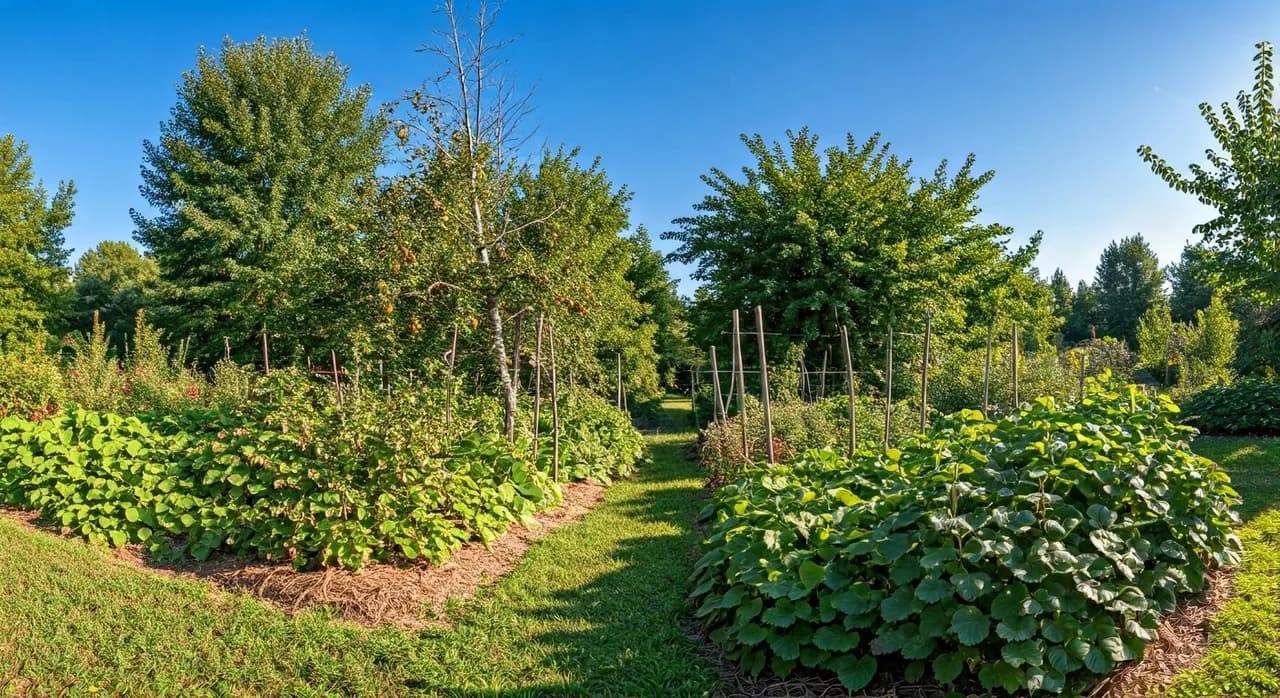
- Incorporate the food forest's layers: canopy, understory, shrub, herbaceous, groundcover, rhizome, and vertical, to maximize productivity and ecosystem health.
- Select species with proven success in short growing seasons, often 120-150 days, typical of the Upper Midwest and Northern New England.
Quick answer: Designing a food forest for USDA zones 3-5 involves prioritizing cold-hardy species, implementing water management like swales, and layering diverse plants to mimic natural woodlands. Focus on resilient species adapted to short growing seasons and harsh winters for a self-sustaining system.
In regions like northern Minnesota, where winter temperatures can plummet to -40°F, successful food forest design hinges on selecting incredibly resilient plant species. This area, largely within USDA zones 3 and 4, presents unique challenges with its short growing season (sometimes as brief as 120 days) and deep winter freezes. However, with careful planning and species selection, a productive and diverse food forest is entirely achievable, providing food and habitat for decades.
A well-designed food forest mimics the structure of a natural woodland, incorporating multiple layers of edible plants, from towering canopy trees to groundcovers and root crops. This approach, rooted in permaculture principles, focuses on building a self-sustaining system that requires minimal external inputs over its 30-50 year lifespan. By understanding your specific site conditions and the hardiness requirements of plants, you can cultivate a thriving edible landscape even in the coldest parts of the US [3].
Understanding the cold climate challenge in zones 3-5
The Northeast and Upper Midwest, particularly USDA zones 3, 4, and 5, face distinct climatic hurdles for perennial food systems. These include harsh winters with average minimum temperatures ranging from -40°F to -20°F, short growing seasons often lasting only 120 to 150 days, and significant snowfall. For instance, parts of northern Maine in Zone 3 can see ground freezes extending 4-6 feet deep, making root protection a critical consideration for young plants. Selecting plants rated for at least one zone colder than your site’s average minimum is a sound strategy to build resilience.
selecting cold-hardy species for resilience
When planning a food forest in these colder zones, hardiness is paramount. Many common fruit and nut trees thrive in warmer climates but will not survive the -30°F nights typical of a Zone 4 winter. Focus on native or naturalized species that have adapted to these conditions over centuries. For example, the American hazelnut (Corylus americana) is reliably hardy to Zone 3, producing nuts even after severe winters. Similarly, Nanking cherry (Prunus tomentosa), a shrub, can withstand temperatures down to -35°F and offers early-season fruit. Consider species with a proven track record in your specific region, such as those historically grown by early settlers or found in local nurseries that specialize in cold-hardy stock.
- Assess your microclimates: Identify warmer spots near buildings or south-facing slopes, which can effectively be a half-zone warmer.
- Choose species rated for your zone: Select plants that can survive the average annual minimum temperature for your specific USDA zone.
- Consider late spring frosts: Opt for varieties that flower later to avoid damage from unexpected cold snaps, common in May in Zone 5.
- Protect young plants: Use mulch, snow, or temporary covers to insulate roots and trunks during their first 2-3 winters.
- Source locally: Nurseries in your region often stock varieties already proven in local conditions, which improves your odds of establishment.
Foundation species: trees and shrubs for the canopy and understory
The backbone of any food forest is its woody perennial layer, providing the main harvest, structure, and long-term resilience. For USDA zones 3-5, selecting the right trees and shrubs is critical. Serviceberry (Amelanchier species), also known as Juneberry, is an excellent choice, hardy to Zone 2 and producing sweet berries in early summer. Pawpaw (Asimina triloba), while typically Zone 5, has cold-hardy cultivars that can thrive in protected Zone 4 locations, offering unique tropical-like fruit. For nuts, the American hazelnut (Corylus americana) is a standout, hardy to Zone 3 and producing abundant, small nuts. You can find more options at Best Cold-Hardy Fruit and Nut Trees for USDA Zones 4-6.
nitrogen fixers and dynamic accumulators
Beyond direct food production, certain trees and shrubs play vital support roles. Nitrogen-fixing plants, like Siberian peashrub (Caragana arborescens), hardy to Zone 2, convert atmospheric nitrogen into a form other plants can use. It self-seeds freely and is listed as invasive or watch-listed across parts of the upper Midwest and northern prairies, so check your state noxious weed list before planting it, and cut the pods off before they shed if you do. Autumn olive (Elaeagnus umbellata) is often promoted as a nitrogen fixer, but agripure does not recommend planting it. It is bird-dispersed, invades old fields and forest edges across the Northeast and Midwest, and its sale, transport or planting is prohibited or restricted in a number of states in exactly the region this article covers. Check your state noxious weed and prohibited plant lists before buying any Elaeagnus. Dynamic accumulators such as comfrey - buy it as Bocking 14, a sterile cultivar of Russian comfrey (Symphytum x uplandicum), not seed-setting common comfrey (Symphytum officinale) - draw up minerals from deeper soil layers, returning them to the topsoil when the leaves are cut and dropped as mulch. Comfrey contains hepatotoxic pyrrolizidine alkaloids, so it is mulch only, never food or fodder. These support species are important for building a self-fertile and resilient ecosystem. More information on these can be found at The Best Nitrogen-Fixing Trees for Every USDA Zone.
- American Hazelnut (Corylus americana): Zone 3, produces nuts, excellent for wildlife forage.
- Serviceberry (Amelanchier spp.): Zone 2, early summer berries, ornamental value.
- Siberian Peashrub (Caragana arborescens): Zone 2, nitrogen fixer, windbreak; self-seeds readily - check state noxious weed lists.
- Nanking Cherry (Prunus tomentosa): Zone 2, tart cherries, hardy shrub, often grows 6-10 feet tall.
- Elderberry (Sambucus canadensis): Zone 3, berries for jams/wine, fast-growing, grows 5-12 feet tall.
Understory and groundcover layers: maximizing vertical space
A food forest’s productivity is dramatically increased by utilizing all seven layers: canopy, understory, shrub, herbaceous, groundcover, rhizome (root), and vertical (climbers). In zones 3-5, the understory and groundcover layers are critical for maximizing yield in a limited growing season. For the shrub layer, consider currants (Ribes spp.) and gooseberries (Ribes uva-crispa), many varieties of which are hardy to Zone 3 and produce abundant fruit. Some states and counties in the Northeast still restrict Ribes planting or require a permit because of white pine blister rust, and the rules vary locally, so check with your state agriculture department and choose a rust-immune cultivar. For the herbaceous layer, perennial vegetables like rhubarb (Rheum rhabarbarum) and asparagus (Asparagus officinalis) are excellent choices, reliably returning each spring even after -30°F winters. These can provide a harvest for 15-20 years from a single planting.
designing plant guilds for synergy
Plant guilds are communities of plants that support each other, mimicking natural forest dynamics. A typical guild might feature a central fruit tree, surrounded by nitrogen fixers like Siberian peashrub, dynamic accumulators like comfrey, pest deterrents such as garlic chives (hardy to Zone 3), and groundcovers like wild strawberry (Fragaria virginiana). This arrangement improves resilience and reduces the inputs any single tree needs. For example, a guild around an apple tree (hardy to Zone 3-4 depending on cultivar) might include a nitrogen-fixing shrub 3-5 feet away, comfrey at its drip line, and creeping thyme as a groundcover. This thoughtful placement reduces competition and improves nutrient cycling. More on this topic can be found at A permaculture garden plan: zones, guilds, and a first-year layout.
- Currants and Gooseberries (Ribes spp.): Zone 3, various berry colors, thrive in partial shade.
- Rhubarb (Rheum rhabarbarum): Zone 3, perennial stalks for pies, grows 2-3 feet tall.
- Asparagus (Asparagus officinalis): Zone 3, perennial spears, can produce for 20+ years.
- Wild Strawberry (Fragaria virginiana): Zone 3, edible groundcover, spreads readily.
- Garlic Chives (Allium tuberosum): Zone 3, perennial herb, pest deterrent, edible flowers.
Permaculture principles in practice: swales and zones
Effective water management matters, especially in regions with distinct wet and dry periods, or heavy spring snowmelt. Swales, level ditches dug along contour lines with an earth berm on the downhill side, are excellent for capturing and infiltrating rainwater. In the Northeast and Upper Midwest, where annual rainfall can range from 30 to 45 inches, swales can significantly reduce runoff and increase soil moisture, holding meaningful volumes of water after a heavy rain, with the exact amount set by the swale cross-section and the area draining into it. This stored water then slowly seeps into the soil, benefiting plants downslope, easing irrigation needs in drier periods. They are particularly useful on slopes greater than 5% to prevent erosion.
designing with permaculture zones
Permaculture zoning organizes your landscape based on frequency of human interaction and intensity of management. Zone 1 is closest to your home, reserved for plants needing daily attention, like culinary herbs (e.g., chives, parsley) or annual vegetables. Zone 2, slightly further out, might contain perennial vegetables, small fruit bushes, and chickens, requiring weekly visits. Zone 3 is for staple crops, orchards, and larger animals, needing less frequent attention—perhaps monthly. Zone 4 is for managed woodland, timber, or larger foraging animals, visited a few times a year. Zone 5 is the wild, unmanaged area, observed for learning and occasional foraging, representing 10-20% of a larger property. This systematic approach ensures that the resources you use most often are easily accessible, saving time and energy over the 20-30 year life of a food forest [2]. For more on design, see Permaculture design: how to read a site before you plant it.
- Zone 1: Kitchen garden, frequently used herbs (e.g., mint, thyme), small annuals, located within 10 feet of the house.
- Zone 2: Berry bushes (e.g., raspberries, blueberries), perennial vegetables, small fruit trees, requiring weekly care, 10-50 feet from home.
- Zone 3: Main orchard, nut trees, larger garden beds, requiring monthly maintenance, 50-200 feet from home.
- Zone 4: Managed forest, fodder trees (Best Fodder Trees and Shrubs for Livestock), timber, visited seasonally. If animals browse this zone, keep them away from cherry and plum prunings - wilted or frost-damaged Prunus foliage releases cyanide and has killed cattle, sheep and horses within hours.
- Zone 5: Wild area, for observation and minimal intervention, typically 10-20% of a larger property.
Deer and pest management in cold climates
Deer pressure can be significant in the Northeast and Upper Midwest, with populations often exceeding 20-30 deer per square mile in many rural areas. While no plant is truly deer-proof, strategic planting and physical barriers are essential. For young trees, tree tubes offer protection for the first 3-5 years, allowing the trunk to harden. A sturdy 8-foot fence is the most reliable long-term solution for excluding deer from a dedicated orchard or garden area, a significant investment but one that protects years of effort. For smaller areas, electric fences with 2-3 strands can be effective, maintained at 30-40 inches high.
integrating pest-resistant plants and beneficials
Beyond physical barriers, integrating plants that deer tend to avoid can be helpful. Many aromatic herbs like mint (Mentha spp.) and garlic chives (Allium tuberosum), both hardy to Zone 3, are generally less appealing to deer. Some plants, like Siberian peashrub, are also less palatable. Encouraging beneficial insects by planting flowering herbs and native wildflowers helps keep common insect pests in check. For example, dill and fennel attract predatory wasps that control aphids. A diverse food forest with many plant species is inherently more resilient to pest outbreaks than a monoculture, generally suffering less severe outbreaks. For more detailed information, consult Deer resistant plants: a selection guide that admits no plant is truly deer-proof.
- Install an 8-foot fence: The most effective barrier for deer, lasting 15-20 years with proper maintenance.
- Use tree tubes: Protect young tree trunks from deer rub and rodent damage for 3-5 years.
- Plant deer-resistant species: Incorporate plants like mint, garlic chives, or Siberian peashrub around more vulnerable species.
- Encourage beneficial insects: Plant dill, fennel, and yarrow to attract predators that control common garden pests.
- Rotate annual crops: If including annuals, rotate them every 2-3 years to interrupt pest cycles and maintain soil health.
Cold-Hardy Edible Trees and Shrubs for USDA Zones 3-5
Plant Name | USDA Hardiness Zone | Primary Yield | Mature Height (feet) | Notes |
|---|---|---|---|---|
American Hazelnut (Corylus americana) | 3-8 | Nuts | 8-15 | Excellent for wildlife; suckers into a thicket unless managed |
Serviceberry (Amelanchier spp.) | 2-8 | Berries | 15-25 | Early summer fruit, ornamental |
Nanking Cherry (Prunus tomentosa) | 2-7 | Cherries | 6-10 | Tart fruit, hardy shrub, early bloomer |
Siberian Peashrub (Caragana arborescens) | 2-7 | Seeds, Fodder | 10-15 | Nitrogen fixer, windbreak; self-seeds readily, so check state noxious weed lists |
Elderberry (Sambucus canadensis) | 3-9 | Berries | 5-12 | Fast-growing, good for jams and wine |
Winter Hardiness: In USDA Zone 3, average minimum winter temperatures can drop to -40°F, requiring plants with extreme cold tolerance.
Growing Season Length: The Northeast and Upper Midwest often have short growing seasons, typically 120-150 days, necessitating fast-maturing or early-producing varieties.
Frequently asked questions
What are the best fruit trees for USDA Zone 3?
For USDA Zone 3, excellent fruit tree choices include specific cultivars of apple (e.g., ‘Honeycrisp’, ‘Haralson’), cold-hardy pears, and various plum varieties like ‘Superior’. Serviceberry (Amelanchier species) is also a reliable producer of sweet berries, hardy down to Zone 2, making it a very safe bet.
How do I protect young trees from harsh winters in Zone 4?
To protect young trees in Zone 4, where temperatures can reach -30°F, apply a thick layer of mulch (4-6 inches) around the base to insulate roots. Use tree tubes or burlap wraps on trunks for the first 3-5 years to prevent sunscald and rodent damage, which can be significant in winter.
What is a plant guild, and why is it important for a food forest?
A plant guild is a group of plants that grow well together, supporting each other’s health and productivity. It’s important because it mimics natural ecosystems, improving soil fertility, deterring pests, and increasing overall yields through synergistic relationships, such as nitrogen fixers feeding nearby fruit trees.
Can I grow pawpaws in the Upper Midwest (Zone 4)?
While pawpaws (Asimina triloba) are typically rated for USDA Zone 5, some cold-hardy cultivars like ‘NC-1’ or ‘Shenandoah’ can survive in protected Zone 4 microclimates, especially if planted on a south-facing slope or near a building. They need at least 150 frost-free days plus real summer heat to ripen fruit, which sits at the very top of the 120 to 150 day season typical of zones 3 and 4. Treat pawpaw as an experiment in a warm microclimate there, not a reliable crop.
How much space does a typical food forest require?
A food forest can be scaled to fit various spaces, from a small backyard plot of 500 square feet to several acres. Even a 20×20 foot area can host 2-3 canopy trees, 5-7 shrubs, and dozens of understory plants, providing a significant amount of food and habitat over its 30-year lifespan.
What are swales, and how do they benefit a food forest?
Swales are level ditches dug along contour lines with an earth berm on the downhill side, designed to capture and slowly infiltrate rainwater into the soil. In a food forest, they reduce runoff by 30-50%, increase soil moisture for plants, and help prevent erosion, especially on slopes greater than 5%.
References
- forest trees (woody plants) (2019). forest trees (woody plants).
- Forest ecology: Three trillion trees (2015). Forest ecology: Three trillion trees.
- Index of Plants and Trees (2021). Index of Plants and Trees.
- Is forest certification working on the ground? Forest managers perspectives from the northeast U.S. (2022). Is forest certification working on the ground? Forest managers perspectives from the northeast U.S..
- Annual wholesale catalogue of Forest City Nurseries for 1904 : hardy evergreens, deciduous trees, shrubs and vines, hardy herbaceous flowering plants, seed of A (1904). Annual wholesale catalogue of Forest City Nurseries for 1904 : hardy evergreens, deciduous trees, shrubs and vines, hardy herbaceous flowering plants, seed of A.