Key takeaways
- Plan succession plantings with heat-tolerant varieties like okra and sweet potatoes, especially for USDA zones 7-10.
- Implement robust soil management, including 4-6 inches of organic mulch and targeted drip irrigation, to cut evaporation losses.
- Utilize shade cloth providing 30-50% blockage to protect tender plants from intense afternoon sun, particularly from 10 am to 4 pm.
- Rotate crops regularly, following a 3-4 year cycle, to interrupt pest and disease cycles and maintain soil fertility.
- Monitor plant health closely during heatwaves, scouting for pests every two weeks, as stressed plants are more susceptible.
- Time plantings carefully, aiming for early spring or late summer starts in regions experiencing 95°F+ summer temperatures.
Quick answer: To manage succession plantings in hot climates like USDA Zone 8 during heatwaves, select heat-tolerant varieties, implement robust soil management with mulch and drip irrigation, utilize shade cloth, and rotate crops regularly to maintain continuous harvests.
In regions like central Texas or southern Arizona, where summer temperatures can regularly exceed 100°F for weeks, maintaining a productive garden through succession planting presents a unique challenge. Gardeners in USDA zones 7 through 10 often find their carefully planned planting schedules interrupted by intense heat, which can halt germination, stress young plants, and cause mature crops to bolt prematurely. This article offers practical, data-driven strategies to keep your garden thriving, ensuring continuous harvests even when the mercury climbs.
Successful succession planting during a Southern or Southwestern heatwave requires more than just choosing the right seeds; it demands a comprehensive approach to soil health, water management, and strategic timing. By understanding how high temperatures affect plant physiology and soil ecosystems, growers can implement effective measures to mitigate heat stress, support vigorous growth, and extend their harvest windows well into the late season. We will explore methods that have proven effective across various hot climates, from the humid Gulf Coast to the arid Sonoran Desert.
Understanding succession planting and crop rotation in hot climates
These takeaways points carry into this section, too.
Succession planting is the practice of making several small plantings of the same crop, or different crops, in sequence over time, rather than planting the entire crop at once. This strategy ensures a continuous harvest throughout the growing season, preventing gluts and maintaining fresh produce. For instance, planting a new row of bush beans every two to three weeks can provide a steady supply. In hot climates, this also means staggering plantings to avoid the peak heat, often aiming for early spring or late summer starts in USDA zone 9, where summer temperatures can reach 105°F.
the role of crop rotation in soil health
Crop rotation, a complementary practice, involves planting different crops in a specific area over several seasons, typically following a 3-4 year cycle. This method is crucial for maintaining soil health, breaking pest cycles, and managing nutrient levels. For example, rotating nitrogen-fixing legumes like cowpeas after heavy feeders such as corn can significantly improve soil fertility for the next crop.
- Prevents nutrient depletion in specific soil layers.
- Reduces the buildup of soil-borne diseases and pests.
- Improves soil structure and organic matter content.
- Optimizes the use of available soil nutrients over time.
- Supports beneficial microbial populations in the soil.
Choosing resilient crops and varieties for heat
That work on understanding succession planting sets up what follows here.
When planning succession plantings in areas prone to 95°F+ heatwaves, selecting the right crops and varieties is paramount. Some vegetables, like lettuce and spinach, quickly bolt and become bitter in high temperatures, while others thrive. Okra, a staple in Southern gardens, can produce prolifically even when temperatures consistently exceed 90°F. Similarly, sweet potatoes, a warm-season crop, flourish in extended periods of heat, typically producing a few pounds of storage roots per plant. Consider varieties specifically bred for heat-tolerant performance and bolting resistance.
heat-tolerant options for continuous harvest
For continuous harvests, focus on crops that have a longer window of productivity in heat or can be quickly replanted. Southern peas (cowpeas), for example, mature in 60-70 days and can be succession planted every 3-4 weeks from late spring through late summer in USDA zone 8. Many varieties of corn, particularly those with a 70-80 day maturity, can also be planted in stages — but time the stages so tasselling and silking miss the peak. Corn pollen loses viability and silks dry out above roughly 95°F, so a block that flowers during a 100°F stretch sets poorly however well it is watered. Look for seed packets that specify heat tolerance or a shorter maturity period, allowing you to fit more cycles into the growing season. This approach helps maintain a steady supply of fresh produce, even when the thermometer hits 100°F.
- Okra (e.g., ‘Clemson Spineless’)
- Sweet Potatoes (e.g., ‘Beauregard’)
- Southern Peas (e.g., ‘California Blackeye No. 5’)
- Eggplant (e.g., ‘Black Beauty’)
- Malabar Spinach (a heat-loving alternative to traditional spinach)
Soil and water management during heatwaves
This builds directly on choosing resilient crops.
Effective soil and water management are critical for plant survival and productivity during Southern and Southwestern heatwaves, where soil temperatures can reach 120°F at the surface. Applying a thick layer of organic mulch, 4-6 inches deep, is one of the most effective strategies. Pull it back from the row before each new succession sowing so seedlings can emerge, and keep it off plant stems to avoid collar rot. This layer insulates the soil, keeping root zones up to 10-15°F cooler, suppresses weeds that compete for water, and reduces evaporation loss by 25-30%. Materials like straw, wood chips, or shredded leaves work well. For more on soil health, consider exploring living mulches and cover crops.
efficient irrigation techniques
During periods of extreme heat, plants require consistent moisture, but overwatering can be detrimental. Drip irrigation or soaker hoses deliver water directly to the root zone, minimizing waste and preventing fungal diseases on foliage. Watering deeply and infrequently, typically 1-2 inches of water per week, encourages roots to grow deeper, making plants more resilient to dry spells. Watering early in the morning, before 8 am, allows plants to absorb moisture before the sun’s intensity increases, reducing immediate evaporation. Monitoring soil moisture with a simple probe can help ensure plants receive adequate water without saturation, especially in sandy soils typical of parts of Arizona and New Mexico.
- Apply 4-6 inches of organic mulch (straw, wood chips).
- Utilize drip irrigation or soaker hoses for targeted watering.
- Water deeply and infrequently, aiming for 1-2 inches per week.
- Water in the early morning to minimize evaporation.
- Incorporate compost to improve soil water retention by up to 20%.
Timing and shading strategies for plant protection
Those soil and water habits matter here as well.
Strategic timing of plantings is crucial for succession gardening in hot climates. In USDA zone 9, for example, cool-season crops like kale can be planted in early spring for a harvest before June, and again in late summer for a fall harvest, avoiding the 90-day period of peak summer heat. Warm-season crops can be planted in early spring for an early summer harvest or mid-summer for a late fall harvest. Knowing your local average first and last frost dates, and the duration of typical heatwaves (e.g., 30 consecutive days above 95°F), helps in planning these succession intervals.
utilizing shade cloth and microclimates
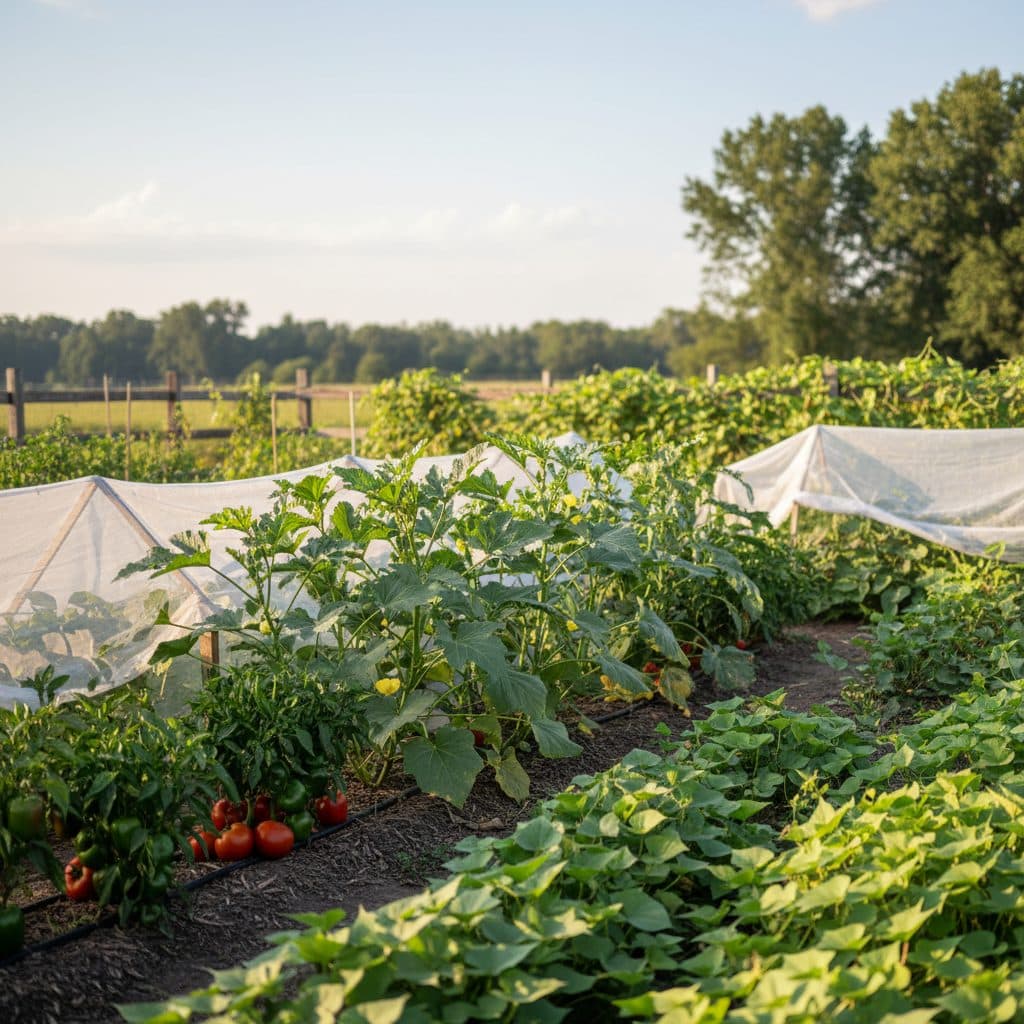
When temperatures consistently exceed 90°F, even heat-tolerant plants can benefit from protection. Shade cloth, typically providing 30-50% shade, can significantly reduce leaf temperatures and prevent sunscald, especially for fruiting vegetables like tomatoes and peppers. Erecting temporary shade structures from 10 am to 4 pm, when solar radiation is most intense, sharply lowers leaf and soil surface temperatures. Air temperature under the cloth drops far less — usually only a few degrees — so shade protects the plant by cutting radiant load, not by cooling the air. This is particularly useful in arid regions like Arizona, where intense solar radiation is a primary stressor for garden plants. Creating microclimates using taller plants as living shade for shorter, more sensitive crops is another effective strategy. For more options, explore drought-tolerant trees and shrubs that can serve as natural shade.
- Use 30-50% shade cloth for sensitive crops.
- Erect temporary shade structures from 10 am to 4 pm.
- Plant taller crops (e.g., corn, sunflowers) to shade shorter ones.
- Utilize existing structures (fences, buildings) for afternoon shade.
- Consider planting on the east side of a structure for morning sun, afternoon shade.
Pest and disease management in stressed plants
These timing and shading lessons apply to the steps below, too.
Heat stress significantly weakens plants, making them more susceptible to pests and diseases. A plant struggling to cope with 100°F temperatures will have reduced natural defenses, inviting opportunistic invaders. For example, spider mites thrive in hot, dry conditions and can rapidly decimate stressed vegetable crops within a week. Regular scouting, at least every two weeks, is essential to catch problems early. Look for signs of wilting, discoloration, or insect activity on the undersides of leaves, especially during periods of prolonged heat in USDA zone 8.
integrated pest management (IPM) strategies
Implementing an Integrated Pest Management (IPM) approach is crucial. This involves a combination of cultural practices, biological controls, and judicious use of organic pesticides as a last resort. Crop rotation, as discussed earlier, is a foundational IPM strategy that interrupts pest life cycles by moving host plants to different locations each year. Encouraging beneficial insects like ladybugs and lacewings, which prey on aphids and other soft-bodied pests, can be achieved by planting flowering herbs and native plants nearby. For example, dill and cilantro flowers attract a variety of beneficials. Maintaining good garden hygiene, removing plant debris, and ensuring proper plant spacing for air circulation also contribute to a healthier, more resilient garden, reducing how often you need to reach for a spray.
- Scout plants every two weeks for early pest detection.
- Practice crop rotation to interrupt pest and disease cycles.
- Encourage beneficial insects by planting diverse flowers.
- Maintain good garden hygiene, removing diseased plant material.
- Use organic pest controls only when necessary, and check the temperature before you spray. Neem and horticultural oils cause phytotoxic leaf burn above roughly 90°F or in direct sun — most labels say so explicitly — so during a heatwave wait for a cool, overcast morning rather than oiling heat-stressed foliage.
Heat-Tolerant vs. Heat-Sensitive Crop Performance in 95°F+ Conditions
Crop Type | Heat Tolerance | Typical Response to 95°F+ | Succession Planting Strategy |
|---|---|---|---|
Okra | High | Thrives, continuous production for 60-90 days. | Plant every 3-4 weeks from late spring through mid-summer. |
Sweet Potato | High | Vigorous growth, large tuber development. | Single planting in late spring for fall harvest. |
Southern Peas | Medium-High | Good production for 60-70 days. | Plant every 3-4 weeks from late spring to late summer. |
Tomato (Heat-Set Varieties) | Medium | Reduced fruit set, possible sunscald. | Plant early spring and late summer; provide 30% shade. |
Lettuce | Low | Bolts rapidly, leaves become bitter in 75°F+. | Plant only in early spring or late fall; use 50% shade. |
Spinach | Low | Bolts quickly, becomes inedible in 75°F+. | Plant only in early spring or late fall; consider Malabar spinach for summer. |
Mulch Benefits: A 4-6 inch layer of organic mulch can reduce soil surface temperatures by 10-15°F and conserve up to 30% more soil moisture during heatwaves.
Shade Cloth Impact: Using 30-50% shade cloth substantially lowers leaf and soil surface temperatures and prevents sunscald on sensitive crops during peak sun hours (10 am-4 pm), though it changes the air temperature only slightly.
Frequently asked questions
What is the primary goal of succession planting during a heatwave?
The primary goal is to ensure a continuous harvest of vegetables by staggering plantings and selecting heat-tolerant varieties. This strategy helps avoid crop loss from extreme temperatures, which can exceed 100°F for weeks in Southern regions, and keeps your garden productive.
How much mulch should I use to protect plants from heat?
For effective heat protection and moisture retention, apply a layer of organic mulch 4-6 inches deep around your plants. This can reduce soil temperatures by 10-15°F and cut water evaporation by up to 30%.
When is the best time to water plants during a heatwave?
The best time to water plants during a heatwave is early in the morning, typically before 8 am. This allows the plants to absorb the water before the intense sun causes significant evaporation, ensuring more of the 1-2 inches of water applied each week reaches the roots.
What type of shade cloth is recommended for summer heat?
For most vegetable gardens in Southern and Southwestern heatwaves, a shade cloth with 30-50% blockage is recommended. This level of shade can reduce plant stress and prevent sunscald without excessively limiting sunlight for fruit development, especially when temperatures are above 95°F.
How does crop rotation help with heatwave gardening?
Crop rotation helps by breaking pest and disease cycles that can be exacerbated by heat-stressed plants, improving soil health, and ensuring nutrient availability. A typical 3-4 year rotation cycle can significantly reduce the buildup of soil-borne pathogens and insect populations.
Which specific crops are best for succession planting in 100°F+ heat?
For succession planting in 100°F+ heat, focus on crops like okra, sweet potatoes, southern peas, and certain varieties of eggplant. These crops are known for their high heat tolerance and can continue to produce well even when temperatures consistently exceed 90°F.
References
- USDA Natural Resources Conservation Service (2024). USDA Natural Resources Conservation Service.