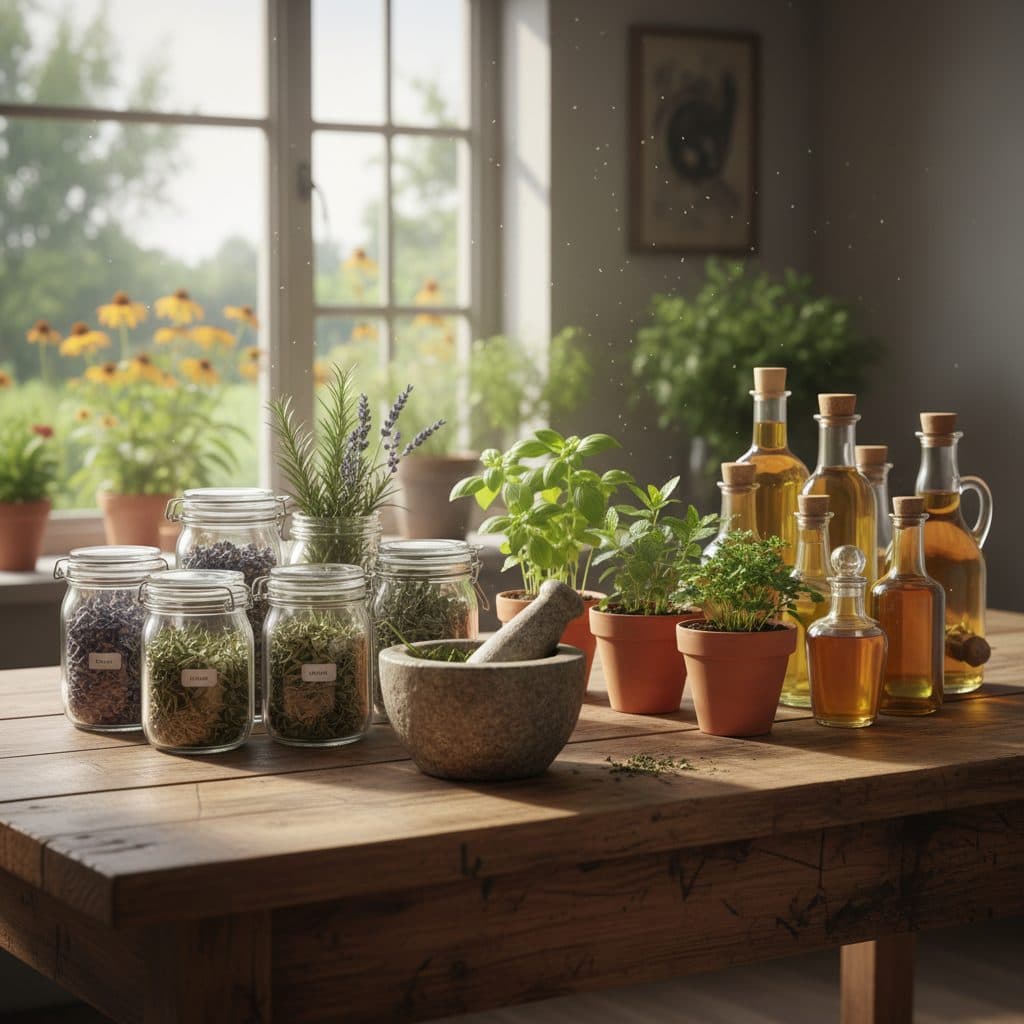
Key takeaways
- Cultivating a home medicinal herb garden, even a small 4 ft x 4 ft plot, provides fresh, potent ingredients for remedies.
- Infused honeys, like those with thyme or sage, offer soothing properties for coughs and sore throats, with a shelf life of up to one year.
- Herbal oils, prepared with carrier oils and herbs like calendula, are effective for topical skin support and can last for 6-12 months.
- Homemade herbal syrups, using bases like vegetable glycerin or honey, can be tailored for specific ailments and stored for several weeks in a refrigerator.
- Proper harvesting, drying, and storage methods are important for keeping medicinal herbs potent for up to 24 months.
- Always ensure cleanliness in preparation to avoid microbial contamination, a concern highlighted in studies of traditional remedies [1].
Quick answer: Cultivating a medicinal herb garden in USDA Zone 6 allows for crafting effective home remedies like infused honeys, oils, and syrups. Proper harvesting and preparation ensure potency and safety for family wellness.
Across the United States, from the humid summers of USDA zone 7 in the Southeast to the cooler climates of zone 5 in the Midwest, many growers are rediscovering the value of a home apothecary. Cultivating medicinal herbs in your own garden provides a direct connection to the plants that can support your family’s wellness. With just a few square feet of dedicated space, perhaps a 4 ft by 8 ft raised bed, you can grow a significant portion of the botanicals needed for various home remedies.
This practice also connects you to the provenance and quality of your ingredients. For instance, a well-maintained patch of peppermint (Mentha x piperita) in a sunny spot can yield several pounds of fresh leaves annually, enough for numerous batches of infused oils and syrups. Learning to transform these garden treasures into infused honeys, oils, syrups, and cough remedies offers a practical skill set, grounded in centuries of botanical knowledge and supported by modern understanding of plant compounds.
Cultivating your home apothecary: foundational herbs
Establishing a medicinal herb garden is the first step toward a functional home apothecary. In many regions, such as USDA zone 6, common herbs like garden sage (Salvia officinalis) and thyme (Thymus vulgaris) thrive with minimal intervention, preferring full sun — at least six hours daily — and well-drained soil. A soil pH between 6.0 and 7.0 is ideal for most culinary and medicinal herbs, and a simple 3-in-1 soil meter can help you monitor these conditions. For new growers, starting with a few reliable species ensures success and provides a steady supply of fresh material for infusions.
selecting and harvesting potent botanicals
When selecting herbs, consider their specific medicinal properties and growing requirements. For example, elderberry (Sambucus canadensis), a shrub hardy from USDA zones 3 to 9, produces berries and flowers rich in beneficial compounds. Harvesting should occur at peak potency — typically when flowers are fully open or berries are ripe, deep purple, and soft. Drying herbs properly, either by hanging small bundles in a dark, airy room with temperatures around 70°F or using a dehydrator set to 95°F, preserves their volatile oils and active constituents. Store dried herbs in airtight containers away from direct light, where they can maintain potency for up to 24 months.
- Garden Sage (Salvia officinalis): Hardy in USDA zones 4-10, prefers full sun and well-drained soil.
- Thyme (Thymus vulgaris): Thrives in USDA zones 5-9, requires similar conditions to sage.
- Peppermint (Mentha x piperita): Grows vigorously in USDA zones 3-11, often needing containment due to its spreading habit.
- **Calendula (Calendula officinalis):** An annual that self-seeds readily, blooming throughout summer in most zones.
- Mullein (Verbascum thapsus): A biennial, hardy in USDA zones 3-9, with large leaves and tall flower stalks.
Infused honeys: sweetening wellness
These cultivating home apothecary points carry into this section, too.
Herbal infused honeys combine the soothing properties of raw honey with the therapeutic benefits of medicinal herbs. Honey itself, particularly raw, unfiltered varieties, possesses natural antimicrobial qualities and can help coat a sore throat, providing immediate comfort. For a basic infusion, a ratio of one part dried herb to two parts honey by volume often works well. For example, using one cup of dried thyme leaves with two cups of local honey yields a potent remedy. This preparation is particularly popular in regions like the Pacific Northwest, where seasonal allergies and winter colds are common.
crafting and storing your herbal honeys
To make an infused honey, gently warm the honey in a double boiler to about 100°F — never exceeding 115°F to preserve its beneficial enzymes. Add the dried herbs, ensuring they are fully submerged. Let the mixture infuse for two to four weeks in a warm, dark place, stirring daily. After infusion, strain the honey through a fine mesh sieve or cheesecloth, pressing out all the liquid. Store the finished herbal honey in a clean, airtight glass jar at room temperature. Properly prepared, these honeys can last for up to one year, offering a convenient and pleasant way to consume herbal medicine, such as a teaspoon taken three times a day for cough relief.
- Thyme Honey: Excellent for coughs and respiratory congestion, often used in one-teaspoon doses.
- Sage Honey: Soothing for sore throats and can help with inflammation.
- **Ginger Honey:** Warming and supports digestion, useful for nausea and cold symptoms.
- Elderberry Honey: Boosts immune support, especially during cold and flu season.
- **Garlic Honey:** A potent antimicrobial, though its flavor is quite strong.
Herbal oils: topical comfort and care
That work on infused honeys sets up what follows here.
Herbal infused oils serve as excellent bases for salves, balms, and direct topical application, offering localized relief for skin irritations, muscle aches, or minor wounds. The choice of carrier oil significantly impacts the final product; common options include olive oil, almond oil, or jojoba oil, each with distinct absorption rates and shelf lives. For instance, a high-quality olive oil, often found in kitchens across the Midwest, can provide a stable base for an infusion, offering a shelf life of 12-18 months. A typical ratio for infusion is 1:2 or 1:3 dried herb to oil by weight, ensuring the herbs are fully covered.
infusion methods and practical applications
There are two primary methods for infusing oils: the solar method and the gentle heat method. The solar method involves placing dried herbs in a jar, covering them with oil, and allowing the mixture to infuse in a sunny window for four to six weeks, shaking daily. This method is ideal for delicate herbs like calendula (Calendula officinalis) flowers, which are easily grown in USDA zone 5 gardens. For a quicker infusion, the gentle heat method uses a double boiler to warm the oil and herbs to about 120°F for two to four hours. After infusion, strain the oil through cheesecloth, pressing firmly to extract all the beneficial compounds. Store the finished oil in dark glass bottles in a cool, dark place, where it can remain potent for six to twelve months, depending on the carrier oil’s stability.
- Calendula Oil: Soothes irritated skin, promotes wound healing, and is gentle enough for sensitive skin.
- St. John’s Wort Oil: Known for nerve pain relief and anti-inflammatory properties, often used for bruises.
- Arnica Oil: Excellent for muscle soreness, sprains, and bruising, but should not be applied to broken skin.
- **Lavender Oil:** Calming, antiseptic, and promotes relaxation, useful in massage oils.
- Comfrey Oil: Supports bone and tissue repair, but use with caution and on unbroken skin due to pyrrolizidine alkaloids.
Syrups and cough remedies: soothing the system
This builds directly on herbal oils.
Herbal syrups are a classic way to administer medicinal herbs, particularly for coughs, sore throats, and immune support. Their sweet taste makes them palatable, especially for children. A basic syrup involves a strong herbal decoction or infusion combined with a sweetener, typically sugar or honey, at a 1:1 ratio by volume. For example, a potent elderberry syrup can be made by simmering one cup of dried elderberries in four cups of water until reduced by half, yielding about two cups of liquid before adding two cups of honey. Studies, such as one from 2016 in Nigeria, show why hygienic preparation matters to prevent microbial contamination in traditional cough syrups [1].
formulation for efficacy and safety
When formulating herbal cough syrups, consider herbs with expectorant, demulcent, or antitussive properties. Mullein (Verbascum thapsus), a common biennial in many US states, is an excellent demulcent, soothing irritated mucous membranes. For a glycerin-based syrup, a 1:5 herb-to-glycerin ratio by weight can be used, offering a sugar-free alternative. Research is ongoing to develop standardized formulations for herbal cough syrups, with some studies projecting advancements by 2026 in understanding their therapeutic mechanisms [1, 3]. Always store homemade syrups in the refrigerator, where they typically remain potent for two to four weeks. If a preservative like a small amount of brandy (one tablespoon per cup of syrup) is added, the shelf life can extend to several months, though alcohol content should be considered [5].
- Elderberry Syrup: Widely used for immune support and reducing the duration of colds and flu.
- Mullein Leaf Syrup: Soothes coughs, helps clear congestion, and acts as a demulcent.
- Thyme Syrup: An expectorant that helps loosen mucus and relieve spasmodic coughs.
- Wild Cherry Bark Syrup: Traditionally used as a cough suppressant and for respiratory irritation.
- Ginger and Lemon Syrup: Warming, anti-inflammatory, and provides Vitamin C for immune health.
Comparison of Common Herbal Remedy Types
Remedy Type | Primary Use | Typical Shelf Life | Preparation Time |
|---|---|---|---|
Infused Honey | Cough, sore throat, immune support | Up to one year | 4-6 weeks infusion |
Herbal Oil | Topical skin issues, muscle aches | 6-12 months | 2-6 weeks infusion |
Herbal Syrup | Coughs, colds, immune boost | 2-4 weeks (refrigerated) | 2-4 hours active prep |
Herb Potency: Properly dried herbs stored in airtight containers can retain up to 90% of their medicinal potency for 12-24 months.
Honey Temperature: When infusing honey, maintain temperatures below 115°F to preserve beneficial enzymes and antimicrobial properties.
Frequently asked questions
How long do homemade herbal honeys typically last?
Properly prepared herbal infused honeys, stored in airtight containers at room temperature, can last for up to one year. The high sugar content of honey acts as a natural preservative, inhibiting microbial growth, but always check for signs of spoilage if stored longer than 12 months.
What’s the best way to store fresh herbs for later use in remedies?
For optimal potency, fresh herbs should be dried thoroughly before storage. Hanging small bundles in a dark, well-ventilated area at around 70°F or using a dehydrator at 95°F are effective methods. Once completely dry, store them in airtight glass jars away from direct light, where they can maintain quality for up to 24 months.
Can I use fresh herbs for oil infusions instead of dried?
While possible, using fresh herbs for oil infusions significantly increases the risk of spoilage due to their high water content. The water can introduce bacteria and mold, leading to rancidity. It is generally recommended to use thoroughly dried herbs for oil infusions to ensure a stable product with a shelf life of 6-12 months.
What are the safety considerations for making homemade cough syrups?
Cleanliness is paramount when making homemade cough syrups to prevent microbial contamination, as noted in studies on traditional remedies [1]. Use sterilized equipment and ensure ingredients are fresh and of good quality. Store syrups in the refrigerator and discard after two to four weeks, or if any signs of mold or off-smell appear. For children under one year, avoid honey due to the risk of infant botulism.
How much herbal remedy should I take?
Dosage varies significantly based on the herb, the concentration of the remedy, and the individual’s age and health status. For infused honeys, a common adult dose might be one teaspoon three times a day. For topical oils, apply a small amount (e.g., 1/2 teaspoon) to the affected area as needed. Always start with a lower dose and observe your body’s response, especially with new preparations.
References
- Microbiological Quality of Cough Syrups and Herbal Solutions ‘Agbo’ Sold in Makurdi Metropolis of Benue State, Nigeria (2016). Microbiological Quality of Cough Syrups and Herbal Solutions ‘Agbo’ Sold in Makurdi Metropolis of Benue State, Nigeria.
- DEVELOPMENT OF FORMULATIONS AND PRODUCTION TECHNOLOGY FOR HERBAL COUGH SYRUPS (2026). DEVELOPMENT OF FORMULATIONS AND PRODUCTION TECHNOLOGY FOR HERBAL COUGH SYRUPS.
- The Determination of Antibacterial Activities of Herbal-Infused Syrups Recommended for Use as Food Supplements (2025). The Determination of Antibacterial Activities of Herbal-Infused Syrups Recommended for Use as Food Supplements.
- Herbal Cough Syrups: Medicinal Plants, Formulation Approaches, Therapeutic Mechanisms and Recent Advances (2026). Herbal Cough Syrups: Medicinal Plants, Formulation Approaches, Therapeutic Mechanisms and Recent Advances.
- Quantification of Ethanol Content in Traditional Herbal Cough Syrups (2017). Quantification of Ethanol Content in Traditional Herbal Cough Syrups.
- USDA Natural Resources Conservation Service (2024). USDA Natural Resources Conservation Service.