Key takeaways
- Passive ventilation, including ridge vents and roll-up sides, is the primary method for reducing internal temperatures by 10-15°F.
- Strategic shading, using shade cloth or whitewash, can block up to 70% of solar radiation, preventing overheating.
- Evaporative cooling through misting or wet pads can lower temperatures by 5-10°F in dry climates by converting water to vapor.
- Thermal mass materials like water barrels or rock beds absorb heat during the day and release it slowly at night, stabilizing temperatures.
- Proper site selection and orientation can minimize sun exposure and maximize natural airflow, reducing cooling demands by up to 20%.
- Integrating water management, including drip irrigation and rainwater harvesting, supports cooling methods and plant health without grid power.
Quick answer: To cool a greenhouse without electricity, utilize passive ventilation, strategic shading, evaporative cooling, and thermal mass. These methods can reduce internal temperatures by 10-20°F, making summer cultivation possible.
Summer heat can quickly turn a greenhouse or high tunnel into an oven, especially in regions like the high desert of Arizona or the humid plains of Iowa, where daytime temperatures often exceed 90°F. For growers aiming for self-sufficiency or operating far from the grid, relying on electric fans and evaporative coolers isn’t always an option. The goal isn’t just to survive the summer, but to cultivate thriving plants like heat-loving tomatoes or peppers, which can suffer significantly above 85°F.
This article explores practical, electricity-free strategies for cooling your growing space. From passive ventilation to thermal mass and strategic water use, these methods can drop internal temperatures by 10°F to 20°F, making summer cultivation possible even when the sun beats down and the grid is out of reach. We’ll focus on techniques proven to work for homesteaders and small-scale farmers across various US climates, so your plants stay productive.
Mastering passive ventilation for natural airflow
The most fundamental and effective strategy for cooling a greenhouse without electricity is maximizing passive ventilation. This involves designing your structure to allow hot air to escape and cooler air to enter naturally. A high-roof design, for instance, promotes the chimney effect, where warm air rises and exits through ridge vents, drawing in cooler air from lower side vents. Research from 2007 on pepper production in hot-humid conditions showed that high-roof, passively ventilated greenhouses held internal temperatures far closer to outside air than a poorly vented structure manages, keeping conditions workable through peak heat [1].
optimizing vent placement and size
For optimal airflow, your total vent area should ideally be 20% to 30% of your greenhouse floor area. This ratio ensures sufficient air exchange to prevent heat buildup. For example, a 100 square foot greenhouse might need 20 to 30 square feet of combined intake and exhaust vents. Roll-up sides, common on high tunnels, provide excellent cross-ventilation, especially when paired with ridge vents or gable-end openings. In a 20 ft by 40 ft high tunnel, rolling up both 20 ft sides by 4 ft high provides 160 square feet of vent area, which is 20% of the 800 square foot floor area. Orienting your greenhouse with its longest side facing the prevailing summer winds can further enhance this natural air movement, reducing internal temperatures by several degrees.
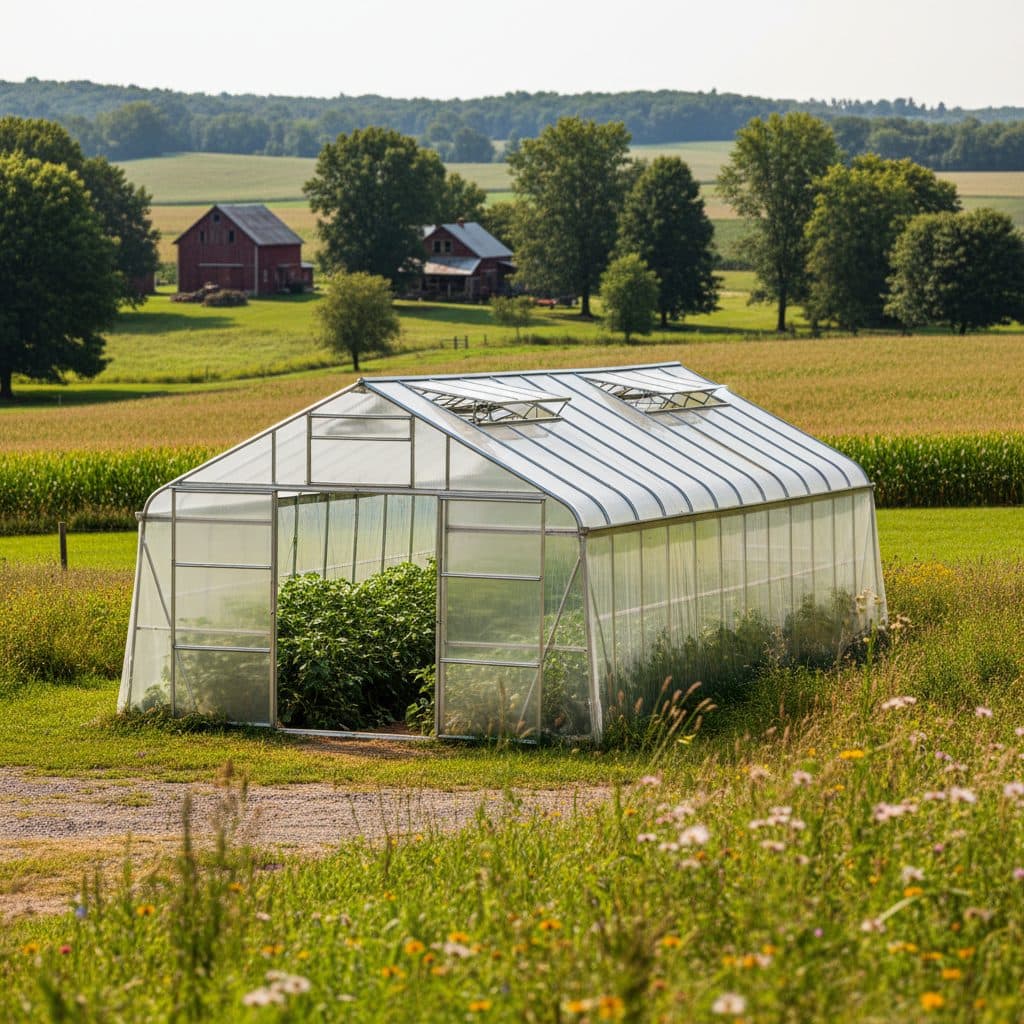
- Ridge vents for hot air exhaust.
- Roll-up sides for lower air intake.
- Gable-end vents for cross-ventilation.
- Insect screens on vents to prevent pest entry, at a real cost in airflow — the finer the mesh, the bigger the loss, so oversize the screened vent area to compensate.
- Automated vent openers that use a heat-sensitive wax cylinder, requiring no electricity.
Strategic shading and reflective surfaces
Direct solar radiation is the primary source of heat gain in a greenhouse. Reducing the amount of sunlight entering the structure can significantly lower internal temperatures. Shading can block 30% to 70% of incoming solar radiation, depending on the material and density. For instance, a 50% shade cloth can reduce the temperature inside by 5°F to 10°F on a sunny 90°F day. In regions like USDA zone 8, where summer sun is intense, a 60% shade cloth might be necessary for sensitive crops like lettuce, while tomatoes might tolerate 30% to 40%.
choosing and applying shading materials
Shade cloth, typically made from woven polyethylene, is a common solution. It can be installed externally, which is more effective as it blocks heat before it enters the structure, or internally. External installation can reduce heat gain by an additional 10% compared to internal shading. Another option is whitewash, a mixture of hydrated lime and water, applied directly to the glazing. Hydrated lime is caustic — it burns skin on contact and can cause serious eye injury — so mix and apply it in sealed goggles, gloves, and a dust mask, keep out from under glazing you are coating overhead, and have clean water on hand to flush any splash immediately. Ready-made greenhouse shading compounds do the same job without the hazard. This provides a temporary, reflective coating that can be washed off by fall rains. Shading is the single most effective lever here, because it stops solar gain before it becomes heat inside the structure. For more on off-grid solutions, consider exploring off-grid living strategies.
- External shade cloth: Most effective, blocks heat before entry.
- Internal shade cloth: Easier to install and remove, but less efficient.
- Whitewash: Inexpensive, temporary, and effective reflective coating.
- North-south orientation: Minimizes direct sun exposure on the longest sides during peak summer.
- Deciduous trees: Planted on the south and west sides to provide natural summer shade.
Evaporative cooling with minimal or no electricity
Evaporative cooling works by converting liquid water into water vapor, which absorbs heat from the air. This process can significantly lower temperatures, especially in dry climates like those found in Colorado or Nevada. A simple misting system, using low-pressure nozzles and a gravity-fed water supply, can drop internal temperatures by 5°F to 10°F. For a 200 square foot greenhouse, a few gallons of water per hour can provide substantial cooling. The effectiveness of evaporative cooling is directly related to the relative humidity; it works best when humidity is below 60%.
passive evaporative cooling systems
One common passive method involves wet pads and natural airflow. Water is dripped onto a permeable material, such as excelsior pads or burlap, placed at the air intake vents. As air moves through the wet pads, it picks up water vapor and cools down. This can be achieved with a simple elevated water tank and gravity feed, requiring no electricity. For example, a 55-gallon rain barrel positioned 4 ft above the pads can provide continuous water flow for several hours. This method is particularly useful in arid regions where the wet-bulb temperature is significantly lower than the dry-bulb temperature. Consider how drip irrigation systems can operate without electricity to support such water-intensive cooling methods.
- Misting systems: Low-pressure nozzles connected to a gravity-fed tank.
- Wet pad walls: Air drawn through water-soaked pads.
- Evaporative ponds/troughs: Open water bodies inside or near intake vents.
- Wick systems: Capillary action draws water up to evaporate from porous materials.
- Regular watering of pathways: Cools surfaces and raises humidity — genuinely useful in dry climates, but stop short of leaving leaf surfaces wet, since sustained high humidity in a warm greenhouse drives botrytis, downy mildew, and bacterial leaf spot.
Leveraging thermal mass and earth coupling
Thermal mass refers to materials that can absorb, store, and slowly release heat. This property helps stabilize internal temperatures, preventing extreme swings. During the day, thermal mass absorbs excess heat, keeping the greenhouse cooler. At night, it releases this stored heat, preventing temperatures from dropping too low. Common thermal mass materials include water, concrete, stone, and earth itself. Thermal mass is a long-established way to moderate internal temperatures without mechanical cooling.
integrating thermal mass into your design
Water is an excellent and readily available thermal mass. Large, dark-colored water barrels (e.g., 55-gallon drums) placed inside the greenhouse can absorb thousands of BTUs of heat during the day. For a 200 square foot greenhouse, four to six 55-gallon barrels can significantly dampen temperature fluctuations, potentially reducing daytime peaks by 3°F to 5°F. Earth coupling, such as an earth-bermed greenhouse or a pit greenhouse, uses the stable temperature of the soil to moderate internal conditions. Below 4 ft, soil temperatures remain relatively constant, often around 50°F-60°F in many US regions, providing a natural cooling sink in summer. This can keep a pit greenhouse 10°F to 15°F cooler than an above-ground structure during peak heat.
- Water barrels: Dark-colored drums filled with water.
- Stone or concrete: Walls, floors, or raised beds.
- Earth berming: Piling soil against north, east, and west walls.
- Underground air tubes: Drawing air through buried pipes to cool it.
- Rock beds: Large beds of rocks beneath the growing area to absorb and release heat.
Water management and plant selection
Effective water management is critical for both plant health and passive cooling. While evaporative cooling uses water directly, general watering practices also contribute to a cooler environment. Drip irrigation systems, even those without electricity, deliver water directly to the plant roots, minimizing waste and preventing excess humidity. A well-designed gravity-fed drip system can water a 20 ft by 30 ft growing area using a 200-gallon elevated tank. Healthy, well-hydrated plants transpire more efficiently, releasing water vapor and further cooling the surrounding air by 1°F to 2°F.
optimizing water use and crop choices
Rainwater harvesting is part of off-grid water management. A 1,000 square foot greenhouse roof in a region receiving 30 inches of annual rainfall can collect over 18,000 gallons of water per year, providing ample supply for cooling and irrigation. The USDA Natural Resources Conservation Service provides resources on efficient water use strategies for agricultural settings [6]. Selecting heat-tolerant plant varieties also matters. For example, tomato and pepper varieties bred specifically for high-temperature fruit set — sold as heat-set or heat-tolerant types — will hold fruit at temperatures where standard beefsteaks and bells drop their blossoms. In hot climates like USDA zone 9, consider growing crops like sweet potatoes, okra, or certain varieties of peppers that thrive in high heat, rather than cool-season crops like lettuce or spinach which bolt above 75°F. For more on off-grid power solutions, explore solar panels for off-grid living.
- Drip irrigation: Efficiently delivers water to roots, minimizing evaporation.
- Rainwater harvesting: Collects free water for irrigation and cooling.
- Mulching: Reduces soil temperature and conserves moisture by 20% to 30%.
- Heat-tolerant varieties: Choose crops that thrive in higher temperatures.
- Strategic watering times: Water in the early morning or late evening to minimize heat-induced stress.
Site selection and structural considerations
The initial placement and design of your greenhouse or high tunnel play a significant role in its ability to stay cool without electricity. A well-chosen site can reduce cooling demands by as much as 20%. Consider prevailing summer winds; orienting the longest side of your structure to catch these breezes can significantly improve cross-ventilation. For example, in many parts of the Midwest, prevailing summer winds come from the south or southwest, so a north-south orientation for a long high tunnel can be beneficial.
designing for passive cooling from the start
The type of glazing material also impacts heat gain. While polycarbonate panels offer good insulation, they can trap more heat than single-layer polyethylene film, which allows more heat to radiate out at night. For summer cooling, a single layer of UV-stabilized polyethylene film, especially with a diffused light property, can be more forgiving than rigid panels in very hot climates. The height of your greenhouse is also important; taller structures allow for a greater volume of air, which heats up more slowly, and provide a larger thermal chimney effect. A greenhouse with 10 ft sidewalls and a 12 ft ridge height will generally stay cooler than one with 6 ft sidewalls and an 8 ft ridge, especially in USDA zones 7-9. For those building from scratch, integrating these principles from the start can save considerable effort later. You can find more information on general off-grid building principles at off-grid and hybrid solar systems.
- Prevailing wind orientation: Position structure to maximize natural airflow.
- Glazing material choice: Single-layer poly film for better heat dissipation in summer.
- Structure height: Taller greenhouses allow for more air volume and better chimney effect.
- Thermal break foundation: Prevents heat transfer from the ground into the structure.
- Minimal opaque walls: Reduces heat absorption from solid surfaces.
Comparison of Non-Electric Greenhouse Cooling Methods
Method | Primary Mechanism | Typical Temperature Drop | Best Climate Type | Water Use |
|---|---|---|---|---|
Passive Ventilation | Air exchange (chimney effect, cross-ventilation) | 10-15°F | All climates | None |
Shading | Blocking solar radiation | 5-10°F | All climates, especially sunny | None |
Evaporative Cooling (passive) | Water phase change (liquid to vapor) | 5-10°F | Dry climates (low humidity) | High |
Thermal Mass | Heat absorption and slow release | 3-5°F (stabilization) | All climates (moderates swings) | None (for water barrels) |
Earth Coupling | Ground temperature moderation | 10-15°F (pit greenhouse) | All climates | None |
Ventilation Ratio: Ensure total vent area is 20% to 30% of your greenhouse floor area for effective passive cooling, potentially reducing internal temperatures by 10°F.
Shade Cloth Effectiveness: A 50% external shade cloth can lower greenhouse temperatures by 5-10°F on a 90°F day, blocking significant solar gain.
Water Barrel Capacity: Four 55-gallon water barrels can absorb thousands of BTUs of heat daily, helping to stabilize greenhouse temperatures by 3-5°F.
Frequently asked questions
How much can passive ventilation reduce greenhouse temperatures?
Passive ventilation, especially with high-roof designs and large vent areas, can reduce internal greenhouse temperatures by 10-15°F compared to unventilated structures. Research from 2007 on pepper production demonstrated its effectiveness in hot, humid conditions [1].
What is the best type of shade for a greenhouse without electricity?
External shade cloth, typically 40-70% density, is generally the most effective, as it blocks solar radiation before it enters the greenhouse. Whitewash is another inexpensive option that can reduce light by 20-40%.
Can evaporative cooling work in humid climates?
Evaporative cooling is most effective in dry climates where relative humidity is below 60%. In humid climates, its cooling potential is significantly reduced, often only dropping temperatures by 2-3°F, as the air is already saturated with moisture.
How do thermal mass materials help cool a greenhouse?
Thermal mass materials like water barrels or concrete absorb heat during the day, preventing excessive temperature spikes. They then slowly release this stored heat at night. In winter that is the point; in summer it is the trade-off, because heat-stressed plants need cool nights to recover and to set fruit — so in genuinely hot climates keep summer thermal mass modest and vent aggressively after dark rather than holding the day's heat indoors.
What role does site selection play in cooling a greenhouse?
Proper site selection, considering prevailing winds and sun exposure, can reduce cooling demands by up to 20%. Orienting the longest side of a high tunnel perpendicular to summer winds, for example, maximizes natural cross-ventilation.
Are there specific plants that tolerate hot greenhouse conditions better?
Yes. Okra and sweet potatoes genuinely thrive in high heat, and for tomatoes and peppers you want varieties bred for high-temperature fruit set rather than standard heirlooms or bells. These plants can often tolerate temperatures up to 95°F, whereas cool-season crops may bolt above 75°F.
References
- GREENHOUSE COOLING FOR PRODUCTION OF PEPPERS UNDER HOT-HUMID SUMMER CONDITIONS IN A HIGH-ROOF PASSIVELY-VENTILATED GREENHOUSE (2007). GREENHOUSE COOLING FOR PRODUCTION OF PEPPERS UNDER HOT-HUMID SUMMER CONDITIONS IN A HIGH-ROOF PASSIVELY-VENTILATED GREENHOUSE.
- Thermal performance of buildings. Calculation of internal temperatures of a room in summer without mechanical cooling. Simplified methods (2023). Thermal performance of buildings. Calculation of internal temperatures of a room in summer without mechanical cooling. Simplified methods.
- Thermal performance of buildings. Calculation of internal temperatures of a room in summer without mechanical cooling. Simplified methods (2023). Thermal performance of buildings. Calculation of internal temperatures of a room in summer without mechanical cooling. Simplified methods.
- Thermal performance of buildings. Calculation of internal temperatures of a room in summer without mechanical cooling. Simplified methods (2023). Thermal performance of buildings. Calculation of internal temperatures of a room in summer without mechanical cooling. Simplified methods.
- Performance of Household Heat Pumps for Nighttime Cooling of a Tomato Greenhouse during the Summer (2013). Performance of Household Heat Pumps for Nighttime Cooling of a Tomato Greenhouse during the Summer.
- USDA Natural Resources Conservation Service (2024). USDA Natural Resources Conservation Service.