Key takeaways
- Blueberries thrive in acidic soil, ideally between pH 4.5 and 5.5, which allows proper nutrient uptake.
- Begin with a professional soil test to understand your current pH, organic matter, and nutrient levels.
- Elemental sulfur is the most effective long-term amendment for lowering soil pH, working slowly over several months.
- Sphagnum peat moss can provide an immediate, though temporary, pH drop and improve soil structure.
- Ongoing maintenance includes regular soil testing, acidifying fertilizers, and mulching with pine bark or needles.
- Monitor irrigation water pH, as high-alkaline water can counteract acidification efforts over time.
Quick answer: To acidify soil for blueberries, which thrive at pH 4.5-5.5, start with a professional soil test. Use elemental sulfur for long-term pH reduction and sphagnum peat moss for immediate, temporary effects, along with ongoing maintenance.
In many parts of the United States, from the fertile soils of the Pacific Northwest to the sandy loams of the Southeast, growing blueberries can be a rewarding endeavor. Blueberries require specific soil chemistry to grow well. Unlike many garden vegetables that prefer a neutral pH around 6.5 to 7.0, blueberries demand a significantly more acidic environment, ideally ranging from pH 4.5 to 5.5. Without this specific acidity, they struggle to absorb essential nutrients like iron, leading to stunted growth and poor fruit production.
Achieving and maintaining this precise pH range is often the biggest hurdle for home gardeners. Most native soils in the US, particularly those derived from limestone or in arid regions, tend to be alkaline or neutral, with pH values often above 6.0 or even 7.0. Lowering pH requires diagnosing existing soil, selecting amendments, applying them at tested rates, and monitoring levels over time.
Understanding blueberry soil needs and initial testing
Blueberries are native to environments with naturally acidic soils, often rich in organic matter, such as bogs and woodlands across North America. Their root systems are particularly adapted to absorb nutrients in a pH range of 4.5 to 5.5. When the soil pH rises above 6.0, iron and manganese become less available, leading to a condition called chlorosis, where leaves turn yellow between the veins while the veins remain green. This symptom is a clear indicator that your blueberries are struggling to feed themselves, even if these nutrients are present in the soil. In USDA zone 7 gardens, for instance, where many soils are naturally around pH 6.0, this can be a common issue.
Initial soil testing
Before you add anything to your soil, you need to know what you’re starting with. A laboratory soil test establishes the baseline pH and nutrient levels. You can purchase a a calibrated soil pH or moisture test for a quick reading, but for detailed analysis, send a sample to your local university extension office or a reputable private lab. These labs, often supported by institutions like the USDA, can provide a precise pH reading, along with levels of essential nutrients like phosphorus, potassium, calcium, and magnesium, and even organic matter content [1]. A typical test costs between 15 and 30 dollars and provides results within two to three weeks.
- Current pH: The most vital piece of information for blueberry growers.
- Organic matter content: Impacts soil structure and nutrient retention.
- Nutrient levels: Helps identify existing deficiencies or excesses.
- Cation exchange capacity (CEC): Indicates the soil’s ability to hold nutrients.
- Recommended amendments: Often included with the report, tailored to your goals.
Choosing the right amendments for acidification
Once you have your soil test results, you can select the most appropriate amendments to bring your pH down to the target 4.5-5.5 range. The choice depends on your starting pH, soil type, and how quickly you need to see results. For example, if your soil pH is 6.5 and you aim for 5.0, you’ll need a significant adjustment. The USDA Natural Resources Conservation Service notes that soil texture (sandy, loamy, or clay) influences how much amendment is needed, with clay soils requiring more [1].
Elemental sulfur: the long-term solution
Elemental sulfur (often labeled as ‘soil acidifier’) is the most effective and long-lasting way to lower soil pH. It works by slowly converting to sulfuric acid through microbial action in the soil. This process is gradual, typically taking several months to a year to show its full effect. For every one point you need to lower the pH in a loamy soil, you might apply 1 to 2 pounds of elemental sulfur per 100 square feet. For sandy soils, this might be 0.5 to 1 pound, and for heavy clay soils, it can be 2 to 3 pounds per 100 square feet. These rates assume soil with no free lime. If your soil test reports calcium carbonate, routine on limestone-derived and arid-region soils, the sulfur has to neutralize that lime before it touches the pH, the true requirement can be many times higher, and a raised bed or container is usually the practical answer instead. It’s best applied in the fall or early spring, allowing time for the microbes to work before planting. Always incorporate it into the top 6 to 8 inches of soil.
Sphagnum peat moss: quick but temporary relief
Sphagnum peat moss is another popular choice, particularly for immediate acidification and improving soil structure. It has a naturally low pH, usually around 3.5 to 4.5. When mixed into the soil at a ratio of 30% to 50% by volume, it can provide an instant pH drop. Blueberries root mostly in the top 12 inches, so a wide shallow planting area matters far more than a deep hole. In heavy or slow-draining soil, do not dig a deep peat-filled pit, it becomes a bathtub that holds water and drowns the roots. Build a raised berm or bed instead. Where drainage is genuinely good, mix roughly equal volumes of peat moss and native soil through the top 12 to 18 inches of a 3-foot-wide area. However, peat moss decomposes over time, and its acidifying effect is not as permanent as elemental sulfur. It also improves water retention, which is beneficial for blueberries, as they prefer consistently moist soil, especially in drier regions like parts of California.
- Elemental sulfur: Slow-acting, long-lasting, best for significant pH reduction.
- Sphagnum peat moss: Fast-acting, improves soil structure, temporary effect.
- Composted pine bark: Mildly acidic, good as a mulch and soil amendment.
- Acidifying fertilizers: Provide a minor, ongoing pH reduction (e.g., ammonium sulfate).
- Iron sulfate: Can lower pH and provide iron, but less effective than elemental sulfur for major adjustments.
Maintaining low pH over time
Lowering your soil pH is one thing; keeping it there is another. Soil pH is not static; it naturally tends to revert to its original state due to factors like irrigation water, decomposing organic matter, and mineral composition. Regular monitoring and ongoing adjustments maintain suitable soil for blueberries, especially in areas like Arizona where water sources can be highly alkaline, with pH levels often above 8.0 [5].
Ongoing pH checks and acidifying fertilizers
Plan to retest your soil pH every one to two years. Use a reliable soil test kit or send samples to a lab again. Based on these results, you may need to apply small maintenance doses of elemental sulfur. For instance, if your pH creeps up from 5.0 to 5.8, a light application of 0.5 pounds per 100 square feet might be sufficient. Also, using acidifying fertilizers can help. Ammonium sulfate is the standard choice while soil pH is still above about 5.0, because it acidifies as it nitrifies. Once pH is at or below 5.0, switch to urea, which still supplies ammonium nitrogen but acidifies far less, continuing with ammonium sulfate at that point is how growers push blueberries below pH 4.5. Avoid fertilizers with nitrates, which can raise pH. Many blueberry-specific fertilizers are formulated with a high percentage of ammonium nitrogen to support this.
Mulching and irrigation water management
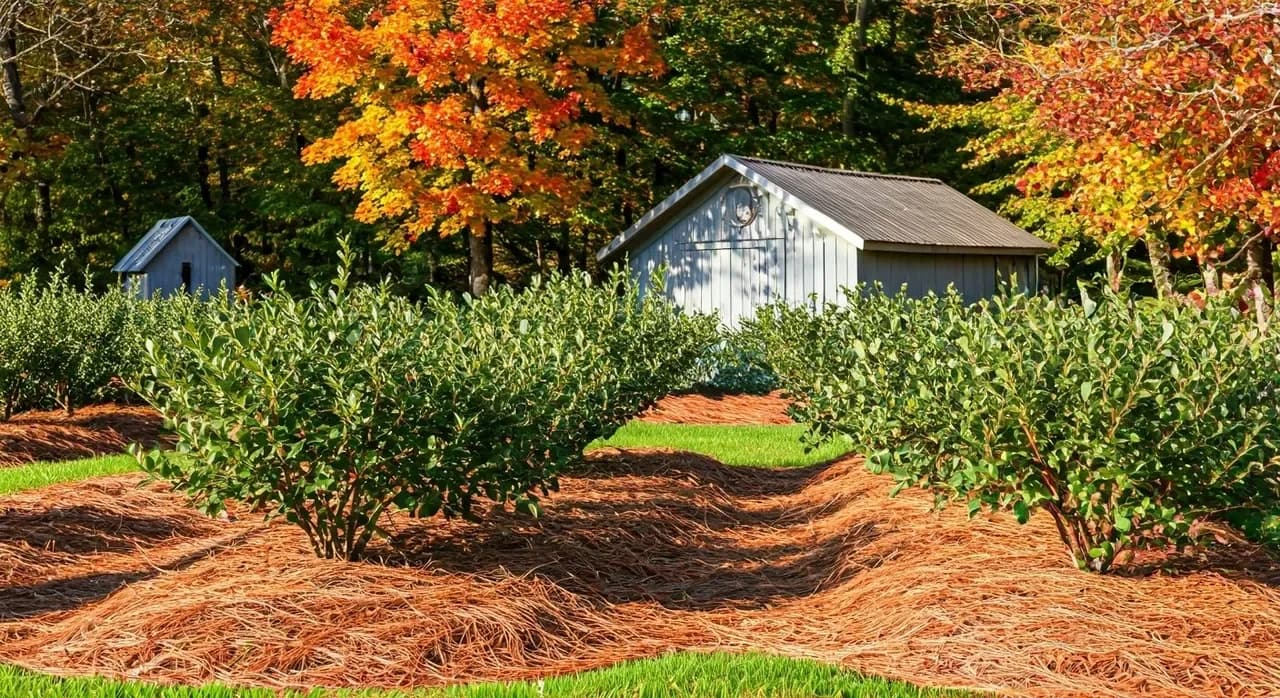
Mulching suppresses weeds, conserves moisture, and can help maintain soil acidity. Pine bark fines and nuggets are genuinely acidic and help hold pH down. Pine needles and oak leaves are useful mulch but only mildly acidic, they will not measurably acidify soil, so treat them as moisture and weed control rather than as an acidifier. Apply a 3 to 4 inch layer around your blueberry plants, keeping it a few inches away from the main stems. Another critical factor is your irrigation water. If your tap water has a high pH (above 7.0), it will slowly counteract your acidification efforts. In some cases, gardeners in regions with very hard water might consider collecting rainwater or installing a filter to acidify their irrigation water before applying it with a Garden PE Irrigation Hose. The EPA’s ‘Soak Up the Rain’ initiative shows the benefits of rainwater harvesting for various garden needs [2].
- Annual soil testing: Essential for monitoring pH and nutrient levels.
- Acidifying fertilizers: Use ammonium sulfate or urea-based formulations.
- Organic mulches: Pine bark helps maintain acidity; pine needles and oak leaves are useful mulch but will not measurably change soil pH.
- Rainwater harvesting: Collect and use rainwater if your tap water is alkaline.
- Avoid lime and wood ash: These materials raise soil pH and should not be used near blueberries.
Common pitfalls and troubleshooting
Even with the best intentions, gardeners can run into issues when trying to cultivate blueberries. One of the most common problems is misinterpreting soil test results or applying amendments incorrectly. Over-acidification, though less common than insufficient acidification, can also occur if too much elemental sulfur is applied too quickly, potentially dropping the pH below 4.0 and harming beneficial soil microbes. Conversely, under-acidification is far more prevalent, especially in regions with naturally high pH soils, like much of the Midwest where pH can easily be 7.0 or higher.
Signs of trouble and solutions
The most telling sign of incorrect pH is leaf chlorosis, particularly interveinal yellowing with green veins. This indicates iron deficiency, a common issue when pH is above 6.0. If you see this, recheck your soil pH immediately. If the pH is too high, apply a small, controlled dose of elemental sulfur (e.g., 0.5 pounds per 100 square feet) and retest in three to four months. Another issue can be poor growth or lack of fruit set, which often points to a broader nutrient imbalance or pH problem. Broad nutrient imbalances and poor soil structure also limit fruit set in perennial crops [4].
Watering and nutrient imbalances
Ensure your blueberries are receiving adequate moisture, especially during fruit development. Blueberries require about 1 inch of water per week, either from rain or irrigation. If soil is too dry, nutrient uptake is hindered regardless of pH. Conversely, waterlogged soil can lead to root rot. Use a Soil Moisture Meter to ensure consistent moisture levels. Beyond pH, occasionally, blueberries might suffer from specific nutrient deficiencies even if the pH is correct. For example, a lack of nitrogen can cause overall pale green or yellow leaves and stunted growth, while phosphorus deficiency might lead to purplish leaves. A comprehensive soil test will help diagnose these issues, and you can then apply specific fertilizers as recommended.
- Interveinal chlorosis: Yellow leaves with green veins, usually indicates high pH and iron deficiency.
- Stunted growth: Can be caused by incorrect pH, nutrient deficiency, or insufficient water.
- Poor fruit set: Results from plant stress caused by unsuitable soil conditions.
- Leaf scorch: Edges of leaves turn brown, indicating water stress or nutrient burn.
- Root rot: Caused by consistently waterlogged soil, leading to wilting and plant death.
Comparison of primary soil acidification amendments
Amendment | Primary benefit | Speed of action | Application rate (approx. per 100 sq ft for 1 pH point drop in loam) |
|---|---|---|---|
Elemental Sulfur | Long-term pH reduction | Slow (3-12 months) | 1-2 pounds |
Sphagnum Peat Moss | Immediate pH reduction, soil structure improvement | Fast (immediate) | Mix 30-50% by volume into planting area |
Iron Sulfate | Quick iron boost; only a minor pH reduction — it takes roughly six times as much iron sulfate as elemental sulfur for the same drop | Medium (weeks) | 0.5-1 pound |
Ammonium Sulfate | Acidifying fertilizer, minor pH reduction | Medium (weeks) | As per fertilizer instructions (e.g., 0.25 pounds) |
Target pH Range: Blueberries thrive best in soil with a pH between 4.5 and 5.5, which is significantly more acidic than most garden plants prefer.
Sulfur Application: To lower loamy soil pH by one point, apply approximately 1 to 2 pounds of elemental sulfur per 100 square feet, allowing several months for full effect.
Understanding soil pH and plant nutrient availability
Soil pH is a measure of its acidity or alkalinity, expressed on a scale from 0 to 14, where 7.0 is neutral. A pH below 7.0 is acidic, and above 7.0 is alkaline. For acid-loving plants, the pH directly impacts their ability to absorb essential nutrients from the soil. For example, iron, manganese, and zinc become less available in alkaline soils, leading to nutrient deficiencies that manifest as yellowing leaves or stunted growth.
Why pH matters for acid-lovers
Blueberries, for instance, are particularly sensitive to high pH because they struggle to absorb iron when the soil pH rises above 5.5. This can lead to chlorosis, where the leaves turn yellow between the veins while the veins remain green. Azaleas, while somewhat more tolerant than blueberries, still show stress in soils above pH 6.0, often exhibiting similar symptoms [4]. Understanding your starting soil pH is the first critical step, usually measured with a simple soil test kit or a 3-in-1 soil pH, moisture, and light meter. A good quality meter, like the a calibrated soil pH or moisture test, can provide immediate readings, though lab tests offer more detailed nutrient profiles.
- Test your soil pH every one to two years to monitor changes.
- Aim for a pH of 4.5 to 5.5 for blueberries in most regions.
- Target a pH of 5.0 to 6.0 for azaleas and rhododendrons.
- Observe plant leaves for signs of nutrient deficiency, such as yellowing.
- Understand that soil pH can vary even within a small garden plot by 0.5 to 1.0 points.
Composting for gradual pH reduction
Composting is a cornerstone of organic gardening, and specific composting practices can help lower soil pH over time. The key is to incorporate a higher proportion of ‘brown’ materials that are inherently acidic or have a high carbon-to-nitrogen ratio, such as pine needles, oak leaves, coffee grounds, and peat moss. A compost pile with a C:N ratio of around 30:1 will decompose efficiently and contribute to soil acidity. For example, adding a 2-inch layer of well-rotted compost to a blueberry bed in USDA Zone 6 can slowly shift the pH by 0.2 to 0.5 points over a 6-month period.
Acidic compost materials
When building your compost pile, aim for a mix that favors these acidic components. Pine needles, for example, have a pH between 3.5 and 4.5, and while they break down slowly, they contribute to a more acidic finished compost. Spent brewed coffee grounds are nearly neutral (pH ~6.2–6.8) because water extracts the soluble acids into the coffee cup—treat them as a mild nitrogen/organic-matter source rather than a true soil acidifier, and rely on elemental sulfur when a soil test calls for a full pH-unit drop. Avoid adding excessive amounts of wood ash or lime, which are alkaline and will counteract your efforts. Applying 1 to 2 inches of mature, acidic compost annually around your acid-loving plants will provide a steady, gentle pH adjustment and improve overall soil structure, increasing organic carbon levels. You can learn more about managing soil organic carbon in our article Reading soil organic-carbon numbers without losing your nerve.
- Collect pine needles, oak leaves, and coffee grounds for your compost.
- Maintain a carbon-to-nitrogen ratio of approximately 30:1 in your compost pile.
- Turn your compost regularly to ensure even decomposition and aeration.
- Apply 1 to 2 inches of finished compost annually as a top-dressing.
- Expect gradual pH changes over 6 to 12 months.
Getting an accurate soil pH reading
Before you add any amendments, you need to know your starting point. Guessing can lead to over-correction or insufficient treatment, potentially harming your plants. While home soil test kits are available for around $10 to $25, they often provide less precise results, sometimes with a margin of error of 0.5 to 1.0 pH units. For the most reliable data, particularly when trying to establish a new planting of high-value crops like blueberries, a laboratory analysis is the gold standard. Most state university extension services offer affordable soil testing, typically for $15 to $30 per sample, providing detailed reports that include pH, nutrient levels, and specific amendment recommendations for your region, such as those in USDA zone 7.
Choosing your testing method
To get a representative sample, collect soil from 10 to 15 different spots across the area you plan to plant, mixing them thoroughly in a clean bucket. For most garden plants, the sampling depth should be 6 to 8 inches, as this is where the majority of roots reside. For established trees or shrubs, you might need to sample deeper, up to 12 inches. Send about one cup of this mixed soil to your local extension office. They will provide a report within one to three weeks, detailing your soil’s current pH and suggesting specific amendments like elemental sulfur if your pH is above 6.0. While a 3-in-1 soil pH meter can offer quick spot checks, it is not a substitute for a comprehensive lab report when making significant soil adjustments.
- Current soil pH level.
- Levels of macro-nutrients (nitrogen, phosphorus, potassium).
- Levels of micro-nutrients (iron, manganese, zinc, boron).
- Organic matter content.
- Cation exchange capacity (CEC).
Long-term pH management and plant care
Lowering soil pH is not a one-time task; it requires ongoing management. Regular monitoring, ideally every two to three years and annually after applying amendments, will help you maintain the ideal pH range for your acid-loving plants. Use a soil moisture meter to also keep an eye on water levels, as consistent moisture is important for microbial activity that converts sulfur. Many fertilizers are formulated specifically for acid-loving plants, often labeled for ‘azaleas, rhododendrons, and blueberries.’ These fertilizers typically contain ammonium sulfate or other acidifying nitrogen sources and often include chelated iron to prevent chlorosis. Applying these according to package directions, usually every 4 to 6 weeks during the growing season, can help sustain lower pH levels and provide essential nutrients.
Mulching and water quality considerations
The choice of mulch can also contribute to long-term pH management. Pine needle mulch, pine bark, and oak leaves are mildly acidic and make good mulches for acid-loving plants, but their measurable effect on soil pH is small and slow. Treat them as a way to hold your gains, not as an amendment that will move pH on its own. A 2- to 4-inch layer of these materials can be beneficial, especially in regions like the Pacific Northwest where naturally acidic soils are common. Conversely, avoid mulches made from hardwood or mushroom compost, as these can raise soil pH. Furthermore, consider your irrigation water. Tap water in many municipalities, particularly in arid regions like Arizona or parts of California, can have a pH of 7.5 or higher, gradually neutralizing your efforts. Collecting and using rainwater, which typically has a pH of 5.5 to 6.5, can help maintain acidic soil conditions for your plants.
- Test soil pH annually or biennially.
- Use acidifying fertilizers designed for specific plants.
- Apply organic mulches like pine needles or bark.
- Consider rainwater harvesting for irrigation.
- Avoid alkaline amendments and tap water if pH is high.
Comparison of Common pH-Lowering Amendments
Amendment | Speed of Action | Longevity of Effect | Adds Organic Matter |
|---|---|---|---|
Elemental Sulfur | Slow (6-12 months) | Long-lasting (1-2 years) | No |
Sphagnum Peat Moss | Moderate (weeks to months) | Temporary (6-12 months) | Yes |
Aluminum Sulfate | Fast (days to weeks) | Moderate (3-6 months) | No |
Iron Sulfate | Moderate (weeks) | Moderate (3-6 months) | No |
Sulfur application rate: Applying 1 pound of elemental sulfur per 100 square feet can lower pH by one full point in sandy soils over 6 to 12 months.
Peat moss effect: Incorporating a 2-inch layer of sphagnum peat moss into the top 6 inches of soil can temporarily reduce pH by 0.5 to 1.0 points.
The science behind sulfur and soil pH
When you add elemental sulfur to your garden soil, you’re initiating a biological process rather than a chemical reaction. Soil microbes, specifically certain bacteria, are responsible for converting the elemental sulfur into sulfuric acid, which then lowers the soil’s pH. This conversion is an oxidation process, and it requires specific conditions to proceed efficiently, typically occurring best when soil temperatures are above 55°F (13°C). The right amount depends on your soil's texture and buffering, which is what a soil test report or extension chart accounts for.
How sulfur works in your garden
The effectiveness of sulfur hinges on the presence and activity of these beneficial soil microorganisms. Without a healthy microbial population, the conversion of sulfur to sulfuric acid will be slow or even nonexistent. This is why soils rich in organic matter often respond more quickly to sulfur applications, as organic matter supports a diverse and active microbial community. For example, a sandy loam soil in USDA zone 8 with 3% organic matter might see a pH shift in three months, while a compacted clay soil with 1% organic matter can take nine months or longer. Maintaining adequate soil moisture also matters for microbial function, as dry conditions can halt their activity.
- Sulfur is oxidized by soil bacteria.
- This process creates sulfuric acid.
- Sulfuric acid lowers the soil’s pH.
- Microbial activity is key to the conversion speed.
- Organic matter supports a healthy microbial population.
Soil types and their pH adjustment timelines
The type of soil in your garden is perhaps the most significant factor determining how quickly elemental sulfur will lower its pH. Understanding your soil’s composition (whether it’s predominantly sand, silt, or clay) is the first step in predicting your timeline. A good starting point is a comprehensive soil test, which can reveal your soil’s texture and current pH, often for less than 20 dollars through a local extension office. This information matters for calculating the appropriate sulfur application rate.
Expected timelines by soil texture
For sandy soils, which are well-aerated and drain quickly, you might see noticeable pH changes within three to six months. These soils typically require less sulfur to achieve a desired pH drop, though the exact rate still comes from a soil test. Loamy soils, a balanced mix of sand, silt, and clay, usually fall in the middle, showing pH adjustments in four to eight months. Heavy clay soils, with their dense structure and often poor aeration, are the slowest to respond. Expect six to twelve months, or even longer, for significant changes. Soils with high buffering capacity, often those with high calcium carbonate content, can resist pH changes and will demand higher sulfur rates and longer timelines, sometimes over a year [1].
- Sandy soils: three to six months.
- Loamy soils: four to eight months.
- Clay soils: six to twelve months or more.
- High buffering capacity soils require more sulfur and time.
- Soil tests provide critical data for accurate planning.