Key takeaways
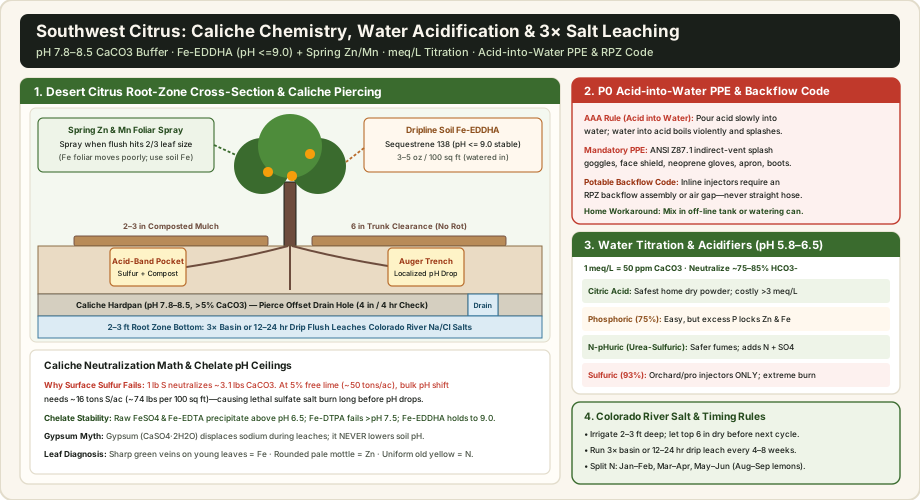
- Caliche neutralization stoichiometry defeats bulk surface sulfur: 1 lb of elemental sulfur neutralizes ~3.1 lbs CaCO3, meaning 5% free lime (~50 tons/acre) demands ~16 tons/acre of sulfur (~74 lbs per 100 sq ft)—far above fatal citrus root salt thresholds.
- Match iron chelates to pH 7.8–8.5 soils: raw ferrous sulfate and Fe-EDTA break down above pH 6.5, whereas Fe-EDDHA (Sequestrene 138) stays soluble up to pH 9.0 at 3–5 oz per 100 sq ft around the canopy dripline.
- Pair soil Fe-EDDHA with spring flush zinc sulfate and manganese sulfate foliar sprays applied once new leaves reach two-thirds to full expansion, because foliar iron barely translocates while soil Zn and Mn lock up in caliche.
- Test irrigation alkalinity in meq/L or ppm CaCO3 (1 meq/L = 50 ppm CaCO3) and never connect an acid injector straight to house plumbing without an approved RPZ backflow assembly or off-line tank; always pour Acid into Water wearing ANSI Z87.1 indirect-vent splash goggles, face shield, and chemical gloves.
- Flush accumulated Colorado River and well sodium/chloride below the 2–3 ft root zone with 3× basin or 12–24 hour drip leaching cycles every 4–8 weeks—only after verifying caliche drainage drops at least 4 inches in 4 hours.
Quick answer: Broadcasting granular sulfur across alkaline pH 7.8–8.5 Southwest caliche soil containing over 5% free calcium carbonate (CaCO3) cannot drop bulk yard pH because neutralizing 5% lime takes roughly 16 tons of sulfur per acre—triggering root-burning sulfate salts before soil pH shifts. Instead, pair three extension-proven steps: (1) apply chelated Fe-EDDHA (Sequestrene 138, stable up to pH 9.0) at 3–5 oz per 100 sq ft around the dripline plus spring flush Zn and Mn foliar sprays when new leaves reach two-thirds size; (2) pack elemental sulfur locally into pierced auger pockets and 2–3 inch composted low-salt mulch bands; and (3) neutralize high-bicarbonate water (above 150 ppm CaCO3 / 3 meq/L) down to pH 5.8–6.5 off-line or behind an approved RPZ backflow preventer while running 3× deep basin or 12–24 hour drip leaching cycles to flush Colorado River and well salts below 2–3 ft roots.
Why Broadcasting Sulfur Fails on Southwest Caliche Soils
Home growers across Phoenix, Tucson, Las Vegas, Palm Springs, and El Paso routinely scatter 2 to 5 lbs of elemental sulfur per 100 sq ft beneath yellowing Eureka lemon, Meyer lemon, or Valencia orange trees and wonder why soil tests six months later still read pH 8.1. University of Arizona Cooperative Extension (AZ1281, AZ1415) and Utah State University calcareous soil trials explain why desert yards reject bulk sulfur.
Desert soils accumulate free calcium carbonate (CaCO3) and cemented subsurface caliche because arid rainfall cannot leach lime downward. Free CaCO3 buffers soil solution tightly between pH 7.8 and 8.5, neutralizing acid produced by soil bacteria on contact. Our Southwest alkaline fruit tree guide covers orchard siting, while the chemical stoichiometry below shows why backyard sulfur broadcasting fails.
Calcium carbonate neutralization stoichiometry and salt burn
When Thiobacillus bacteria oxidize elemental sulfur (S) in warm (>60°F), moist, aerated soil, 1 mole of sulfur (32 g) forms 1 mole of sulfuric acid, neutralizing 1 mole of calcium carbonate (100 g). That fixes a rigid chemical ratio: 1 lb of pure elemental sulfur neutralizes ~3.1 lbs of CaCO3.
An acre-furrow slice (6 inches deep) weighs roughly 2,000,000 lbs. Even 1% free CaCO3 equals 10 tons of lime per acre, demanding ~3.2 tons/acre of sulfur before bulk pH budges. Sonoran and Mojave caliche yards routinely contain 5% to 15%+ free lime. At 5% CaCO3 (50 tons/acre lime), neutralization requires ~16 tons of sulfur per acre—around 74 lbs per 100 sq ft. Dumping even a fraction of that rate triggers lethal sulfate salt burn long before pH reaches 6.5, and remember from gypsum and sulfur soil test rules that gypsum (CaSO4·2H2O) never lowers soil pH.
What Works in Caliche Soil: Localized Acid-Bands, Fe-EDDHA & Spring Zn/Mn Sprays
Since neutralizing an entire yard's CaCO3 reserve is chemically futile, UC ANR and UArizona Cooperative Extension recommend combining localized micro-zone acid-bands, high-pH-stable Fe-EDDHA chelates, and foliar Zn/Mn sprays.
Southwest Caliche Soil Remediation & Micronutrient Chemistry Matrix
Treatment / Amendment | Active pH Range | Desert Citrus Dose & Placement | Cost ($ USD) | Caliche Verdict & Failure Mode |
|---|---|---|---|---|
Bulk Surface Elemental Sulfur Broadcast | Ineffective >2% free CaCO3 | Do NOT broadcast across mature caliche basins | $15–$25 / 50 lb bag | Neutralized immediately by CaCO3; excess >5 lbs/100 sq ft risks sulfate root burn and nutrient lockout |
Localized Auger Pocket / Trench Acid-Band + Composted Mulch | Creates local pH 6.2–6.8 micro-pockets | Drill 6–8 peripheral 2-in auger holes along dripline; pack 2–3 tsp sulfur + finished low-salt compost (14–56 g/cu ft inside pockets) + 2–3 in mulch (6 in off trunk) | $20–$45 / tree | Works locally where roots hit acid pockets while low-salt desert compost supplies humic chelates; skip salty steer manure |
Chelated Fe-EDDHA (Sequestrene 138 / 6% Fe o,o-EDDHA) | Stable pH 4.0 to 9.0 | Apply 3–5 oz per 100 sq ft (2–3 lbs / 1,000 sq ft) around canopy dripline before spring flush; water in deeply | $35–$65 / 1 lb jar | Gold-standard soil fix on pH 7.8–8.5 caliche; read labels so 100% of iron is o,o-EDDHA chelated |
Fe-EDTA or Raw Ferrous Sulfate (FeSO4) | Fails above pH 6.5 (Fe-DTPA fails >pH 7.5) | Skip as soil drench in Southwest desert soils | $12–$25 / bag | Iron breaks free from EDTA within hours in alkaline soil, locking into insoluble rust oxides |
Spring Zn & Mn Foliar Sprays (Zinc & Manganese Sulfate) | Bypasses soil pH completely | Dilute 2–4 lbs / 100 gal (~0.6–1.3 oz / 2 gal sprayer, buffered or low-biuret urea); spray spring flush at 2/3 leaf expansion | $18–$30 / bag | Essential spring partner because foliar Fe barely moves to new shoots while Zn and Mn absorb cleanly; spray at dusk under 85°F |
Diagnosing iron vs. zinc vs. nitrogen yellowing before dosing
Inspect leaf age and vein geometry before dosing, using visual keys from diagnosing yellow citrus leaves and UArizona AZ1415. Iron chlorosis strikes young flush leaves with pale yellow tissue framed by sharp, angular green veins. Zinc deficiency also strikes new growth—especially on sunlit south and west branches—forming smaller leaves with rounded yellow mottles between soft green bands. Nitrogen deficiency greens new shoots by draining older inner leaves uniformly yellow, fixed via regional citrus fertilization schedules rather than iron.
Following UArizona's localized placement principles from our elemental sulfur guide, never rototill beneath mature citrus canopies where feeder roots sit in the top 6–12 inches. Drill narrow peripheral auger pockets around the outer dripline, pack them with sulfur and finished plant compost, and water in Fe-EDDHA across the wetted root zone.
Irrigation Alkalinity Titration, Acidifier Math & P0 Safety Code
Every irrigation cycle in Phoenix, Tucson, Coachella Valley, or Southern Nevada applies dissolved bicarbonates that act like liquid lime. Testing water for total alkalinity (meq/L or ppm CaCO3, where 1 meq/L = 50 ppm CaCO3) matters far more than raw pH, because water above 150–300+ ppm CaCO3 (3–6+ meq/L) pushes root-zone pH upward even when tap pH reads 7.4.
Review your municipal water report or submit a well sample alongside a Cooperative Extension soil test ($25–$60 total) and interpret pH, alkalinity, and salinity lines. If alkalinity exceeds 150 ppm CaCO3 (3 meq/L), titrate a measured sample using a nursery alkalinity kit and pH meter to hit pH 5.8–6.5—neutralizing 75–85% of bicarbonates while leaving ~0.5–1.0 meq/L residual buffer.
P0 Acid-into-Water PPE & potable backflow plumbing code: Always pour Acid into Water (AAA) while stirring slowly—pouring water into concentrated acid triggers violent exothermic boiling and chemical splashes. Wear ANSI Z87.1 indirect-vent chemical-splash goggles (not open safety glasses), a full-face shield, nitrile or neoprene gloves, rubber apron, and boots. Plumbing codes bar connecting an acid injector straight to a household hose bibb without a certified Reduced Pressure Zone (RPZ) backflow preventer or physical air gap; a safer home method mixes acidified water in an off-line poly drum isolated from potable plumbing.
Irrigation Water Acidification Options for Southwest Citrus (Target pH 5.8–6.5)
Water Treatment Option | Starting Dose (per 100 gal at ~3–4 meq/L) | Nutritional & Chemical Trade-Offs | PPE & Plumbing Requirement | Home Yard Suitability |
|---|---|---|---|---|
Citric Acid (food-grade anhydrous powder) | ~1.5–3.0 oz (40–85 g) per 100 gal (verify by meter) | Organic-safe carbon source; zero excess P or salt buildup, but weak buffering gets expensive above 4–5 meq/L | ANSI splash goggles + gloves; mix in off-line barrel or drip tank (flush lines clean to curb biofilm) | Top home pick for patio pots and 1–4 backyard citrus trees |
Phosphoric Acid (75%, 0-52-0 liquid) | ~10–25 mL (0.3–0.8 fl oz) per 100 gal | Lower vapor hazard than sulfuric, but routine dosing overloads soil phosphorus—antagonizing Zn and Fe uptake | ANSI splash goggles, face shield, chemical gloves, RPZ backflow preventer or off-line tank; Acid into Water only | Occasional low-alkalinity use only; skip continuous dosing |
Urea-Sulfuric Acid (N-pHuric 15-0-0 / ~49% H2SO4 eq.) | ~20–45 mL (0.7–1.5 fl oz) per 100 gal (titrate to target) | Urea adduct suppresses fumes while supplying ~15% N and sulfate without P excess; subtract supplied N from fertilizer plan | Full chemical PPE (splash goggles, face shield, apron, neoprene gloves) + interlocked PVDF injector + RPZ preventer | Standard choice for multi-tree orchards and >4 meq/L well water |
Sulfuric Acid (93% technical grade) | Per lab titration curve (~133 lbs 100% eq. per ac-ft per meq/L) | Lowest cost per meq/L neutralized; adds benign sulfate with zero N or P distortion | Extreme burn & boil hazard; industrial PPE, eyewash, acid-rated metering pump, and commercial RPZ backflow code | Avoid residential storage; use N-pHuric, citric acid, or acid-forming ammonium sulfate |
Do not rely on household 5% vinegar for large trees: acetic acid costs more per meq/L than bulk citric powder and stresses microbes if over-applied. Keep emitters scale-free with sandy soil drip design practices and short clean-water flushes after each acidified cycle.
Piercing Caliche & 3× Deep Leaching Cycles for Colorado River Salinity
Colorado River water serving Phoenix, Yuma, Tucson (CAP canal), Las Vegas, and Southern California citrus averages 600–750+ ppm TDS rich in sodium (Na+) and chloride (Cl-), while desert wells often run saltier. Because desert evapotranspiration pulls roughly 60 inches/year through mature trees, shallow lawn sprinklers leave white salt crusts in the top 6 inches—scorching citrus leaf tips brown.
Step 1: Verify caliche percolation (4 inches in 4 hours) before leaching
Per UArizona AZ1281 and AZ1151, flushing extra water onto an unpierced caliche pan perches stagnant water around roots, spiking bicarbonate stress and inviting Phytophthora root rot. When planting Persian lime, Ruby Red grapefruit, or sweet oranges in caliche yards, dig a wide shallow hole (3–5× rootball width) and pierce an offset chimney drain hole through the cemented CaCO3 layer—never directly beneath the trunk. Fill with water and verify levels drop at least 4 inches in 4 hours; over solid bedrock caliche, build 24-inch raised mounds.
Step 2: Run 3× basin or 12–24 hour drip leaching cycles
On well-drained soil, wet 2 to 3 ft deep across the dripline (1–2 ft past canopy edges), letting the top 6 inches dry before watering again—stopping citrus fruit splitting and thick, dry fruit rind. Every 4 to 8 weeks in warm weather (or twice yearly), run a 3× leaching cycle: flood the basin with triple normal volume—or run drip emitters continuously for 12 to 24 hours (keeping salty spray off leaves)—to push Na+ and Cl- below 3-ft feeder roots. On sodic clays where sodium seals pores, apply gypsum before leaching per saline-alkaline Southwest soil rules and right-sized irrigation scheduling.
Seasonal Southwest Desert Citrus Acidification, Micronutrient & 3× Leaching Calendar
Season Window | Irrigation Water & Leaching Action | Soil Chelate & Localized Acid-Band | Nitrogen & Foliar Spray Timing (UArizona AZ1671) |
|---|---|---|---|
Jan–Feb (Pre-Spring Flush) | Irrigate every 21–30 days (2–3 ft deep); run pre-flush 3× basin or 12–24 hr drip leach if leaf tips show brown salt burn | Apply 3–5 oz / 100 sq ft Fe-EDDHA around dripline and water in; refresh 2–3 in low-salt mulch (6 in off trunk) | Split #1 of annual ammonium sulfate / citrus N (~1/3 total; +10% for lemons/limes, -50% for grapefruit) |
Mar–Apr (Spring Bloom & Leaf Flush) | Step up to 14–21 day deep watering (pH 5.8–6.5 acidified water if alkalinity >150 ppm CaCO3) | Top up peripheral auger acid-band pockets (2–3 tsp elemental sulfur + compost) as soil warms above 60°F | Split #2 N in March–April; apply Zn + Mn foliar spray at dusk once spring flush hits 2/3 leaf expansion |
May–Aug (Extreme Heat 100–115°F+) | Water deeply every 7–14 days (~29 gal/day equivalent for a 14-ft orange in July); run midsummer 3× salinity flush | Spot-reapply Fe-EDDHA only on stubborn yellowing shoots; avoid digging near shallow feeder roots | Split #3 N in May–June for oranges/mandarins/grapefruit; pause feeding during >105°F heatwave stress |
Sep–Dec (Fall Flush & Winter Rest) | Taper from 14–21 days to 21–30 days; run fall 3× deep leach after summer evaporation peaks | Soil sample annually around dripline (6–12 in deep) to track EC salinity and free-lime trends | Split #3 N in Aug–Sep for lemons/limes ONLY (skip fall N on oranges); second Zn/Mn spray if fall flush mottles |
Pair deep leaches with Southwest moisture-conserving mulches, citrus guild companion planting, and home citrus diagnostics, adding heatwave shade cloth over young trees planted near reflective desert rock.