Key takeaways
- Install fences at least 8 feet high for effective deer exclusion, or 6 feet for electric designs.
- Rotate deer repellents every 2-4 weeks to prevent deer from habituating to specific scents or tastes.
- Select deer-resistant plants suited to your USDA zone, understanding that no plant is truly deer-proof.
- Combine multiple deer management strategies, such as fencing, repellents, and plant selection, for best results.
- Regularly inspect fences and reapply repellents, especially after heavy rain or new plant growth.
Quick answer: Protecting gardens from deer effectively involves a multi-faceted approach, combining physical barriers like 8-foot fences, rotating deer repellents every 2-4 weeks, and selecting deer-resistant plants suited to your USDA zone.
Across the United States, from the suburban plots of USDA zone 7 in Pennsylvania to the rural farms of USDA zone 4 in Minnesota, deer present a persistent challenge for growers. These animals, often beautiful to observe, can quickly decimate a garden, consuming 6-10 pounds of forage daily if left unchecked [1]. This browsing pressure can lead to significant crop loss and damage to ornamental plants, impacting both food production and landscape aesthetics for thousands of growers each year.
Successfully managing deer requires a thoughtful, integrated approach, combining physical barriers, deterrents, and strategic plant choices. Relying on a single method often proves insufficient over time, as deer are adaptable creatures. By understanding their behavior and implementing a layered defense, growers can significantly reduce damage and protect their investments for a more productive, enjoyable growing season.
Understanding deer behavior and the damage they inflict
Deer activity in gardens typically peaks during dawn and dusk, though hungry animals will feed at any time. White-tailed deer, common across much of the US, are particularly known for their browsing habits, often consuming young, tender shoots and leaves. A single deer can cause extensive damage, with an estimated cost to US agriculture exceeding $1 billion annually due to crop loss and related issues [1]. This impact is felt from California’s Central Valley to the cornfields of Iowa.
identifying common deer damage
Recognizing deer damage is the first step in effective management. Deer typically browse plants up to 6 feet high, leaving ragged, torn edges on stems and leaves, unlike the clean cuts left by rabbits or rodents. They also rub their antlers on young trees, especially during late summer and fall, stripping bark and potentially girdling the tree, which kills it. Look for hoof prints, pellet droppings, and rub marks on tree trunks, often 2-5 feet from the ground. Young fruit trees, like those in USDA zone 5 orchards, are particularly vulnerable to antler rubbing.
- Ragged browsing marks on leaves and stems, often 3-6 feet high.
- Stripped bark or girdled young trees, 2-5 feet from the ground.
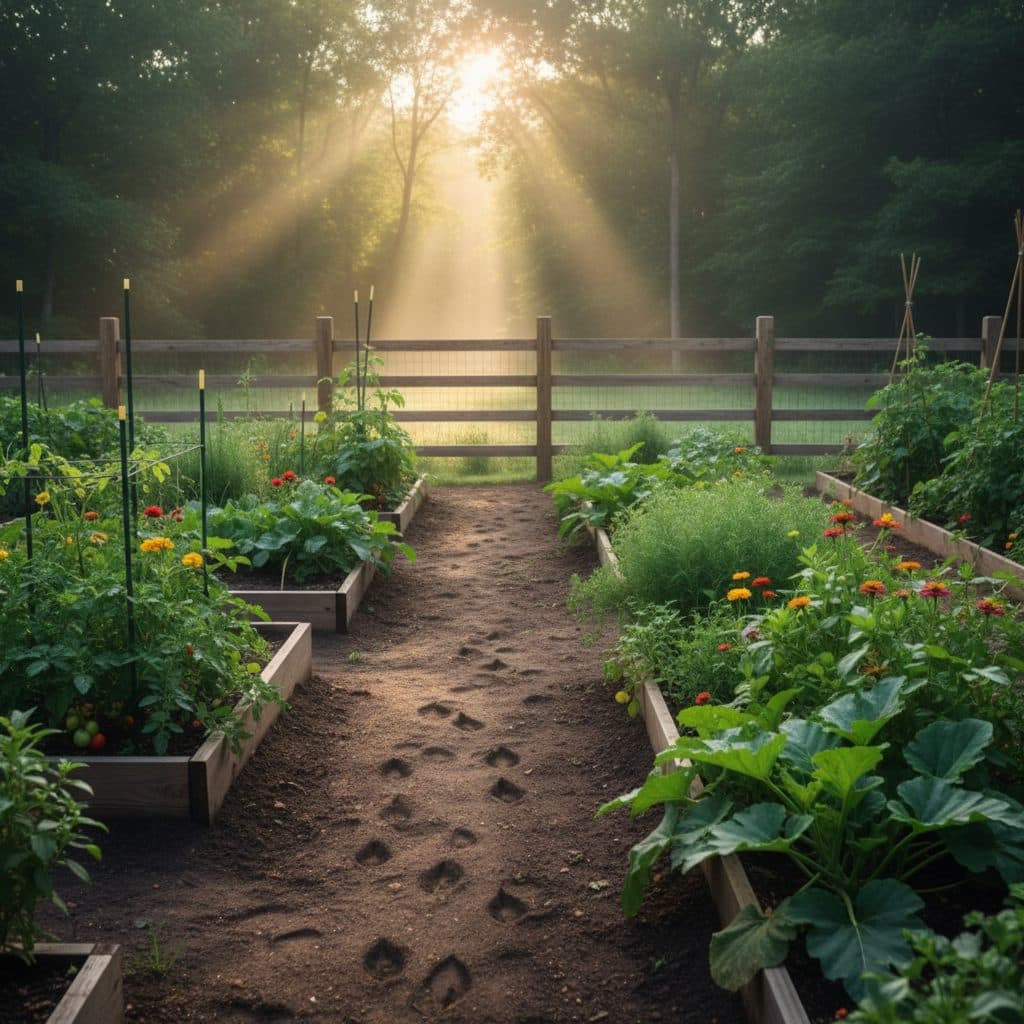
- Deer tracks—two distinct, pointed hooves—in soft soil.
- Small, dark, pellet-like droppings near damaged plants.
- Missing flower buds or entire plants, especially during spring and early summer.
Fencing: the most reliable physical barrier
When it comes to keeping deer out, a well-constructed fence is often the most dependable solution. For most situations, a fence must be at least 8 feet high to effectively deter deer, as they are capable jumpers [1]. This height is critical for protecting high-value crops or entire garden areas, especially in regions with high deer populations like the Appalachian foothills.
choosing the right fence type
Permanent fences, such as woven wire or high-tensile mesh, offer long-term protection and can last for 15-20 years with proper maintenance. These typically require sturdy posts set 8-10 feet apart, with the fence material buried 6-12 inches deep to prevent deer from pushing underneath. Electric fences provide another option; a 6-foot high electric fence with multiple strands, spaced 10-12 inches apart, can be effective, delivering a mild but memorable shock [1]. For smaller, temporary plots or seasonal protection, lightweight plastic mesh or electric poly-wire fences are more economical, often costing less than $1.50 per linear foot compared to $5-15 for permanent options. When installing any fence, tools like a wooden-handle garden fork can help prepare the ground for posts.
- Woven wire fences, 8 feet high, for permanent exclusion.
- High-tensile electric fences, 6 feet high with 5-7 strands.
- Plastic mesh fences for temporary or seasonal protection.
- Slanted fences, angled at 45 degrees, can be effective at 6 feet high.
- Double fences, two 4-foot fences spaced 3-4 feet apart, confuse deer.
Repellents: a tactical deterrent
While not as foolproof as a physical barrier, repellents can be a useful part of a deer management strategy, especially for smaller gardens or areas where fencing is impractical. Repellents work by making plants unappealing through taste or smell. Many commercial products contain putrescent egg solids, which emit an odor offensive to deer but generally undetectable to humans after drying [3]. These repellents can deter deer for 2-4 weeks, depending on weather conditions and product formulation.
applying and rotating repellents
For repellents to remain effective, consistent application is key. Reapply after heavy rains, new plant growth, or approximately every 2-4 weeks, especially during periods of high deer activity. Deer are intelligent and can habituate to a single repellent over time, so rotating between two or three different types every 2-4 weeks is a recommended strategy to maintain effectiveness [4]. For instance, alternate a putrescent egg-based product with one containing capsaicin or thiram. Monitoring soil moisture with a 3-in-1 soil moisture meter can help ensure plants are healthy enough to recover from any minor browsing that might occur before repellents are reapplied.
- Apply repellents every 2-4 weeks, or after significant rainfall.
- Rotate between different repellent types to prevent deer habituation.
- Focus application on new growth and vulnerable plants.
- Consider DIY options like soap or hot pepper sprays for small areas.
- Ensure repellents are safe for edible plants if used on food crops.
Deer-resistant plants by region: strategic selection
While no plant is truly deer-proof, some species are significantly less appealing to deer than others. Selecting these plants for your garden can reduce browsing pressure, especially when combined with other deterrents. Deer generally avoid plants with strong aromatic foliage, fuzzy or thorny textures, or those that are toxic. For example, Garden Sage (Salvia officinalis), often grown in USDA zones 4-8, is known for its pungent scent and is frequently ignored by deer [4].
regional plant recommendations
Plant preferences vary by region and deer population density. In the Northeast (USDA zones 3-7), deer often avoid plants like lavender, boxwood, and ornamental grasses. In the Southeast (USDA zones 7-9), lantana, rosemary, and coneflowers are typically less browsed. Growers in the Pacific Northwest (USDA zones 6-9) might find success with hellebores, ferns, and bleeding hearts. Conversely, plants like hostas, daylilies, and especially Garden Peas are highly attractive to deer across most regions [4]. For a more comprehensive list, consult the deer-resistant plants selection guide.
- Northeast (USDA zones 3-7): Lavender, Boxwood, Bleeding Heart, Coneflower.
- Southeast (USDA zones 7-9): Lantana, Rosemary, Salvia, Butterfly Bush.
- Midwest (USDA zones 4-6): Peonies, Catmint, Russian Sage, Ornamental Grasses.
- Southwest (USDA zones 7-10): Agave, Yucca, Penstemon, Desert Marigold.
- Pacific Northwest (USDA zones 6-9): Hellebores, Ferns, Oregon Grape, Daphne.
Integrated pest management for deer: a holistic strategy
The most successful deer management programs employ an Integrated Pest Management (IPM) approach, combining multiple strategies rather than relying on a single method. This layered defense increases effectiveness and reduces the likelihood of deer adapting to any one deterrent. For instance, a 6-foot electric fence around a vegetable garden in USDA zone 6, combined with repellents applied to perimeter ornamentals, provides a robust defense against browsing deer.
monitoring and adapting your approach
Regular monitoring of your garden for signs of deer activity matters. Check fences monthly for breaches or weakened sections, and reapply repellents every 2-4 weeks, especially after heavy rains or new growth. If deer pressure remains high, consider adding another layer of defense, such as motion-activated sprinklers or noise deterrents. The USDA Natural Resources Conservation Service emphasizes that a diverse set of management tools is more sustainable and effective in the long term [1]. This adaptive approach ensures that your deer-proofing efforts remain effective throughout the growing season and for years to come.
- Combine fencing with repellents and deer-resistant plant choices.
- Regularly inspect fences for damage and repair promptly.
- Monitor plant damage and adjust repellent types or application frequency.
- Consider adding scare devices like motion-activated sprinklers or lights.
- Maintain a clean garden to avoid attracting deer with fallen fruit or vegetables.
Comparison of Common Deer Fencing Options
Fence Type | Typical Height | Effectiveness | Maintenance | Approx. Cost per Linear Foot |
|---|---|---|---|---|
Woven Wire (Permanent) | 8 feet | High, excellent physical barrier | Low, annual checks | $5-15 |
Electric (High-Tensile) | 6 feet | High, psychological deterrent | Moderate, voltage checks, weed control | $2-7 |
Plastic Mesh (Temporary) | 7-8 feet | Moderate, less durable | High, prone to tearing | $0.50-1.50 |
Slanted (Permanent) | 6 feet (at 45° angle) | High, confuses deer’s jumping ability | Low, annual checks | $6-18 |
Deer Forage: A single deer can consume 6-10 pounds of vegetation daily, leading to significant garden damage [1].
Repellent Rotation: Rotating deer repellents every 2-4 weeks is key to preventing deer from becoming accustomed to a single product [4].
Frequently asked questions
How high should a fence be to keep deer out of a garden?
For most deer species, a fence needs to be at least 8 feet high to be an effective physical barrier. Deer are impressive jumpers and can clear lower fences, especially if they are highly motivated by accessible food sources within your garden. Some electric fence designs can be effective at 6 feet with multiple wires.
How often should I reapply deer repellents?
Deer repellents should generally be reapplied every 2-4 weeks, or more frequently after heavy rainfall, overhead irrigation, or significant new plant growth. Consistent reapplication ensures the deterrent scent or taste remains strong enough to discourage deer from browsing your plants.
Are there any plants that deer absolutely will not eat?
No plant is truly 100% deer-proof. While some plants are highly resistant due to strong scents, fuzzy textures, or toxicity, a very hungry deer, especially in areas with high populations or limited food, may browse almost anything. For example, Garden Sage is generally avoided, but Garden Peas are a deer favorite.
Can deer damage young trees by rubbing their antlers?
Yes, deer, particularly bucks, commonly damage young trees by rubbing their antlers on the bark, especially during late summer and fall. This activity, known as ‘buck rub,’ can strip bark, girdle the tree, and ultimately kill it, often affecting trees with trunks 2-5 inches in diameter.
What is the best time of day to apply deer repellents?
The best time to apply liquid deer repellents is typically on a dry, calm day when temperatures are above 40°F and below 85°F. This allows the repellent to dry thoroughly before rain or dew, maximizing its adherence and effectiveness for the next 2-4 weeks. Avoid application during windy conditions to prevent drift.
References
- USDA Natural Resources Conservation Service (2024). USDA Natural Resources Conservation Service.
- EPA — Soak Up the Rain (2024). EPA — Soak Up the Rain.
- SARE — Sustainable Agriculture Research & Education (2023). SARE — Sustainable Agriculture Research & Education.
- ATTRA / NCAT Sustainable Agriculture (2023). ATTRA / NCAT Sustainable Agriculture.
- USDA National Agroforestry Center (2023). USDA National Agroforestry Center.