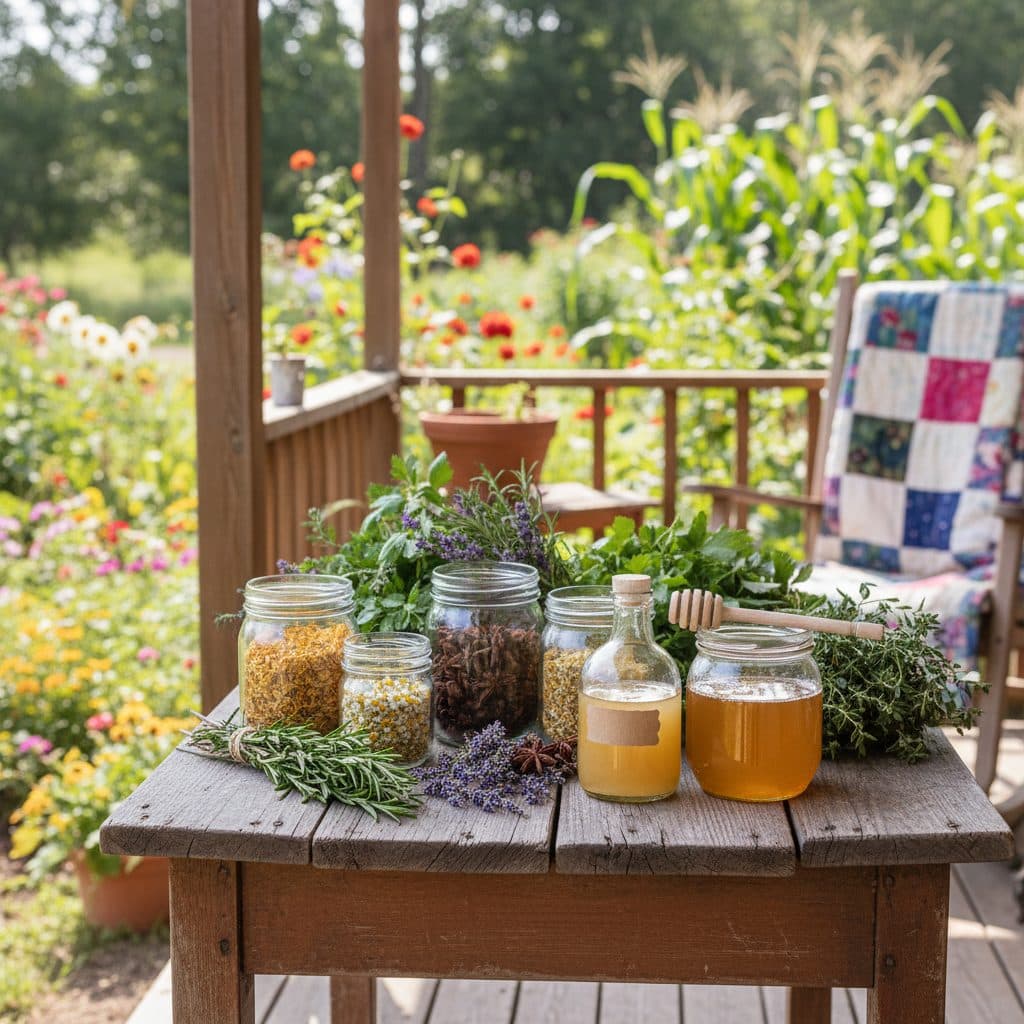
Key takeaways
- Oxymels are ancient, non-alcoholic herbal preparations using vinegar, honey, and herbs for wellness.
- Quality ingredients are essential: organic apple cider vinegar with the mother, raw local honey, and pesticide-free herbs.
- Common vinegar-to-honey ratios range from 1:1 (sweeter) to 3:1 (more acidic), depending on taste and herb potency.
- Macerate herbs in vinegar for 2-4 weeks in a cool, dark place, then strain and combine with honey.
- Store finished oxymels in dark, airtight bottles in a cool, dark place for 6-12 months to maintain potency.
- Oxymels can be used internally (1-2 teaspoons, 1-3 times daily) or externally (diluted) for various applications.
Quick answer: An oxymel is an ancient, non-alcoholic herbal preparation combining vinegar, honey, and herbs for wellness. To formulate one, macerate herbs in vinegar for 2-4 weeks, then strain and combine with raw honey, typically using 1:1 to 3:1 vinegar-to-honey ratios.
In the humid summers of the American Southeast, where temperatures often reach 90°F or higher, many home growers turn to traditional remedies to support their well-being. One such preparation, with roots tracing back thousands of years, is the oxymel. This simple yet potent blend of vinegar, honey, and often medicinal herbs offers a versatile addition to any home apothecary. For centuries, across various cultures, oxymels have been valued for their ability to extract beneficial compounds from plants, making them a practical choice for those seeking to incorporate garden-grown remedies into their daily lives.
Here in the US, from the temperate climates of USDA zone 6 where apple cider vinegar is readily produced, to the arid regions where desert herbs thrive, the principles of oxymel formulation remain consistent. Understanding the balance between acidity and sweetness, and how these components interact with plant constituents, is key to crafting effective preparations. This article will guide you through the process, from selecting your ingredients to determining the right vinegar-to-honey ratios, empowering you to create your own customized oxymels right from your garden.
What is an oxymel?
An oxymel, derived from the Greek words ‘oxys’ meaning acid and ‘meli’ meaning honey, is essentially a medicinal syrup made by combining vinegar, honey, and usually herbs. This ancient preparation method was widely used in ancient Greece and Rome, with records suggesting its use for at least 2,500 years. The vinegar acts as a solvent, drawing out minerals and other beneficial compounds from plant material, while the honey provides sweetness, acts as a preservative, and offers its own therapeutic properties, including antimicrobial effects.
The beauty of an oxymel lies in its simplicity and effectiveness. Unlike alcohol-based tinctures, oxymels are non-alcoholic, making them suitable for a broader audience, including older children and those avoiding alcohol. Because they are built on raw honey, oxymels must never be given to a child under twelve months of age — raw honey can carry Clostridium botulinum spores that an infant gut cannot suppress. For instance, a common application in the Appalachian region involves using an oxymel made with horehound (Marrubium vulgare) for respiratory support. Horehound is a non-native mint that naturalizes readily on dry, disturbed ground, so give it a contained bed and deadhead it before it seeds; it is also traditionally avoided during pregnancy. The acidic nature of the vinegar, typically with a pH between 2.4 and 3.4, helps to break down plant cell walls, releasing active constituents that might not be as readily available in a simple tea or infusion. The honey, often local raw honey, contributes enzymes and antioxidants.
the historical context of oxymels
Historical texts indicate that oxymels were a staple in ancient medicine, prescribed for a range of ailments from respiratory issues to digestive complaints. The physician Hippocrates, active around 400 BC, is often credited with their widespread use. These preparations were not just medicinal; they were also a way to preserve perishable herbs, especially during seasons when fresh plants were scarce. For example, in regions with cold winters, dried herbs could be preserved in oxymels for up to 1 year, ensuring a continuous supply of remedies. This shows how practical and long-lasting oxymels have been in a home apothecary.
- Extracts water-soluble compounds like vitamins and minerals.
- Extracts alcohol-soluble compounds like resins and essential oils (to a lesser degree than alcohol).
- Provides a palatable way to consume bitter or pungent herbs.
- Offers a non-alcoholic alternative to tinctures.
- Acts as a natural preservative due to high acidity and sugar content, extending shelf life to 6-12 months.
Choosing your ingredients
The quality of your oxymel starts with the quality of its components. For the vinegar, unpasteurized, organic apple cider vinegar (ACV) with ‘the mother’ is generally preferred. The ‘mother’ is a cellulose matrix left behind by the acetic acid bacteria that made the vinegar. It is a reliable sign the vinegar is raw and unpasteurized, rather than a proven health ingredient in its own right. In states like Vermont, where apple orchards are abundant, locally produced ACV can be found with a consistent acidity of 5%. Other vinegars, such as white wine vinegar or rice vinegar, can also be used, but ACV is favored for its mild flavor and established health benefits.
When it comes to honey, raw, unfiltered honey is the gold standard. Local honey, sourced within 50 miles of your home, often contains local pollen, which some believe can help with seasonal allergies. For example, a beekeeper in central California might produce a wildflower honey with unique properties. The type of honey can also influence the flavor profile – a dark buckwheat honey will impart a much stronger taste than a light clover honey. Aim for honey that is thick and viscous, with a moisture content typically below 18% to prevent fermentation.
selecting the right herbs for your oxymel
Herbs are where you can truly customize your oxymel. Consider what you want the oxymel to do. For digestive support, herbs like ginger (Zingiber officinale) or peppermint (Mentha piperita) are excellent choices. For respiratory health, mullein (Verbascum thapsus) or thyme (Thymus vulgaris) are often used; strain any mullein preparation through fine cloth or a coffee filter, because the fine hairs on the leaf irritate the throat. If you’re starting a herb garden, consider easy-to-grow species like garden sage (Salvia officinalis), which thrives in USDA zones 4-8 and is known for its astringent properties. You can learn more about starting your own herb garden. Always ensure your herbs are free from pesticides and heavy metals, whether you forage them, grow them yourself, or purchase them from a reputable supplier. Your state Cooperative Extension service can advise on testing garden soil for contaminants and on which sites are safe for growing or foraging herbs intended for internal use.
- Organic, unpasteurized apple cider vinegar with the ‘mother’.
- Raw, unfiltered honey, preferably local.
- Fresh or dried herbs, free from pesticides.
- Clean, sterilized glass jars with non-reactive lids.
- A non-reactive stirring utensil, like a wooden spoon.
Formulation — ratios and methods
This builds directly on choosing ingredients.
Crafting an oxymel involves understanding the balance between vinegar and honey, and the proper technique for extracting herbal constituents. The most common vinegar-to-honey ratios range from 1:1 to 3:1. Keep at least as much vinegar as honey: a finished oxymel needs to stay below pH 4.6 to remain hostile to Clostridium botulinum, and honey-forward blends drift up toward that line. A 1:1 ratio will result in a sweeter, more palatable oxymel, often preferred for children or those sensitive to acidity. For a stronger, more acidic preparation, a 2:1 or even 3:1 vinegar-to-honey ratio is appropriate. For example, a 2:1 ratio might use 2 cups of vinegar and 1 cup of honey. The choice depends on the herb’s taste and your desired outcome. Some herbalists in the Pacific Northwest prefer a 3:1 ratio for pungent herbs like garlic (Allium sativum) to balance their strong flavor.
The process typically begins with preparing your herbs. If using fresh herbs, chop them finely to increase surface area for extraction. For dried herbs, a coarse grind is often sufficient. Fill a clean, sterilized glass jar one-quarter to one-half full with your chosen herbs. Next, pour in your vinegar until the herbs are completely submerged, leaving about 1 in of headspace. Secure the lid tightly. Allow the herbs to macerate in the vinegar for 2-4 weeks in a cool, dark place, shaking the jar daily to ensure even extraction. After this period, strain the vinegar through a fine-mesh sieve or cheesecloth, pressing out all liquid from the herbs. This infused vinegar is now ready for the honey.
combining infused vinegar with honey
Once you have your infused vinegar, gently warm it if necessary – but do not boil it – to help the honey dissolve. Combine the infused vinegar with your chosen amount of raw honey, stirring until fully incorporated. For a 1:1 ratio, if you have 1 cup of infused vinegar, you would add 1 cup of honey. If you’re aiming for a 2:1 ratio, you’d add 0.5 cups of honey. Pour the finished oxymel into clean, sterilized bottles. Label with the ingredients and date.
- Chop fresh herbs or coarsely grind dried herbs.
- Fill a sterilized jar 1/4 to 1/2 full with herbs.
- Cover herbs completely with vinegar, leaving 1 in headspace.
- Macerate for 2-4 weeks in a cool, dark place, shaking daily.
- Strain herbs, then combine infused vinegar with honey according to desired ratio.
Storage and usage
Proper storage is important for maintaining the potency and extending the shelf life of your homemade oxymels. Store your finished oxymels in airtight, dark glass bottles in a cool, dark place, such as a pantry or cupboard. Refrigeration is not strictly necessary due to the preserving properties of vinegar and honey, but it can further extend shelf life, particularly in warmer climates like Florida where average temperatures can exceed 75°F for much of the year. When stored correctly, an oxymel can last for 6 months to 1 year, sometimes even longer, though potency may gradually decrease over time. Always check for any signs of spoilage, such as mold or an off odor, before use.
Oxymels are incredibly versatile in their application. For general wellness support, a common dosage is 1-2 teaspoons, taken 1-3 times daily. They can be taken straight, diluted in a small amount of water or juice, or even incorporated into culinary creations. For instance, a ginger oxymel can be added to sparkling water for a refreshing digestive aid, or a thyme oxymel can be drizzled over roasted vegetables. Many herbalists in the Northeast US use elderberry (Sambucus canadensis) oxymels during cold and flu season, often taking 1 tablespoon daily for preventive measures. The key is consistency and listening to your body’s response.
external applications and safety considerations
Beyond internal use, oxymels can also be used externally. A diluted oxymel (e.g., 1 part oxymel to 3 parts water) can serve as a hair rinse to promote shine, or as a skin toner. The pH of diluted oxymel is typically around 4.5, which is close to the natural pH of human skin, making it a gentle option. When using any new herbal preparation, it is always wise to start with a small dose and observe for any reactions. For example, some individuals might find a 1:1 ratio too acidic initially. Wash and sterilize every jar, lid, sieve, funnel and bottle that touches a preparation intended for internal use, and stir with non-reactive utensils — vinegar corrodes bare metal.
- Store in dark, airtight glass bottles.
- Keep in a cool, dark pantry or cupboard.
- Refrigeration can extend shelf life, especially in warm climates.
- Check for signs of spoilage like mold or off odors.
- Label bottles clearly with contents and date of preparation.
Comparing common vinegars for oxymel preparation
Vinegar Type | Flavor Profile | Acidity (approx.) | Common Uses |
|---|---|---|---|
Apple Cider Vinegar | Fruity, slightly sweet | 5% | Most common, versatile, digestive support |
White Wine Vinegar | Sharp, clean | 5-7% | Lighter flavor, good for delicate herbs |
Red Wine Vinegar | Robust, fruity | 5-7% | Stronger flavor, pairs well with pungent herbs |
Rice Vinegar | Mild, slightly sweet | 4-4.5% | Gentle, often used in Asian-inspired remedies |
Ancient Roots: Oxymels have been used for over 2,500 years, with historical records tracing their use to ancient Greece and Rome.
Optimal pH: The typical pH range for vinegar used in oxymels is 2.4 to 3.4, effectively extracting plant compounds.
Shelf Life: Homemade oxymels, stored properly, can maintain potency for 6 months to 1 year, sometimes longer.
Frequently asked questions
Can I use any type of honey?
While any honey will work, raw, unfiltered honey is generally preferred for its beneficial enzymes and antioxidants. Local honey, especially, is often sought after for its unique pollen profile, which some believe offers additional benefits. Aim for honey with a moisture content below 18% to ensure preservation.
How long do oxymels last?
When stored in a cool, dark place in airtight bottles, homemade oxymels typically last for 6 months to 1 year. Refrigeration can extend this period, particularly in regions with high ambient temperatures, but always check for signs of spoilage before use.
Can children take oxymels?
Not for infants. Oxymels are made with raw honey, which can carry Clostridium botulinum spores, so no oxymel should be given to a child under twelve months of age. For children over one year, oxymels are non-alcoholic and a 1:1 vinegar-to-honey ratio makes a sweeter, more palatable preparation; ask your pediatrician about an appropriate dose before starting.
What kind of herbs are best for oxymels?
A wide variety of herbs can be used. For respiratory support, consider mullein or thyme. For digestive aid, ginger or peppermint work well. Garden sage (Salvia officinalis) is a versatile choice, thriving in USDA zones 4-8 across much of the US.
Do I need to heat the vinegar or honey?
It’s best to avoid heating the vinegar or honey significantly, as high temperatures can degrade beneficial enzymes and compounds. If honey is too thick, gently warm the infused vinegar slightly to help it dissolve, but keep the temperature below 100°F to preserve its integrity.
What if my oxymel ferments?
Fermentation can occur if the honey’s moisture content is too high or if the jar isn’t sealed properly. If you notice bubbling, a yeasty smell, or alcohol production, the oxymel is fermenting. While not necessarily harmful, it changes the product; ensure your honey has less than 18% moisture to prevent this issue.
References
- USDA Natural Resources Conservation Service (2024). USDA Natural Resources Conservation Service.
- SARE — Sustainable Agriculture Research & Education (2023). SARE — Sustainable Agriculture Research & Education.
- ATTRA / NCAT Sustainable Agriculture (2023). ATTRA / NCAT Sustainable Agriculture.