Key takeaways
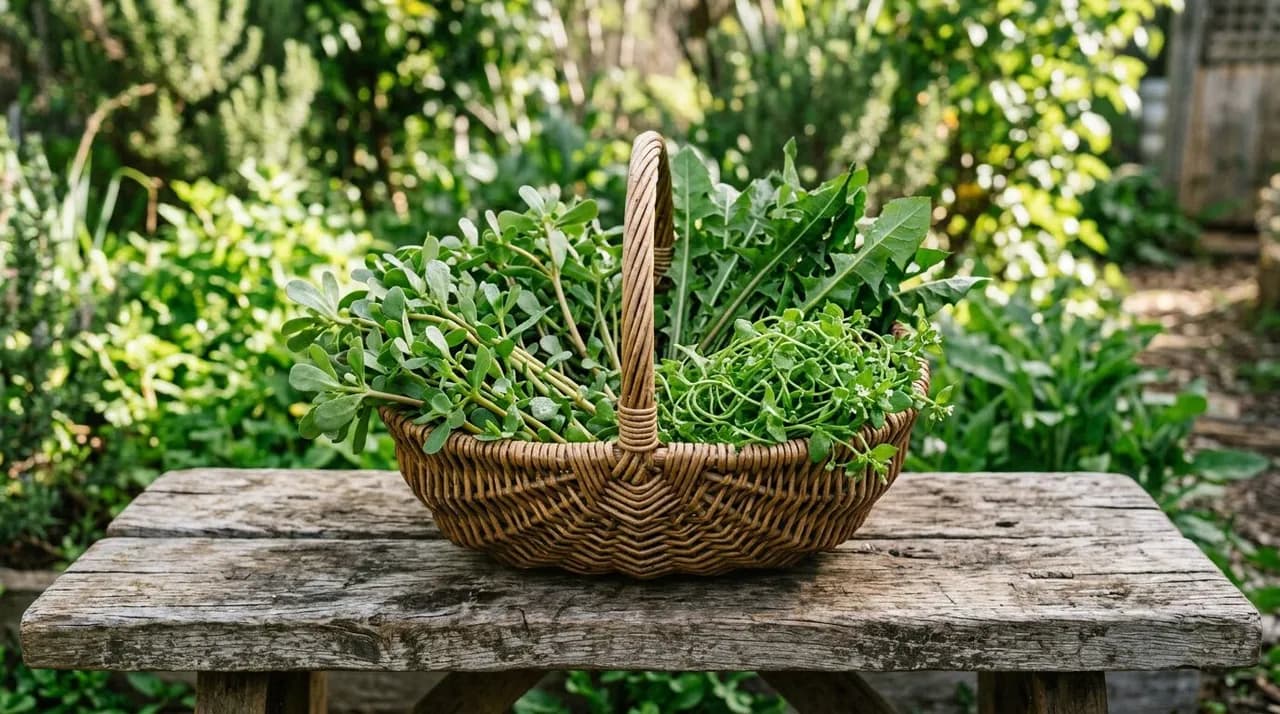
- Many wild plants colonising Australian backyards are highly nutritious leafy greens, dynamic bio-accumulators, and resilient seasonal herbs.
- Ensure 100% positive botanical identification before consuming any wild plant, checking leaf arrangement, stem sap, and flower structure.
- Never forage from roadside nature strips, public parks treated with council herbicides, industrial runoff zones, or dog-walking areas.
- Learn toxic look-alikes, particularly milky-sapped spurges (Euphorbia species) and nightshades, before harvesting.
- Harvest young, tender foliage in early morning and wash thoroughly in cold water before preparing raw or cooked dishes.
Quick answer: Foraging edible weeds in Australia requires 100% positive identification and picking from uncontaminated soil. Backyard favourites include purslane, dandelion, fat hen, chickweed, and plantain. Always check for toxic look-alikes like milky-sapped petty spurge and avoid areas sprayed with council chemicals.
Learning to identify edible weeds australia offers gardeners an abundance of nutrient-dense greens that grow vigorously without irrigation, fertilising, or pampering. While conventional gardening often views these spontaneous pioneers as nuisance invaders to be eradicated with herbicides, permaculture recognises wild plants as valuable food resources, dynamic nutrient accumulators, and natural indicators of soil health.
From temperate suburban lawns in Melbourne and Sydney to subtropical gardens in Brisbane and coastal Western Australia, edible weeds in your backyard emerge reliably across changing seasons. Many of these species were deliberately introduced to Australia by early European settlers as culinary pot herbs and traditional tonics before escaping into domestic gardens.
However, foraging wild plants carries serious responsibility. Safety requires methodical botanical observation, strict adherence to clean harvesting locations, and clear knowledge of toxic look-alikes that share the same garden beds.
Golden rules of safe wild foraging in Australia
Before harvesting weeds you can eat, master these non-negotiable safety rules:
1. Absolute positive identification
Never consume any wild plant based on a rough visual resemblance. Examine multiple identifying features:
- Leaf arrangement (alternate, opposite, or basal rosette)
- Leaf margins (smooth, toothed, or deeply lobed)
- Stem structure (hollow, solid, hairy, or smooth)
- Sap characteristics (clear, milky, or coloured)
- Flower structure and seed formation
If you are unsure of a plant's exact identity, do not consume it. For foundational identification skills, review our introduction to foraging for beginners.
2. Sourcing from clean environments
Plants absorb chemical residues and heavy metals from their growing environment:
- Avoid roadside verges: Plants growing within 10 metres of busy roadways accumulate lead, brake dust, and exhaust particulates.
- Avoid council-sprayed zones: Local councils routinely apply non-selective synthetic herbicides to footpath cracks, park edges, and nature strips. If foliage appears withered, curled, or unnaturally yellowed, avoid the entire area.
- Backyard safety: Harvest only from your own unsprayed garden beds, raised planters, or certified organic land out of reach of domestic pets.
3. Preparation and moderation
When sampling an edible wild weed for the first time:
- Wash leaves thoroughly in a bowl of clean, cold water to dislodge grit and insects.
- Eat a small trial portion cooked rather than raw to check for personal digestive sensitivities or allergies.
Top 5 common edible weeds in Australian backyards
The following species represent Australia's most widespread, palatable, and nutritious wild greens:
+------------------+-----------------------+-------------------+------------------------------+
| Weed Common Name | Botanical Name        | Edible Parts      | Look-alike to check          |
+------------------+-----------------------+-------------------+------------------------------+
| Purslane         | Portulaca oleracea    | Leaves, stems     | Petty Spurge (TOXIC)         |
|                  |                       |                   | (Euphorbia spp.)             |
+------------------+-----------------------+-------------------+------------------------------+
| Dandelion        | Taraxacum officinale  | Leaves, roots,    | Catsear / Flatweed           |
|                  |                       | flowers           | (Hypochaeris)                |
+------------------+-----------------------+-------------------+------------------------------+
| Fat Hen          | Chenopodium album     | Tender leaves,    | Black Nightshade (TOXIC)     |
|                  |                       | shoot tips        | (Solanum nigrum)             |
+------------------+-----------------------+-------------------+------------------------------+
| Chickweed        | Stellaria media       | Tender leafy      | Scarlet Pimpernel /          |
|                  |                       | stems             | Spurge (TOXIC)               |
+------------------+-----------------------+-------------------+------------------------------+
| Broadleaf / Rib  | Plantago major /      | Young leaves,     | Foxglove (Digitalis          |
| Plantain         | Plantago lanceolata   | seed spikes       | purpurea) (TOXIC)            |
+------------------+-----------------------+-------------------+------------------------------+
1. Purslane (Portulaca oleracea)
Also known as pigweed or munyeroo, purslane is a sprawling annual succulent that thrives in hot Australian summers:
- Identification: Smooth, reddish-purple creeping stems and paddle-shaped, fleshy green leaves. Small yellow flowers open only on bright sunny mornings. Stems snap cleanly with clear, non-milky juice.
- Culinary use: Crisp texture with a refreshing, slightly sour, lemony flavour. Excellent raw in summer salads, tossed into stir-fries, or blended into cold dips.
- Critical toxic look-alike: Petty spurge (Euphorbia peplus) or spotted spurge (Euphorbia maculata). Spurges often grow alongside purslane but have thinner stems that exude an irritating, toxic milky white latex sap when broken. Never eat any succulent weed that produces milky sap.
2. Dandelion (Taraxacum officinale)
A cool-season perennial weed common in lawns and fertile garden beds:
- Identification: Basal rosette of deeply toothed, hairless green leaves. A single, unbranched, hollow flower stem rises directly from the root crown, bearing a solitary bright yellow flower head. The hollow stem exudes a white latex when broken.
- Culinary use: Young spring leaves make mineral-rich salad greens; older leaves are blanched or sautéed like chicory. Roots can be roasted as an earthy coffee alternative.
- Look-alikes: Catsear or flatweed (Hypochaeris radicata) and prickly sow thistle (Sonchus oleraceus). Flatweed has rough, bristly leaves and solid, branching flower stems; while non-toxic, it is stringy and bitter.
3. Fat hen / lamb's quarters (Chenopodium album)
An upright annual weed thriving in rich, cultivated garden soil:
- Identification: Diamond to goosefoot-shaped alternate leaves with wavy toothed edges. The undersides of young leaves and growing tips are covered in a characteristic whitish, powdery mealy coating.
- Culinary use: One of the finest wild greens, tasting remarkably like tender spinach. Steam or sauté young shoots with butter, garlic, and sea salt.
- Caution: Like domestic spinach and silverbeet, fat hen contains naturally occurring oxalic acid; cook thoroughly if consuming in quantity.
- Toxic look-alike: Black nightshade (Solanum nigrum) sprouts in the same rich beds. Fat hen carries a white mealy bloom on its new growth and shoot tips and bears dense green flower spikes; nightshade has no mealy coating, produces small white star-shaped flowers with yellow centres, and forms green berries that ripen black. Green nightshade fruit and foliage are toxic.
4. Common chickweed (Stellaria media)
A delicate winter and spring annual that forms lush green mats in damp, shady areas:
- Identification: Small, oval, pointed green leaves arranged in opposite pairs along sprawling stems. Look closely at the stem with a magnifying lens: a distinct single line of fine white hairs runs down one side of the stem, alternating sides at each node. Tiny white flowers feature five petals split so deeply they appear as ten petals.
- Culinary use: Tender, juicy stems taste similar to fresh sweet corn. Eat raw in salads or blend into green pestos.
- Toxic look-alike: Scarlet pimpernel (Lysimachia arvensis). It has similar small opposite leaves, but its stems are square and completely hairless, producing orange-red or blue flowers. Scarlet pimpernel contains toxic saponins.
5. Plantain (Plantago major and Plantago lanceolata)
A rugged perennial found in lawns and compacted pathway edges across Australia:
- Identification: Broad oval leaves (P. major) or narrow lance-shaped leaves (P. lanceolata) bearing prominent, stringy parallel veins running from the base to the leaf tip. Dense green cylindrical seed heads rise on wiry stems.
- Culinary use: Young, small spring leaves are tender and palatable when finely shredded. For an in-depth botanical overview, see our dedicated guide on plantain weed.
- Critical toxic look-alike: Foxglove (Digitalis purpurea) forms a similar flat rosette. Plantain leaves are smooth-edged with prominent parallel veins running base to tip; foxglove leaves are soft, grey-downy, net-veined and finely toothed. Foxglove is cardiotoxic; never harvest a rosette without checking the veins.
Other notable wild edibles: stinging nettle and wild brassicas
Beyond the top five, other common edible weeds deserve a place in your culinary repertoire:
Stinging nettle (Urtica incisa and Urtica urens)
- Harvesting safely: The native scrub nettle (Urtica incisa) and the introduced annual small nettle (Urtica urens) both carry stinging hairs loaded with histamine and other irritants. Always wear thick leather gloves and long sleeves when gathering.
- Cooking disarms the sting: Boiling, steaming, or drying completely neutralises the stinging hairs within seconds. Nettle soup and nettle tea are exceptionally rich in iron, calcium, and plant proteins.
- Garden use: Excess harvested nettles make outstanding fermented organic liquid fertilisers. Explore how to brew nutrient-dense feeds in nettle weed fermented feeds.
Wild brassicas and mustards
Wild rocket (Diplotaxis tenuifolia), wild mustard (Sinapis arvensis), and shepherd's purse (Capsella bursa-pastoris) are common winter weeds with peppery leaves, edible yellow or white cruciform flowers, and spicy seed pods that can be harvested as wild caper substitutes.
Integrating wild greens into your veggie patch routine
Managing wild weeds does not require chemical warfare. Adopting ecological weed management turns unwanted growth into biological capital:
- Selective weeding: Instead of stripping garden beds bare, harvest culinary weeds when they are young and tender, allowing beneficial species to cover bare soil between crop rows.
- Sheet mulching: Where invasive grassy weeds threaten production, suppress them organically using cardboard and organic matter as detailed in our guide to sheet mulching with leaves and cardboard.
- Soil regeneration: Deep-rooting weeds like dandelion pull subsoil minerals into their leafy biomass. Chop and drop spent weeds before they set seed to enrich your topsoil naturally.
To pair your foraging knowledge with active vegetable production, explore our seasonal calendars for what to plant in September in Australia and foundational bed preparation in starting an Australian veggie patch.