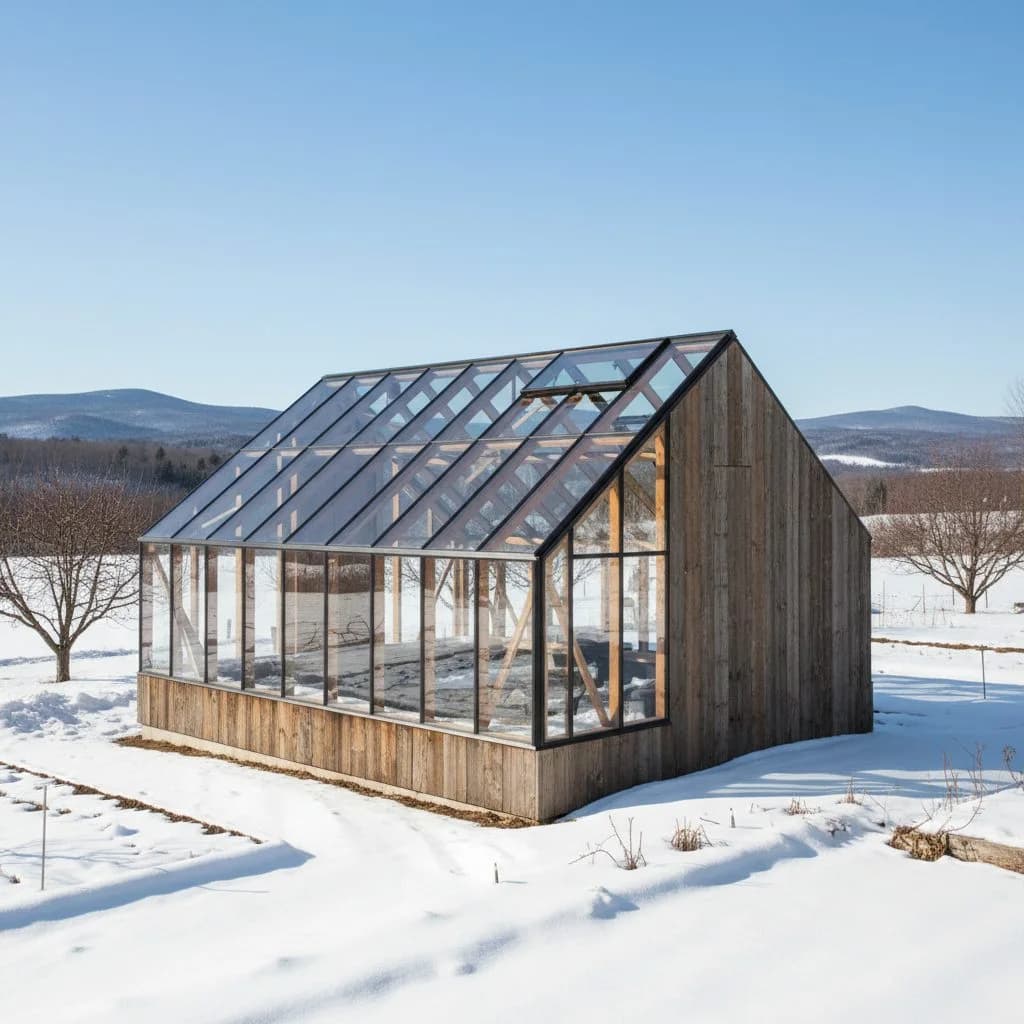
Key takeaways
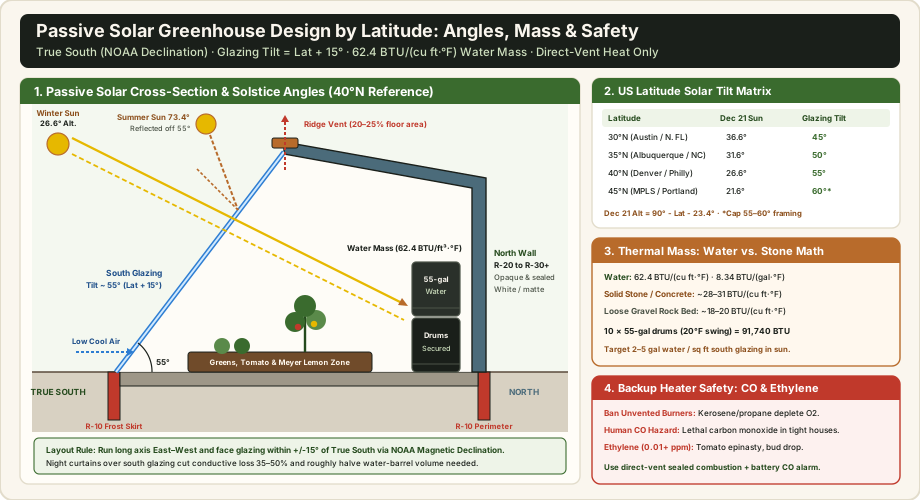
- Winter solstice sun altitude equals 90° - Latitude - 23.4° (ranging from 36.6° at 30°N to 18.6° at 48°N); tilting south glazing at Latitude + 15° keeps low December sun nearly perpendicular while shedding snow and reflecting steep summer sun.
- Always align to true south using NOAA magnetic declination rather than raw compass south, since declination swings from roughly +14° East in the Pacific Northwest to -15° West in New England.
- Water stores 62.4 BTU/(cu ft·°F) (8.34 BTU/(gal·°F)) compared with ~28–31 BTU/(cu ft·°F) for solid stone or concrete and ~18–20 BTU/(cu ft·°F) for loose gravel rock beds—giving water more than double the diurnal storage per cubic foot.
- Seal and insulate every non-collecting surface: build an R-20 to R-30+ north wall, line perimeter foundations with R-10 XPS foam down 2–4 feet, and add movable night thermal curtains to cut overnight heat loss by 35–50%.
- Never run unvented propane, kerosene, or natural gas heaters inside tight solar greenhouses: oxygen depletion creates lethal carbon monoxide (CO) for growers and >= 0.01 ppm ethylene (C2H4) that curls tomato leaves and aborts winter blossoms.
Quick answer: To design a passive solar greenhouse for any US latitude, orient the long axis east-west with primary glazing within 15 degrees of true south using NOAA magnetic declination, and pitch the south glazing at your latitude plus 15 degrees (capped around 55–60 degrees at far-northern sites for framing and wind stability). Insulate the opaque north wall to R-20 to R-30+ and skirt the perimeter foundation down to the frost line, pair sunlit water barrels (62.4 BTU/(cu ft·°F) vs. ~28–31 for solid stone) sized at 2 to 5 gallons per square foot of south glazing, include >= 20–25% floor-area stack venting, and use only direct-vented or electric backup heat to prevent carbon monoxide and ethylene crop damage.
Why Latitude Drives Solar Greenhouse Geometry More Than Hardiness Zones
Conventional four-wall glass greenhouses lose most of their captured winter warmth straight out the north roof and glazing overnight. A passive solar design flips that heat budget: glazing faces strictly toward the winter sun, the north side turns into an insulated thermal shell, and internal thermal mass banks midday surplus BTUs for sub-freezing nights.
Growers often size greenhouse geometry around USDA hardiness maps, yet winter minimum temperature only tells half the story. Solar gain depends on latitude—specifically how high the sun climbs at solar noon on December 21 and how many daylight hours cross the south wall. Two sites sharing winter lows can sit 10 degrees of latitude apart, shifting noon solstice sun height by 10 full degrees and changing optimal roof framing from a moderate pitch to a steep solar collector.
Whether you are planning a compact homestead shed or scaling up four-season greenhouse design, grounding every angle, insulation value, and water-drum volume in latitude physics avoids building a solar oven that roasts greens in July and freezes hard by January.
True South Orientation and Latitude-Indexed Glazing Angles
Run the greenhouse's long axis east to west so the widest glazed face looks toward the southern horizon. Standard magnetic compasses point to magnetic north rather than geographic north, and US declination varies sharply—roughly +14 degrees East in Washington and Oregon versus -15 degrees West in northern Maine. Look up your exact site offset with the NOAA NCEI magnetic declination calculator before staking corner batter boards so your south wall lands within 15 degrees of true south.
Once oriented, check the winter horizon from 9:00 AM to 3:00 PM solar time. Trees, barns, or ridgelines that cast zero shade in August often block the sun all afternoon in December when solar altitude plunges below 25 degrees. For deeper site-layout steps, pair these geometry checks with greenhouse sizing and siting for cold climates.
US Latitude Solar Geometry: Solstice Sun Altitudes and South Glazing Tilt Targets
US Latitude & Reference Cities | Winter Solstice Altitude (Dec 21) | Summer Solstice Altitude (Jun 21) | Target South Glazing Tilt (Lat + 15°) |
|---|---|---|---|
30°N (Austin, TX / Tallahassee, FL) | 36.6° above southern horizon | 83.4° (nearly overhead) | 45° from horizontal (steep shed pitch; sheds high summer sun) |
35°N (Albuquerque, NM / Charlotte, NC) | 31.6° above southern horizon | 78.4° above southern horizon | 50° from horizontal (strong winter gain; moderate framing height) |
40°N (Denver, CO / Philadelphia, PA) | 26.6° above southern horizon | 73.4° above southern horizon | 55° from horizontal (classic balanced passive solar collector pitch) |
45°N (Minneapolis, MN / Portland, OR) | 21.6° above southern horizon | 68.4° above southern horizon | 60° from horizontal (strong snow shedding and low-angle capture) |
48°N (Spokane, WA / Northern Border) | 18.6° above southern horizon | 65.4° above southern horizon | 63° theoretical; cap practical wall framing around 55–60° with knee wall |
The solstice sun formula and practical framing limits
Solar noon altitude follows a clean astronomical rule: Winter Solstice Altitude = 90° - Latitude - 23.4°, while Summer Solstice Altitude = 90° - Latitude + 23.4°. At 40°N, December noon sunlight enters at just 26.6 degrees above the southern horizon. Pitching the south glazing perpendicular to that winter beam places the wall near 63 degrees, though setting glazing at Latitude + 15° (55 degrees at 40°N) captures nearly peak December–February solar radiation without creating an excessively tall back wall.
Above 45°N, strict Latitude + 15° math pushes glazing past 60 degrees, increasing wind-uplift height and lumber spans. Builders in northern latitudes commonly combine a 2-to-3-foot insulated knee wall with a 55-to-60-degree glazed wall or an asymmetric greenhouse style, reinforced against heavy snow and gusts as outlined in greenhouse snow and wind bracing.
Insulated North Walls, Frost Skirts, and Glazing Selection
Because winter sun never strikes the north roof or north wall directly, glazing that side leaks far more BTUs than it admits. Replace north glass with an opaque, air-sealed framed wall insulated to R-20 in mild southern latitudes (30°–35°N) and R-25 to R-30+ in northern latitudes (40°–48°N), insulating the upper north roof slope and opaque east/west corners to match.
Interior wall finish depends on how you store heat. University of Minnesota Deep Winter Greenhouse trials paint the north wall bright white or line it with foil-free light reflective panels when growing winter greens on sunlit benches so diffuse light bounces onto crop canopies. If you stack black water barrels directly against the north wall instead, leave the upper wall white to reflect Photosynthetically Active Radiation (PAR) downward while keeping the drums dark matte for solar absorption.
Passive Solar Glazing Materials: R-Value, Light Transmission, and Service Life
Glazing Material | Approx. R-Value | PAR Light Transmittance | Expected Lifespan & Trade-Offs |
|---|---|---|---|
Single-layer 6-mil polyethylene film | R-0.8 to R-0.9 | 88–92% | 2–4 years; too cold alone for multi-season passive solar without thermal blankets. |
Double-layer inflated polyethylene film | R-1.5 to R-1.7 | 78–83% | 4–6 years; lowest cost per sq ft, requires a small continuous inflation blower. |
Single-pane tempered glass | R-0.9 | 89–91% | 30–50+ years; excellent clarity, but sheds heat rapidly unless paired with night curtains. |
Double-pane insulated glass unit | R-1.9 to R-2.2 | 78–83% | 20–30 years; heavy framing requirements and higher cost; durable in hail zones. |
8 mm twin-wall polycarbonate | R-1.6 to R-1.7 | 80–82% | 10–15 years; lightweight, hail-resistant, diffuses harsh glare evenly across leaves. |
16 mm triple-wall polycarbonate | R-2.5 to R-2.8 | 74–78% | 12–20 years; prime cold-latitude glazing balancing high R-value with solid winter PAR. |
Perimeter frost-line insulation and night thermal curtains
Heat also bleeds sideways through cold perimeter soil. Line the outer foundation with 2 to 4 inches of extruded polystyrene (XPS, R-10 to R-20) extending down 2 to 4 feet—or splayed outward horizontally in a shallow frost-protected skirt—so winter ground freezes stay outside the growing beds. Comparing options in greenhouse kits and cost alongside DIY budget passive solar greenhouse builds shows perimeter foam typically delivers faster payback than upgrading triple-pane glass.
Adding an interior insulated night curtain that pulls across the south glazing at sunset boosts effective R-value dramatically, cutting overnight conductive heat loss by 35% to 50% and shrinking the water-barrel volume needed to stay frost-free.
Thermal Mass Math: 62.4 BTU Water Storage vs. Stone and Rock Beds
Without thermal mass, a sealed solar greenhouse behaves like a parked car—soaring past 90°F on a crisp sunny afternoon and plummeting toward outdoor air temperature two hours after sunset. Effective thermal mass passive heat storage absorbs excess midday BTUs and releases them slowly overnight.
Thermal Mass Heat Capacity Comparison: Water vs. Concrete, Brick, and Rock Beds
Storage Medium | Density (lb/cu ft) | Volumetric Heat Capacity | Volume Needed to Store 91,740 BTU (20°F Swing) |
|---|---|---|---|
Liquid water (in dark drums or totes) | 62.4 lb/cu ft | 62.4 BTU/(cu ft·°F) (8.34 BTU/gal·°F) | 73.5 cu ft (550 gal = ten 55-gal drums); convects internally for fast charge/discharge. |
Solid poured concrete or dense granite | 140–165 lb/cu ft | ~28–31 BTU/(cu ft·°F) | ~150–164 cu ft (over 2× water volume; only outer 4–6 inches cycle daily without air ducts). |
Common masonry brick | 120 lb/cu ft | ~24 BTU/(cu ft·°F) | ~191 cu ft; higher masonry cost and slower surface-to-core heat conduction. |
Loose gravel / river-rock bed (35–40% voids) | 95–105 lb/cu ft | ~18–20 BTU/(cu ft·°F) | ~230–255 cu ft; requires fan-forced ducts (GAHT / climate battery) to charge effectively. |
Worked BTU math: sizing water barrels per square foot of glazing
Water combines a density of 62.4 lb/cu ft with a specific heat of 1.0 BTU/(lb·°F), yielding 62.4 BTU/(cu ft·°F)—or 8.34 BTU/(gal·°F). Suppose a 10 × 20 ft greenhouse has 160 sq ft of south glazing and holds ten black 55-gallon drums (550 gallons, or 73.5 cu ft of water) stacked in direct winter sun along the north wall.
If sunny afternoon temperatures lift the water from 52°F to 72°F (a 20°F rise), those ten barrels absorb 550 gal × 8.34 BTU/(gal·°F) × 20°F = 91,740 BTU (matching 73.5 cu ft × 62.4 × 20 = 91,728 BTU). Releasing that 91,740 BTU evenly across a 14-hour winter night supplies roughly 6,550 BTU/hr of passive heating without burning a drop of fuel. Achieving that same 91,740 BTU storage over a 20°F swing in solid stone or concrete (~30 BTU/(cu ft·°F)) requires 153 cubic feet of masonry—more than double the volume, and unlike water that circulates internally by convection, thick concrete stores heat sluggishly past its outer 4 to 6 inches.
Extension guidelines commonly target 2 to 3 gallons of sunlit water per square foot of south glazing in temperate southern latitudes or curtain-equipped houses, scaling up to 4 to 5+ gallons per square foot of glazing at cold northern latitudes (42°–48°N). Notice two critical field rules: water barrels sitting in permanent bench shade store almost no useful solar heat, and each filled 55-gallon drum weighs roughly 460 pounds—so anchor stacked barrels securely against framing studs or rest them on solid concrete pads. Where floor space is tight, explore active sub-floor storage in underground greenhouse ventilation and condensation or walipini vs. above-ground greenhouses.
Ventilation, Backup Heater Hazards (CO & Ethylene), and Crop Zones
Steep south glazing and tight R-30 insulation create two year-round risks that catch new builders off guard: afternoon overheating on clear days—even in February or July—and deadly combustion fumes when growers add unvented backup heaters during cloudy polar-vortex cold snaps.
Critical safety alert: carbon monoxide and ethylene from unvented heaters
In a weather-stripped passive solar greenhouse, unvented propane, kerosene, or natural gas space heaters rapidly consume interior oxygen and dump combustion exhaust straight into the growing air. Incomplete combustion creates a double emergency documented repeatedly by Michigan State University, Alabama Cooperative Extension, and University of Delaware vegetable specialists.
Never run unvented fossil-fuel heaters inside a sealed greenhouse: First, oxygen-starved unvented burners generate odorless, potentially lethal carbon monoxide (CO) inside the structure, putting anyone stepping inside to harvest at acute risk. Second, combustion leaks trace ethylene gas (C2H4) plus nitrogen oxides; concentrations as low as 0.01 to 0.1 ppm act as a potent plant hormone that causes epinasty (downward curling of turgid petioles), thickened twisted stems, flower bud abortion, and fruit drop within 24 hours. Use only direct-vented, sealed-combustion heaters with factory sealed outside intake and exhaust pipes (or atmospheric vented heaters with >= 1 sq in of dedicated outside combustion-air free area per 2,000–2,500 BTU/hr and exhaust stacks above the ridge), or electric heat pumps paired with a battery CO detector.
Matching crops and passive ventilation across seasons
Cool-season greens like lettuce and spinach thrive along the coolest perimeter beds under passive winter light (often surviving down to 20–28°F inside unheated thermal-mass zones; see cold-hardy fall and winter vegetables). Warm-season tomatoes—which also act as early-warning indicator plants because they show ethylene leaf epinasty faster than almost any crop—belong in the warmest sunlit center once night lows hold above 50°F, aided by pollinating greenhouse tomatoes and frost-buffer lessons from solar livestock water heaters.
Containerized subtropicals such as Meyer lemon and Brown Turkey fig perform steadily near sunlit water drums when protected against sub-freezing drafts, extending guidelines in growing citrus indoors and overwintering figs in cold zones.
To purge excess spring and summer heat, build passive stack venting—low intake vents near the south floor paired with high ridge exhaust vents—totaling 20% to 25% of greenhouse floor area using heat-activated wax-cylinder openers. Reinforce summer cooling with 40–50% shade cloth, passive greenhouse ventilation, greenhouse shade and whitewash, off-grid greenhouse cooling, and solar greenhouse fans as part of whole-system greenhouse climate control.