Key takeaways
- Hydrophobic soil occurs when waxy organic compounds coat dry soil particles, causing irrigation water to bead up and run off.
- The problem is intensely prevalent in Australian sandy soils, particularly across Western Australia, South Australia, and coastal regions.
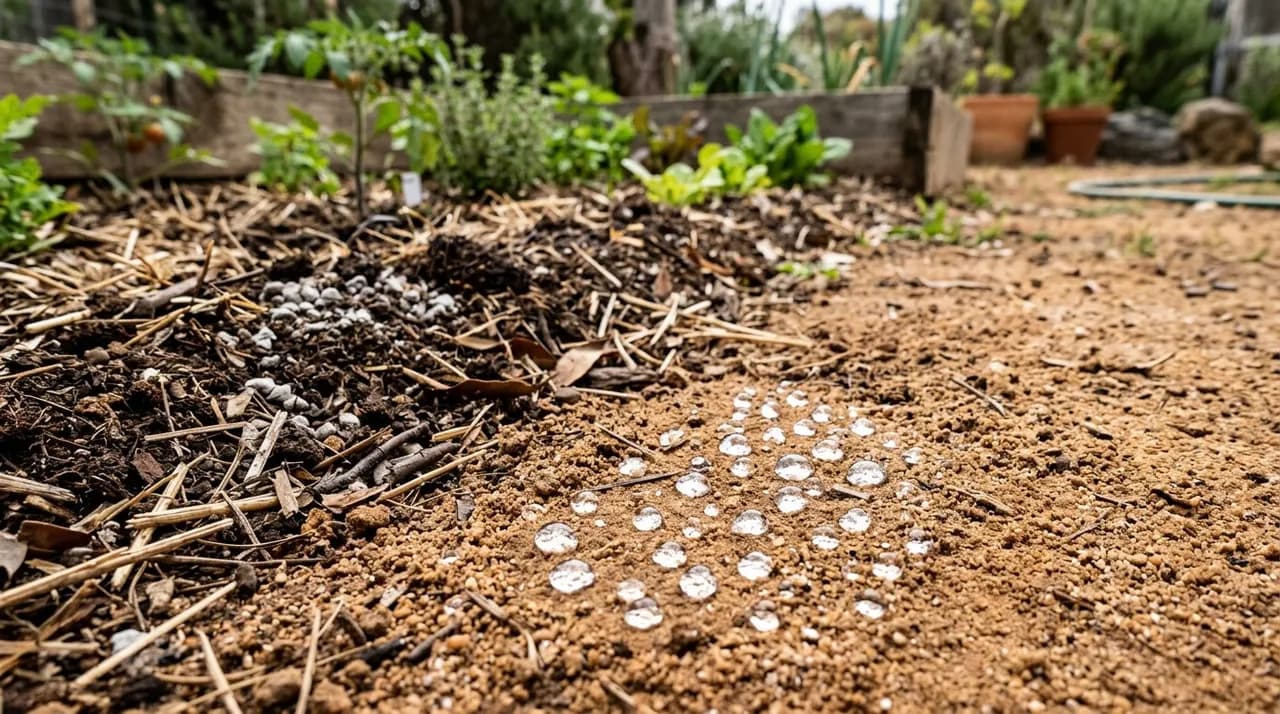
- Conduct a water droplet penetration test: if water beads on the soil surface instead of soaking in within seconds, the soil is repellent.
- Apply quality horticultural soil wetting agents to break water surface tension and allow initial moisture penetration.
- Incorporate calcium bentonite clay (3 to 5 kg per square metre) and compost into sandy beds to substantially reduce water repellence.
Quick answer: To fix hydrophobic soil in Australian gardens, apply a certified soil wetting agent to break surface tension, followed by deep watering. For a permanent structural cure in sandy soil, incorporate bentonite clay and well-aged compost, then maintain a thick layer of organic mulch.
Discovering hydrophobic soil in your garden beds is one of the most frustrating experiences for Australian growers. You turn on the hose or run the drip irrigation for an hour, only to watch water bead into glossy spheres, pool on the surface, or channel down hairline cracks into paths while leaving your plant root zones completely parched.
Water repellence is a signature challenge across the Australian continent. From the pale, coarse sands of the Perth coastal plain to dry sandy loams in Adelaide, Melbourne, and regional areas, prolonged summer heat bakes dry topsoil. Plants begin to wilt, flower buds drop, and newly transplanted seedlings fail to establish, despite constant watering.
Understanding why dry soil repels water helps solve it. By combining rapid-acting soil wetting agents for immediate relief with permanent mineral and organic amendments (such as bentonite clay, worm castings, and coarse organic mulches), you can restore healthy soil hydrology and ensure water reaches your crops.
What causes soil to become hydrophobic?
Hydrophobicity is a biochemical coating that develops on soil particles over time, not a permanent defect of the sand itself.
- Waxy hydrocarbon residues: As plant debris, fallen leaves, roots, and fungal hyphae break down in hot, dry environments, they produce natural waxes, oils, and long-chain organic compounds. Eucalypts, tea trees, and many native Australian plants produce particularly high levels of waxy resins.
- Particle coating in sandy soil: Coarse sand particles have a relatively small total surface area compared to fine clay particles. When waxy residues accumulate, they coat individual sand grains with a microscopic waterproof jacket.
- Loss of electrostatic attraction: Water molecules are polar and naturally bond to charged soil minerals. The hydrophobic organic coating masks these charges, creating a non-polar surface that repels water molecules.
- Preferential channeling: When water encounters a repellent surface, it seeks the path of least resistance, flowing down cracks or worm burrows without wetting the surrounding soil mass.
To understand how soil texture influences moisture dynamics, review our detailed guide on sandy soil water retention.
How to test for water-repellent soil
Before applying treatments, perform two simple diagnostic tests in your garden beds:
1. The water droplet penetration test (WDPT)
- Scrape away the top layer of mulch to expose the bare, dry mineral soil.
- Place several individual drops of clean water onto the soil surface using a dropper or your fingertips.
- 0 to 5 seconds: Wettable (normal soil).
- 5 to 60 seconds: Slightly hydrophobic.
- 1 to 10 minutes: Moderately hydrophobic.
- Over 10 minutes: Severely hydrophobic.
2. The post-watering spade check
- Water a suspected problem bed thoroughly with a watering can or sprinkler for 15 minutes.
- Take a clean garden spade and dig a small trench 15 cm deep into the centre of the bed.
- Examine the soil cross-section: in severely hydrophobic ground, you will find a dark, damp crust only 5 mm thick, while the soil directly underneath remains bone-dry, powdery grey sand.
For testing larger garden areas and planting zones, compare this method with our standardized soil drainage percolation test.
Immediate relief: using soil wetting agents
When garden plants are actively suffering from heat stress in midsummer, you need an immediate solution to break surface tension and deliver water to the root zone.
How wetting agents work
Soil wetters (surfactants) possess molecules with two distinct ends: a hydrophobic (water-hating) tail that binds to the waxy coating on the sand grain, and a hydrophilic (water-loving) head that attracts water molecules. This bridges the physical gap, allowing moisture to coat and penetrate the soil profile.
Application best practices
- Re-wetting potted plants: For severely hydrophobic potting mix in containers: submerge the pot in a bucket of water for 30 minutes until bubbling stops, or apply water in pulses: a light sprinkle to break surface tension, wait 15 minutes, then water deeply.
- Choose the right product: Use a soil wetter containing yucca extract or other plant saponins. Synthetic wetting agents (based on non-ionic surfactants) work faster on severe repellence, but botanical wetters are gentler on earthworms and soil life. Granular formulations applied around the root zone last longer in hot weather, while liquid concentrates provide rapid knockdown for dry beds.
- Avoid ordinary dishwashing liquids: They are designed to strip grease, not wet soil, and their sodium and fragrance levels can damage tender root tips. Use a garden-specific soil wetter or a plain, unperfumed horticultural soap instead.
- Water in thoroughly: Apply liquid soil wetter according to product label rates, then immediately follow with a generous drenching of clean water to wash the surfactant down into the top 15 cm to 20 cm of the root zone.
- Reapplication frequency: In hot Australian summers, standard wetting agents provide relief for roughly 6 to 10 weeks before microbial activity breaks down the surfactant molecules.
The permanent fix: clay amendments and organic matter
Wetting agents provide temporary relief, but they do not alter the underlying texture of sandy soil. To eliminate hydrophobicity permanently, you must increase the soil's surface area and mineral exchange capacity.
1. Incorporating bentonite clay
Bentonite (a naturally occurring smectite clay) is the most effective mineral amendment for transforming water-repellent Australian sands:
- How it works: Microscopic clay platelets have an immense surface area and strong electrical charges. When blended with sand, the clay coats the sand grains, masking the waxy hydrocarbon residues and holding onto moisture.
- Application rate: Spread calcium bentonite clay at 3 kg to 5 kg per square metre into the top 10 cm to 15 cm of sandy soil, then blend in 3 cm to 5 cm of compost. Clay gives sand the polar mineral surfaces it lacks; one treatment makes a lasting difference, though very sandy soils often need a top-up after a couple of seasons.
- Mixing technique: Never leave bentonite as a solid layer on top of the soil, as it will form an impermeable crust. Spread the clay evenly across the bed, then work it thoroughly into the top 15 cm of sand using a garden fork or spade until fully integrated.
2. Boosting humified organic matter
Blended alongside clay, mature organic matter creates stable organo-mineral complexes:
- Spread a 5 cm layer of well-aged compost, leaf mould, or rich worm castings across the clay-amended bed.
- Fork the compost into the top 15 cm alongside the bentonite clay.
- The combination of clay and humified organic matter increases water-holding capacity, provides a habitat for beneficial soil microbes, and promotes strong root penetration.
For advice on integrating soil building with productive backyard layouts, explore our veggie patch ideas.
Long-term biological protection and mulching
Once you have treated the soil, adopting proper cultural management prevents hydrophobicity from returning in future seasons.
Maintain continuous thick mulch
Bare Australian soil exposed to direct summer sunlight heats up past 50°C, accelerating the baking of waxy resins onto sand particles:
- Apply a 7 cm to 10 cm layer of coarse organic mulch, such as arboricultural woodchips, pea straw, or coarse lupin mulch.
- Coarse mulches shade the soil surface, lower soil temperatures, reduce evaporative water loss, and encourage earthworms to move through the upper soil layers.
- For maximum moisture retention and weed control in hot climates, explore sheet mulching methods.
Keep living roots in the ground
Fallow, barren garden beds dry out and develop hydrophobicity much faster than beds supporting active plant life. Living roots release exudates that support mycorrhizal fungi and beneficial bacteria that process organic waxes:
- In between main vegetable crops, sow green manure cover crops such as cowpeas, buckwheat, or daikon radish.
- Transitioning into cooler months, plan your seasonal succession using our guide on what to plant in autumn australia.
Identifying repellent soil early, applying wetting agents during dry spells, and amending sandy beds with bentonite clay and compost keeps soil absorbing water evenly through hot months, supporting vegetables and vines like passionfruit in Australia.