Key takeaways
- Comply with Australian wildlife netting laws by using mesh with an aperture size of 5 mm by 5 mm or smaller at full stretch.
- Use the "finger test" before buying netting: if your finger can pass through any mesh hole, the netting is very likely unsafe. The legal test in Victoria is a mesh aperture of 5 mm x 5 mm or smaller measured at full stretch, so check the product's stated aperture as well.
- Choose white netting rather than green or black, as white stands out against dark foliage for nocturnal flying foxes and possums. (Microbats echolocate rather than rely on sight, which is why aperture size, not colour, is what protects them.)
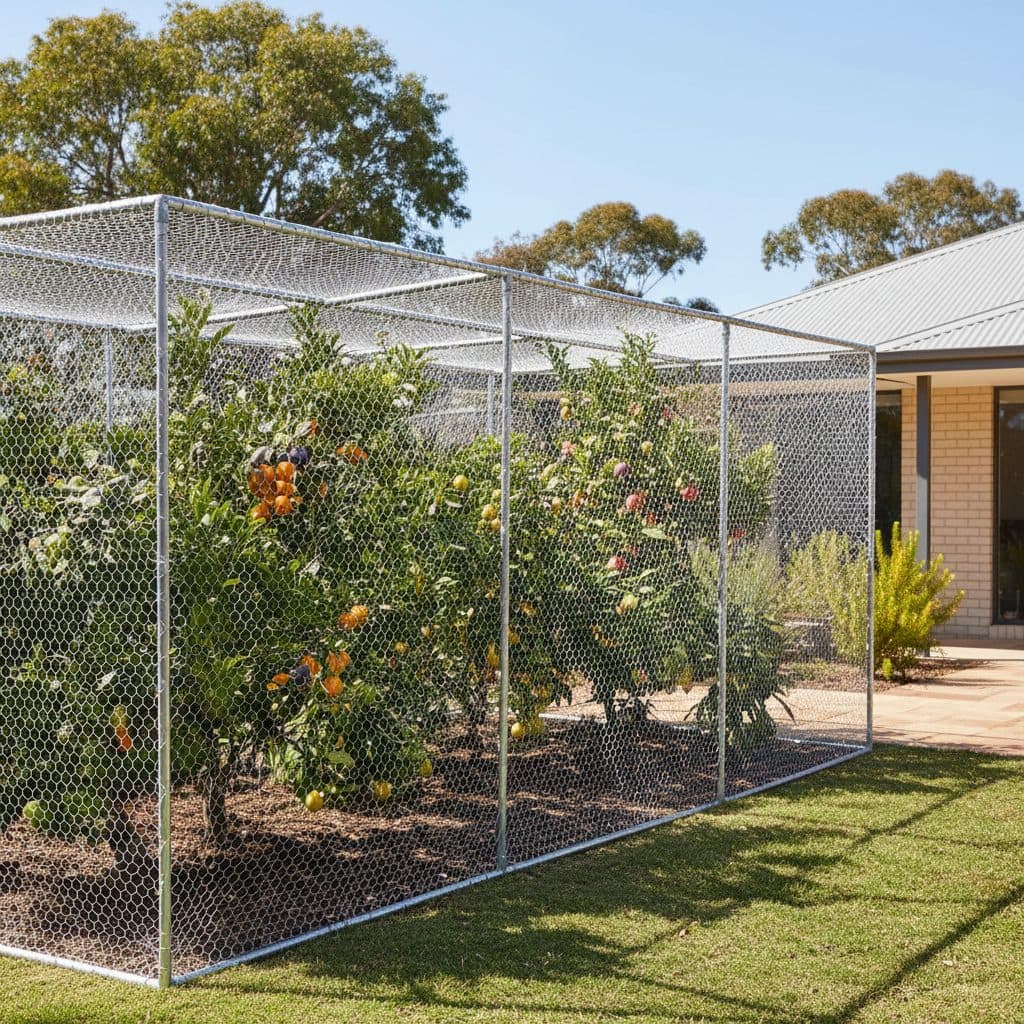
- Erect a rigid timber or polypipe frame over fruit trees so the net remains taut and elevated above foliage rather than draped loosely across branches.
- Secure the bottom perimeter tightly against the ground or trunk to prevent protected native possums and birds from crawling beneath.
Quick answer: Installing fruit tree netting in Australia requires using wildlife-safe exclusion mesh with an aperture size of 5 mm or smaller, complying with statutory animal welfare regulations such as Victoria's Prevention of Cruelty to Animals Regulations. Nets should be bright white for nocturnal visibility, mounted tautly over a rigid poly pipe or timber frame, and fastened securely at the base to protect ripening fruit from birds, flying foxes, and possums without risk of entanglement.
Backyard fruit trees across Australia face heavy grazing pressure from native birds (parrots, silvereyes, cockatoos), grey-headed flying foxes, and common brushtail or ringtail possums. Stone fruit ripens from late spring into summer, figs and apples through late summer and autumn, and citrus through winter — so the netting window depends on the tree, not the calendar.
However, old-fashioned, wide-aperture black monofilament netting has historically caused horrific injuries and deaths to native wildlife. Animals become entangled in loose, stretchy netting, resulting in constriction, starvation, and severe limb damage.
Understanding Australian wildlife-safe netting regulations, selecting compliant 5 mm mesh, and building freestanding canopy frames protects the crop while keeping native animals safe.
Australian wildlife netting regulations and the 5 mm rule
In response to widespread wildlife casualties, Australian authorities have established strict rules and guidance for household fruit tree netting.
+------------------------+-----------------------------------+-----------------------------------------+
| Jurisdiction           | Governing Framework               | Netting Requirements                    |
+------------------------+-----------------------------------+-----------------------------------------+
| Victoria (VIC)         | Prevention of Cruelty to Animals  | Mandatory 5 mm x 5 mm max mesh size     |
| Other States & Terr.   | State Wildlife / Animal Welfare   | 5 mm mesh is best-practice guidance;    |
| (NSW, QLD, SA, WA, etc)| Guidance & Codes of Practice      | check state authority before relying    |
+------------------------+-----------------------------------+-----------------------------------------+
+-------------------------------------------------------------------+
| THE AUSTRALIAN NETTING "FINGER TEST" |
| |
| [HAZARDOUS / NON-COMPLIANT] [COMPLIANT / WILDLIFE-SAFE] |
| - Mesh aperture > 5 mm - Mesh aperture <= 5 mm |
| - Finger easily passes through - Finger CANNOT pass through |
| - Thin nylon monofilament - Knitted cross-weave HDPE |
| - Entangles bat wings & toes - Acts as a smooth solid wall |
+-------------------------------------------------------------------+In Victoria, it is an offence under the Prevention of Cruelty to Animals Regulations to use fruit tree netting on residential properties with a mesh size greater than 5 mm by 5 mm at full stretch. Breaching the Victorian requirement is an offence under those regulations; check the current penalty and enforcement arrangements with the responsible Victorian department. In other states and territories, 5 mm aperture is best-practice guidance to protect wildlife.
+-------------------------------------------------------------------+
|               WHAT TO DO IF AN ANIMAL IS ENTANGLED                |
|                                                                   |
| If you find an animal caught in netting, do not cut it free       |
| yourself and never handle a bat or flying fox — even a scratch    |
| can transmit Australian bat lyssavirus. Cover the animal loosely  |
| with a towel or box, keep pets and children away, and phone your  |
| state wildlife rescue service immediately. Only vaccinated,       |
| trained rescuers should handle bats.                              |
+-------------------------------------------------------------------+
Possum protection and ethical backyard deterrence
All possum species in Australia (including the common brushtail and common ringtail possum) are protected native wildlife under state legislation.
+-------------------------------------------------------------------+
|               LEGAL RESPONSIBILITIES FOR POSSUMS                  |
+-------------------------------------------------------------------+
| 1. NEVER Harm or Poison: Causing physical harm is strictly illegal|
| 2. NO Unlicensed Trapping: Trapping requires state wildlife permit|
| 3. NO Distant Relocation: Must be released on same property       |
| 4. EXCLUSION ONLY: Taut, compliant netting is the lawful method   |
+-------------------------------------------------------------------+
Trapping and release rules differ by state — in general a trapped possum must be released on the same property, within a short distance and the same night. Check your state wildlife authority before trapping anything.
Properly installed, taut 5 mm exclusion netting prevents possums from accessing fruit without causing injury or requiring trapping.
Netting material specifications: colour, weave and weight
Choosing the right netting fabric ensures durability under harsh Australian summer UV radiation while protecting wildlife.
+------------------------+-------------------+-------------------------------------------------------------------+
| Specification Feature  | Ideal Benchmark   | Horticultural & Wildlife Reason                                   |
+------------------------+-------------------+-------------------------------------------------------------------+
| Mesh Aperture Size     | 2 mm to 5 mm max  | Excludes birds, possums and flying foxes; insect exclusion needs a much finer bag or mesh |
| Mesh Colour            | Bright White      | Highly visible to bats/possums at night                           |
| Construction           | Knitted UV HDPE   | Stated fabric weight (gsm); will not ladder; resists possum claws |
| Material Type          | 100% Virgin HDPE  | UV-stabilised for 5 to 10 years outdoors                          |
| Fabric Weave           | Knitted lock-mesh | Will not unravel when snagged                                     |
+------------------------+-------------------+-------------------------------------------------------------------+
Flying foxes and possums navigate visually at night, and white netting stands out against dark foliage where green or black netting disappears. (Microbats echolocate rather than rely on sight, which is why aperture size, not colour, is what protects them.) Dark green and black netting becomes invisible against dark leaves at night, leading to disastrous collisions.
Compare bird deterrent systems and physical barriers in birds vs berries netting scare devices.
Frame construction: why throw-over netting fails
Simply throwing loose netting directly over a fruit tree canopy creates two major failures:
- Weight sags onto branches, allowing birds and possums to eat fruit pressed against the mesh.
- Billowing loose folds trap lizards, snakes, and birds on the ground.
+-------------------------------------------------------------------+
|               RIGID FREESTANDING NETTING FRAME DESIGN             |
|                                                                   |
|          +==================== Dome Peak ===================+     |
|         /                                                    \    |
|        /    [ Taut 5 mm White Netting Stretched Over Frame ]  \   |
|       /                                                        \  |
|   |=======|                                                |=======|
|   |  PVC  | 2.5 m High                          2.5 m High |  PVC  |
|   | Conduit                                                | Conduit
|   |  Pipe |         [ Pruned Fruit Tree Canopy ]           |  Pipe |
|   +-------+                                                +-------+
|  [Star Picket Anchor]                            [Star Picket Anchor]
|  ========================= Ground Level ===========================
|               [ Base Pegged Securely into Soil ]                  |
+-------------------------------------------------------------------+
Building an inexpensive poly pipe frame
- Drive Ground Stakes: Drive four steel star pickets or hardwood stakes 60 cm into the ground at each corner of the tree canopy, and fit a plastic safety cap to every picket top.
- Arch Poly Conduit: Slide lengths of 25 mm rural poly pipe or electrical conduit over opposing diagonal stakes to form a crossed dome over the tree.
- Drape and Tension Netting: Pull the white 5 mm netting smoothly over the poly arches. Ensure the net does not touch outer foliage.
- Anchor Base Perimeter: Fasten the bottom of the net firmly to the soil using galvanised ground pins, timber base boards, or bricks. The net must be drum-tight.
For commercial orchard configurations and desert canopy protection, see shade netting desert fruit trees.
Individual branch bagging for large trees
If a mature fruit tree is too large to net completely, individual fruit bagging is an economical, highly effective alternative.
+-------------------------------------------------------------------+
|               INDIVIDUAL FRUIT BAGGING TECHNIQUE                  |
|                                                                   |
|   1. Commercial Bags: Use reusable 2 mm insect exclusion bags     |
|   2. Installation:    Slip bag over individual fruit or cluster   |
|   3. Drawstring Seal: Pull double drawstrings tight around branch |
|   4. Pest Protection: Blocks QLD fruit fly, birds, and possums    |
+-------------------------------------------------------------------+
Individual exclusion bags made of fine organza or UV-rated mesh allow sunlight and air to reach ripening stone fruit while preventing Queensland fruit fly stings and parrot bites.
Learn more about pruning fruit trees to keep them at a manageable, net-friendly height in how to prune fruit trees.
Seasonal deployment and net storage
Netting is only required while fruit is developing and ripening.
+-------------------------------------------------------------------+
|               SEASONAL NETTING PROTOCOL                           |
+-------------------------------------------------------------------+
| [Flowering / Set]    Keep nets OFF during blossom for pollination |
| [Late Spring-Summer] Install 5 mm net on stone fruit post-petal fall|
| [Late Summer-Aut]    Net figs, apples, and pears as fruit swells  |
| [Winter]             Net winter citrus where bats/possums target it|
| [Post-Harvest]       Remove net, wash dust off, fold, store in shed|
+-------------------------------------------------------------------+
Leaving nets on trees during flowering blocks honeybees and native solitary bees, causing pollination failure and poor fruit set. Install netting only after flower petals have dropped and green fruitlets are visible.
Coordinate your backyard planting and netting schedule with what to plant in november australia and protect tropical species detailed in growing bananas in australia.