Key takeaways
- Design your Australian veggie patch with a true north-facing orientation to maximize Southern Hemisphere solar exposure.
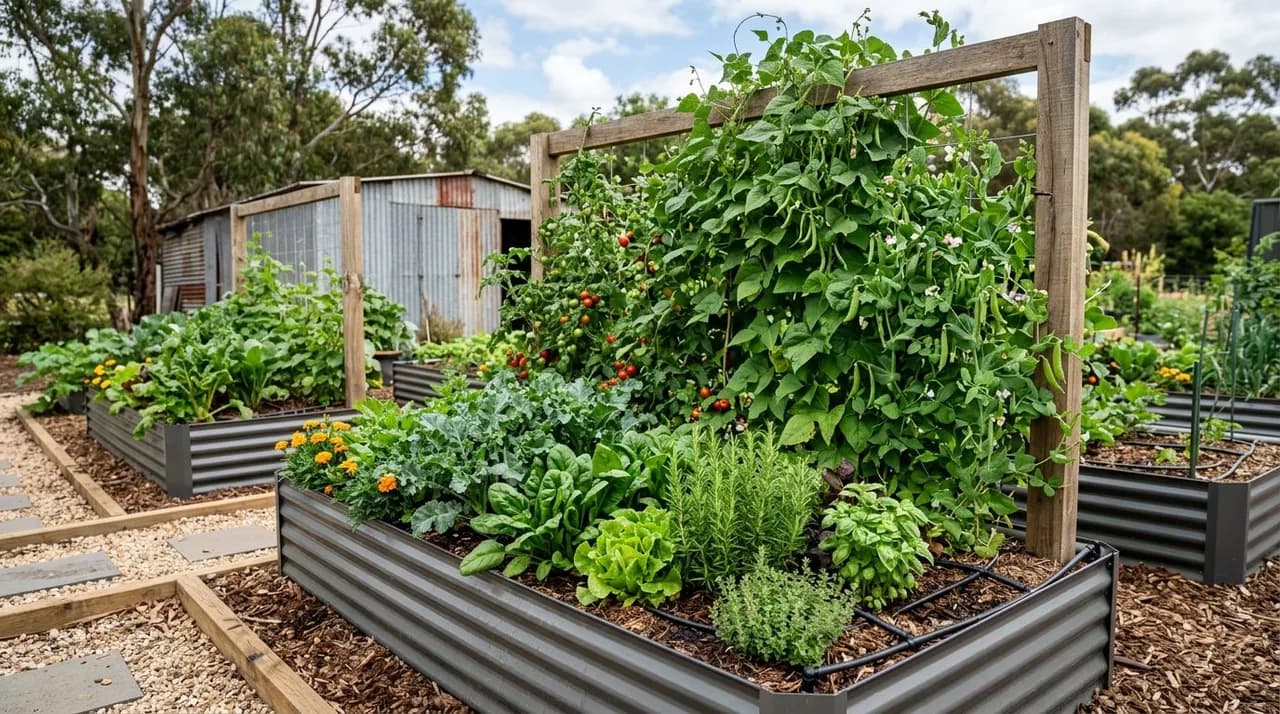
- Colorbond corrugated steel raised beds provide durable, termite-proof growing zones with excellent drainage.
- Sub-irrigated wicking beds deliver water directly to the root zone via capillary action, sharply reducing evaporative losses during 40°C heatwaves.
- Protect crops from protected native possums and birds using wildlife-safe exclusion netting (5 mm mesh) mounted on arched poly-pipe hoops.
- Incorporate companion flowers, vertical climbing frames, and wide mulch paths to create a low-maintenance, biodiverse layout.
Quick answer: Inspiring Australian veggie patch ideas combine raised steel beds, water-efficient wicking systems, north-facing sun orientation, and wildlife-safe netting frames. Adapting bed designs to your local climate zone ensures productive year-round harvesting while conserving precious water.
Exploring practical veggie patch ideas tailored to Australian conditions is the first step toward transforming an ordinary backyard lawn into a productive food garden. From coastal suburbs in Sydney and Brisbane to temperate backyards in Melbourne and Adelaide or the sandy plains of Perth, growing your own organic produce is an Australian way of life.
However, designing a productive food garden in Australia requires addressing unique environmental realities. Australian growers must plan for blazing summer sun with temperatures regularly exceeding 40°C, unpredictable rainfall, water restrictions, hungry native wildlife, and soils that range from water-repellent coastal sand to heavy alkaline clay. Standard European or North American garden layouts often fail under the harsh southern sun.
Whether you have a compact urban courtyard, a suburban quarter-acre block, or a rural homestead, choosing the right garden layout elevates your growing success. By integrating raised corrugated steel beds, self-watering wicking reservoirs, no-dig soil building, and wildlife-safe exclusion structures, you can build an attractive, high-yielding veggie patch that feeds your family all year round.
Orientation, sun angles, and Southern Hemisphere layouts
In the Southern Hemisphere, getting your garden orientation right determines how much winter sunlight and summer shade your crops receive.
Maximizing true north solar exposure
- North-facing aspect: Position your primary vegetable beds where they receive uninterrupted sunlight from the north. In winter (June to August), the sun sits low in the northern sky; beds shaded by southern fences or large two-storey walls will stall in growth.
- East-to-west bed alignment: Aligning rectangular beds along an east-west axis ensures equal sun distribution across rows and prevents tall crops from casting long shadows over shorter greens.
- Windbreaks against seasonal extremes: Australian summers bring scorching, dry northerly or westerly winds that desiccate leafy greens within hours. In contrast, winter storms bring icy southerly blasts. Plant hardy native hedging or erect slatted timber screens along exposed boundaries to filter harsh winds without blocking sunlight.
To keep sandy beds functioning efficiently beneath high summer solar loads, learn how to prevent water run-off in our guide on how to fix hydrophobic soil.
1. Raised corrugated steel and Colorbond beds
Corrugated steel and Colorbond raised garden beds are the signature aesthetic of modern Australian backyard food production.
Why raised steel beds excel in Australia
- Durability and pest resistance: Unlike treated timber, which eventually rots or attracts subterranean termites, galvanised and coated steel beds last for decades without deteriorating.
- Ergonomic heights: Available in heights ranging from 40 cm up to 80 cm, waist-high raised beds significantly reduce the bending and kneeling required for planting and weeding.
- Soil control: Raising beds above native soil allows you to bypass poor subsoils, heavy compaction, and aggressive tree roots from surrounding gum trees.
- Thermal benefits: In cool and temperate regions (Melbourne, Tasmania, inland highlands), steel beds warm up rapidly in early spring (September), giving heat-loving crops like capsicums and tomatoes a valuable head start.
Filling deep beds with hugelkultur
Filling an 80 cm deep bed entirely with premium bagged potting mix is expensive. Instead, use a layered hugelkultur approach:
- Place thick, untreated hardwood logs, fallen branches, and decaying timber in the bottom 30 cm of the bed.
- Add a 15 cm layer of nitrogen-rich green waste, lawn clippings, and aged manure.
- Top with 30 cm to 35 cm of rich organic loam blended with aged compost and worm castings. The buried wood acts as an underground sponge, absorbing winter rains and releasing moisture and nutrients over years of slow decomposition.
2. Self-watering wicking beds for drought-prone regions
In hot, arid, and water-restricted regions of Australia, traditional overhead watering loses immense amounts of moisture to surface evaporation. Sub-irrigated wicking beds are an effective water-wise solution.
How wicking beds function
A wicking bed incorporates a sealed water reservoir beneath the growing soil:
- A waterproof liner or sealed container holds a 15 cm to 20 cm layer of washed drainage gravel or scoria, fitted with an overflow drainage pipe and a vertical PVC fill tube.
- A permeable geotextile fabric sits on top of the gravel, separating the reservoir from 30 cm of compost-rich organic soil.
- Through capillary action, water wicks upward from the reservoir directly into the active root zone, keeping the soil consistently moist while the top surface stays dry.
Wicking beds deliver water directly to the root zone via capillary action from a sealed water reservoir beneath the soil, sharply reducing the evaporative losses of overhead watering and buffering vegetables against extreme 40°C heatwaves. For construction blueprints and material sourcing, explore our comprehensive guide on wicking beds and self-watering design and container adaptations in self-watering containers for veggies and herbs.
3. No-dig sheet-mulched in-ground gardens
If you have a large suburban lawn and want an expansive, budget-friendly growing area, the no-dig sheet-mulching method builds fertile topsoil without mechanical tilling.
The Australian no-dig method
- Smother the grass: Scalp the existing lawn or weeds with a mower, then lay down overlapping layers of thick, non-glossy cardboard or 10 layers of newspaper directly over the ground.
- Layer organic nutrients: Spread a 5 cm layer of aged cow or horse manure, followed by 10 cm of lucerne hay or pea straw, a generous dusting of blood and bone, and 10 cm of rich garden compost.
- Top with mulch: Finish with a 5 cm layer of sugar cane mulch or lupin mulch.
- Planting directly: Part the mulch layers, add a handful of compost, and plant seedlings directly into the decomposing sandwich. Earthworms and soil microbes will break down the organic matter into dark, crumbly loam within a single season.
To master moisture buffering across seasonal cycles, review our detailed guide on sheet mulching for moisture retention.
4. Wildlife-safe netting and exclusion enclosures
Australia has diverse native wildlife, but hungry ringtail and brushtail possums, cockatoos, fruit bats (flying foxes), and cabbage white butterflies can strip a veggie patch bare overnight.
Possum and bird protection rules
- Protected Native Wildlife: In every Australian state and territory, native possums and birds are strictly protected by law. Harming, trapping without a wildlife licence, or relocating possums is illegal and harmful to native ecosystems. Physical exclusion is the only ethical and effective solution.
- Hoop Frame Systems: Bend 25 mm flexible white PVC poly-pipes into arches over raised beds, securing the pipe ends inside timber saddles attached to the bed walls.
- Wildlife-Safe Netting Mesh: Drape wildlife-safe white exclusion netting over the hoops. In Victoria, wildlife netting laws mandate a mesh size of 5 mm × 5 mm or smaller on household fruit-bearing plants to prevent bird and flying fox entanglement; gardeners elsewhere should follow the same 5 mm standard for animal safety. Large-aperture netting (where fingers pass through easily) traps and injures birds, lizards, and bats.
- Queensland Fruit Fly Biosecurity: In fruit fly risk zones across eastern and northern Australia, use 2 mm insect mesh over fruiting crops to prevent egg-laying stings on tomatoes and capsicums without chemical sprays.
For companion climbing structures, train vigorous vines along boundaries by reviewing passionfruit troubleshooting in Australia.
5. Small-space courtyard and vertical patch ideas
Living in a rental property, townhouse, or urban apartment does not prevent you from growing fresh food:
- Vertical Trellises on Boundary Fences: Attach modular mesh panels to sunny Colorbond or timber fences to train climbing beans, snow peas, and vining cherry tomatoes vertically, taking up zero floor footprint.
- Mobile Planter Boxes on Castors: Build or buy timber planter boxes mounted on heavy-duty lockable wheels. Roll them into sunny courtyard spots in winter and wheel them beneath patio shade during extreme summer heatwaves.
- Tiered Herb Planters: Stack terracotta pots or modular cedar boxes vertically near the kitchen door for continuous pickings of fresh parsley, basil, coriander, and thyme.
Seasonal planting transitions for Australian patches
A well-designed veggie patch should yield continuous harvests throughout the entire calendar:
- Spring (September to November): Plant warm-season favorites: tomatoes, capsicums, zucchini, sweet corn, cucumbers, and sweet basil.
- Summer (December to February): Maintain thick organic mulch, monitor irrigation systems, shade delicate leafy greens, and sow heat-tolerant beans.
- Autumn (March to May): Transition into cool-season crops. Clear spent summer vines and plant brassicas, root vegetables, and leafy greens. Plan your seasonal changeover using our complete guide on what to plant in autumn australia.
- Winter (June to August): Harvest crisp silverbeet, broccoli, broad beans, and winter greens while planning spring infrastructure improvements. (Garlic planted in autumn is harvested in late spring or early summer, once lower leaves yellow.)
By combining durable raised beds, water-wise wicking principles, and wildlife-friendly exclusion netting, you can build a resilient Australian veggie patch that delivers fresh, nutrient-dense food for years to come.