Key takeaways
- Design your layout based on sunlight exposure: place fruiting crops in full sun (6+ hours) and leafy greens or herbs in partial shade.
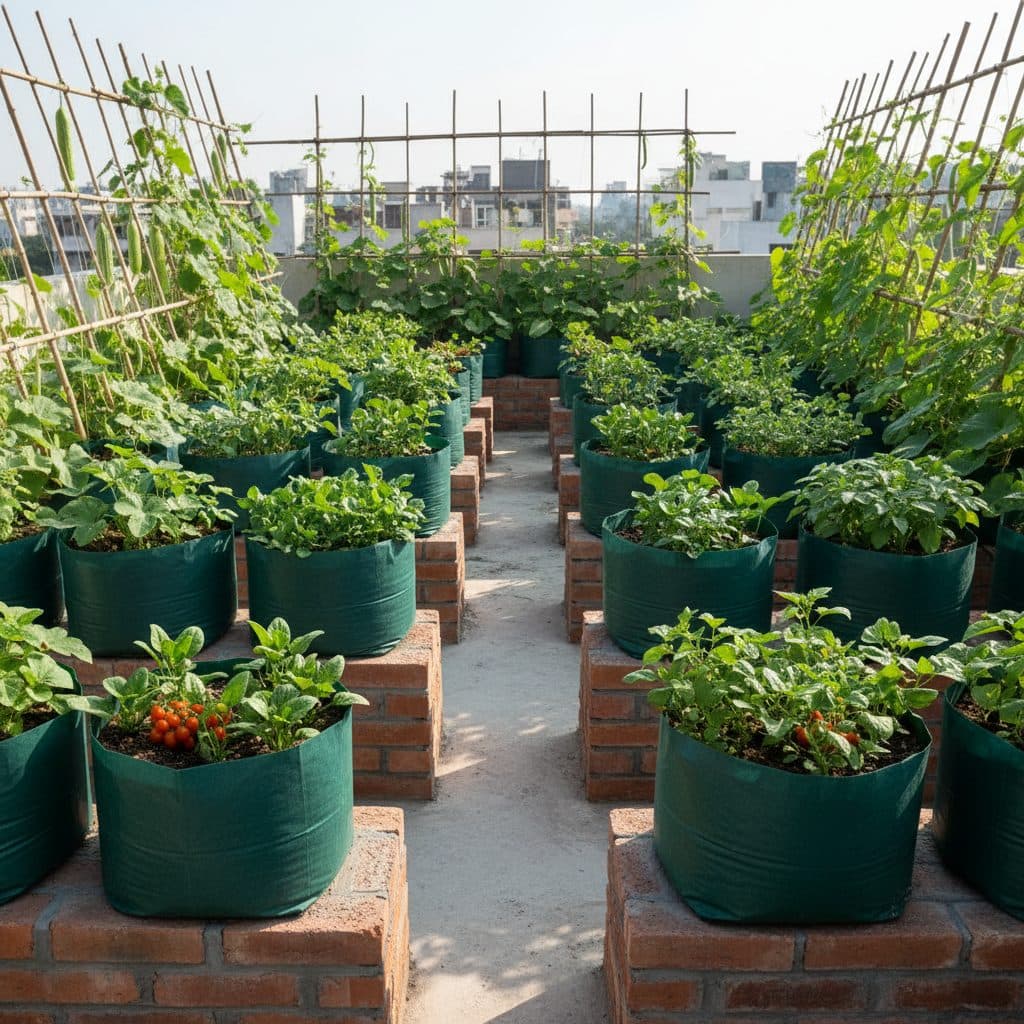
- For rooftop and terrace setups, elevate all containers on brick feet or metal pot stands to protect waterproofing and allow monsoon drainage.
- Match vegetable root depth to container size: use 24x24 cm or 30x30 cm HDPE grow bags for heavy feeders like brinjal, tomatoes, and bhindi.
- Use a lightweight, moisture-retentive potting mix of 40% coco peat, 30% aged cow dung manure (gobar khad) or vermicompost, 28-29% garden soil, and 1-2% neem cake.
- Align vertical climbers (bottle gourd, bitter gourd) along the northern and north-eastern boundaries of the plot to avoid shading low-growing bush vegetables situated to the south.
- Structure seasonal rotations around the three Indian agro-climatic windows: kharif (monsoon), rabi (winter), and zaid (summer).
Quick answer: A functional Indian kitchen garden layout zones plants by sunlight and height: tall climbers (lauki, ridge gourd) along northern and north-eastern boundary trellises, medium bushy vegetables (brinjal, tomatoes, chillies) in 30x30 cm grow bags in central full sun, and shallow greens (methi, palak, coriander) in rectangular trays along edges, elevated on pot stands for monsoon drainage.
Setting up a home kitchen garden in India offers a daily supply of fresh, pesticide-free vegetables, culinary herbs, and medicinal plants. Whether you have open ground in a suburban backyard, a concrete rooftop terrace, or a compact apartment balcony, proper planning ensures steady productivity and manageable maintenance.
A successful kitchen garden layout requires harmonising plant positioning with extreme Indian climatic realities. Intense 40°C+ summer heatwaves, heavy monsoonal cloudbursts, and shifting seasonal sun angles mean that haphazard pot placement leads to root overheating, waterlogged soil, or stunted growth.
Whether you are designing a new terrace garden in Bengaluru, Pune, Delhi, or Chennai, this guide outlines spatial planning, container sizing, vertical trellising, and seasonal crop rotations.
+-------------------------------------------------------------+
|              INDIAN KITCHEN GARDEN ZONING BLUEPRINT         |
|                                                             |
|   ZONE              SUNLIGHT / POSITION   TARGET CROPS      |
|   ----              -------------------   ------------      |
|   North/East Wall   Tall Trellis (Full)   Bottle gourd, luff|
|   Central Area      Direct Sun (6+ hrs)   Brinjal, tomatoes,|
|                                           bhindi, chillies  |
|   Border / Partial  Dappled Sun (3-4 hrs) Methi, palak,     |
|                                           coriander, mint   |
|   Permanent Corner  Morning Sun           Curry leaf, tulsi |
+-------------------------------------------------------------+
How do you plan space for ground vs terrace gardens?
The physical foundation dictates your structural choices, particularly regarding weight loads and drainage.
+-------------------------------------------------------------+
|                 GROUND VS TERRACE COMPARISON                |
|                                                             |
|   PARAMETER         GROUND GARDEN         TERRACE GARDEN    |
|   ---------         -------------         --------------    |
|   Growing Media     Native soil + compost Lightweight mix   |
|   Container Style   Permanent raised beds HDPE grow bags    |
|   Weight Concern    None                  Load-bearing check|
|   Drainage Flow     Natural subsoil soak  Floor slope/drain |
|   Summer Heat       Ground buffers root   Concrete slab bakes|
+-------------------------------------------------------------+
1. Ground backyard gardens
- Divide available ground into 1-metre-wide rectangular raised beds with 50 cm walking pathways between them.
- Narrow beds allow you to weed, water, and harvest without ever stepping on the cultivated soil, preserving soil aeration and root channels.
- Enclose beds with local bricks, stone edging, or treated timber.
2. Concrete rooftop terrace gardens
Terraces present specific structural and microclimatic considerations:
- Lightweight potting media: Never fill large terrace pots with heavy, pure garden clay. Heavy clay waterlogs during the monsoon and places excessive dead weight on the roof slab. Use a lightweight blend of 40% washed coco peat, 30% cow dung fertilizer (aged gobar khad) or vermicompost, 28% to 29% local garden soil, and 1% to 2% neem cake (neem khali).
- The brick stand rule and roof safety: Always elevate grow bags and terracotta pots 5 to 7 cm off the roof slab using flat bricks or coated metal pot stands. Direct contact traps stagnant water under pots, damaging roof waterproofing and staining tiles. Check your building's roof load-bearing capacity before placing large masonry planters, and keep drainage paths to roof scuppers clear so heavy monsoon downpours cannot pool on the slab.
- Pathway clearance: Keep a 60 cm central walkway clear for moving watering cans, compost bags, and harvesting baskets.
+-------------------------------------------------------------+
|                 ELEVATED TERRACE CONTAINER SETUP            |
|                                                             |
|              [ HDPE Grow Bag / Pot: 30x30 cm ]              |
|              =================================              |
|                 [ Brick ]          [ Brick ]                |
|           -----------------------------------------         |
|           =========== Waterproof Roof Slab ========         |
|           <--- Water drains freely toward drain --->        |
+-------------------------------------------------------------+
For hot balcony microclimates, see our guide on west-facing balcony plants.
What container sizes match specific Indian vegetables?
Crowding large vegetable roots into tiny pots is the primary reason for poor fruiting and early pest infestation:
+-------------------------------------------------------------+
|              GROW BAG SIZING FOR INDIAN CROPS               |
|                                                             |
|   CONTAINER SIZE    VOLUME (APPROX)  RECOMMENDED VEGETABLES |
|   --------------    ---------------  ---------------------- |
|   60x30x15 cm Tray  Shallow Bed      Methi, palak, coriander|
|   24x24 cm (9x9")   10 Litres        Chillies, bush beans   |
|   30x30 cm (12x12") 20 Litres        Brinjal, tomato, bhindi|
|   45x45 cm (18x18") 50 Litres        Bottle gourd, pumpkin  |
|   60x60 cm (24x24") 120 Litres       Curry leaf, dwarf lemon|
+-------------------------------------------------------------+- Shallow leafy greens: Methi (fenugreek), palak (spinach), coriander (dhania), and amaranth (chaulai) have shallow fibrous roots. They thrive in wide, shallow rectangular grow bags (60 cm long by 15 cm deep). Learn pot sowing steps in how to grow methi in pots.
- Solanaceous and bush crops: Brinjal (eggplant), tomatoes, capsicums, and bhindi (okra) require deep taproot anchorage and generous nutrition. Provide individual 30x30 cm (12x12 inch) round grow bags. For cultivation protocols, see how to grow brinjal at home.
- Heavy cucurbit climbers: Bottle gourd (lauki), bitter gourd (karela), and ridge gourd (turai) develop extensive root networks and require 45x45 cm or 60x60 cm bags. Read our guide on how to grow bottle gourd.
How do you integrate vertical trellises and boundary walls?
Vertical gardening doubles your productive growing space while keeping heavy cucurbit fruits off damp terrace floors.
+-------------------------------------------------------------+
|                 VERTICAL PERIMETER TRELLIS DESIGN           |
|                                                             |
|         | |===================================| |           |
|         | |     Heavy-Duty Nylon Netting      | | (Trellis) |
|         | |      (15 cm Mesh Aperture)        | |           |
|         | |===================================| |           |
|         | |                                   | |           |
|        [ Gourd Grow Bag ]               [ Gourd Grow Bag ]  |
|        [ 45 x 45 cm     ]               [ 45 x 45 cm     ]  |
+-------------------------------------------------------------+- Perimeter positioning: Position the highest elements (such as vertical bamboo trellises, climbing gourds, and lemon trees) along the northern and north-eastern boundaries of the plot. This prevents tall foliage from casting unwanted shade over lower sun-loving vegetables situated to the south.
- Fruit support: As bottle gourds and pumpkins swell, support heavy hanging fruits using cloth slings or nylon mesh hammocks tied to the overhead frame to prevent premature stem tearing.
- Wind stability: High-altitude terrace gardens experience strong pre-monsoon winds. Anchor all vertical poles securely to parapet railings with heavy-gauge wire.
To incorporate companion flowers that deter root nematodes and attract pollinators, review how to grow marigold from seeds.
How should you rotate crops across the three Indian seasons?
The Indian climate divides agricultural production into three distinct seasons:
+-------------------------------------------------------------+
|                 INDIAN THREE-SEASON CROP ROTATION           |
|                                                             |
|   SEASON         MONTHS         KEY KITCHEN GARDEN CROPS    |
|   ------         ------         ------------------------    |
|   Kharif         June - Sept    Lauki, karela, bhindi,      |
|   (Monsoon)                     brinjal, chillies, cowpeas  |
|                                                             |
|   Rabi           Oct - Feb      Palak, methi, coriander,    |
|   (Winter)                      tomatoes, peas, carrots     |
|                                                             |
|   Zaid           March - June   Watermelon, cucumber,       |
|   (Peak Summer)                 mint, amaranth, shade crops |
+-------------------------------------------------------------+
1. Kharif season (monsoon: June to September)
- Focus: Warm, rain-tolerant climbers and hardy vegetables like bottle gourd, ridge gourd, okra, and brinjal.
- Management: Ensure drainage holes are completely open; clear decaying leaves to avoid fungal collar rots during continuous rains.
2. Rabi season (winter: October to February)
- Focus: The main growing season for Indian gardens across the plains and south. Grow sweet peas, cabbage, cauliflower, carrots, radishes, beetroot, spinach, methi, coriander, and heirloom tomatoes.
- Management: Provide full sun exposure; apply monthly top-dressings of aged gobar khad and neem cake.
3. Zaid season (peak summer: March to May)
- Focus: Heat-tolerant gourds, cucumbers, watermelons, and amaranth.
- Protection: When daytime rooftop temperatures exceed 38°C to 40°C in April and May, install a 50% green agro-shade net 2.5 metres above the terrace to prevent leaf scorching and conserve container moisture.