Key takeaways
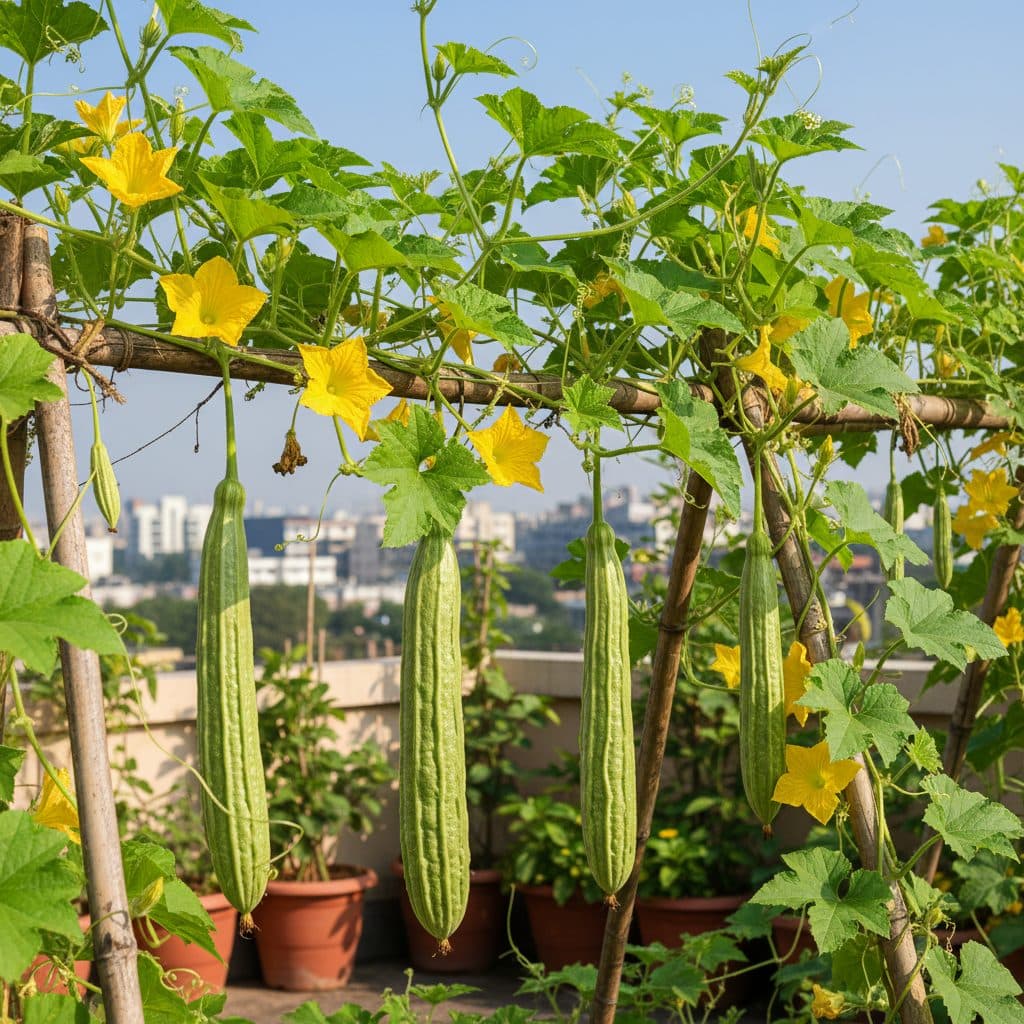
- Ridge gourd (Luffa acutangula), known locally as turai or tori, is a fast-growing warm-season climber ideal for Indian terrace gardens.
- Sow seeds in two primary Indian seasons: zaid (mid-February to March in northern plains; January to February in southern states) and kharif (June to July).
- Use heavy-duty HDPE grow bags of at least 40x40 cm filled with a rich mix of garden soil, vermicompost, cocopeat, and neem cake.
- Install sturdy bamboo or nylon vertical trellises to support heavy vines and keep expanding gourds straight and off wet ground.
- Hand pollinate female flowers in the evening to improve fruit set when natural insect pollinators are absent on high-rise balconies.
Quick answer: To grow ridge gourd (turai) at home, sow seeds 2 to 3 cm deep in large 40x40 cm grow bags or garden beds during February to March (summer crop) or June to July (monsoon crop). Provide a fertile potting mix of soil, compost, and cocopeat, erect a sturdy vertical trellis, and position the plant in full sunlight. Water regularly, feed with organic liquid manure, and hand-pollinate female flowers to harvest tender gourds within 55 to 65 days.
Ridge gourd, widely known across India as turai, tori, or peerkangai, is one of the most productive and rewarding vegetables for home gardeners. A light, low-calorie vegetable with some fibre and vitamin C, and much better flavour picked young than bought. Learning how to grow ridge gourd allows terrace and kitchen gardeners to harvest tender gourds continuously for several months.
As a vigorous climbing vine, ridge gourd is exceptionally well-suited to urban terrace gardens and balconies where ground space is limited. By training vines upward onto vertical trellises, netting, or rooftop railings, growers can produce substantial vegetable yields from a compact footprint.
However, growing ridge gourds on concrete rooftops in the Indian climate requires specific attention to summer heat, monsoon drainage, container size, and flower pollination. By following proven organic practices, you can cultivate vigorous vines that yield heavy harvests in both summer and monsoon seasons.
Indian growing seasons for ridge gourd (turai)
Ridge gourd thrives in warm, humid weather with temperatures between 25°C and 35°C. In India, planting is divided into two primary cropping seasons:
+-------------------------------------------------------------+
|               RIDGE GOURD SOWING CALENDAR (INDIA)           |
|                                                             |
|  ZAID (Summer Crop):                                        |
|  - Sowing window: Feb-Mar (Plains); Jan-Feb (South)         |
|  - Harvesting: April to June                                |
|  - Key care: Daily watering, afternoon shade net in peak May|
|                                                             |
|  KHARIF (Monsoon Crop):                                     |
|  - Sowing window: June to July (Onset of monsoon)           |
|  - Harvesting: August to October                            |
|  - Key care: Excellent pot drainage, neem oil fungal defense|
+-------------------------------------------------------------+- Summer crop (Zaid): In the northern plains sow from mid-February into March, once night temperatures hold above about 15°C and frost risk has passed. January–February sowing suits peninsular and southern India. Vines grow rapidly as temperatures climb, yielding gourds before extreme 42°C heat peaks.
- Monsoon crop (Kharif): Sow seeds with the arrival of pre-monsoon showers in June or July. The natural humidity and warmth accelerate vine growth, making the monsoon season the heaviest yielding period of the year.
- Year-round in South India: In frost-free coastal and southern regions (such as Tamil Nadu, Kerala, and coastal Karnataka), ridge gourd can be cultivated almost year-round, provided intense monsoon downpours do not waterlog root zones.
Potting mix and container selection for terrace gardens
Because ridge gourd develops an extensive taproot and fibrous feeder root network, container volume directly impacts vine vigor and gourd yield.
+-------------------------------------------------------------+
|                 TERRACE POTTING MIX RECIPE                  |
|                                                             |
|  - 40% Good Quality Garden Soil or Red Soil                 |
|  - 30% Well-Rotted Cow Dung Manure (Gobar) or Vermicompost  |
|  - 20% Washed Cocopeat (for moisture retention on hot roofs)|
|  - 10% Coarse River Sand or Perlite (for drainage)          |
|  - Add: 2 Handfuls Neem Cake Powder (Khali) per container   |
+-------------------------------------------------------------+
Container selection
- Grow bags: Choose UV-stabilized green HDPE or geotextile fabric grow bags measuring at least 40x40 cm or 45x45 cm for two vines.
- Drainage and structural care: Ensure containers have multiple free-flowing drainage holes at the bottom and lower sides. Have the slab's load capacity checked by a structural engineer before lining up multiple bags, stand them on feet or bricks to protect the waterproofing and facilitate drainage, and site heavy rows near load-bearing walls rather than mid-span.
Soil preparation
Mix garden soil with rich organic matter and cocopeat to create a light, nutrient-dense medium that retains moisture without compacting. Incorporating neem cake powder (neem khali) into the base mix helps suppress soil nematodes and adds slow nitrogen; root rot is prevented by drainage, not by neem cake.
Sowing seeds and germination care
Ridge gourd seeds have a thick, woody outer coat that can delay germination if sown dry.
- Seed soaking: Soak ridge gourd seeds in lukewarm water for 12 to 24 hours prior to sowing. Soaking softens the hard seed coat and speeds germination by three to four days.
- Direct sowing: Sow two or three seeds directly into the prepared grow bag, pressing them 2 to 3 cm deep into moist soil.
- Moisture and warmth: Keep the soil evenly damp but not soaking wet. Seeds germinate reliably within five to eight days at temperatures between 24°C and 30°C.
- Thinning: Once seedlings develop two true leaves, thin to the single strongest, healthiest vine per container (or two vines in a 45x45 cm bag).
For detailed guidance on maximizing vertical vegetable space, review our practical guide on vining crops in pots vertically.
Trellis systems and vertical climbing support
Ridge gourd is an aggressive climber that produces tendrils capable of scaling 3 to 5 meters. Letting vines scramble on the hot concrete floor of a terrace leads to scorched foliage, fungal disease, and deformed, crooked gourds.
+-------------------------------------------------------------+
|               TERRACE TRELLIS CONFIGURATIONS                |
|                                                             |
|  VERTICAL BAMBOO FRAME:                                     |
|  - 2.5m bamboo poles anchored in weighted bases             |
|  - Cross-tied with coir rope or galvanized wire             |
|                                                             |
|  OVERHEAD NYLON NETTING (Mandap System):                    |
|  - Vines climb vertical strings to a horizontal overhead net|
|  - Gourds hang down freely beneath the canopy               |
|  - Easiest setup for inspection, pollination, and harvesting|
+-------------------------------------------------------------+
Erect a sturdy vertical trellis using bamboo poles, galvanized iron conduit pipes, or heavy-duty nylon creeper netting. Anchor the frame without drilling the slab — use weighted planter bases or guy lines tied back to railings, keeping the frame set well inside the parapet, never fixed to it. When main vines reach approximately 1.5 to 2 meters in height, strip off lower lateral branches up to the eighth to tenth node, then pinch out the main growing tip. This 2G/3G pruning technique forces vigorous secondary and tertiary branches to emerge, which carry a much higher proportion of female flower buds.
Flowering, hand pollination, and organic pest control
Ridge gourd produces separate male and female flowers on the same plant (monoecious).
Identifying male and female flowers
- Male flowers: Grow in small clusters on long, slender stalks with no swelling at the base. They produce yellow pollen and bloom several days before female flowers.
- Female flowers: Grow singly on short stalks and are easily recognized by a miniature, distinctively ribbed baby gourd (the ovary) directly behind the yellow flower petals.
+-------------------------------------------------------------+
|               HAND POLLINATION STEP-BY-STEP                 |
|                                                             |
|  1. Time: Perform between 5:30 PM and 7:00 PM (flowers open)|
|  2. Select: Pluck a fresh, fully open male flower           |
|  3. Prepare: Strip away yellow petals to expose the anther  |
|  4. Transfer: Gently dab pollen onto the sticky central     |
|     stigma of the open female flower                        |
|  5. Confirm: Successful fruit swells noticeably in 48 hours |
+-------------------------------------------------------------+
Ridge gourd flowers open in the late afternoon and evening. On high-rise urban balconies where natural bees and nocturnal moths may be scarce, unpollinated female flowers turn yellow and shrivel within two days. Hand pollination markedly improves fruit set where pollinators are scarce, though some fruitlets will still drop in extreme heat.
Organic feeding and pest control
- Organic feeding: Every 15 days, top-dress grow bags with a handful of vermicompost and apply fermented liquid feeds. Applying our traditional recipe for mustard cake fertilizer for plants provides a rich burst of organic nitrogen and potassium that drives rapid fruit sizing.
- Pest and fly management: Protect against melon fruit fly (Bactrocera cucurbitae), the most damaging pest of ridge gourd: bag developing fruitlets in paper or fine mesh immediately after pollination, pick and destroy stung fruit rather than composting it, and hang a cue-lure pheromone trap nearby. To manage beetles and powdery mildew, spray neem oil (5 ml per litre of water with 2 ml liquid soap) in the early morning or after sunset, keep it off open flowers, and skip spraying on days above about 35°C.
- Urban bird deterrents: If urban pigeons roost near your terrace garden and damage young tender shoots, applying safe exclusion nets as described in how to protect balcony plants from pigeons protects your vines.
Harvest at roughly 15 to 25 cm, about a week after fruit set, while the ridges are still soft and the skin scratches easily with a thumbnail. Harvesting regularly stimulates the vine to produce continuous flushes of fresh gourds. At agripure, we share practical Indian gardening guidance for growing vegetables on your terrace.