Key takeaways
- Force only strong, mature rhubarb crowns that have been established in the ground for at least two to three full growing seasons.
- Allow crowns a period of natural chilling through early winter before covering, so bud dormancy breaks properly.
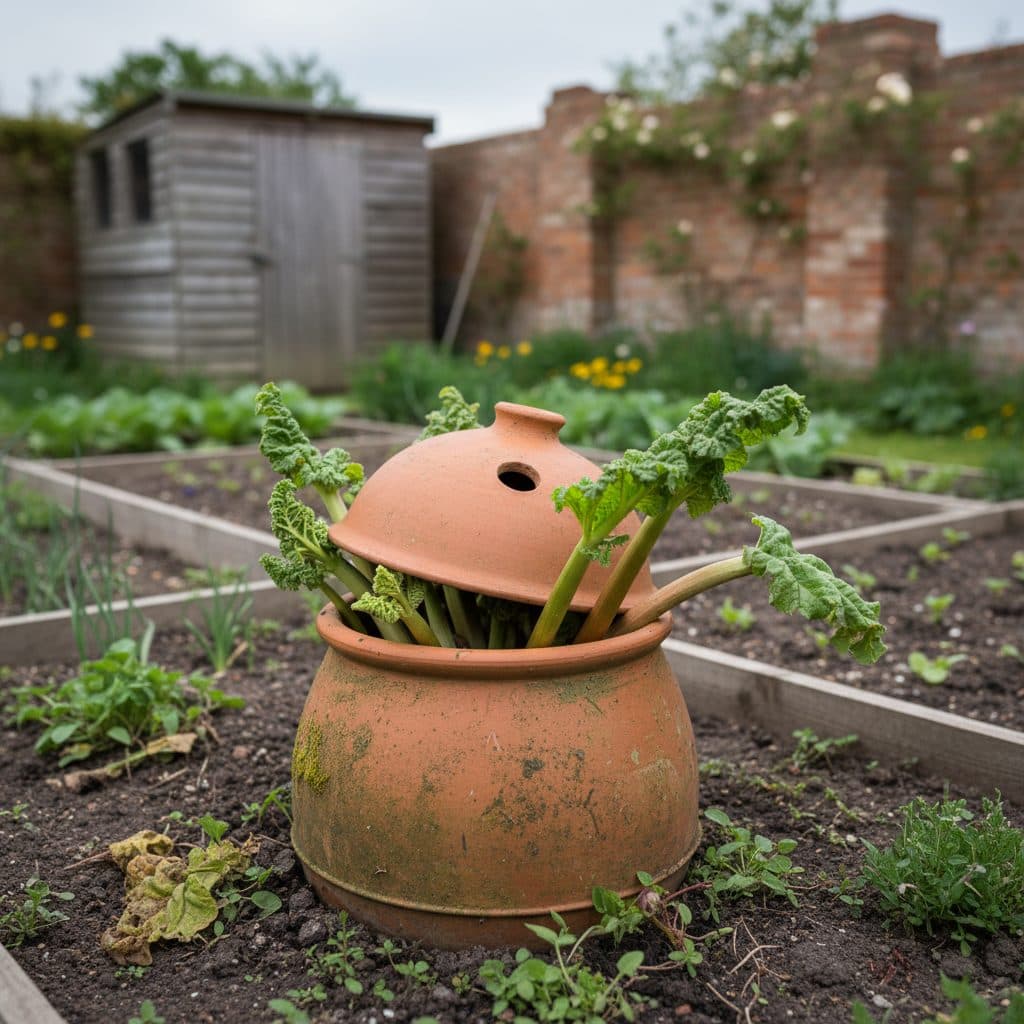
- Exclude 100% of natural daylight using terracotta forcers, upturned dustbins, or deep buckets insulated with straw or horse manure.
- Harvest forced stems four to eight weeks after covering when pale pink stalks reach 20 to 30 cm in length.
- Never harvest an entire crown bare; leave some emerging growth intact to avoid killing the root system.
- Rest forced crowns completely for the following two years, allowing unforced green leaves to recharge root carbohydrate reserves.
Quick answer: In the UK, force established outdoor rhubarb crowns in January by placing a lightproof terracotta pot, bucket, or dustbin over the crown after early winter frosts. Insulate around the cover with straw or dry leaves, and harvest tender, sweet, pale crimson stalks four to eight weeks later in February or March, allowing the crown to rest unforced for the next two seasons.
Rhubarb (Rheum x hybridum) is a perennial garden classic across the UK, offering the earliest fresh tart flavours of the growing calendar. While outdoor maincrop rhubarb produces thick, fibrous green-and-red stalks from April to July, forcing produces tender stalks weeks ahead of the regular season.
The art of forcing rhubarb involves depriving the plant of light in late winter. In total darkness, the crown expends its stored root starches to drive rapid, elongated stem growth. Because the stalks cannot produce chlorophyll without light, they emerge in striking shades of ruby, salmon-pink, and pale yellow, with paper-thin skins and a delicate, honeyed sweetness.
Whether you use traditional terracotta forcers or recycled plastic dustbins, successful forcing depends on proper crown selection, covering methods, and crown recovery.
+-------------------------------------------------------------+
|                UK FORCED RHUBARB TIMELINE                   |
|                                                             |
|   MONTH             STAGE                                   |
|   -----             -----                                   |
|   December          Frost exposure (dormancy-breaking chill)|
|   January           Place lightproof cover & insulate       |
|   February - March  Harvest tender 20-30 cm pink stems      |
|   April onwards     Remove cover; mulch and rest crown      |
+-------------------------------------------------------------+
What is the science behind forcing rhubarb?
Forcing relies on a botanical process known as etiolation, where plants grown in complete darkness elongate rapidly in an attempt to reach light.
+-------------------------------------------------------------+
|                FORCED VS UNFORCED STEM TRAITS               |
|                                                             |
|   ATTRIBUTE         FORCED RHUBARB        UNFORCED MAINCROP |
|   ---------         --------------        ----------------- |
|   Harvest Window    Feb - March           April - July      |
|   Light Exposure    Total darkness        Full daylight     |
|   Stalk Colour      Delicate ruby-pink    Deep red to green |
|   Leaf Texture      Small, pale yellow    Broad, dark green |
|   Flavour Profile   Sweet, delicate, soft Tart, robust, firm|
|   Fibre & Skin      Negligible, thin      Fibrous, stringy  |
+-------------------------------------------------------------+
When light is excluded, three distinct physiological changes occur:
- Chlorophyll suppression: Without light, chloroplasts cannot form green chlorophyll pigments, leaving the stalk with natural anthocyanin pigments that produce distinct pink and crimson hues.
- Acid reduction: Oxalic and malic acid concentrations within the petioles remain lower than in mature outdoor stems, resulting in a sweeter, milder flavour that requires far less sugar during cooking.
- Fibre reduction: The cell walls stretch thin and succulent, eliminating the tough stringiness common in summer stalks.
Which crowns are suitable for forcing?
Forcing is an intensive, draining process for the plant. Attempting to force young or weak crowns can exhaust their energy reserves and kill the root system.
+-------------------------------------------------------------+
|                CROWN SELECTION CRITERIA                     |
|                                                             |
|   SUITABLE FOR FORCING              UNSUITABLE / DO NOT USE |
|   --------------------              ----------------------- |
|   - Minimum 2-3 years established   - Newly planted crowns  |
|   - Thick, fleshy root system       - Forced previous year  |
|   - 4 or more plump winter buds     - Dividing year crowns  |
|   - Vigorous summer growth          - Weak / diseased root  |
+-------------------------------------------------------------+
Ideal UK cultivars for forcing
- 'Timperley Early': The gold standard early variety in Britain. It requires minimal winter chilling and responds rapidly to early covers, producing tender pink stems by early February.
- 'Stockbridge Arrow': Bred in Yorkshire specifically for forcing quality, producing long, straight, bright red stems with exceptional flavour.
- 'Victoria': A vigorous maincrop heritage variety. It can be forced, but it needs more chilling than 'Timperley Early' and should be covered later.
For plot holders planning diverse perennial plantings alongside fruit bushes, combine rhubarb beds with dwarf fruit trees.
How do you force rhubarb outdoors in the garden?
Outdoor forcing is the most practical method for home gardeners and allotment holders, leaving the root system undisturbed in the ground.
+-------------------------------------------------------------+
|                 OUTDOOR FORCING SETUP DIAGRAM               |
|                                                             |
|                  [ Removable Lid / Stone ]                  |
|                   /---------------------\                   |
|                  |   Terracotta Forcer   |                  |
|                  |      or Dustbin       |                  |
|    Straw/Manure  |                       |  Straw/Manure    |
|   ############## |     /\ (Pink Stems)   | ##############   |
|   ############## |    /  \               | ##############   |
|   ############## |   /    \ (Pale Leaf)  | ##############   |
|   ==============+=========================+==============   |
|                 [   Established Crown   ]                   |
|                 [   Deep Root System    ]                   |
+-------------------------------------------------------------+
Step-by-step outdoor forcing method
- Clear the crown: In late December or early January, clear away decaying autumn leaves, weeds, and debris from around the crown to expose the dormant pink buds.
- Wait for chilling: Ensure the crown has experienced several hard frosts. Cold exposure (chilling requirement) breaks internal dormancy and primes the buds for rapid spring growth.
- Position the cover: Place a traditional bell-shaped terracotta rhubarb forcer, an upturned black plastic dustbin, a large bucket, or a clay chimney pot directly over the crown. Ensure the rim sits firmly on the soil so no light leaks into the interior.
- Add thermal insulation: Pack a thick layer of straw, dry bracken, or well-rotted horse manure around the outside of the container. Manure generates gentle biological heat as it breaks down, raising internal temperatures, which brings the harvest forward a little in a cold spring.
- Cap the top: If using an open chimney pot or a container with drainage holes, cover the top with a heavy slate, tile, or lightproof lid.
To monitor regional spring soil warming across your beds, review soil temperature for planting.
How do you harvest forced rhubarb and protect the crown?
Checking your forced crop requires minimal light exposure to avoid triggering unwanted greening of the stems.
+-------------------------------------------------------------+
|                 HARVESTING FORCED STEMS                     |
|                                                             |
|   STEP              ACTION                                  |
|   ----              ------                                  |
|   1. Inspect        Lift lid briefly in dim morning light   |
|   2. Assess Size    Look for stems 20 to 30 cm long         |
|   3. Pull & Twist   Grasp near base; ease stalk sideways    |
|   4. Trim Leaf      Cut yellow leaf off; discard to compost |
|   5. Reseal         Replace lid immediately                 |
+-------------------------------------------------------------+- Harvest technique: When stalks reach 20 to 30 cm tall, reach inside the cover, hold the stalk firmly near the base, and pull gently downward with a slight twist. The stalk will detach cleanly from the crown with a satisfying pop. Avoid using knives, which leave stumps that can rot in the humid darkness.
- Harvest limit: Harvest over a three to four-week window. Never strip all the stalks from the crown; leave at least a third of the developing shoots so the plant can transition back to natural photosynthesis once uncovered.
- Toxicity warning: Rhubarb petioles (stalks) are delicious, but the leaves contain toxic levels of soluble oxalic acid and anthraquinone glycosides. Slice off the leaf blades and compost them; they rot down safely and will not poison your soil. Keep the fresh blades away from livestock, poultry and pets, which can be poisoned by them.
For sustainable bed feeding techniques that support perennial crowns, review the principles of a no-dig allotment.
How do you manage crown recovery and rotation?
Forcing extracts a heavy energetic toll on rhubarb crowns. Without structured recovery management, crowns will weaken, produce thin spindly stalks, and eventually rot.
+-------------------------------------------------------------------+
|                  THREE-YEAR CROWN ROTATION CYCLE                  |
|                                                                   |
|   YEAR      CROWN A            CROWN B            CROWN C         |
|   ----      -------            -------            -------         |
|   Year 1    FORCED (Jan-March) Rest / Unforced    Rest / Unforced |
|   Year 2    Rest / Unforced    FORCED (Jan-March) Rest / Unforced |
|   Year 3    Rest / Unforced    Rest / Unforced    FORCED (Jan-Mar)|
+-------------------------------------------------------------------+
The crown recovery protocol
- Uncover in spring: In late March or early April, remove the forcing pot and insulation.
- Mulch generously: Apply a 7 to 10 cm layer of well-rotted garden compost or aged farmyard manure around the base of the crown, keeping the mulch 5 cm clear of the central buds to avoid fungal rot.
- No summer harvesting: Do not harvest any outdoor green stalks from a forced crown during the summer following forcing. Allow the broad green leaves to expand fully and photosynthesise all summer long, funnelling carbohydrates back into the underground rhizomes.
- Maintain a rotation: Plant at least three separate rhubarb crowns on your plot. Force only one crown each winter on a three-year rotational cycle, so two crowns are always resting and recharging.
Pair your winter kitchen garden planning with early brassica and root crop rotations such as growing parsnips and growing courgettes.