Key takeaways
- A good wicking bed soil mix balances water retention and aeration, often using a 50:50 blend of compost and mineral soil.
- Capillary action, or wicking, can effectively pull water up 6 to 12 inches in a well-structured soil, but rarely beyond 24 inches for practical gardening.
- The wicking zone’s depth depends heavily on soil particle size; finer silts and clays wick higher than coarse sands.
- A water reservoir of 4 to 6 inches deep is common for wicking beds, providing a consistent moisture source.
- Wicking beds can reduce irrigation needs by 50% or more compared to conventional raised beds, especially in arid regions like the Southwest.
- Regular nutrient replenishment through compost and organic amendments is crucial for long-term wicking bed success.
Quick answer: A good wicking bed soil mix typically uses a 50:50 blend of compost and mineral soil for balanced water retention and aeration. Capillary action can effectively pull moisture 6 to 12 inches, with practical limits often around 12 to 24 inches for consistent delivery.
In arid regions like California’s Central Valley, where summer temperatures often exceed 90°F and water conservation is paramount, wicking beds offer a practical solution for efficient gardening. These self-watering systems can significantly reduce water usage, sometimes by 50% or more compared to traditional surface irrigation. Understanding the science behind how they work — specifically, the ideal soil mix and the actual depth water can be pulled upwards — matters for getting the most from them.
Many growers in USDA zones 7 through 10 are turning to wicking beds to grow everything from tomatoes to leafy greens, seeing consistent moisture delivery to plant roots. The effectiveness of a wicking bed hinges on two primary factors: the composition of its soil and the physical limits of capillary action. Let’s dig into the specifics, grounding our understanding in real-world observations and research, to help you build a productive and water-wise garden.
Understanding the science of wicking in soil
Wicking in soil is a phenomenon driven by capillary action, where water moves upwards against gravity through small pores. This process is similar to how a paper towel absorbs a spill, or how water moves through a plant’s vascular system. In a wicking bed, a water reservoir at the bottom provides a constant source, and the soil above acts as a wick, drawing moisture up to the plant roots. The primary forces at play are adhesion (water molecules sticking to soil particles) and cohesion (water molecules sticking to each other), which together create surface tension that pulls water through the soil’s pore network [3].
Factors influencing capillary rise
The height and speed of capillary rise are not uniform; they are heavily influenced by the soil’s physical properties. For instance, a fine-textured soil like silt or clay, with its smaller, more numerous pores, generally exhibits a greater capillary rise than a coarse-textured sandy soil. Research shows that while water can theoretically rise to significant heights in very fine capillaries, the practical wicking height in a garden soil is often limited to about 12 to 24 inches for consistent moisture delivery [2]. In a typical garden bed in USDA zone 7, you might observe effective wicking up to 10 inches within a day, ensuring roots stay hydrated even during a dry spell. The rate of evaporation from the soil surface also plays a role, creating a dynamic balance that affects the overall moisture profile [1].
- Soil particle size: Finer particles create smaller pores, increasing capillary pull.
- Pore connectivity: Well-connected pores allow for continuous water movement.
- Organic matter content: Improves soil structure and water retention.
- Water table depth: The distance from the reservoir to the root zone.
- Evaporation rate: Higher rates can reduce effective wicking height.
Crafting the ideal wicking bed soil mix
The foundation of a successful wicking bed is its soil mix. It needs to strike a balance between holding moisture effectively and providing sufficient aeration for root health. A common and highly effective blend for a 12-inch deep wicking bed in a hot climate like USDA zone 9 is a 50:50 ratio of high-quality compost and mineral soil. The compost provides essential nutrients and improves soil structure, while the mineral soil (often a sandy loam) offers stability and a good balance of pore sizes for wicking. Avoid using pure potting mix, as it can be too light and prone to compaction over time, reducing its wicking capacity. For optimal performance, aim for a soil bulk density between 1.2 and 1.4 g/cm³.
Components of a robust mix
Beyond the primary compost and mineral soil, other amendments can enhance your wicking bed’s performance. Adding 10% to 20% perlite or pumice can improve aeration and drainage, preventing waterlogging in the upper layers while still allowing wicking. For heavy feeders like tomatoes or corn, incorporating a slow-release organic fertilizer or a few pounds of rock dust per cubic yard can provide long-term nutrient availability. In regions with alkaline soil, such as parts of Arizona, a small amount of peat moss or aged pine bark fines (up to 15% by volume) can help lower pH over time. Remember, the goal is a mix that feels light yet holds together, allowing water to move freely upwards but not so quickly that it drains away from the root zone. You can monitor soil moisture with a 3-in-1 Soil pH, Moisture & Light Meter to fine-tune your watering schedule.
- 50% mature compost: Provides nutrients, organic matter, and water retention.
- 50% mineral soil (sandy loam): Offers structure, stability, and consistent wicking.
- 10-20% perlite or pumice: Enhances aeration and prevents compaction.
- Optional: Rock dust/organic fertilizer: For long-term nutrient supply.
- Avoid: Pure peat or coco coir: Can be too spongy, leading to poor aeration over time.
How deep can wicking action actually pull moisture?
This is the central question for many growers: what’s the practical limit of water wicking in a garden bed? Research consistently shows that while capillary rise can theoretically be quite high in very fine materials, the effective wicking zone for plant roots in a typical garden soil is generally limited. For a well-constructed wicking bed with a good soil mix, you can expect reliable moisture delivery up to about 6 to 12 inches above the water reservoir. Beyond 12 inches, the pull becomes significantly weaker, and the upper soil layers may dry out, especially in hot, windy conditions common in places like the Great Plains or California’s Central Valley [4].
Maximizing wicking depth and efficiency
The maximum wicking depth is not a fixed number; it varies with soil type and structure. Fine silts and clays can wick water higher — sometimes up to 24 inches — but they also tend to hold water too tightly, potentially leading to anaerobic conditions if not managed carefully. Sandy soils, with their larger pores, wick less effectively, perhaps only 4 to 6 inches. For most vegetable gardens, a soil depth of 10 to 12 inches above a 4-inch water reservoir is a good starting point, providing ample root space and consistent moisture. Super-absorbent polymers have been explored to increase wicking depth, but their long-term effects on soil biology are still being studied [4]. For most home growers, focusing on a balanced soil mix and proper reservoir depth will yield the best results. Consider growing drought tolerant plants in areas where wicking depth might be a concern.
- Fine-textured soils: Can wick up to 24 inches, but may retain too much water.
- Medium-textured soils (loams): Effective wicking of 6 to 12 inches, ideal for most crops.
- Coarse-textured soils (sands): Wicking often limited to 4 to 6 inches.
- Reservoir depth: A 4-6 inch reservoir provides consistent water to the wicking zone.
- Plant root depth: Match soil depth to the typical root depth of your chosen crops.
Building a functional wicking bed
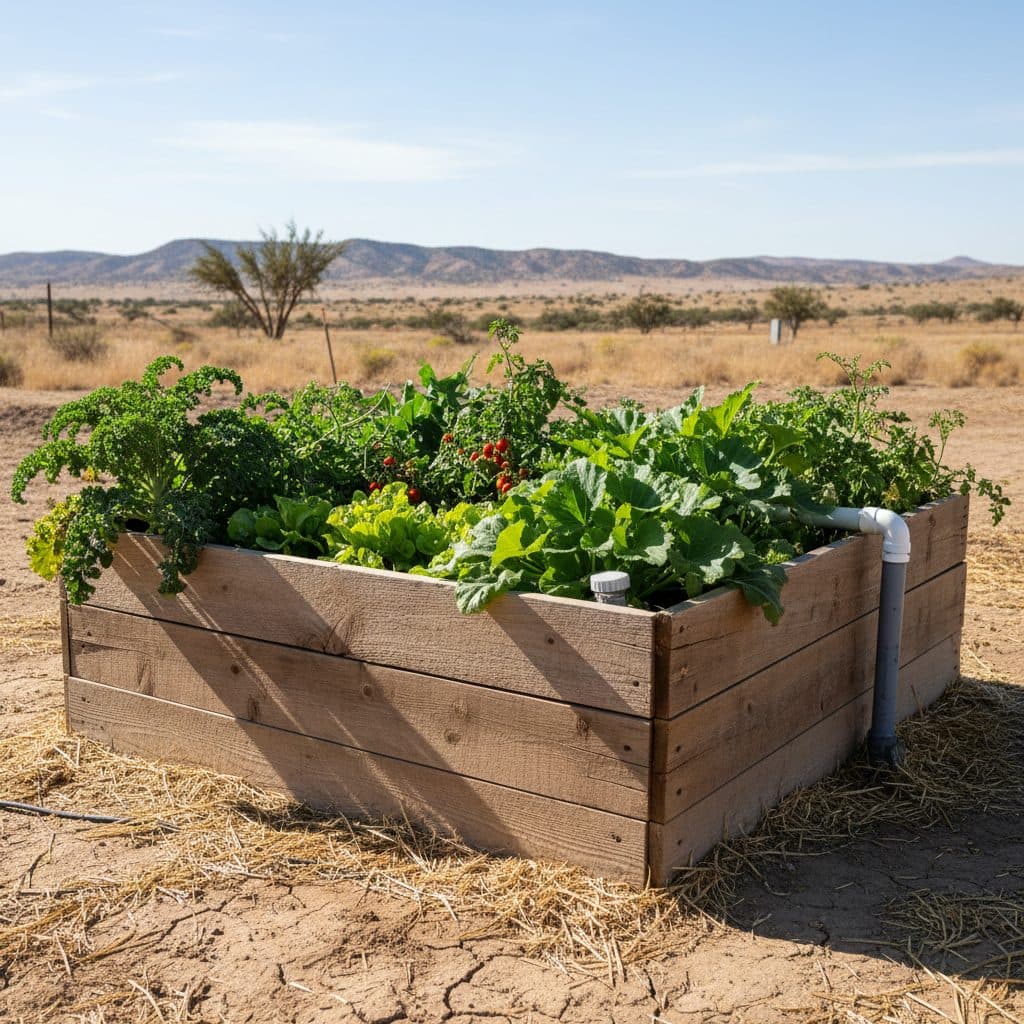
Constructing a wicking bed involves several layers to ensure optimal function. First, you’ll need a sturdy, waterproof container. This could be a stock tank, a repurposed IBC tote, or a custom-built wooden frame lined with pond liner. For a typical 4 ft x 8 ft raised bed, you’ll want a minimum depth of 18 inches to accommodate both the water reservoir and the soil layer. The bottom 4 to 6 inches will form your water reservoir, which should be separated from the soil by a permeable layer.
Layering for success
Above the reservoir, a perforated pipe or gravel layer creates a void for water storage and even distribution. This layer is then covered with a geotextile fabric or shade cloth to prevent soil from migrating into the reservoir while allowing water to pass through freely. For a 4 ft x 8 ft bed, you might need about 15 to 20 cubic feet of gravel or a few lengths of 4-inch perforated drain pipe. An overflow pipe, typically a 1-inch diameter PVC pipe, should be installed at the top of the reservoir layer to prevent overfilling and maintain an air gap between the water and the soil. This air gap matters for root health and prevents anaerobic conditions. Finally, fill the remaining 12 to 14 inches with your carefully prepared wicking bed soil mix. This setup, especially useful in USDA zone 6 where late spring frosts can be an issue, ensures consistent moisture without daily watering. You can find more information on soil-building techniques for raised beds in articles like Best Living-Mulch and Cover-Crop Legumes by USDA Zone for No-Dig Beds.
- Waterproof container: Choose a durable, non-toxic material at least 18 inches deep.
- Water reservoir: Create a 4 to 6 inch deep space at the bottom for water storage.
- Perforated pipe/gravel: Distributes water evenly across the reservoir.
- Geotextile fabric: Separates soil from the reservoir, preventing clogging.
- Overflow pipe: Maintains reservoir level and prevents waterlogging.
Maintaining wicking beds for long-term success
Once your wicking bed is built and planted, ongoing maintenance ensures its long-term productivity. The primary task is monitoring the water reservoir and refilling it as needed. In hot, dry climates like those in USDA zones 8 and 9, you might need to top up the reservoir every few days during peak summer, while in cooler, more humid zones, it could be once a week or less. A simple dipstick or a visual check through the overflow pipe can help you gauge the water level. Remember that plants like corn or squash can be heavy drinkers, consuming several gallons of water per day during fruit development.
Nutrient management and soil health
Wicking beds, while efficient, can sometimes experience nutrient leaching from the topsoil downwards, away from the root zone. To counteract this, it helps to replenish nutrients regularly. Top-dressing with 1 to 2 inches of fresh compost every spring and fall is an excellent practice. Incorporating slow-release organic fertilizers, such as alfalfa meal or bone meal, at planting time can also provide a steady supply of nutrients. For a 4 ft x 8 ft bed, this might mean adding 10 to 20 pounds of compost twice a year. Additionally, maintaining a healthy soil food web is vital; avoid synthetic pesticides that can harm beneficial microorganisms. Consider using Neem oil for plants as a natural pest control option when necessary. Over time, the soil in your wicking bed will settle, so plan to add a few inches of fresh soil mix every year or two to maintain optimal depth and fertility.
- Regular reservoir checks: Refill when the water level drops, especially in hot weather.
- Top-dress with compost: Add 1-2 inches of compost twice a year for nutrient replenishment.
- Incorporate organic fertilizers: Use slow-release options at planting for sustained feeding.
- Monitor soil pH: Use a soil test kit every 1-2 years to ensure optimal nutrient availability.
- Avoid compaction: Do not walk on the soil surface to maintain good aeration and wicking.
Wicking bed vs. traditional raised bed
Feature | Wicking Bed | Traditional Raised Bed |
|---|---|---|
Water usage | Reduced by 50-80% | Higher, often daily watering |
Water delivery | Consistent, bottom-up wicking | Top-down, surface evaporation |
Weed growth | Significantly reduced | More prevalent, especially with surface watering |
Nutrient leaching | Less from surface, but can occur downwards | Higher due to frequent surface watering |
Maintenance | Less frequent watering, more soil replenishment | Frequent watering, less soil replenishment |
Initial cost | Higher due to reservoir components | Lower, simpler construction |
Water Savings: Wicking beds can reduce irrigation water consumption by 50% to 80% compared to conventional gardening, particularly in dry climates like USDA zone 10.
Wicking Height: The effective wicking height for consistent moisture delivery to plant roots in a well-prepared soil mix is typically 6 to 12 inches.
Frequently asked questions
How often do I need to water a wicking bed?
The watering frequency for a wicking bed depends on your climate, plant type, and bed size. In hot, dry climates like USDA zone 9, you might need to refill the reservoir every 3 to 5 days during peak growing season, while in cooler zones, it could be once every 10 to 14 days.
Can I use any soil in a wicking bed?
No, not just any soil. The soil mix matters. It should be a blend of high-quality compost and mineral soil, often a 50:50 ratio, to ensure both water retention and proper aeration. Pure garden soil or potting mix alone is usually not ideal due to compaction or poor wicking properties.
What is the ideal depth for a wicking bed’s water reservoir?
A water reservoir depth of 4 to 6 inches is generally considered ideal for most wicking beds. This depth provides a sufficient volume of water to sustain plants for several days to a week, while also allowing for an air gap above the water to prevent root rot.
Do wicking beds need drainage?
Yes, wicking beds absolutely need an overflow drain. This drain, typically a 1-inch PVC pipe, is installed at the top of the water reservoir layer. It prevents the reservoir from overfilling during heavy rains or refilling, ensuring an essential air gap between the water and the soil, which is critical for healthy root growth and preventing anaerobic conditions.
Can wicking beds be used in cold climates?
Wicking beds can be used in cold climates, including USDA zone 5, but require some modifications. The reservoir can freeze, potentially damaging the bed structure. Growers often drain the reservoir in winter or use insulation. The benefits of water conservation are less pronounced in cold, wet periods, but they still offer consistent moisture during the growing season.
References
- – Evaporation and Wicking (2012). – Evaporation and Wicking.
- Wicking in Absorbent Swelling Porous Materials (2012). Wicking in Absorbent Swelling Porous Materials.
- – Traditional Theories of Wicking: Capillary Models (2012). – Traditional Theories of Wicking: Capillary Models.
- Vadose Zone Soil Moisture Wicking Using Super‐Absorbent Polymers (2012). Vadose Zone Soil Moisture Wicking Using Super‐Absorbent Polymers.
- – A Fractal-Based Approach to Model Wicking (2012). – A Fractal-Based Approach to Model Wicking.
- USDA Natural Resources Conservation Service (2024). USDA Natural Resources Conservation Service.