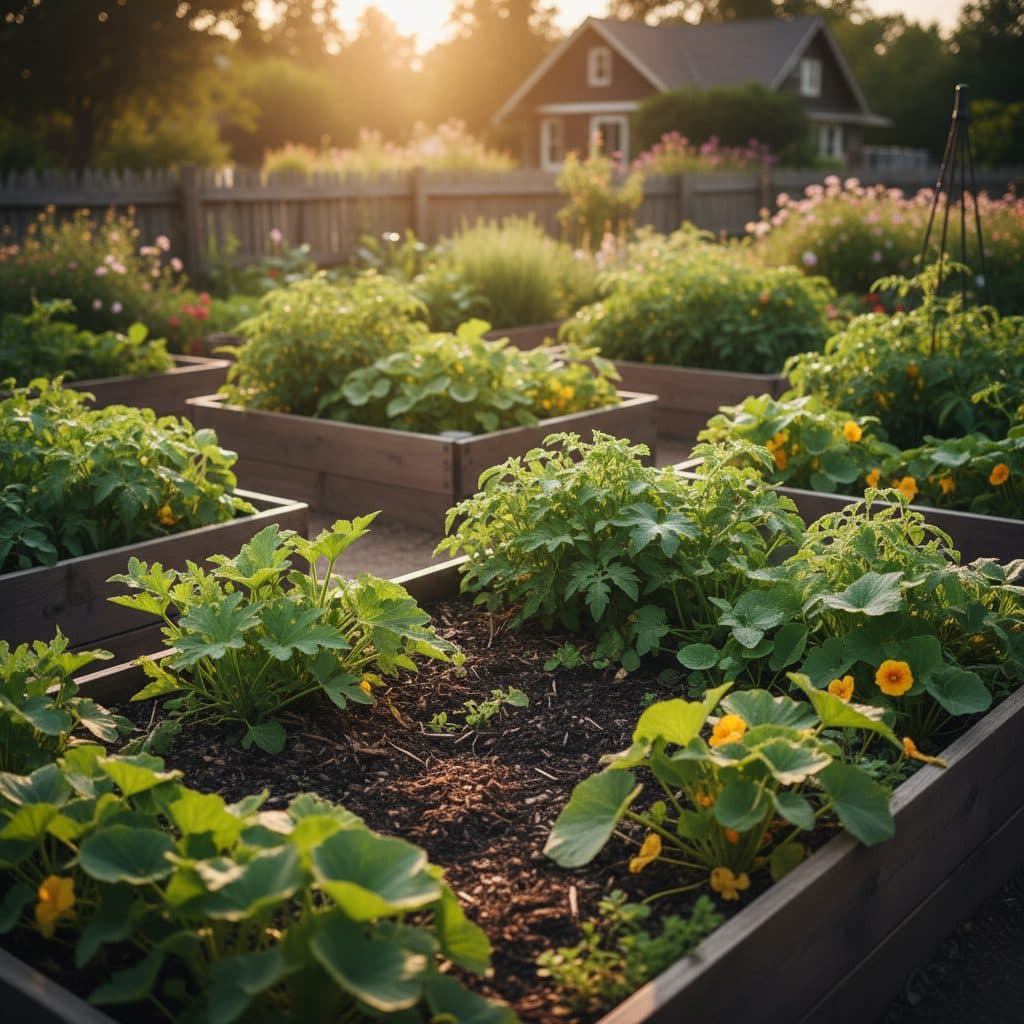
Key takeaways
- Apply organic mulch 2 to 4 inches deep for most plants to conserve water and suppress weeds.
- Avoid ‘mulch volcanoes’ by keeping mulch 3 to 6 inches away from tree trunks and plant stems.
- Use coarser mulches like wood chips to prevent matting and maintain good water penetration.
- Aerate fine-textured mulches annually if compaction occurs to avoid hydrophobic layers.
- In arid regions or poor soils, consider deeper layers of 4 to 6 inches of coarse mulch.
- Replenish mulch every 1 to 2 years, or when the depth falls below 2 inches.
Quick answer: To achieve drought resilience, apply 2 to 4 inches of organic mulch, such as wood chips or shredded leaves, around plants, keeping it 3 to 6 inches away from stems and trunks. This practice conserves water, suppresses weeds, and moderates soil temperature.
In many parts of the United States, from the dry plains of Texas to the sun-baked valleys of California, gardeners face significant challenges with heat, drought, and often nutrient-poor soils. For instance, in USDA zone 7, summer temperatures can regularly exceed 90°F, leading to rapid soil moisture loss. A well-applied layer of mulch can be one of the most effective strategies to combat these conditions, reducing the need for irrigation by up to 30% in a typical growing season.
However, simply throwing down any material isn’t enough. The thickness of your mulch layer, the type of material you choose, and how you maintain it all matter. Improper application can lead to problems like matting, which makes the mulch water-repellent, defeating its primary purpose. Understanding these details can save you significant effort and water, particularly in regions where water conservation is a top priority, such as the Colorado River Basin states.
Mulch: a critical tool for water conservation and soil health
Mulch serves multiple vital functions in a resilient garden, particularly in areas experiencing prolonged dry spells or intense summer heat. For example, in a garden in central Kansas (USDA zone 6), a 3-inch layer of wood chip mulch can reduce soil water evaporation by up to 30%, significantly extending the time between waterings. This reduction in evaporation is a direct benefit, helping plants thrive with less supplemental irrigation, which can save hundreds of gallons of water over a growing season. Beyond water retention, mulch also acts as a natural barrier against weeds, suppressing up to 90% of weed growth, which reduces competition for precious soil moisture and nutrients.
Beyond water saving: building living soil
The benefits extend beyond immediate water savings. Mulch helps to moderate soil temperature, keeping the soil 10 to 15°F cooler on hot summer days and several degrees warmer in cooler months, protecting plant roots from extreme fluctuations. Over time, organic mulches decompose, adding organic matter to the soil. This process improves soil structure, helps water soak in, and supports healthy microbial activity essential for nutrient cycling. For instance, in a sandy soil common in Florida (USDA zone 9), adding 2 inches of composted mulch annually can increase soil organic matter by 0.5% each year, improving its water-holding capacity. This long-term soil improvement is a cornerstone of sustainable gardening practices.
- Reduces soil water evaporation by 30% or more.
- Suppresses up to 90% of weed growth.
- Moderates soil temperature by 10-15°F.
- Enriches soil with organic matter over 1-3 years.
- Enhances soil structure and microbial health.
Selecting the right mulch for your climate and plants
The choice of mulch material significantly impacts its effectiveness and longevity. Organic mulches, derived from plant materials, are generally preferred for their ability to decompose and enrich the soil. For example, wood chips are excellent for perennial beds and trees, lasting 2 to 3 years before needing replenishment, and are widely available across the US. In contrast, straw is a good choice for vegetable gardens, breaking down within one growing season and adding nutrients quickly. In regions like the Pacific Northwest (USDA zone 8), where moisture is abundant, coarser mulches help prevent fungal issues by allowing better air circulation. Conversely, in arid regions, a thicker layer of wood chips can be highly beneficial.
Organic options for diverse US climates
Other organic options include shredded leaves, which are free and readily available in autumn, providing excellent soil conditioning over 1 to 2 years. Pine needles are particularly useful for acid-loving plants like blueberries and rhododendrons, helping to maintain a lower soil pH over 6 to 12 months. For instance, a 4-inch layer of pine needles around blueberry bushes in Michigan (USDA zone 5) can help keep the soil pH between 4.5 and 5.5, ideal for their growth [1]. Composted materials, such as finished compost, offer immediate nutrient benefits and improve soil structure, though they decompose faster than wood chips, often within 6 months. When selecting, consider the material’s texture, decomposition rate, and local availability to ensure it aligns with your garden’s needs and climate. More details on choosing materials can be found at Mulch for organic gardening: the lazy way to better soil.
- Wood chips: long-lasting, good for perennials and trees.
- Straw: ideal for vegetable gardens, decomposes quickly.
- Shredded leaves: free, improves soil structure.
- Pine needles: excellent for acid-loving plants like blueberries.
- Compost: adds immediate nutrients, improves soil rapidly.
The critical question: how thick to apply mulch
Applying mulch at the correct depth is paramount to its effectiveness and to avoiding common problems. For most perennial beds, shrubs, and trees in a typical US garden (e.g., USDA zone 6), a layer of 2 to 4 inches of organic mulch is ideal. This depth is sufficient to suppress weeds, conserve soil moisture, and moderate soil temperature without impeding air and water movement. For areas with particularly aggressive weeds or newly established beds, increasing the depth to 4 to 6 inches can provide stronger weed suppression during the first year. However, avoid piling mulch directly against plant stems or tree trunks.
Specific depths for different garden needs
This common mistake, often called a ‘mulch volcano,’ can lead to several issues, including stem rot, pest infestations, and root suffocation. Always leave a clear space of 3 to 6 inches around the base of plants and trees, exposing the root flare where the trunk widens at the soil line. For instance, a 3-inch layer of wood chips around a young oak tree in Georgia (USDA zone 8) will provide ample benefits without causing harm. For annuals or vegetable gardens, a 2 to 3-inch layer of straw or shredded leaves is generally sufficient, as these materials break down faster and allow for easier seasonal planting. Proper depth ensures optimal water penetration and soil aeration, preventing the mulch from becoming a barrier rather than a benefit.
- General garden beds: 2 to 4 inches.
- Weedy areas or new beds: 4 to 6 inches.
- Around tree trunks: 0 inches, keep 3-6 inches clear.
- Vegetable gardens: 2 to 3 inches.
- Acid-loving plants (e.g., blueberries): 4 inches of pine needles [1].
Preventing mulch matting and ensuring water absorption
One of the most frustrating problems with mulch is when it forms a dense, hydrophobic layer that repels water instead of allowing it to reach the soil. This often occurs with fine-textured mulches, such as finely shredded bark, sawdust, or wood fines, especially after prolonged dry periods or heavy rains followed by compaction. When these materials become tightly packed, water simply beads up and runs off, leaving the soil beneath dry. For example, a 1-inch layer of sawdust in an Ohio garden (USDA zone 6) can become water-repellent within a single season if not regularly disturbed. To prevent this, prioritize coarse mulches like larger wood chips, pine bark nuggets, or straw, which maintain better air pockets and drainage.
Strategies for maintaining permeable mulch layers
If you must use finer materials, or if your mulch begins to compact, regular aeration is key. Gently rake or turn the top 1 to 2 inches of mulch every few months, or at least annually, to break up any matted sections and restore its porosity. This simple action can significantly improve water infiltration. For instance, raking a compacted 3-inch layer of shredded hardwood mulch in a Pennsylvania garden (USDA zone 7) can immediately increase its water absorption rate by 50%. When reapplying mulch, consider mixing in some coarser material or a layer of compost to improve overall structure. Always ensure the existing mulch is not excessively thick before adding new material, as this can exacerbate matting problems. The USDA Natural Resources Conservation Service emphasizes maintaining soil health, which includes proper mulch management [6].
- Choose coarse-textured mulches (wood chips, bark nuggets).
- Avoid overly fine mulches like sawdust or wood fines.
- Rake or turn the top 1-2 inches of mulch annually to aerate.
- Apply new mulch in thinner layers over existing, non-compacted material.
- Incorporate compost to improve structure and microbial activity.
Mulching for extreme conditions: arid zones and nutrient-poor soils
In challenging environments, such as the arid Southwest (USDA zones 8-10) or regions with extremely sandy or clayey soils, mulch becomes an even more critical tool for garden resilience. For instance, in Phoenix, Arizona (USDA zone 9), where summer temperatures can reach 115°F, a 4 to 6-inch layer of coarse wood chips can drastically reduce soil temperatures, keeping them 20°F cooler than bare soil. This deeper layer provides superior evaporation reduction and helps maintain a more stable root environment. For sandy soils prevalent in parts of Florida or the Northeast, a 3 to 4-inch layer of composted mulch or shredded leaves can significantly improve soil organic matter content, enhancing water retention and nutrient availability over 1 to 2 years.
Enhancing resilience in challenging environments
When dealing with poor soils, the decomposition of organic mulch slowly but steadily builds soil structure and fertility. For example, in a heavy clay soil in central Texas (USDA zone 8), a 4-inch layer of shredded hardwood mulch can improve water infiltration by 15% within the first year. This is particularly important for plants chosen for their drought tolerance. For guidance on appropriate plants, consider resources like Drought tolerant plants: how to choose them by zone and water them right and Drought tolerant shrubs: a zone-by-zone guide to low-water structure. The long-term benefits of mulch in these conditions are substantial, leading to healthier, sturdier plants that require less intervention, saving hundreds of gallons of water annually in a 100 square foot garden.
- Arid climates: 4 to 6 inches of coarse wood chips.
- Sandy soils: 3 to 4 inches of composted mulch or shredded leaves.
- Heavy clay soils: 4 inches of shredded hardwood mulch.
- Poor nutrient soils: prioritize mulches that decompose readily.
- Sloped areas: use interlocking mulches to prevent wash-out, applied at 3-4 inches.
Common Organic Mulch Types for US Gardens
Type | Pros | Cons | Ideal Depth (in) |
|---|---|---|---|
Wood Chips | Long-lasting (2-3 years), good weed suppression, excellent temperature moderation. | Can be slow to break down, may tie up nitrogen if not composted. | 2-4 (general), 4-6 (weed control) |
Straw | Inexpensive, good for vegetables, breaks down quickly, improves soil. | Can blow away easily, may introduce weed seeds if not certified weed-free. | 2-3 |
Shredded Leaves | Free, improves soil structure, good for fall application. | Can mat if too thick, may blow away if not weighed down. | 2-4 |
Pine Needles | Good for acid-loving plants, slow to decompose, good air circulation. | Limited availability in some regions, can be slippery on paths. | 3-4 |
Compost | Adds immediate nutrients, improves soil rapidly, suppresses disease. | Decomposes quickly (6-12 months), can be expensive in large quantities. | 1-2 |
Water Savings: Mulch can reduce soil water evaporation by up to 30% in a typical growing season, saving hundreds of gallons of water.
Soil Temperature: Mulched soil can be 10-15°F cooler than bare soil on hot summer days, protecting delicate root systems.
Frequently asked questions
How often should I reapply mulch?
Generally, organic mulch should be replenished every 1 to 2 years, or when its depth falls below 2 inches, to maintain its benefits.
Can I use grass clippings as mulch?
Yes, grass clippings can be used as mulch, but apply them in very thin layers, no more than 1 inch thick, to prevent matting and unpleasant odors as they decompose.
What is a ‘mulch volcano’ and why should I avoid it?
A ‘mulch volcano’ is when mulch is piled high against a tree trunk, which can encourage rot, pest infestations, and suffocate roots. Always leave 3 to 6 inches clear around the trunk.
Does mulch attract pests to the garden?
While some mulches can harbor certain insects, proper application, keeping it away from plant stems and foundations, minimizes issues. Many beneficial insects also thrive in mulched environments.
Is plastic sheeting under mulch a good idea for weed control?
No, plastic sheeting impedes water and air exchange, leading to poor soil health and microbial activity. Permeable landscape fabric is a better option, though still has drawbacks compared to organic mulch directly on soil.
What is the best mulch for a vegetable garden?
For vegetable gardens, straw or shredded leaves are excellent choices, applied at 2 to 3 inches deep. They break down quickly, adding organic matter and nutrients to the soil within a single growing season.
References
- WEED MATTING MULCH FOR BLUEBERRIES (1985). WEED MATTING MULCH FOR BLUEBERRIES.
- GAMIFICATION IN LANGUAGE LESSONS: APPLY OR AVOID? (2024). GAMIFICATION IN LANGUAGE LESSONS: APPLY OR AVOID?.
- Asbestos in playground mulch: how to avoid a repeat of this circular economy scandal (2024). Asbestos in playground mulch: how to avoid a repeat of this circular economy scandal.
- Foundation training overseas: how to apply and the pitfalls to avoid (2015). Foundation training overseas: how to apply and the pitfalls to avoid.
- – Mulch Tillage for Conserving Soil Water (2012). – Mulch Tillage for Conserving Soil Water.
- USDA Natural Resources Conservation Service (2024). USDA Natural Resources Conservation Service.