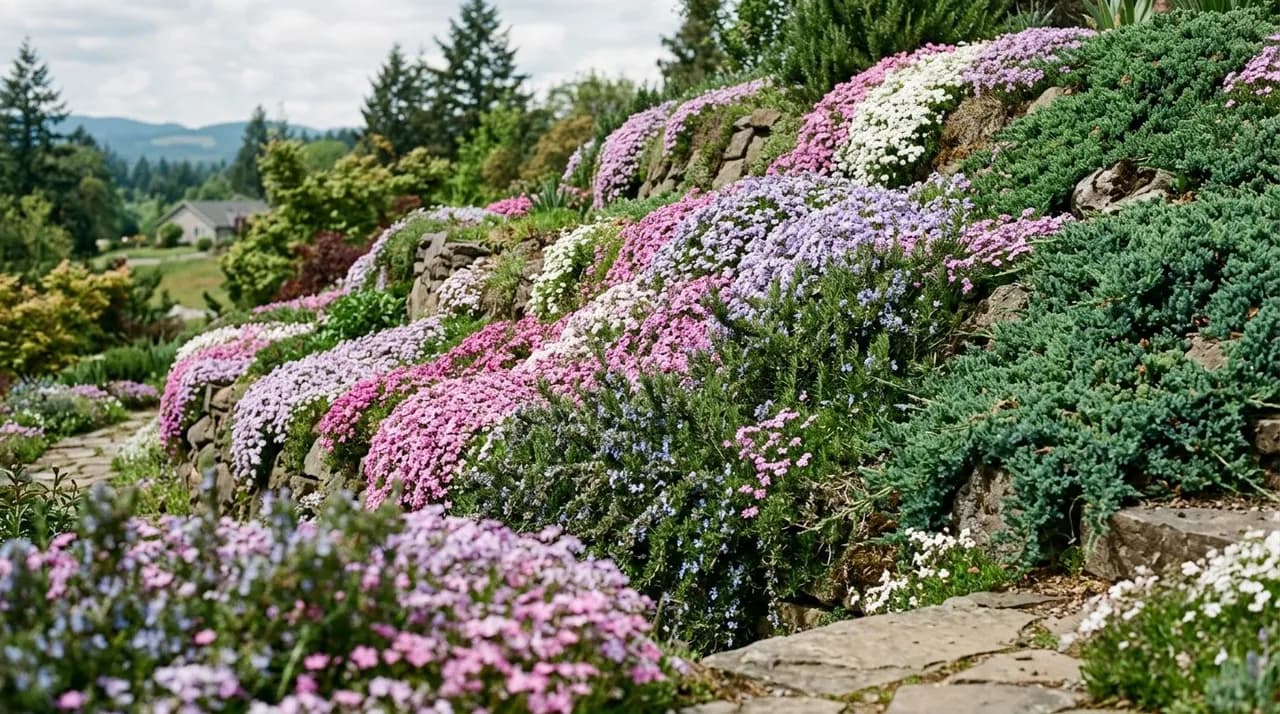
Key takeaways
- Deep-rooting perennial ground covers stabilize hillside topsoil and prevent heavy runoff erosion.
- Replacing steep turf grass with low-growing ground covers eliminates dangerous slope mowing hazards.
- Temporary biodegradable jute netting holds loose soil and mulch in place while young root systems establish.
- Plant selections must match sunlight exposure, soil drainage characteristics, and regional hardiness.
- Pocket planting with crescent-shaped soil berms captures rainwater directly at each root ball.
Quick answer: The best ground cover for slopes combines extensive root systems with dense, sprawling foliage to lock topsoil in place and absorb heavy rainfall. Top choices include creeping juniper, creeping phlox, fragrant sumac, and prostrate rosemary for sunny banks, alongside pachysandra, sweet woodruff, and wild ginger for shaded hillsides.
Landscaping a steep bank or hillside presents severe practical challenges. Heavy rains wash away exposed topsoil, loose mulch slides downhill, and attempting to operate a lawnmower across steep inclines is both exhausting and physically dangerous.
Establishing ground cover on slopes provides an interlocking root system and foliage canopy that stabilizes soil. Selecting the right erosion-control plants turns steep embankments into stable beds that do not need mowing.
On driveway cuts and backyard embankments, stabilizing the slope before planting helps roots establish before heavy rain causes soil loss.
Why are perennial ground covers superior to slope turf?
Managing turf grass on hillsides is inefficient and hazardous. Mowing equipment operates poorly on slopes exceeding 15 to 20 degrees, increasing the risk of rollovers and operator injury. Common lawn grasses have shallow roots (often penetrating only 2 to 4 inches or 5 to 10 cm into the soil) that offer minimal shear strength against hillside slippage in wet conditions.
In contrast, no mow slope solutions utilizing woody and herbaceous perennials provide several distinct ecological advantages:
- Deeper root penetration: Woody shrubs and perennial ground covers send fibrous roots and taproots several feet into the subsoil, physically binding soil strata together.
- Canopy rainfall interception: Dense foliage cushions the physical impact of heavy raindrops, preventing surface crusting and reducing runoff velocity.
- Mulch and moisture retention: Interlocking stems trap organic debris, building a natural sponge of decaying organic matter that absorbs excess moisture.
For more on soil management, see our guide on soil amendments demystified.
What are the best ground cover plants for sunny slopes?
Sunny, south- and west-facing hillsides experience intense heat, rapid evaporation, and strong wind exposure. The best ground cover for hillsides in full sun includes drought-tolerant species with spreading habits:
1. Creeping juniper (Juniperus horizontalis)
Creeping juniper is an exceptional evergreen ground cover for steep slopes. Varieties like 'Blue Rug' or 'Wiltonii' grow only 4 to 6 inches (10 to 15 cm) tall while spreading 6 to 8 feet (1.8 to 2.4 m) wide. Its fibrous root system anchors rocky, poor soils and tolerates severe summer drought once established.
2. Creeping phlox (Phlox subulata)
Forming a dense, needle-like evergreen carpet 4 to 6 inches (10 to 15 cm) tall, creeping phlox covers hillsides in dense spring flowers while binding sandy or gravelly slopes through fine root networks.
3. Gro-Low fragrant sumac (Rhus aromatica 'Gro-Low')
Reaching 1.5 to 2 feet (45 to 60 cm) in height and spreading 6 to 8 feet (1.8 to 2.4 m), this deciduous native shrub spreads via underground suckers, forming an exceptionally tough root mass that stabilizes severe highway embankments and rocky banks.
4. Prostrate rosemary (Salvia rosmarinus 'Prostratus')
In warm, mild-winter climates, prostrate rosemary drapes over retaining walls and steep banks, offering aromatic foliage, pollinator forage, and high drought tolerance in well-drained soils.
5. Bearberry or kinnikinnick (Arctostaphylos uva-ursi)
A cold-hardy, evergreen woody ground cover that thrives in acidic, sandy, and nutrient-poor soils, bearberry forms a dense mat 6 to 12 inches (15 to 30 cm) high with pink spring flowers and red autumn berries.
What are the best ground cover plants for shaded slopes?
North-facing banks and slopes beneath mature tree canopies require shade-tolerant ground cover for banks that can compete with tree roots for available moisture:
1. Allegheny spurge (Pachysandra procumbens)
Unlike invasive Asian pachysandra, this North American native perennial forms a tidy, non-invasive ground cover 6 to 10 inches (15 to 25 cm) high, tolerating dense shade and dry soil under large hardwoods.
2. Sweet woodruff (Galium odoratum)
Sweet woodruff spreads via shallow rhizomes to form a soft green carpet with delicate white spring blossoms in moist, shaded hillside pockets.
3. Wild ginger (Asarum canadense)
Featuring broad, heart-shaped deciduous leaves, wild ginger spreads steadily in rich woodland soils, providing dense seasonal canopy cover that blocks weed establishment on shaded banks.
4. Creeping barrenwort (Epimedium species)
One of the toughest perennials for dry shade, epimedium forms a resilient woody rootstock that thrives directly beneath thirsty tree canopies where other plants struggle.
To see how ground covers integrate into multi-tiered plantings, see our guide on food forest layers.
How do you prepare and plant steep slopes to prevent erosion?
Planting steep slope landscaping plants without proper physical stabilization can result in newly installed plants washing downhill during the first heavy rainstorm. Follow this step-by-step planting protocol:
Step 1: Install biodegradable erosion netting
On slopes steeper than 20 degrees, roll out woven jute netting or coir (coconut fiber) erosion blankets directly over the bare hillside. Secure the netting firmly using heavy-duty biodegradable landscape staples spaced every 2 to 3 feet (60 to 90 cm). The netting holds soil and mulch in place for one to two years while plant roots take hold, gradually decomposing as vegetation matures.
Step 2: Pocket planting with soil berms
Cut an "X" shape through the netting where each plant will go. Dig a planting hole into the slope, ensuring the top of the root ball sits level with the lower edge of the slope. Use the excavated soil to build a crescent-shaped retaining berm on the downhill side of the plant. This small basin catches water and directs moisture into the root ball.
Step 3: Apply coarse, shredded bark mulch
Spread 2 to 3 inches (5 to 8 cm) of fibrous, double-shredded hardwood mulch over the netting and between planting pockets. Shredded hardwood knits together effectively, resisting water washouts far better than smooth bark nuggets or loose woodchips.
How do you maintain establishing hillside ground covers?
During the first one to two growing seasons, hillside plantings require attentive care until root networks fully interlock:
- Targeted drip irrigation: Install drip lines or inline emitter tubing beneath the mulch layer. Overhead spray irrigation causes slope erosion and water runoff, whereas low-pressure drip irrigation delivers water directly to root pockets.
- Hand weeding: Avoid using heavy hoes or broadscale cultivation that disturbs hillside soil. Hand-pull opportunistic weeds when soil is moist to prevent dislodging erosion blankets.
- Selective pruning: Once ground covers establish, prune dead wood or tip-prune sprawling branches annually to encourage denser lateral branching and thicker ground coverage.
For related plant selections, see our guides on ground cover between pavers and cover crops for the home garden.