Key takeaways
- Never fertilize a stalled plant before checking salt EC, root rot, and winter dormancy—excess salts trigger osmotic drought.
- The inverse-square law cuts window PAR 70–90% at 6–8 feet indoors, fooling human eyes in dim 50–100 foot-candle rooms.
- Inspect roots before repotting: firm white coils need 1–2 inches larger in spring; mushy sloughing cortex signals Pythium hypoxia.
- Treat salt-crusted pots (EC > 2.0–3.0 mS/cm) with a 3× pot-volume leach using unsoftened or RO water; never use Na+-softened tap.
- Check distorted, hardened, web-free shoots with a 10–20× loupe for flat mites (Brevipalpus), broad mites, thrips, scale, and root mealybugs.
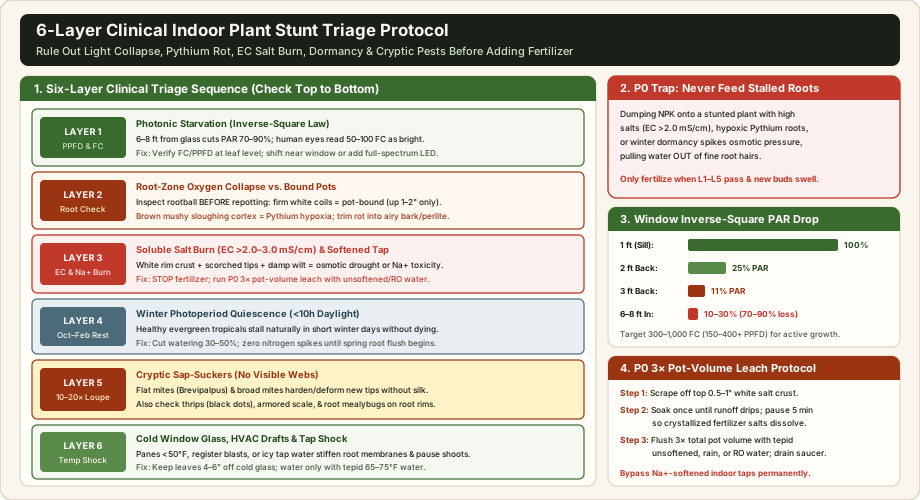
Quick answer: Never dose a stunted houseplant with fertilizer first. Run six clinical checks in order: measure leaf-level light (PPFD and foot-candles, since sitting 6–8 feet back from windows drops PAR 70–90%); slide out the rootball to distinguish firm white pot-bound coils from brown sloughing Pythium root rot; check for soluble salt burn (EC > 2.0–3.0 mS/cm) or sodium-softened tap water and flush 3× pot volume; respect October–February winter dormancy; scan shoot crevices at 10–20× for web-free flat mites, broad mites, thrips, or root mealybugs; and fix cold glass or HVAC draft shock.
Why Blindly Fertilizing a Stalled Houseplant Kills Roots
Few reflexes damage indoor collections faster than pouring liquid plant food onto a heartleaf philodendron, pothos, or ficus simply because it has sat frozen for months. Standard troubleshooting lists still push nitrogen feedings as the default fix for slow growth, yet three of the top five clinical causes of indoor plant stalling—soluble salt toxicity, oxygen-starved root rot, and winter daylight dormancy—grow rapidly worse when extra fertilizer salts hit the potting mix.
When root hairs are already damaged by high Electrical Conductivity (EC), sodium from softened tap water, or waterlogged Pythium pathogens, adding NPK raises osmotic concentration in soil water. Instead of feeding the stem, concentrated ions pull cellular moisture backward out of fine root tips. Follow the six-layer clinical triage sequence below from top to bottom so you treat the true bottleneck first and apply fertilizer only after light, roots, salinity, and pests clear inspection.
Layer 1: Photonic Starvation and the Inverse-Square Window Trap
Photosynthetic energy is the #1 ceiling on indoor plant growth. Because human pupils dilate smoothly inside dim living rooms, our eyes register a bright-looking 50–100 foot-candle (FC) corner as sunlit even while a tropical plant sits below its light compensation point—burning stored sugars just to keep old leaves alive with zero surplus to build new shoots.
University extensions at UF/IFAS, Illinois, and Iowa State evaluate usable plant energy via Foot-Candles (FC) and Photosynthetically Active Radiation (PAR / PPFD in µmol/m²/s across 400–700 nm) rather than human room brightness. Both drop sharply with distance under the inverse-square law: doubling distance from a light source reduces intensity to one-quarter (`25%`), tripling drops it to one-ninth (`11%`), and setting a pot 6–8 feet back from an interior window cuts usable PAR by 70%–90% once blinds, window frames, and ceiling overhangs narrow the plant's view of open sky. Read our full indoor light intensity guide and leggy light-deficiency diagnostic for room mapping.
Indoor Window Light Intensity Drop-off (Foot-Candles & Estimated PPFD) Across US Exposures
Window Orientation / Source | On Sill (0–1.5 ft) | Mid-Zone (3 ft Back) | Interior Floor (6–8 ft Back) | Clinical Growth Impact & Match |
|---|---|---|---|---|
Unobstructed South Window | 1,000–3,500+ FC (200–700 PPFD) | 350–700 FC (70–140 PPFD) | 80–200 FC (16–40 PPFD) | Bright growth at 0–4 ft; stalls hungry Ficus/Monstera past 6 ft |
East or West Window | 600–1,800 FC (120–360 PPFD) | 200–450 FC (40–90 PPFD) | 40–120 FC (8–24 PPFD) | Matches foliage tropicals near glass; inadequate past 5–6 ft |
North Window (US Latitudes) | 150–350 FC (30–70 PPFD) | 50–120 FC (10–24 PPFD) | 15–40 FC (3–8 PPFD) | Survival maintenance only for low-light species; stalls most aroids |
Full-Spectrum LED (12–18" above canopy) | 400–1,200 FC (100–300+ PPFD) | 100–300 FC (25–75 PPFD at 24–36") | <40 FC (<10 PPFD past 4 ft) | Run 12–14 hrs/day via timer to build steady Daily Light Integral (DLI) |
Notice why plants placed six feet from an east window stop sizing up leaves and turn pale: they sit at 40–100 FC, barely matching bare-minimum survival for tough low-light indoor plants such as snake plant, ZZ plant, and cast iron plant. Wipe dust off broad leaf blades monthly with a damp cloth, test leaf-height light with a dedicated smartphone PPFD/FC meter app calibrated to sunlight, shift plants within 1–3 feet of bright windows, or hang budget full-spectrum LED grow lights 12–18 inches above stalled canopies—ordinary overhead room bulbs deliver far below LED plant minimums.
Layer 2: Root-Zone Oxygen Collapse vs. Bound Pots
Once photon delivery checks out, resist guessing from leaf droop alone. Overwatering and underwatering produce nearly identical wilting symptoms because both leave leaves starved for turgor pressure—one from dry air pockets, the other from rotted roots unable to pump water upward.
Gently support the stem base, invert or tilt the pot, and slide the rootball cleanly out to inspect roots before reaching for a larger planter. Healthy pot-bound roots show dense, tightly coiled white or pale cream strands with crisp firm tips wrapping the perimeter; they slow shoot expansion simply because media volume can no longer store water or dissolved oxygen between waterings.
By contrast, waterlogged compacted peat suffocates roots and triggers **Pythium root rot, an oomycete water mold active even at cool indoor temperatures below 68°F. Wisconsin Horticulture and UC IPM diagnostic clinics pinpoint the giveaway tactile test: rotted roots turn brown, gray, or black and feel mushy, and when you gently tug a suspect strand, the outer root cortex sloughs cleanly off**, leaving a bare hair-thin inner vascular core alongside a sour swamp smell. Check our root rot rescue and repot walkthrough and root rot diagnosis guide immediately if cortex sloughing appears.
Strict Repotting Rules: 1–2 Inches Maximum and Chunky Porosity
- Healthy rootbound plants: Move up 1–2 inches in pot diameter ONLY (for instance, 4" to 5" or 6" to 8") during active spring–summer growth—oversized containers wrap small rootballs in wet, anoxic mud that causes oversized-pot root rot. Follow our houseplant repotting guide and best US spring repotting window.
- Pythium root-rot recovery: Wash away sour compacted peat, shear all brown mushy roots cleanly back to crisp white tissue using rubbing-alcohol-wiped shears, and pot down (into a snug container matching remaining healthy roots, NEVER larger) filled with breathable DIY chunky potting mix rich in pine bark and coarse perlite.
- Never skip drainage holes: Avoid closed decorative cachepots unless you slide inner nursery pots out to drain completely after every watering; choose breathable terracotta for root-rot-prone species using our pot material comparison.
Layer 3: Soluble Salt Burn (EC > 2.0–3.0 mS/cm) & Sodium Tap Toxicity
Countless houseplants stop growing in year two because minerals accumulate invisibly inside pots. Every dose of synthetic or liquid fertilizer, plus calcium, magnesium, and bicarbonates in municipal tap water, stays behind in the container whenever moisture evaporates from the surface or transpires through foliage. Even plants watered with unfertilized tap water slowly build crusty salt rims.
Rutgers Cooperative Extension (`FS848`) measures root-zone salinity via Electrical Conductivity (EC) in `mS/cm` (numerically equal to `dS/m`). When PourThru or saturated extract readings climb past 2.0–3.0 mS/cm, soluble fertilizer salts burn root hairs chemically and halt shoot growth—showing white or yellowish chalk crusts on topsoil or clay rims, crispy brown leaf tips bordered by yellow halos, and paradoxical wilting in damp media.
P0 residential water-softener hazard: Penn State Extension warns that standard ion-exchange home water softeners strip beneficial calcium and magnesium out of hard tap water and swap in toxic sodium ions (Na+). Chronic watering with softened tap water spikes root-zone sodium, disperses organic potting media structure into airless slime, burns roots, and locks sensitive Dracaena, spider plants, and peace lilies into permanent stall. Draw houseplant water exclusively from an unsoftened outdoor spigot, cold bypass line, rainwater barrel, or reverse-osmosis filter.
Rootball & Potting-Mix Forensic Diagnosis Matrix (Layers 2 & 3)
Root-Zone Condition | Root Color & Tactile Test | Media & Pot Clues | Foliar Stunt Pattern | Clinical Protocol |
|---|---|---|---|---|
Healthy Pot-Bound | Firm white/tan coils; strong tips | Zero loose mix; water runs out bottom fast | Stalled shoot size; dries every 1–2 days | Step up 1–2" ONLY in spring into porous mix |
Pythium Oxygen Collapse | Brown/black, mushy; outer cortex sloughs off | Cold soggy peat; foul marsh smell | Lower leaf yellowing; limp despite wet soil | Prune all rot; pot down into airy bark/perlite |
Soluble Salt Burn (EC > 2.0–3.0 mS/cm) | Short blackened/brown root tips; sparse hairs | White/yellow crust on soil surface or clay rim | Scorched leaf margins; dry-looking wilt in wet pot | STOP feeding; execute P0 3× pot-volume leach |
Softened Na+ Tap Toxicity | Stunted brown roots; weak lateral branching | Sticky compacted topsoil; dull crusty film | Progressive tip necrosis on spider plant & peace lily | Bypass softener permanently; repot & flush RO/rainwater |
Root Mealybugs (Rhizoecus) | Thin starved roots coated in white clumps | Powdery bluish-white rice-like wax at pot edge | Chronic slow decline mimicking drought or NPK starvation | Wash bare-root cleanly; discard heavily infested mix & pots |
The P0 3× Pot-Volume Leach Protocol
When white crusts, salt-sensitive spider plant tip burn, or an inexpensive handheld TDS/EC meter probing leachate runoff confirms salinity above 2.0 mS/cm, run Colorado State Extension's two-stage leaching flush every 4–6 months:
- Scrape visible surface crust: Lift away the top 0.5–1 inch of salt-encrusted topsoil carefully without tearing feeder roots, and top up later with fresh mix.
- First pass (dissolve salts): Carry the pot to a sink or shower, pour tepid unsoftened, rainwater, or RO water slowly until water streams from drainage holes, then pause 5 minutes so hardened crystalline salts dissolve into solution.
- Flush 3× pot volume and empty runoff: Pour two to three times the container's total soil volume slowly through the rootball (e.g., 2–3 gallons through a 1-gallon pot) until runoff turns clear and low-EC, let drain completely for 15 minutes, and never leave pots sitting in drained salt-rich saucer water. Avoid garden compost or heavy alfalfa pellets indoors; consult our soil and water quality guide and yellowing leaf diagnostic if chlorosis persists after flushing.
Layer 4: Winter Photoperiod Rest (October–February Quiescence)
Not every paused houseplant is sick. University of Vermont Extension explains that as northern US day lengths shrink below 10 hours from October through February and low winter sun angles cut interior solar intensity, evergreen tropicals enter natural photoperiod quiescence—dialing down cell division and root uptake to wait out low-energy months.
If a mature peperomia, parlor palm, or arabica coffee plant holds crisp green foliage without dropping leaves, curling, or yellowing during December and January, stalling is healthy energy conservation. Respect winter rest cleanly:
- Zero midwinter nitrogen spikes: Never force shoots between November and February with full-strength fertilizer; excess unabsorbed nitrogen accumulates straight into Layer 3 salt burn.
- Cut watering frequency by 30%–50%: Check deep moisture using our finger, meter, and pot-weight method and follow our winter heating watering schedule so cool damp soil never invites Pythium.
- Only add grow lights if you want winter growth: Unless you maintain 12–14 hours of supplemental LED light via winter light supplementation alongside warm 70°F temperatures, pause feeding until longer March daylight triggers visible spring root and bud swell.
Layer 5: Cryptic Sap-Suckers That Need a 10–20× Loupe Check
When light, root health, salinity, and season all check out yet emerging leaves emerge deformed, hardened, scarred, or frozen mid-unfurl, microscopic sap-sucking pests are draining meristematic tissue. Most indoor growers look solely for spider-mite silk webbing—missing four stealthier culprits completely.
Keep an inexpensive $10–$15 10–20× jeweler's loupe (or clip-on macro phone lens) beside your watering can. Inspect tight petiole crevices, unfurling leaf sheaths, stem nodes, and outer rootball surfaces whenever new shoots deform:
Cryptic Sap-Sucker & Environmental Shock Diagnostic Triage (Layers 5 & 6)
Stressor / Pest | 10–20× Loupe & Physical Sign | Characteristic Stunt Symptom | Webbing Present? | Targeted Indoor Remedy |
|---|---|---|---|---|
Flat Mites (Brevipalpus spp.) | Tiny flat reddish-orange oval mites pressed into petiole bases | Hardened, woody, rough, or stalled new tips and corky bronzing | No webbing | Horticultural oil or insecticidal soap coating crevices; 3× weekly cycles |
Broad / Cyclamen Mites | Translucent microscopic mites inside tight apical buds | Severely twisted, brittle, curled downward shoot tips; aborted buds | No webbing | Isolate immediately; sulfur/horticultural oil or discard severe cases |
Thrips (Thripidae) | Slender cigar-shaped nymphs; silvery streaks + black tar specks | Puckered, streaked, scarred new leaves stunted right out of sheath | No webbing | Spinosad or insecticidal soap sprays + blue sticky traps; repeat 5–7 days |
Armored & Soft Scale | Immobile brown/tan bumps along stems/midribs; sticky honeydew | Weak twig dieback and starved pale shoots below node clusters | No webbing | Swab shells with 70% rubbing alcohol + horticultural oil for crawlers |
Root Mealybugs (Rhizoecus) | Powdery white wax & rice-sized slow insects on outer rootball | Persistent unexplained wilt, pale leaves & zero growth despite care | No webbing | Bare-root rinse thoroughly; repot clean mix or isolate/discard |
Cold Glass / HVAC Drafts & Icy Tap Water | Foliage <4" from <50°F glass, vent blasts, or <55°F tap water | Water-soaked dark spots, leaf drop, or frozen shoot elongation | N/A (abiotic) | Space foliage 4–6" off cold panes; water only with tepid 65–75°F water |
Flat mites (Brevipalpus spp.) deserve special attention because they fool experienced growers on Hoya, Philodendron, and Anthurium—causing stubby, hardened, aborted shoot tips with zero silk webs. Pair thorough coverage of how to get rid of thrips, indoor scale removal, rubbing alcohol mealybug treatment, and spider mite humidity control, and always isolate new nursery purchases for 30 days using our quarantine protocol so cryptic mites never jump across shelves.
Layer 6: Cold Glass, HVAC Register Drafts & Cold-Water Shock
Tropical foliage touching winter panes loses radiant heat below 45–50°F on freezing nights, while plants beneath furnace registers or AC vents face drying gusts and temperature swings.
Cold glass and icy 48°F winter tap water stiffen root membrane lipids and thicken water viscosity, stalling uptake for days—while cold splashes scar fuzzy leaves like African violets. Space foliage 4–6 inches off cold glass, deflect floor vents, temper watering cans overnight to 65–75°F, and keep VPD balanced with a properly sized plant room humidifier.
Once Layers 1–6 pass cleanly and spring buds swell, apply balanced liquid fertilizer at half-strength every 3–4 weeks. Cross-check stubborn yellowing in our leaf nutrient deficiency guide and repotting guide.