Key takeaways
- Select varieties tolerant to temperatures below 32°F for fall and winter growing.
- Implement succession planting to ensure continuous harvests from late summer through early spring.
- Rotate crops annually to maintain soil health and reduce pest and disease pressure over 3 to 4 years.
- Utilize season extension techniques like cold frames or row covers to protect plants down to 10°F.
- Plan planting dates carefully, often 6 to 10 weeks before the first hard frost, for optimal establishment.
- Build soil organic matter steadily with compost and cover crops, expecting gains measured in tenths of a percentage point per year rather than whole points.
Quick answer: To extend your harvest into fall and winter, select cold-hardy vegetable varieties, implement succession planting, rotate crops annually, and utilize season extension techniques like cold frames. Plan planting dates 6-10 weeks before the first hard frost for optimal establishment in USDA Zones 3-8.
In USDA zone 6, the traditional growing season often ends by late October, but with careful planning, many growers extend their harvests well into winter, sometimes even to March. This expansion can provide fresh produce for an additional 3 to 5 months, significantly reducing grocery bills and increasing food security for a family of four. For example, a well-managed 1,000 square foot garden can carry a household through much of the year, with a substantial share of the cold-season harvest coming from hardy greens and roots.
Cultivating vegetables through the colder months requires a strategic approach, combining specific plant selections with sound horticultural practices. We’ll explore varieties that thrive in temperatures as low as 10°F, discuss the merits of crop rotation for long-term soil vitality, and detail succession planting schedules that keep beds productive. This guide aims to equip US growers, from the Pacific Northwest to the Mid-Atlantic, with the knowledge to transform their gardens into year-round food sources, even in regions experiencing 100 or more frost days per year.
Understanding cold hardiness and microclimates
When planning for a fall and winter harvest, understanding your specific USDA Plant Hardiness Zone is the first critical step. These zones, ranging from 1 to 13 across the US, indicate the average annual extreme minimum winter temperature, which directly impacts what plants can survive outdoors. For instance, a gardener in USDA zone 5 can expect winter lows between -20°F and -10°F, while someone in zone 8 might only see lows between 10°F and 20°F. However, microclimates within your garden can create pockets that are 5 to 10°F warmer or colder than the general zone rating, influencing plant survival.
Identifying your garden’s cold tolerance
Beyond the general hardiness zone, individual plant species exhibit varying degrees of cold tolerance. Many brassicas, like kale and collards, can tolerate temperatures down to 10°F, and some varieties even lower, especially when protected by snow or row covers [4]. Root vegetables such as carrots and parsnips can often overwinter in the ground in USDA zones 6 and warmer, surviving temperatures below 20°F if well-mulched. Knowing your average first and last frost dates—available from local extension offices or online resources—is also essential. For example, the average first frost date in USDA zone 5 typically falls in mid-October, requiring fall crops to be established 6 to 10 weeks prior for optimal growth [1].
- Kale: Tolerates down to 10°F
- Spinach: Tolerates down to 15°F
- Carrots: Tolerates down to 15°F (with mulch)
- Collards: Tolerates down to 10°F
- Mache: Tolerates down to 5°F
Strategic crop rotation for soil health
Crop rotation is a fundamental practice for maintaining long-term soil health and productivity, especially when aiming for continuous harvests. It involves planting different crops in a specific sequence over several seasons, typically a 3- to 4-year cycle, in the same garden bed. This practice helps prevent the buildup of specific soil-borne diseases and pests that are host-specific to certain plant families. For instance, planting brassicas like cabbage or kale in the same spot year after year can lead to clubroot disease, which can persist in the soil for up to 20 years. Crop rotation reduces disease pressure most for pathogens that persist only a season or two in soil, and does far less for long-lived ones.
Planning your 3-year rotation cycle
A common rotation strategy involves grouping vegetables by family: legumes (peas, beans) for nitrogen fixation, heavy feeders (brassicas, corn) that benefit from the nitrogen, and light feeders (carrots, radishes) or root crops. For example, a 4-year rotation in a 100 square foot bed might start with a nitrogen-fixing cover crop like clover, followed by kale, then carrots, then onions or garlic. This cycle ensures that different nutrient demands are met and pest cycles are broken. Incorporating cover crops, when integrated into a rotation, slowly builds soil organic matter and improves soil structure and water retention. For more on cover crops, see our article on Best Living-Mulch and Cover-Crop Legumes by USDA Zone for No-Dig Beds.
- Year 1: Legumes (e.g., peas, beans)
- Year 2: Brassicas (e.g., kale, cabbage)
- Year 3: Root Crops (e.g., carrots, beets)
- Year 4: Alliums (e.g., onions, garlic)
Succession planting for continuous harvest
Succession planting is the art of staggering plantings to ensure a continuous supply of fresh vegetables throughout the growing season, extending well into fall and winter. Instead of planting an entire bed of one crop at once, you plant smaller batches every 2 to 4 weeks. This method maximizes bed productivity and reduces waste, preventing a glut of produce followed by a period of scarcity. For example, planting small batches of radishes every 10 days in late summer can provide a steady harvest through early fall in USDA zone 7, yielding 2 to 3 pounds of roots per square foot over the season. For more on this fast-growing crop, see How to grow radishes: the fastest crop from seed to harvest.
Timing your fall and winter successions
For fall and winter harvests, timing is critical. Most cold-hardy vegetables need 6 to 10 weeks of growth before the first hard frost to establish sufficiently. This means if your first hard frost is typically in late October (common in USDA zone 6), you should aim for your last succession planting of quick-growing greens like spinach or arugula by mid-September. For slower-growing crops like kale or collards, planting in mid-July to early August allows them to reach a substantial size before temperatures consistently drop below 40°F. In USDA zone 8, you might be able to continue planting cold-tolerant greens into early November — but in the northern half of the country growth all but stops once daylight drops below about 10 hours a day, roughly mid-November to late January, so a winter bed there mostly holds what you grew in autumn rather than growing much that is new. A 4 ft by 8 ft raised bed of mixed greens will keep a household in salad through autumn, though the monthly cut drops sharply once day length shortens.
- Radishes: Plant every 10-14 days
- Spinach: Plant every 2-3 weeks
- Arugula: Plant every 2-3 weeks
- Lettuce: Plant every 3-4 weeks
- Peas: Plant early fall for late fall/early winter harvest (see How to grow peas: seed to harvest, plus a second fall crop)
Top cold-hardy vegetables for fall and winter
Selecting the right vegetables matters for a successful cold-season garden. Many varieties are specifically bred for their ability to withstand lower temperatures and even improve in flavor after a light frost, a process known as ‘frost-sweetening.’ For example, ‘Winterbor’ kale is known to withstand temperatures down to 10°F, while ‘Tyee’ spinach is bred for overwintering in regions like the Pacific Northwest. These specialized varieties often have thicker leaves or a more compact growth habit, making them more resilient to frost and short daylight hours, which is what lets them keep producing after standard varieties have stopped.
Specific varieties and their tolerances
Beyond kale and spinach, several other vegetables perform exceptionally well. Mache (corn salad) is incredibly cold-tolerant, surviving down to 5°F and providing tender greens throughout winter. Leeks can withstand temperatures as low as 0°F, especially when their stems are hilled with soil for extra insulation. Root vegetables like carrots (‘Danvers 126’) and beets (‘Detroit Dark Red’) can overwinter in the ground in USDA zones 6 and warmer if mulched with 4 to 6 inches of straw, yielding up to 5 pounds per 10-foot row. Even some varieties of peas, like ‘Oregon Sugar Pod,’ can be planted in late fall for an early spring harvest in milder climates. For detailed guidance on one of the best cold-hardy greens, see How to grow kale: cold-hardy timing, cut-and-come-again harvest, and frost-sweet leaves.
- Kale (‘Winterbor’, ‘Red Russian’)
- Spinach (‘Tyee’, ‘Bloomsdale Long Standing’)
- Mache (Corn Salad)
- Collards (‘Georgia’, ‘Vates’)
- Carrots (‘Danvers 126’, ‘Nantes’)
- Beets (‘Detroit Dark Red’, ‘Bull’s Blood’)
- Leeks (‘American Flag’, ‘Tadorna’)
- Radishes (‘Cherry Belle’, ‘French Breakfast’)
Season extension techniques
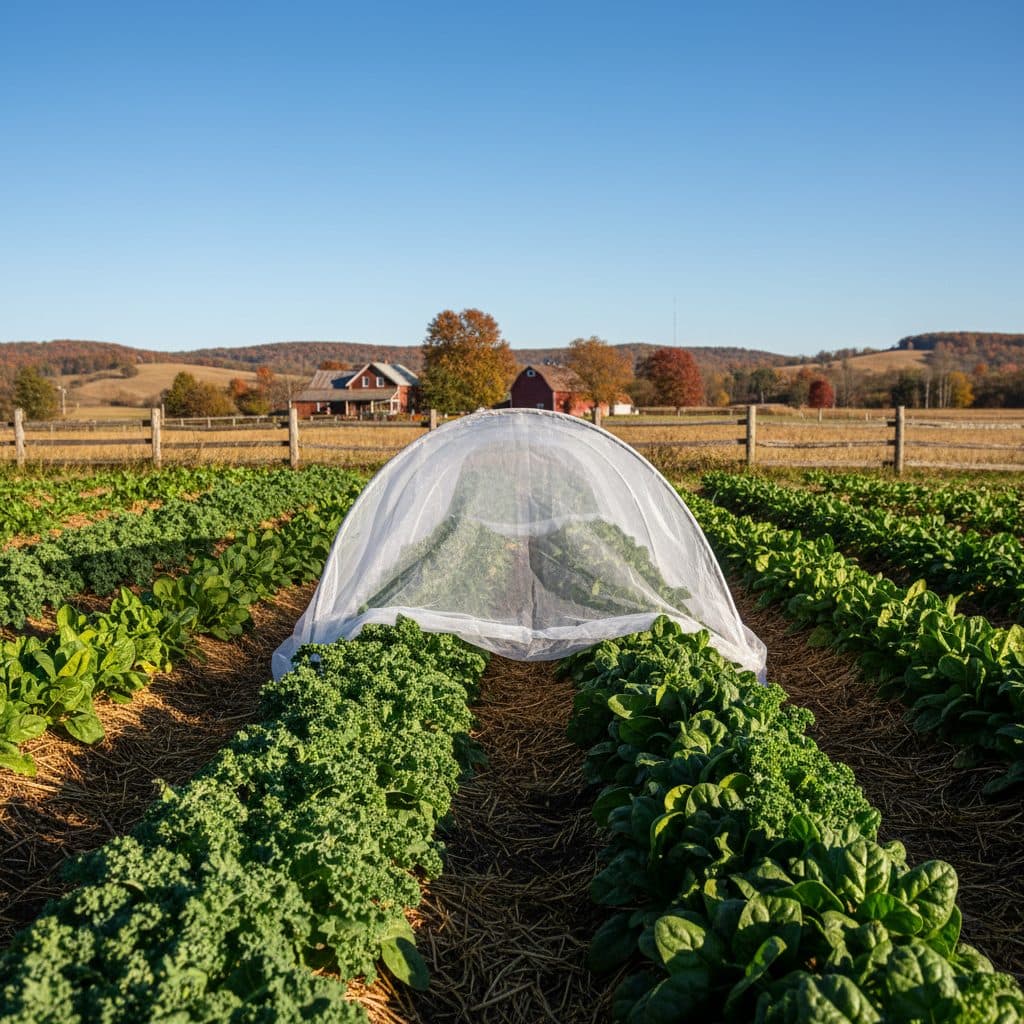
Even the most cold-hardy vegetables benefit from season extension techniques, which can significantly prolong your harvest window and protect plants from extreme cold. Simple structures like cold frames and row covers buy a few degrees of overnight warmth over the outside air, allowing you to grow crops well beyond your typical frost dates. For example, a simple row cover buys roughly 2 to 4°F in lightweight fabric and 6 to 8°F in heavyweight, enough to carry hardy greens through a light frost. In USDA zone 7, these methods can extend the harvest by 2 to 3 months, providing fresh greens well into January.
Building and using cold frames and row covers
Cold frames are essentially bottomless boxes with a transparent lid, typically made from wood and old windows, that create a miniature greenhouse effect. A 3 ft by 6 ft cold frame can easily house 20 to 30 small plants, but on a clear, still night an unheated frame holds only a few degrees over the outside air, so treat it as protection against frost rather than against a hard freeze. Row covers, made from lightweight fabric, can be draped directly over plants or supported by hoops. They offer protection from frost, wind, and some pests, and can increase soil temperature by 2 to 5°F. For even greater protection in colder climates like USDA zone 4, combining a row cover underneath a low tunnel or inside a cold frame can keep plants alive down to -10°F. Remember to vent cold frames on sunny days when temperatures climb above 40°F to prevent overheating and disease.
- Cold Frames: Protects down to 0°F
- Row Covers: Adds roughly 2-4°F in lightweight fabric, 6-8°F in heavyweight
- Low Tunnels: Combines row covers with hoops
- Thick Mulch: Insulates soil, protects roots
- Cloches: Individual plant covers
Cold-Hardy Vegetable Comparison
Vegetable | Min. Temp Tolerance (°F) | Days to Maturity (Avg.) | USDA Zones |
|---|---|---|---|
Kale | 10 | 55-75 | 3-9 |
Spinach | 15 | 30-45 | 3-9 |
Arugula | 20 | 20-40 | 3-9 |
Carrots | 15 (mulched) | 60-80 | 3-10 |
Beets | 20 (mulched) | 50-70 | 2-10 |
Mache (Corn Salad) | 5 | 50-70 | 3-9 |
Leeks | 0 | 90-120 | 3-9 |
Collards | 10 | 60-80 | 3-10 |
Radishes | 25 | 20-30 | 2-10 |
Peas | 20 | 60-70 | 3-9 |
Soil Organic Matter: Organic matter increases how much water soil can hold, though how much depends heavily on soil texture — treat the round figures widely quoted for this as rules of thumb rather than measurements.
Frost Protection: A simple row cover buys roughly 2 to 4°F in lightweight fabric and 6 to 8°F in heavyweight, enough to carry hardy greens through a light frost.
Winter Harvest Yield: A 100 square foot cold frame planted in autumn will carry a household in greens through the winter in USDA zone 7.
Frequently asked questions
What is the best way to determine my planting dates for fall and winter crops?
To determine optimal planting dates, identify your average first frost date, which varies significantly across USDA zones. For instance, in USDA zone 5, the first frost typically occurs in mid-October. Most fall crops need 6 to 10 weeks of growth before this date to establish sufficiently, allowing them to withstand colder temperatures and produce a harvest.
How much protection do cold frames offer against freezing temperatures?
A cold frame runs far warmer than outside air on a sunny day, but that heat sheds overnight — on a still, clear night an unheated frame holds only a few degrees over the outside air. Do not count on a frame turning a 20°F-hardy crop into a 0°F-hardy one; add an inner row cover or a thick mulch when a harder night is forecast.
Can I use the same garden bed for fall and spring crops without rotation?
While possible for a single season, continuous planting of the same crop family in the same bed can deplete specific nutrients and increase pest and disease pressure over time. For example, planting brassicas like kale in the same spot for more than two consecutive years can lead to a buildup of clubroot disease, which can persist in the soil for up to 20 years. Rotating crops every 3 to 4 years helps maintain soil health and productivity.
What’s the role of soil organic matter in cold-season gardening?
Soil organic matter helps cold-season gardening because it improves soil structure, drainage, and water retention, which are vital for plant health in fluctuating temperatures. Soils with 3% to 5% organic matter buffer temperature swings more effectively than soils with less than 1%, providing a more stable root environment for plants during cold snaps and thaws [2].
Are there specific varieties of common vegetables that perform better in cold weather?
Yes, selecting cold-hardy varieties is key. For instance, ‘Winterbor’ kale is known to withstand temperatures down to 10°F, while ‘Tyee’ spinach is bred for overwintering in regions like the Pacific Northwest. These specialized varieties often have thicker leaves or a more compact growth habit, making them more resilient to frost and short daylight hours, offering a 15% to 20% greater yield in cold conditions compared to standard varieties.
How does succession planting benefit a fall and winter garden?
Succession planting ensures a continuous supply of fresh vegetables by staggering plantings every 2 to 4 weeks, rather than harvesting everything at once. For example, planting small batches of radishes every 10 days in late summer can provide a steady harvest through early fall in USDA zone 7, yielding 2 to 3 pounds of roots per square foot over the season. This method maximizes bed productivity and reduces waste.
References
- USDA Natural Resources Conservation Service (2024). USDA Natural Resources Conservation Service.
- EPA — Soak Up the Rain (2024). EPA — Soak Up the Rain.
- SARE — Sustainable Agriculture Research & Education (2023). SARE — Sustainable Agriculture Research & Education.
- ATTRA / NCAT Sustainable Agriculture (2023). ATTRA / NCAT Sustainable Agriculture.