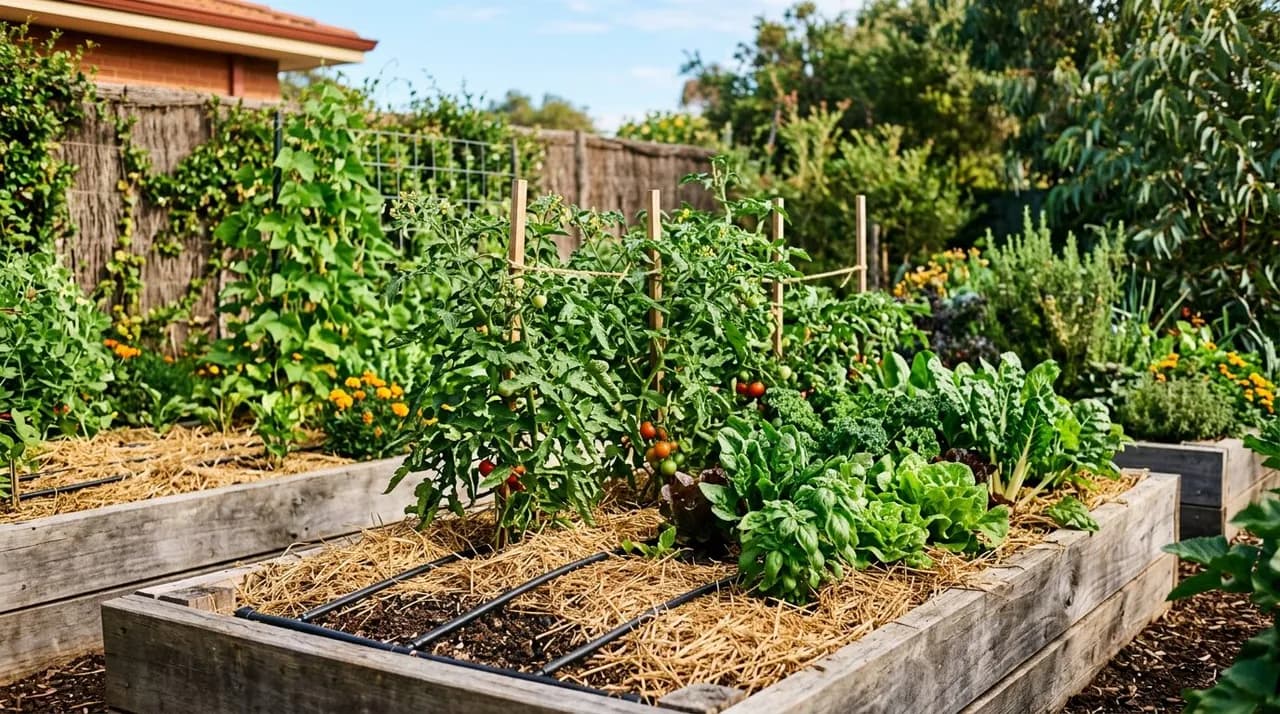
Key takeaways
- Perth experiences a Mediterranean climate with hot, dry summers and mild, wet winters that dictate two distinct planting calendars.
- Swan Coastal Plain soils consist of gutless, hydrophobic sands requiring permanent amendment with kaolin or bentonite clay and compost.
- Autumn and winter (March to August) represent Perth's most productive season for brassicas, root vegetables, alliums, and leafy greens.
- Spring (September to November) is the prime window to establish warm-season crops like tomatoes, capsicums, zucchini, and cucumbers.
- Protect crops during extreme summer heatwaves (December to February) using 50% white shade cloth, heavy straw mulching, and deep early morning watering.
Quick answer: Successful vegetable growing in Perth requires amending hydrophobic coastal sand with bentonite clay and compost, following a Mediterranean planting calendar, and installing 50% shade cloth in summer. Winter is ideal for brassicas and leafy greens, while spring is the prime time to plant tomatoes and warm-season vegetables.
Growing vegetables on Western Australia’s Swan Coastal Plain requires adapting to an intense Mediterranean climate and highly water-repellent sandy soils. While Perth receives more sunshine hours than other Australian capital cities, the summer heat and sandy soil require specific amendments and planting times.
Between December and March, Perth gardeners face prolonged dry spells, baking 38°C to 42°C heatwaves, and scorching easterly winds that desiccate unprotected foliage. Conversely, mild, wet winters (June to August) provide the most fertile, trouble-free growing window of the year.
Amending sandy soils with natural clay and matching crops to seasonal temperature shifts allows year-round vegetable production.
Transforming Perth's hydrophobic sandy soils into fertile loam
Most suburban gardens across Perth, from Joondalup down to Mandurah, sit upon ancient coastal dunes known geologically as Bassendean and Karrakatta sands. These soils contain virtually zero natural clay or silt and are severely water-repellent (hydrophobic), causing water to pool on the surface and run off without wetting the root zone.
+---------------------------------------------------------------+
|                     [Amending Perth Sand]                     |
|   5 cm Lucerne / Pea Straw Mulch                              |
|   ---------------------------------------------------------   |
|   10 kg/m² Mature Organic Compost & Manure                    |
|   ---------------------------------------------------------   |
|   5-10 kg/m² Bentonite or Kaolin Clay (Spaded into top 20 cm) |
|   ---------------------------------------------------------   |
|   ================ Gutless Coastal Sand ===================   |
+---------------------------------------------------------------+
1. Adding Bentonite or Kaolin Clay
Compost alone breaks down and disappears in sandy soils within months under hot summer conditions. Incorporating mineral clay permanently alters soil texture:
- Application rate: Spread 5 kg to 10 kg of sodium bentonite clay or kaolin clay powder per square metre of garden bed.
- Incorporation: Spade and blend the clay thoroughly through the top 15 cm to 20 cm of native sand. The fine clay particles coat individual sand grains, permanently locking in moisture and holding onto applied plant nutrients.
2. High-Volume Organic Matter and Compost
Once clay is integrated, load the bed with biological fertility:
- Dig in 10 kg to 15 kg per square metre of fully matured compost, well-rotted sheep manure, or aged cow manure.
- Organic matter fuels beneficial soil microbes and forms a spongy soil structure that holds moisture like a reservoir. Learn more about moisture dynamics in sandy soil water retention and sandy soil nutrient retention.
3. Organic Wetting Agents
If dry patches develop, apply an organic certified soil wetting agent (such as liquid yucca extract or agar-based formulas) followed by deep soaking to break water surface tension.
The Perth seasonal planting calendar: what to plant now
Crop selection depends closely on the season in a Mediterranean climate. Plant choices by season include:
+-------------------+---------------------------------------------------------+
| Season            | Recommended Sowing & Planting for Perth                 |
+-------------------+---------------------------------------------------------+
| Autumn            | Broccoli, cabbage, cauliflower, kale, silverbeet,       |
| (March - May)     | carrots, beetroot, peas, broad beans, garlic, leeks     |
+-------------------+---------------------------------------------------------+
| Winter            | English spinach, silverbeet, rocket, Asian greens,      |
| (June - August)   | spring onions, radishes, snow peas, coriander           |
+-------------------+---------------------------------------------------------+
| Spring            | Tomatoes, capsicums, chillies, eggplants, zucchini,     |
| (Sept - Nov)      | cucumbers, beans, sweetcorn, pumpkins, rockmelons       |
+-------------------+---------------------------------------------------------+
| Summer            | Sweet potato, snake beans, okra, amaranth, basil,       |
| (Dec - Feb)       | sweetcorn (under shade cloth with deep drip irrigation) |
+-------------------+---------------------------------------------------------+
1. Autumn and winter (the prime cool season)
Unlike cold European or North American climates where winter shuts down gardening, autumn and winter are Perth's easiest food-producing window:
- March to May: As extreme summer heat breaks, sow brassicas (broccoli, cauliflower, Tuscan kale, cabbage) and direct-sow root crops. Plant garlic cloves through April for a November harvest.
- June to August: The cool rainy season. Plant perth winter vegetables like English spinach, silverbeet, winter lettuces, broad beans, and Asian greens (pak choy, tatsoi). These crops thrive without heat stress and require minimal supplemental irrigation.
- For additional cool-season crops, see our guide to winter vegetables in Australia.
2. Spring (the warm-season surge)
September to November is the major planting window for summer staples:
- As soil temperatures climb past 18°C in September, direct-sow dwarf bush beans, climbing beans, sweetcorn, and cucurbits (zucchini, cucumbers, pumpkins).
- For detailed spring planting schedules, see our guide on what to plant in September in Australia.
3. When to plant tomatoes in Perth
To achieve high yields without summer blossom drop:
- Optimal window: Mid-August (in warm, frost-free coastal suburbs) through September and October.
- Early spring planting allows tomato vines to flower and set heavy fruit loads in October and November before scorching 40°C December heat halts pollen viability.
- Choose heat-tolerant indeterminate varieties (like Gross Lisse and Tommy Toe) that keep producing through early summer; determinate types such as Roma crop in one concentrated flush, so stagger two plantings if you want them.
4. Summer (surviving the extreme heat)
Midsummer gardening in Perth requires focusing on heat-resilient tropical and subtropical species:
- Sweet potatoes, snake beans (yardlong beans), okra, and Lebanese cucumbers perform well under high heat.
- Establish quick leafy salad greens in deep shade under the canopy of established fruit trees or north-facing verandas.
For bed layout fundamentals, see our guide to starting an Australian veggie patch.
Protecting Perth vegetable beds from summer heatwaves
Surviving December through February requires active environmental management:
1. Installing 50% Agro-Shade Cloth
Direct sun can heat dark garden soil beyond 45°C, damaging feeder roots and causing soil moisture swings that lead to blossom end rot in tomatoes and capsicums.
- Erect a simple timber or poly-pipe frame over raised vegetable beds 1.5 metres above the soil.
- Drape 50% white or green knitted shade cloth over the frame from December to early March. White shade cloth is particularly effective as it reflects excess infrared heat while admitting abundant diffuse photosynthetically active radiation.
2. Deep Drip Irrigation
- Avoid hand-watering with an overhead spray gun during hot afternoons; droplets evaporate instantly and scorch wet foliage.
- Install pressure-compensating inline drip tubes (spaced 30 cm apart) laid directly beneath the mulch layer.
- Run irrigation for 30 to 45 minutes in the early dawn hours (4:00 AM to 6:00 AM) 2 to 3 times per week, allowing water to penetrate 20 cm deep rather than moistening only the top few centimetres; check your Water Corporation roster day before setting a controller, and note the winter sprinkler ban from 1 June to 31 August.
3. Heavy Organic Mulching
Apply a generous 6 cm to 8 cm layer of clean coarse pea straw, lupin mulch, or lucerne straw over all garden beds:
- Lupin mulch is exceptionally popular across Western Australia as it is sustainably grown, breaks down to feed soil microbes, and adds natural nitrogen to the root zone.
- Keep mulch 3 cm clear of main plant stems to prevent fungal collar rot during humid summer mornings.
Managing local pests in Western Australia
Perth gardens host unique pest pressures that require vigilant organic management:
1. Mediterranean Fruit Fly (Ceratitis capitata)
While eastern Australia battles Queensland fruit fly, Perth is home to the Mediterranean fruit fly (Medfly):
- Medfly attacks tomatoes, capsicums, chillies, stone fruits, and citrus.
- Install fine 2 mm insect exclusion netting over entire vegetable frames as soon as spring flowering finishes.
- Hang male lure traps (Capilure) in spring to monitor pest pressure, and collect and solarise any fallen or stung fruit in sealed black plastic bags for 7 days.
2. Slugs and Snails in Damp Winters
Perth's rainy winters stimulate large populations of European brown garden snails and small black keeled slugs:
- Hand-collect snails along fence lines and under wooden boards on wet winter evenings.
- Scatter small quantities of iron-EDTA bait pellets around bed perimeters or install sunk beer traps.
3. Sucking Insects in Dry Springs
Aphids, thrips, and two-spotted spider mites proliferate during warm, dry spring weather:
- Spray infested leaf undersides with cold-pressed neem oil or horticultural potassium soap sprays on cool, overcast mornings.
- Encourage predatory hoverflies, lacewings, and ladybirds by interplanting flowering alyssum, dill, and coriander throughout your vegetable rows.