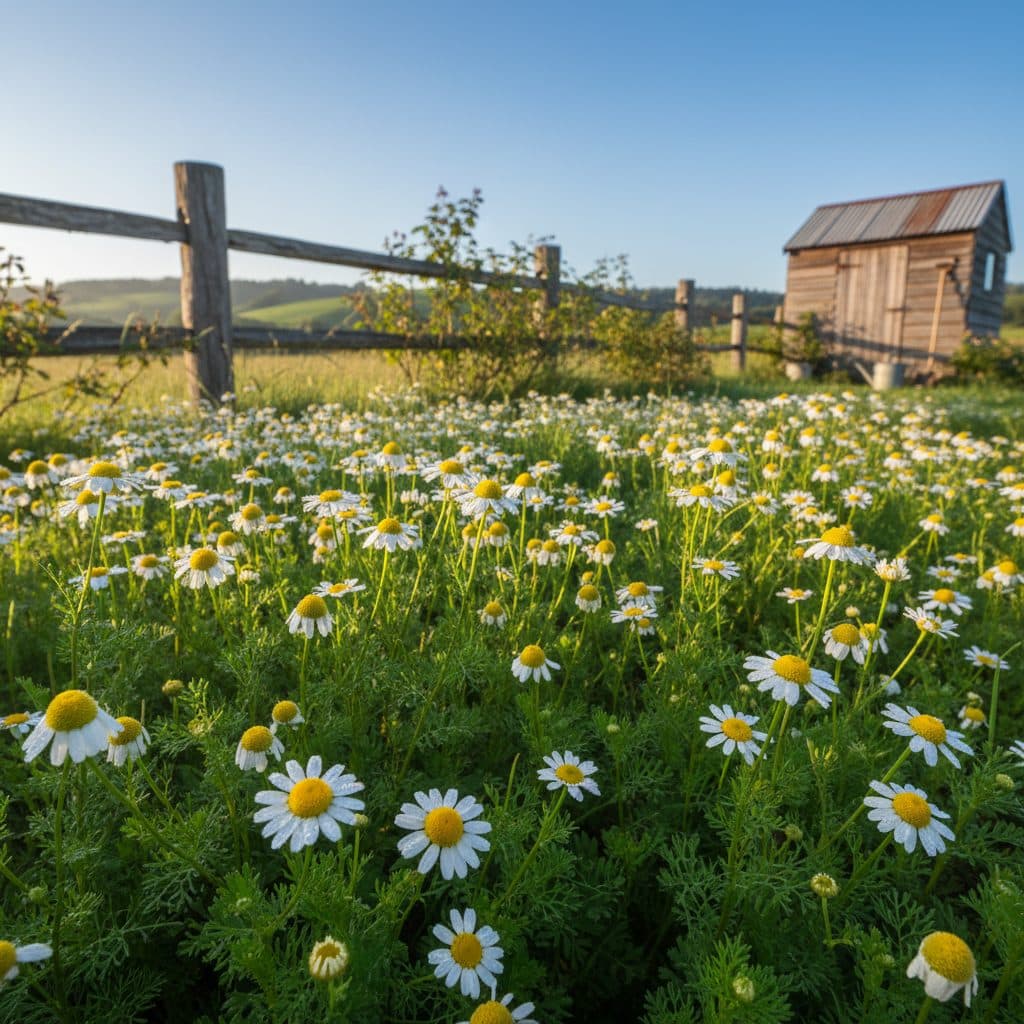
Key takeaways
- German chamomile (Matricaria recutita) is an annual, growing 12 to 24 inches tall, best for light, well-draining soil.
- Roman chamomile (Chamaemelum nobile) is a perennial, reaching 4 to 12 inches high, thriving in USDA zones 3-9.
- While German chamomile prefers full sun and a soil pH of 6.0-7.5, Roman chamomile tolerates partial shade and a wider pH range of 5.6-7.8.
- Harvest chamomile flowers when fully open, typically in the morning, and dry them thoroughly, keeping them below about 100°F.
- Use dried flowers for teas at a ratio of 1-2 teaspoons per 8 ounces of hot water, or for tinctures with 80-100 proof alcohol.
- Proper cultivation, including adequate spacing (6-8 inches for German, 12 inches for Roman), significantly impacts yield and potency.
Quick answer: Grow German or Roman chamomile in full sun and well-drained soil (pH 5.6-7.8), harvesting fully open flowers for medicinal teas and tinctures.
In many US home gardens, from the cool, damp Pacific Northwest to the hot, humid Southeast, chamomile is a staple for its calming properties. This article focuses on two primary species: German chamomile (Matricaria recutita) and Roman chamomile (Chamaemelum nobile), both valued for their medicinal uses in teas and tinctures. While German chamomile is an annual, often growing 12 to 24 inches tall, Roman chamomile is a perennial, typically staying shorter at 4 to 12 inches, and can be a reliable groundcover in USDA zones 3 through 9.
Cultivating these herbs for your home apothecary can be a rewarding endeavor, yielding fresh, potent material for relaxation and wellness. The key to successful growth and maximum medicinal benefit lies in understanding each plant’s specific needs, from soil composition and sun exposure to harvesting techniques. For instance, German chamomile prefers a lighter soil texture, while Roman chamomile is more tolerant of heavier soils, provided they drain well. Both species benefit from at least 6 hours of direct sunlight daily to produce abundant, fragrant flowers.
German chamomile: the annual workhorse for tea
German chamomile, botanically known as Matricaria recutita or Matricaria chamomilla, is an annual herb widely cultivated for its prolific flower production and high concentration of beneficial compounds. This species typically grows 12 to 24 inches tall, forming bushy plants covered in small, daisy-like flowers with hollow centers. It thrives in a wide range of climates, performing well in USDA zones 2 through 9, but is particularly productive in regions with moderate summers, such as the upper Midwest or New England, where temperatures rarely exceed 85°F for extended periods.
Characteristics and cultivation
For optimal growth, German chamomile prefers full sun exposure, meaning at least 6 hours of direct sunlight per day, and a light, well-draining soil with a pH between 6.0 and 7.5. Seeds can be sown directly outdoors in early spring, about two to three weeks before the last frost date, or started indoors 4-6 weeks prior. When direct sowing, scatter seeds lightly over prepared soil and barely cover them, as they require light for germination, which typically occurs within 7-14 days at soil temperatures around 60°F. Once established, thin seedlings to stand 6-8 inches apart to ensure adequate air circulation and resource availability.
- Botanical Name: Matricaria recutita
- Growth Habit: Annual, upright, 12-24 inches tall
- Preferred Soil: Light, well-draining, pH 6.0-7.5
- Sunlight Needs: Full sun (6+ hours daily)
- USDA Zones: 2-9 (as an annual)
Roman chamomile: the perennial groundcover and medicinal herb
Roman chamomile, Chamaemelum nobile, offers a different profile as a low-growing, spreading perennial that forms a dense mat, making it an excellent choice for groundcover or planting between stepping stones. Unlike its German cousin, Roman chamomile only reaches 4 to 12 inches in height. Its flowers are aromatic, but the two species are chemically distinct, and Roman chamomile is the one more often responsible for contact dermatitis in people sensitive to the daisy family. This species is hardy in USDA zones 3 through 9, demonstrating resilience in colder climates like Minnesota and warmer ones like central Texas, provided it has consistent moisture and good drainage. Its ability to return year after year makes it a sustainable choice for a long-term herb garden.
Propagation and care
While German chamomile is typically grown from seed, Roman chamomile is often propagated from divisions or cuttings, as its seeds can be less reliable for germination. If starting from seed, sow them indoors 6-8 weeks before the last frost, maintaining a soil temperature around 65°F. Once established, plants should be spaced about 12 inches apart to allow for their spreading habit. Roman chamomile prefers full sun to partial shade and tolerates a wider range of soil types than German chamomile, though well-drained, moderately fertile soil with a pH of 5.6 to 7.8 is ideal. Regular watering, especially during dry spells, is important for maintaining its lush appearance and flower production, often requiring 1 inch of water per week.
- Botanical Name: Chamaemelum nobile
- Growth Habit: Perennial, spreading, 4-12 inches tall
- Preferred Soil: Well-drained, moderately fertile, pH 5.6-7.8
- Sunlight Needs: Full sun to partial shade
- USDA Zones: 3-9
Cultivating chamomile for peak potency and yield
Regardless of whether you choose German or Roman chamomile, consistent care is paramount for maximizing the medicinal quality and quantity of your harvest. Both species thrive in a location that receives at least 6 hours of direct sunlight daily, which encourages robust flowering. Soil preparation is critical; incorporating 2-3 inches of organic matter, such as aged compost, improves drainage and fertility. A soil test can help determine your garden’s pH, which ideally should be between 6.0 and 7.5 for most chamomile varieties. You can check your soil’s pH and moisture levels using a 3-in-1 Soil pH, Moisture & Light Meter to ensure optimal conditions.
Watering, feeding, and pest management
Chamomile prefers consistent moisture but dislikes soggy feet, so well-drained soil is non-negotiable. Aim for about 1 inch of water per week, either from rainfall or irrigation, especially during dry periods in regions like California’s Central Valley. Overwatering can lead to root rot, while underwatering stunts growth and cuts flower production. Fertilization is generally minimal; a balanced organic fertilizer applied once in spring at a rate of 1 tablespoon per square foot is usually sufficient. Pests are rarely a major issue, but aphids or spider mites can sometimes appear, particularly in stressed plants. A strong spray of water or an insecticidal soap solution (2 tablespoons per gallon of water) can typically manage these issues without harming beneficial insects. Maintaining good air circulation by proper spacing, 6-8 inches for German and 12 inches for Roman, helps prevent fungal diseases.
- Sunlight: 6+ hours direct sun daily
- Soil pH: 6.0-7.5 (ideal range)
- Watering: 1 inch per week, consistent moisture
- Fertilization: Minimal, balanced organic in spring
- Pest Control: Water spray or insecticidal soap for aphids
Harvesting and drying for potent teas and tinctures
The timing of your chamomile harvest significantly impacts the potency of your final product. For both German and Roman chamomile, the flowers are the primary part used for medicinal purposes. Harvest flowers when they are fully open, typically in the morning after the dew has dried but before the midday sun has begun to dissipate their volatile oils. This usually occurs from late spring through summer, with German chamomile often providing multiple flushes of flowers if regularly picked, building up a worthwhile quantity of dried flowers over the summer. Roman chamomile, being perennial, offers a continuous harvest throughout its growing season in USDA zones 3-9.
Drying methods and storage
To prepare flowers for tea or tinctures, they must be dried thoroughly to prevent mold and preserve their medicinal compounds. Spread freshly picked flowers in a single layer on screens or clean trays in a warm, dry, well-ventilated area, away from direct sunlight. Keep them below about 100°F — that is a ceiling, not a target, since higher heat drives off the volatile oils. An herb drying rack or a food dehydrator on its lowest setting works well and will finish them far faster than screens do. On screens, drying typically takes 3-7 days, depending on humidity. The flowers are fully dry when they feel papery and crumble easily between your fingers. Store dried chamomile in airtight containers, such as glass jars, in a cool, dark place. Properly stored, dried chamomile can retain its potency for up to 12 months, though it’s often best used within 6 months for optimal flavor and effect.
- Harvest Time: When flowers are fully open, morning
- Drying Temperature: below 100°F
- Drying Duration: 3-7 days
- Storage: Airtight containers, cool, dark place
- Shelf Life: Up to 12 months (optimal within 6)
Crafting teas and tinctures from your harvest
Once your chamomile flowers are properly dried, you have a versatile ingredient for your home apothecary. Chamomile tea is perhaps the most common preparation, known for its calming and digestive aid properties. To make a soothing cup of tea, use 1-2 teaspoons of dried German chamomile flowers per 8 ounces of hot (not boiling) water. Steep for 5-10 minutes, then strain. Roman chamomile can also be used, though its flavor is often described as slightly more bitter, and some prefer German for tea due to its sweeter, apple-like notes. For a stronger brew, increase the flower quantity by 50%.
Making chamomile tinctures
Tinctures offer a concentrated, shelf-stable form of chamomile’s medicinal compounds. To make a basic chamomile tincture, you’ll need dried chamomile flowers and a high-proof alcohol, typically 80-100 proof (40-50% alcohol by volume), such as vodka or brandy. A common ratio is 1 part dried herb to 5 parts alcohol by weight (1:5 ratio). For example, combine 1 ounce (by weight) of dried chamomile flowers with 5 fluid ounces of 80-proof alcohol in a clean glass jar. Seal the jar tightly and store it in a cool, dark place for 4-6 weeks, shaking it daily or every other day to ensure proper extraction. After the maceration period, strain the liquid through cheesecloth or a fine mesh sieve, pressing the solids to extract as much liquid as possible. Store the finished tincture in dark glass dropper bottles. Dosing is outside the scope of a growing guide. Two cautions matter before you use chamomile medicinally: it is an Asteraceae, so people sensitized to ragweed, daisies or chrysanthemums can react to it, with documented reactions ranging from contact dermatitis to anaphylaxis; and it may add to the effect of sedatives and of blood thinners such as warfarin. Check with a clinician first, particularly if you are pregnant, nursing, or taking prescription medication. Stored this way, a tincture typically keeps for several years, considerably longer than dried flowers.
- Tea Ratio: 1-2 tsp dried flowers per 8 oz hot water
- Steep Time: 5-10 minutes for tea
- Tincture Ratio: 1 part dried herb to 5 parts alcohol (1:5)
- Alcohol Proof: 80-100 proof (40-50% ABV)
- Maceration Time: 4-6 weeks for tinctures
German vs. Roman Chamomile: Key Differences for Growers
Feature | German Chamomile (Matricaria recutita) | Roman Chamomile (Chamaemelum nobile) |
|---|---|---|
Growth Habit | Annual, upright, 12-24 inches tall | Perennial, spreading, 4-12 inches tall |
USDA Hardiness Zones | Grown as an annual in zones 2-9 | Hardy in zones 3-9 |
Propagation | Primarily by seed (easy germination) | Primarily by division or cuttings (seeds less reliable) |
Flower Appearance | Small, daisy-like with hollow centers | Small, daisy-like with solid centers |
Aroma/Flavor | Sweet, apple-like, preferred for tea | Slightly more bitter, herbaceous |
Primary Use | Tea, tinctures, internal use | Groundcover, tea, tinctures, external use |
Soil Preference | Light, well-draining, pH 6.0-7.5 | Well-drained, moderately fertile, pH 5.6-7.8 |
Chamomile yield: German chamomile flowers in flushes, so a small patch picked every few days through the season produces far more dried material than a single harvest would suggest.
Tincture Potency: Chamomile tinctures, prepared at a 1:5 herb-to-alcohol ratio, can maintain their potency for 3-5 years when stored correctly in dark glass bottles.
Soil pH Range: Both German and Roman chamomile thrive in slightly acidic to slightly alkaline soil, with optimal pH levels generally between 6.0 and 7.5.
Frequently asked questions
What is the main difference between German and Roman chamomile?
German chamomile (Matricaria recutita) is an annual plant that grows taller, up to 24 inches, and is typically preferred for teas due to its sweeter flavor. Roman chamomile (Chamaemelum nobile) is a perennial, grows as a low-spreading groundcover (4-12 inches), and is hardy in USDA zones 3-9, often used for both tea and as an ornamental.
How much sunlight does chamomile need for good flower production?
Both German and Roman chamomile require a minimum of 6 hours of direct sunlight per day to produce abundant, potent flowers. In hotter climates, Roman chamomile can tolerate some partial afternoon shade, but German chamomile generally prefers full sun throughout the day for best results.
What kind of soil is best for growing chamomile?
Chamomile thrives in well-draining soil. German chamomile prefers a lighter, sandier loam with a pH between 6.0 and 7.5. Roman chamomile is more adaptable but still requires good drainage, performing well in moderately fertile soil within a pH range of 5.6 to 7.8. Adding 2-3 inches of compost can improve most garden soils.
When is the best time to harvest chamomile flowers?
Harvest chamomile flowers when they are fully open, typically in the morning after the dew has dried but before the sun is too strong. This timing helps preserve the volatile oils responsible for their medicinal properties. German chamomile often provides multiple harvests, sometimes 2-3 flushes, from late spring through summer.
How do I dry chamomile flowers for storage?
To dry chamomile, spread the freshly picked flowers in a single layer on screens or trays in a well-ventilated area, away from direct sunlight. Keep them below about 100°F; higher heat drives off the volatile oils. On screens this usually takes 3-7 days, until the flowers are papery and crumble easily, and they can be stored for up to 12 months in airtight containers.
Can I grow chamomile in a container?
Yes, both German and Roman chamomile can be successfully grown in containers. Choose a pot at least 8-10 inches in diameter with good drainage holes. Use a high-quality potting mix and ensure the plants receive at least 6 hours of direct sunlight daily. Container plants may require more frequent watering, sometimes daily in hot summer regions above 85°F.
References
- Chamomile, German (Matricaria recutita/chamomilla) and Chamomile, Roman (Chamaemelum nobile) (2022). Chamomile, German (Matricaria recutita/chamomilla) and Chamomile, Roman (Chamaemelum nobile).
- Chamomile Oil, German Type (2023). Chamomile Oil, German Type.
- High-Quality Assembly and Analysis of the Complete Mitogenomes of German Chamomile (Matricaria recutita) and Roman Chamomile (Chamaemelum nobile) (2024). High-Quality Assembly and Analysis of the Complete Mitogenomes of German Chamomile (Matricaria recutita) and Roman Chamomile (Chamaemelum nobile).
- Chamomile, German (2017). Chamomile, German.
- Chamomile, German (2017). Chamomile, German.
- USDA Natural Resources Conservation Service (2024). USDA Natural Resources Conservation Service.