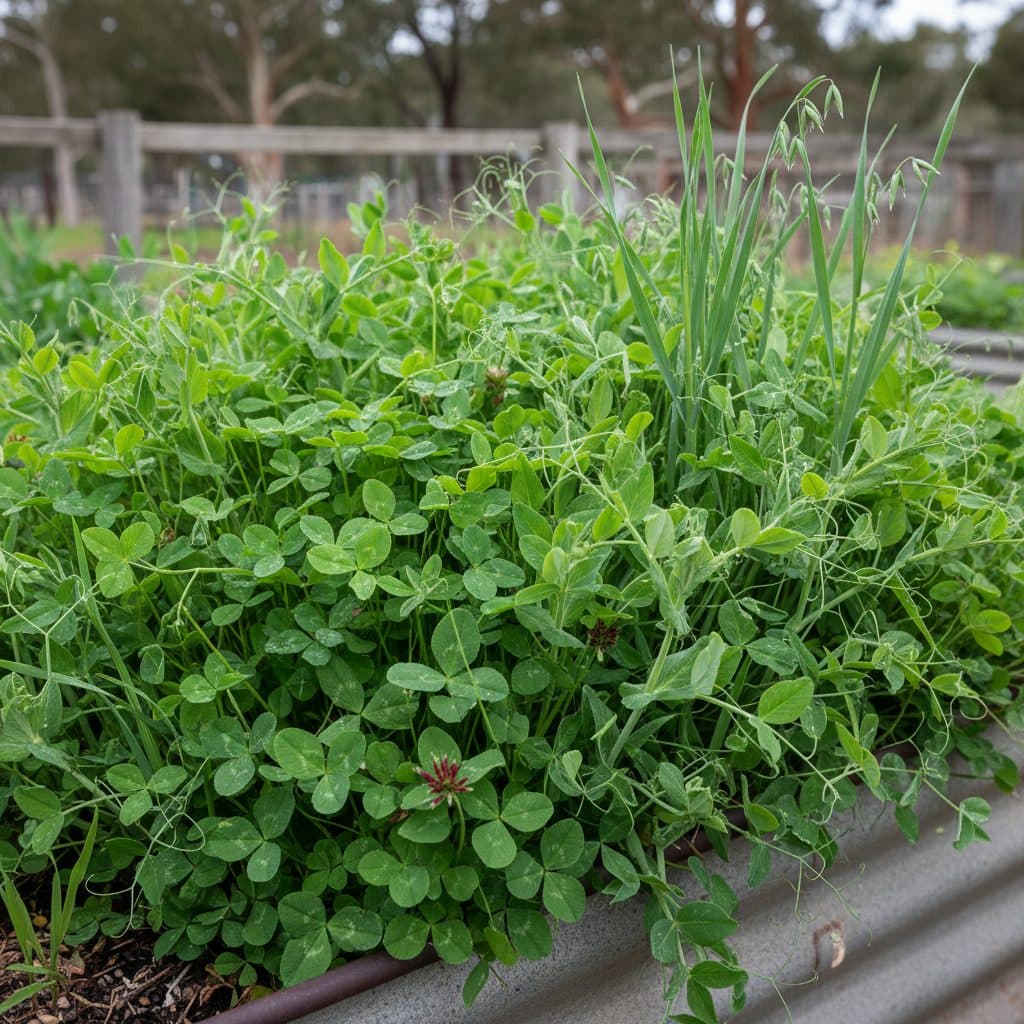
Key takeaways
- Green manure crops add essential organic matter, cycle subsoil minerals, and fix atmospheric nitrogen in weathered Australian soils.
- Sow cool-season mixes of field peas, tick beans, and oats in autumn (March to May) to protect beds during winter rains.
- Sow warm-season mixes of cowpeas, Japanese millet, and buckwheat in spring (September to November) to shield soil from harsh summer heat.
- Slash or dig in crops at the 10% to 20% flowering stage before stems turn woody and before seeds form.
- Allow 2 to 4 weeks for incorporated green matter to break down in the soil before planting hungry vegetable seedlings.
Quick answer: Green manure crops in Australia are fast-growing plants grown specifically to be slashed, dug into the topsoil, or used as surface mulch before setting seed. Sowing legume and cereal mixes in autumn (March to May) or spring (September to November) restores organic matter, fixes nitrogen, and improves water retention in sandy and clay soils.
Australian soils are among the oldest, most weathered, and lowest in natural organic carbon in the world. Intense summer sunshine, heavy downpours, and long dry spells rapidly burn through soil organic matter in home veggie patches and market gardens. Growing green manure crops in australia provides an effective, organic method to rebuild topsoil fertility between food cropping cycles.
Rather than leaving garden beds bare during seasonal transitions, when nutrients leach away and weed seeds take root, green manures protect and nourish the living soil. A balanced mix of legumes and grasses works symbiotically: legumes capture atmospheric nitrogen through root nodules, while deep-rooting cereals produce abundant biomass and break through compacted subsoil.
Whether you are preparing a raised garden bed for heavy-feeding summer tomatoes and capsicums, or rejuvenating depleted orchard bays, understanding seasonal sowing windows and termination methods will transform your garden soil.
How green manure improves Australian garden soils
Incorporating green manure crops into your crop rotation delivers measurable benefits to soil structure and microbial life:
- Building soil organic carbon: Slashed green biomass decomposes into stable humus, improving the water-holding capacity of hydrophobic coastal sands and opening up dense, heavy clay.
- Biological nitrogen fixation: Legume roots form a symbiosis with rhizobia, which convert atmospheric nitrogen gas into ammonia that the plant builds into its own leaves, stems and roots. That nitrogen only becomes available to the following crop once the green manure is terminated and the residues break down, so time the termination to the crop that follows rather than expecting nitrogen to be sitting in the soil.
- Weed suppression: Dense cover crop canopies smother competitive weeds, preventing weed seeds from germinating and reducing the need for manual weeding.
- Nutrient cycling and scavenging: Deep-rooted cereals capture nitrate, potassium and magnesium that have moved down the profile with rainfall and hold them in their foliage, returning them to the topsoil when chopped down. Phosphorus behaves differently: it is bound near the surface rather than leached, so green manures redistribute it rather than recovering it from depth.
- Biofumigation and pest management: Certain brassica green manures release natural isothiocyanate compounds as they decompose, suppressing soil-borne fungal diseases and root-knot nematodes.
Techniques from plants and amendments for clay soil and vermicomposting at home complement green manuring by establishing active biological nutrient cycles in garden beds.
+-------------------------------------------------------------+
|             AUSTRALIAN GREEN MANURE SOWING CALENDAR         |
|                                                             |
| [AUTUMN SOWING: March to May]                               |
| - Climate: Temperate, Cool, Mediterranean, Subtropical      |
| - Key Species: Field Peas, Tick Beans, Oats, Cereal Rye     |
| - Growth: Autumn to late Winter                             |
| - Termination: August to September (before Spring planting) |
|                                                             |
| [SPRING SOWING: September to November]                      |
| - Climate: Temperate, Subtropical, Tropical                 |
| - Key Species: Cowpeas, Buckwheat, Japanese Millet          |
| - Growth: Spring to early Summer                            |
| - Termination: November to December (or early Autumn)       |
+-------------------------------------------------------------+
Choosing the best green manure crops by season and climate
Matching crop species to your local Australian climate zone and season ensures rapid growth and abundant biomass:
1. Autumn and winter green manure mixes (sown March to May)
Cool-season green manures grow steadily through winter across temperate, cool, and Mediterranean climate zones (including Victoria, Tasmania, southern New South Wales, South Australia, and south-west Western Australia):
- Tick beans / Broad beans (Vicia faba): Vigorous nitrogen fixers with thick, upright stems that produce massive biomass and deep taproots to open compacted soil.
- Field peas (Pisum sativum): Fast-growing scrambling legumes that fix abundant nitrogen and produce tender foliage that breaks down quickly when dug in.
- Oats (Avena sativa) and cereal rye (Secale cereale): Cold-tolerant grasses that develop fibrous root systems, scavenge leftover soil nitrates, and generate durable organic matter.
- Vetch (Vicia sativa): A trailing legume that forms a dense ground carpet, fixing nitrogen and suppressing winter weeds.
- Fodder mustard (Brassica juncea): Fast-growing brassica used for biofumigation. Glucosinolates peak at early flowering, so slash at about 10-50% bloom, macerate the tissue as finely as you can, dig it in immediately and water it in straight away — the active isothiocyanates are volatile and are lost if the material is left lying or turned in coarsely. Mustard is a brassica. Do not use it in a bed where you grow cabbages, broccoli, kale or turnips if clubroot is present or suspected, and count it as a brassica when planning your rotation.
A classic cool-season mix combines oats (40%), field peas (30%), tick beans (20%), and vetch (10%) by seed weight.
2. Spring and summer green manure mixes (sown September to November)
Warm-season green manures thrive in hot conditions, growing rapidly to provide soil cover across subtropical, tropical, and warm temperate regions:
- Cowpeas (Vigna unguiculata): Heat-loving, drought-tolerant legumes that fix nitrogen efficiently and tolerate sandy soils.
- Buckwheat (Fagopyrum esculentum): An ultra-fast broadleaf cover crop that flowers within 4 to 6 weeks, accumulating soil phosphorus and attracting beneficial hoverflies and bees.
- Japanese millet (Echinochloa esculenta): A rapid warm-season grass producing substantial fibrous biomass that shades soil during extreme heat.
- Sunn hemp (Crotalaria juncea): A tropical legume producing rapid nitrogen fixation and tall, fibrous biomass in warm northern regions. Crotalaria species contain pyrrolizidine alkaloids and the seed is toxic to poultry and livestock — slash sunn hemp well before it sets seed and keep chooks and stock off the crop and its seed.
+-------------------------------------------------------------+
|         GREEN MANURE SPECIES CHARACTERISTICS IN AU          |
|                                                             |
| Species           Season   Type      Primary Function       |
| -------           ------   ----      ----------------       |
| Tick Bean         Autumn   Legume    Nitrogen + Taproot     |
| Field Pea         Autumn   Legume    Nitrogen + Fast Decay  |
| Oats              Autumn   Grass     Biomass + Scavenger    |
| Fodder Mustard    Autumn   Brassica  Biofumigation          |
| Cowpea            Spring   Legume    Nitrogen + Heat Hardy  |
| Buckwheat         Spring   Broadleaf Phosphorus + Nectar    |
| Japanese Millet   Spring   Grass     Biomass + Soil Shade   |
+-------------------------------------------------------------+
Step-by-step sowing and managing a green manure crop
Establishing a green manure crop requires minimal effort:
- Bed preparation: Clear spent vegetable plants from the bed. Rake the surface lightly to create a fine, crumbly seedbed. If the soil is severely depleted, broadcast a handful of organic blood and bone or mature compost.
- Inoculation (optional but recommended): For maximum nitrogen fixation, coat legume seeds with the correct inoculant group just before sowing.
- Broadcast sowing: Scatter seed evenly across the bed surface at a density of roughly 50 to 80 grams per square metre for mixed seed.
- Raking and covering: Rake the seed into the top 1 cm to 2 cm of soil, or cover with a thin layer of compost or aged manure. Tamp the soil down lightly with the back of a rake to ensure good seed-to-soil contact.
- Irrigation: Water thoroughly with a fine spray rose. Keep the topsoil moist until seeds germinate (typically 4 to 8 days), then irrigate deeply once or twice a week depending on natural rainfall.
When to dig in green manure for maximum nutrient benefit
Timing is critical when terminating a green manure crop. The optimal window to slash or dig in your crop is at 10% to 20% flowering—just as the first blossoms appear on the legumes.
At this developmental stage, the plants have accumulated their maximum levels of nitrogen and succulent green tissue, while their carbon-to-nitrogen (C:N) ratio remains low. If you allow the plants to set pods and form mature seeds:
- The plants divert their accumulated nitrogen into seed formation rather than releasing it to the soil.
- The stems lignify and turn woody, which ties up available soil nitrogen (nitrogen drawdown) while microbes struggle to break down tough carbon.
- The crop risks becoming a persistent weed in your veggie patch if mature seeds drop into the soil.
Termination techniques: digging in versus chop-and-drop no-dig
Growers can terminate their green manure using two distinct methods:
Method A: Traditional incorporation (Digging in)
Use a sharp spade or garden fork to slice through the roots roughly 5 cm below soil level. Chop the standing tops into 10 cm to 15 cm pieces, then turn the green matter into the top 10 cm to 15 cm of soil. Ensure the green material is lightly buried where soil microbes and earthworms can consume it.
Method B: No-dig chop-and-drop
For no-till beds, slash the crop at ground level with shears or a brushcutter. Lay the chopped foliage directly on the soil surface as a green mulch, then cover it with a layer of mature compost and clean straw. This method preserves delicate soil fungal hyphae and worm tunnels while slowly feeding the topsoil.
+-------------------------------------------------------------------------+
|                  TERMINATION TIMELINE BEFORE PLANTING                   |
|                                                                         |
| Day 0: Slash crop at 10-20% flowering (Chop into pieces)                |
|   |                                                                     |
| Days 1-14: Active microbial decomposition (Soil warms)                  |
|   |                                                                     |
| Days 15-28: Residue largely broken down; nitrogen begins to release     |
|   |                                                                     |
| Week 4: Plant hungry vegetable seedlings (Tomatoes/Capsicum)            |
+-------------------------------------------------------------------------+
After terminating the crop, wait 2 to 4 weeks before transplanting delicate seedlings or sowing fine seeds. During the initial decomposition phase, soil microbes consume oxygen and temporary organic acids can inhibit seedling root growth. Once the green matter has largely broken down and the bed no longer smells sour, it is ready to plant. Building genuinely stable organic matter is a slower process, measured in seasons of repeated green manuring.
Pairing green manures with sheet mulching for moisture retention and mulching strategies to conserve soil moisture helps maintain soil structure throughout the hot Australian growing season, while understanding vegetable growth stages ensures timely crop rotations.