Key takeaways
- Form a constituted community group or Community Interest Company (CIC) with clear governance and a written constitution.
- Secure land access by working with local authorities (district, borough, unitary or county councils), parish and town councils, housing associations, or private trusts.
- Conduct mandatory site safety assessments, including soil contamination testing and public liability insurance coverage.
- Secure UK grant funding from sources like the National Lottery Community Fund and local council community grants.
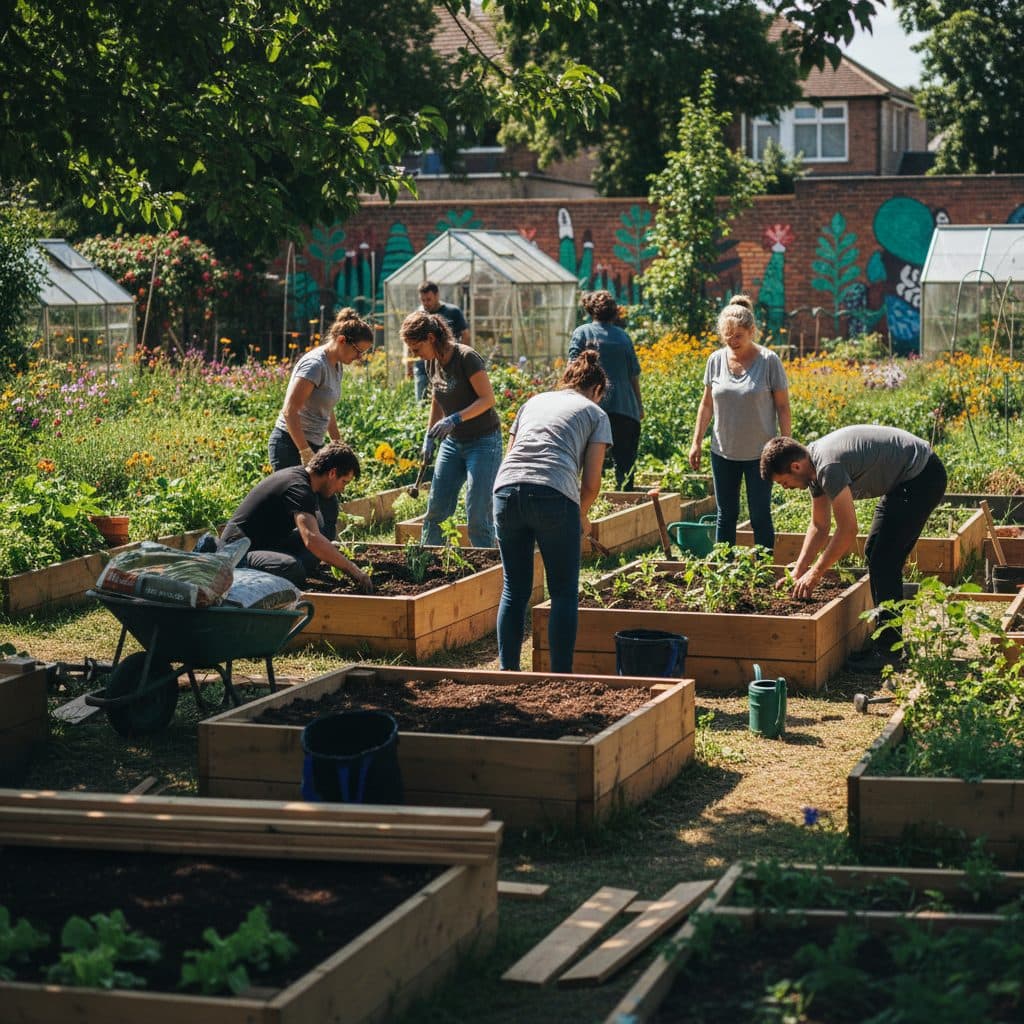
- Design an accessible garden layout featuring timber raised beds, wide wheelchair-friendly paths, and rainwater harvesting.
Quick answer: Starting a community garden in the UK requires forming a constituted volunteer committee, securing a formal land lease from a local council or private landowner, and obtaining public liability insurance. With governance in place, groups access UK grant funding (such as the National Lottery Community Fund) to build accessible raised beds, install shared sheds, and establish communal growing spaces.
Community gardens across the United Kingdom are hubs of local food production, biodiversity, mental wellbeing, and community connection. Transforming unused urban wasteland, derelict council plots, or church grounds into a shared growing sanctuary brings neighbours together while teaching sustainable horticultural skills.
However, knowing how to start a community garden successfully requires more than enthusiasm and vegetable seeds. A durable community garden requires solid organisational structure, legal permission to occupy land, thorough risk management, and strategic fundraising through UK grant bodies.
By following a structured roadmap (from forming your founding steering group to signing a secure council lease, designing accessible growing beds, and harvesting your first communal crops), you can establish a thriving green asset for your neighbourhood.
Step 1: Forming a steering committee and constituted group
A successful community garden is built on strong collective leadership rather than the efforts of a single individual:
- Host a public launch meeting: Gather local residents, allotment holders, schools, and neighbourhood groups at a local community hall or library to gauge community interest, gather ideas, and recruit active volunteers.
- Form a steering committee: Elect a dedicated core team with clearly defined officer roles: Chair (leads meetings and coordinates projects), Secretary (manages communications and records minutes), and Treasurer (manages the bank account and financial records).
- Adopt a formal constitution: To open a community bank account and apply for UK grant funding, your group must become a constituted voluntary organisation (unincorporated association) or a Community Interest Company (CIC). A written constitution outlines your group's aims, membership rules, voting procedures, and dissolution clause. Free community constitution templates are readily available through local Councils for Voluntary Service (CVS).
- Draft a group code of conduct: Agree upon shared rules regarding site access, tool sharing, organic growing standards, and dispute resolution to maintain harmonious community cooperation.
For seasonal bed planning ideas once your site is running, review our allotment guides on what to plant in August UK and what to plant in October UK.
Step 2: Finding land and negotiating a secure lease
Securing legal access to suitable land is often the most demanding phase of starting a UK community project:
- Identify potential sites: Walk your local neighbourhood to locate neglected plots, disused allotment corners, housing association verges, church grounds, hospital grounds, or railway land.
- Identify land ownership: In England and Wales, buy the title register from HM Land Registry (a small fee per title; note some land remains unregistered). In Scotland use Registers of Scotland, and in Northern Ireland the Land Registry of Northern Ireland.
- Negotiate a formal lease or licence: Never begin building on a site without a signed legal agreement. Work with the landowner to secure a formal lease or meanwhile use licence to occupy for a minimum of three to five years. Grant funders generally require proof of secure tenure before awarding capital grants.
- Planning permission: Most simple community gardens with raised beds and soft landscaping do not require formal planning permission. However, erecting permanent structures (such as large timber storage sheds, polytunnels, or security perimeter fencing) may require local council planning consent.
- Guidance on land agreements: Social Farms & Gardens, the UK network body for community gardens and city farms, publishes guidance on land agreements, licences and leases.
Step 3: Site assessment, soil testing and insurance
Ensuring public safety and assessing environmental contamination protects your volunteers and visitors:
- Soil contamination testing: If your site has an industrial history, sits adjacent to old railway lines, or occupies reclaimed brownfield land, test the soil for heavy metals (lead, arsenic, cadmium) and polycyclic aromatic hydrocarbons (PAHs) through an accredited UK soil testing laboratory. If contamination is detected, do not plant into the ground, and take the laboratory results to your local authority's contaminated land officer before going further. Where raised beds are agreed as the mitigation, lay a marker/separation geotextile and build beds deep enough to hold the entire root zone in imported topsoil certified to BS 3882.
- Public Liability Insurance (PLI): Public liability cover is usually arranged through membership bodies such as Social Farms & Gardens or the National Allotment Society, or through specialist community insurers. £5 million is a common minimum, but your landowner and funders set the level they require — ask them before you buy a policy.
- Health and safety risk assessments: Document simple written risk assessments covering tool handling, lifting heavy bags, slip/trip hazards, and child safeguarding policies. Ensure an approved first-aid kit is maintained on site in the tool shed.
Learn how to maintain clean composting operations on shared community sites with small space composting without odor.
Step 4: Securing UK funding and grants
Building raised beds, buying tools, and installing fencing requires capital funding. Numerous UK funding streams support community food growing:
- The National Lottery Community Fund: The National Lottery Community Fund's Awards for All programme funds grassroots community projects. The grant range differs by nation and is revised periodically — check the current range for your nation before applying.
- Local Council Community Grants: Many district, borough and parish councils run small community grant schemes. Amounts and eligibility vary widely between councils — check your own council's current scheme.
- Supermarket Community Schemes: Apply to Tesco Stronger Starts, Co-op Local Community Fund, and Asda Foundation community grants.
- Local business sponsorship and crowdfunding: Approach local builders' merchants for donations of timber, gravel, and tools, or run a crowdfunding campaign through platforms like Spacehive or Crowdfunder UK.
- Charitable trusts and local foundations: Explore grant opportunities from funders that operate at this scale — for example the Greggs Foundation, your local community foundation within the UK Community Foundations network, and Groundwork.
To minimise water costs, design gravity-fed water setups following principles in rainwater harvesting in low water gardens.
Step 5: Garden design, construction and community engagement
Designing your physical space to be inclusive, accessible, and productive ensures long-term volunteer participation:
- Accessible raised timber beds: Construct beds from untreated, sustainably sourced larch or cedar. Standing beds: 1.2 m wide, 2.4 m long, 45 cm high. Wheelchair-accessible beds: 60–75 cm high, with no point more than about 60 cm from an edge a user can reach — so 1.2 m wide only where the bed is reachable from both sides, otherwise 60–75 cm wide, ideally with a knee recess under one edge.
- Wide, even pathways: Lay pathways at least 1.2 to 1.5 metres wide using compacted self-binding gravel (such as Breedon gravel) or non-slip paving slabs to allow effortless access for wheelchairs, pushchairs, and wheelbarrows.
- Shared infrastructure: Install a secure timber tool shed, a three-bay wooden compost bin system, a communal greenhouse or polytunnel, and heavy-duty water butts connected to shed guttering.
- Community social space: Include seating benches, a covered picnic table, a wildlife pond with safety fencing, and native pollinator borders to create a welcoming social environment.
- Organised volunteer workdays: Host regular weekly or fortnightly volunteer gardening sessions, pairing experienced allotment growers with beginner gardeners to share knowledge, distribute harvest produce fairly, and build lasting neighbourhood friendships.