Key takeaways
- Propagate sweet potatoes from slips sprouted from healthy, unblemished storage roots in early spring.
- Time your planting according to your regional Australian climate: year-round in the tropics, spring to early summer in temperate zones.
- Build raised mounds or ridges 30 cm high using loose, sandy loam to encourage straight, uniform storage roots.
- Avoid high-nitrogen fertilisers, which trigger excessive vine growth at the expense of root development.
- Harvest storage roots after 100 to 140 days when foliage begins to yellow, and cure in a warm, shaded spot before storing.
Quick answer: Growing sweet potato in Australia requires warm soil, full sun, and loose, well-draining soil. Gardeners plant slips, rooted shoots sprouted from mature storage roots, after the last frost in temperate regions or year-round in subtropical and tropical zones. Mounding the soil and keeping nitrogen levels moderate ensures prolific root swelling over a 100 to 140 day growing season.
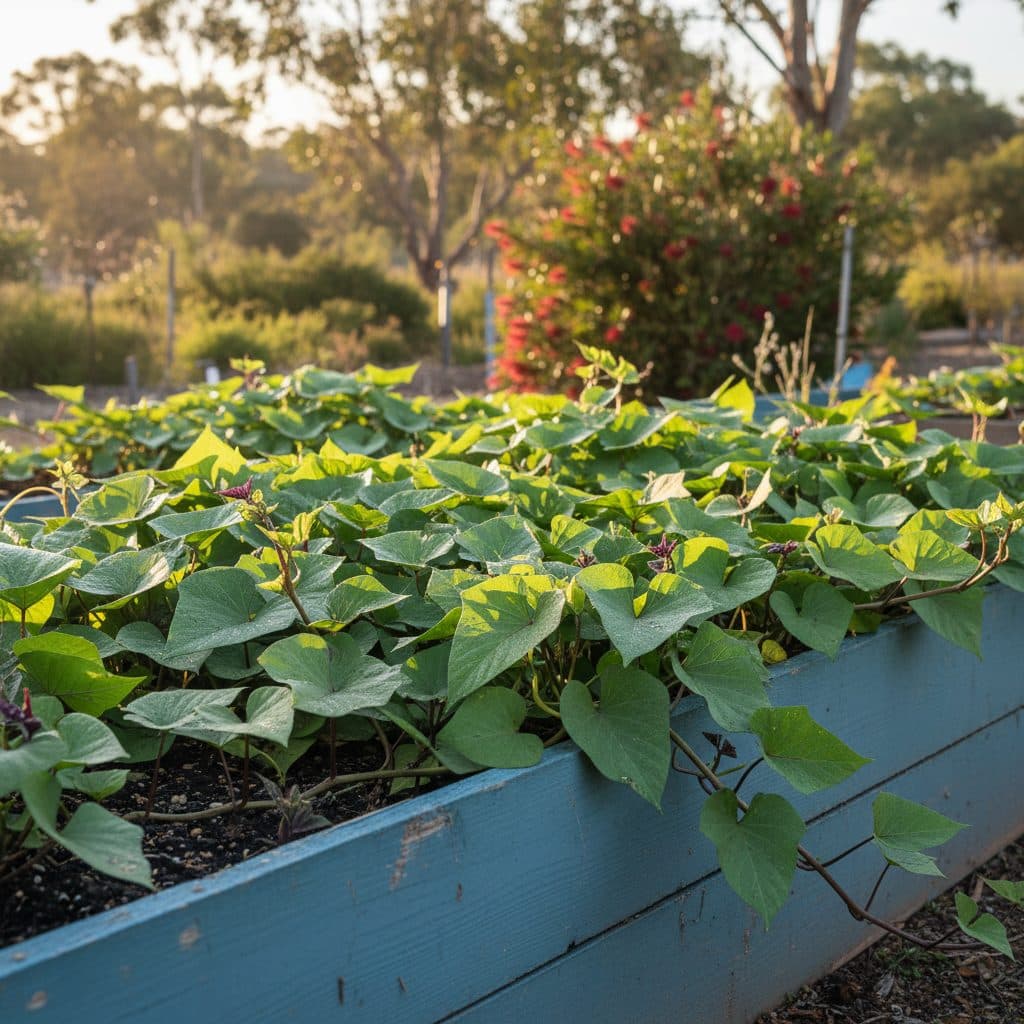
Sweet potato (Ipomoea batatas) is one of the most resilient, productive root crops you can grow across Australian veggie patches. Thriving in the heat of Australian summers, this versatile perennial (grown as an annual in cooler climates) provides two valuable yields: nutrient-rich storage roots and edible green vine tips that make an excellent spinach substitute.
Knowing the best practices for growing sweet potato in Australia ensures you obtain heavy harvests of smooth, sweet storage roots rather than tangled, stringy roots. Unlike standard potatoes, sweet potatoes are tropical morning glories that demand warm soil temperatures (consistently above 18°C) to establish vigorous growth.
Whether you cultivate sweet potatoes in garden beds, large containers, or as a living weed-suppressing ground cover in a permaculture food forest, understanding propagation, climate-specific timing, and balanced soil nutrition is essential.
Raising sweet potato slips in Australia
Sweet potatoes are grown from 'slips' — shoots that sprout from adventitious buds on the surface of a mature storage root. Planting slips rather than whole roots produces healthier root systems, minimises disease transmission, and yields far superior storage roots.
To raise your own slips at home in late winter or early spring:
- Select healthy storage roots: Choose firm, organic sweet potatoes free of blemishes or chemical sprout inhibitors. Popular Australian varieties include Beauregard (orange flesh, sweet flavour) and Murasaki (purple skin, white nutty flesh). Where you can, buy virus-tested slips from a nursery rather than sprouting supermarket roots — home-sprouted roots carry virus load and, in Queensland and the Northern Territory, sweetpotato weevil. Check your state's rules before moving planting material between districts.
- Sprout the storage roots: Place the storage root halfway into a jar of water secured with toothpicks, or lay it horizontally in a shallow tray filled with damp sand, potting mix, or perlite. Keep the container in a warm, bright position (such as an indoor windowsill or greenhouse) at 22°C to 28°C.
- Harvest the slips: Within three to four weeks, shoots will emerge from the storage root. When shoots reach 15 cm to 20 cm in length with several leaves, snap or cut them cleanly from the mother root.
- Root the slips: Place the cut stems in a jar of clean water for three to five days until roots appear, or plant them directly into moist potting mix in small pots before transplanting into the garden.
For foundational root crop knowledge, review our complete overview on how to grow sweet potatoes.
When to plant sweet potato across Australian climates
Because Australia encompasses diverse climate zones, planting dates must match local soil temperatures rather than arbitrary calendar dates:
- Tropical (Far North Queensland, Top End, Kimberley): Plant year-round. The most favourable window is the start of the dry season (April to May) or early wet season (October to November) when soil moisture is readily managed.
- Subtropical (South East Queensland, Northern NSW coastal strips): Plant from August through to February. Soil warms early, allowing an extended harvest window across multiple successions.
- Warm Temperate (Sydney, Perth, Adelaide, coastal inland NSW/VIC): Plant from September to December, once all danger of frost has passed and soil temperature reaches at least 18°C.
- Cool and Cold (Melbourne, Hobart, Canberra, tablelands): Sweet potato is marginal in Hobart, Canberra and the tablelands — the season is too short and too cool for full root fill. Plant November to early December in black pots or under clear plastic to bank heat, expect smaller roots and a longer season than the catalogue figure suggests, and lift before the first autumn frost.
To complement root crops with perennial tree choices in dry Australian regions, explore our guide to drought tolerant fruit trees.
Soil preparation, mounding and nutrient balance
Sweet potatoes produce their finest storage roots in light, sandy loam with a pH between 5.5 and 6.5. Dense clay soils restrict root expansion, leading to knobbly, misshapen roots and poor drainage.
Creating raised mounds or long ridges 25 cm to 30 cm high is standard Australian practice. Mounding improves drainage during heavy summer rainstorms, increases soil warmth around the root zone, and makes harvesting significantly easier. Space mounds 80 cm to 100 cm apart, and plant slips 30 cm apart along the ridge, burying at least two to three leaf nodes beneath the soil.
Nutrient management requires careful balance. Sweet potatoes need modest fertility with a high potassium-to-nitrogen ratio. Excessive nitrogen encourages lush, sprawling foliage but inhibits storage root swelling, resulting in skinny, fibrous roots. Work well-aged compost and rock minerals into the mound before planting, but avoid fresh manures. A light application of sulphate of potash provides the potassium needed for starch synthesis. Avoid wood ash on sweet potato mounds — it is strongly alkaline and will lift pH above the 5.5–6.5 range this crop prefers.
Watering, mulching and weed suppression
Once established, sweet potato vines grow with incredible vigour, covering the ground and outcompeting most garden weeds. However, steady moisture is required during the initial six weeks while root systems develop.
Water newly planted slips daily for the first week, tapering to deep weekly waterings as roots penetrate deep into the subsoil. Applying a 5 cm layer of sugarcane mulch or cane trash around young plants suppresses weeds and conserves soil moisture. Keep nitrogen-rich legume mulches such as lucerne and pea straw off sweet potato mounds — they push vine growth at the expense of root fill. Understanding mulching for drought resilience helps maintain steady soil conditions during extreme heatwaves.
In small gardens or urban courtyards, sweet potatoes thrive in large grow bags, half-wine barrels, or wicking bed systems. Container growing provides perfect drainage, allows easy temperature management, and simplifies harvesting—simply tip the container onto a tarp to collect your storage roots without slicing them with a garden fork.
Harvesting, curing and storing Australian sweet potatoes
Sweet potatoes are ready for harvest between 100 and 140 days after planting, depending on climate and variety.
Look for cues: the lower leaves begin to yellow, and vines slow their outward expansion. In temperate and cool regions, storage roots must be lifted before the first autumn frost, as cold soil causes roots to rot rapidly in the ground.
Harvest on a warm, dry day using a garden fork. Insert the fork 30 cm away from the crown and lift gently to avoid piercing the delicate root skins.
Curing is essential to develop sweetness and long storage life. Freshly dug sweet potatoes taste starchy and bland. Lay the unwashed storage roots in a warm (25°C to 30°C), humid, shaded, well-ventilated area for 7 to 10 days. During curing, natural enzymes convert starches into sugars, and a protective suberin layer thickens over scratches and skin abrasions.
After curing, store your sweet potatoes in cardboard boxes or crates in a cool, dark pantry (12°C to 16°C). Never refrigerate raw sweet potatoes, as temperatures below 10°C cause internal chilling injury and hard cores. Properly cured sweet potatoes will store in top condition for up to six months.