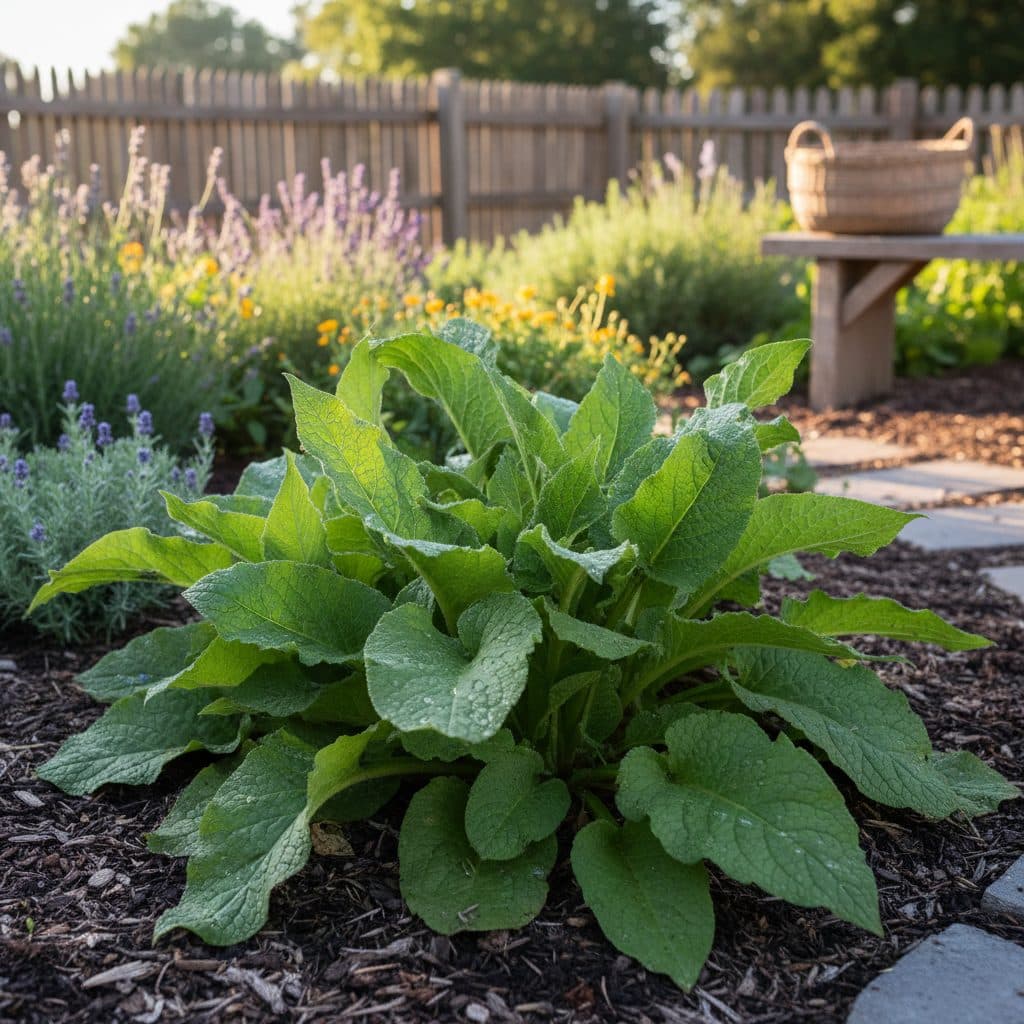
Key takeaways
- Comfrey thrives across a wide range of climates, specifically USDA zones 3 to 9, requiring minimal care once established.
- Select specific species like Symphytum officinale or Bocking 14 for medicinal use, as they offer distinct characteristics.
- Harvest comfrey leaves multiple times per season, typically 4 to 6 cuts from a mature plant, for various preparations.
- Always use comfrey externally due to the presence of pyrrolizidine alkaloids, which can cause liver damage if ingested.
- Comfrey is a dynamic accumulator of nutrients and an excellent compost activator in the garden.
- Proper soil conditions, including a pH between 6.0 and 7.0, matter for optimal growth and nutrient uptake.
Quick answer: Comfrey (Symphytum officinale) thrives in USDA zones 3-9 with well-draining soil (pH 6.0-7.0) and 4+ hours of sun. Propagate from root cuttings, space 2-3 feet apart, and harvest leaves when 12-18 inches long for external medicinal use.
In many American homesteads, from the cool Pacific Northwest to the warm, humid Gulf Coast, comfrey has been a staple in medicinal gardens for over a century. This hardy perennial, particularly Symphytum officinale, has many uses for the home apothecary and garden alike. First cultivated widely in the United States during the 19th century, its reputation grew for its ability to support skin health and bone mending, earning it folk names like ‘knitbone’ or ‘boneset’ (My growing garden, 1915 [4]).
While its internal use is now largely discouraged due to specific alkaloid compounds, its external applications remain highly valued by experienced growers. A single mature comfrey plant can produce 4 to 6 harvests per growing season, providing ample material for salves, poultices, and nutrient-rich garden amendments. Understanding proper cultivation, harvesting, and safe application methods helps you use this powerful herb effectively.
Understanding comfrey species and their uses
When considering comfrey for your medicinal garden, it is important to distinguish between species, as not all are created equal. The most commonly cultivated medicinal species is Symphytum officinale, often referred to as common comfrey or true comfrey. Another popular choice is the Bocking 14 cultivar, a sterile hybrid of Symphytum officinale and Symphytum asperum, which was developed in England and is prized for its high allantoin content and non-spreading nature (Symphytum officinale Russian comfrey, 2007 [2]). This specific cultivar does not produce viable seeds, preventing it from becoming invasive in your garden beds.
Both Symphytum officinale and Bocking 14 are known for their rich nutrient profile, accumulating minerals like potassium, phosphorus, and nitrogen from deep within the soil. A mature plant can reach heights of 3 feet and spread 2 feet wide, providing substantial biomass for harvest. For external applications, comfrey has been historically used in poultices and salves to support the healing of bruises, sprains, and bone fractures, though always with caution and external use only. The leaves, which can be harvested when they reach 12 to 18 inches in length, are the primary part used.
- Choose Symphytum officinale or Bocking 14 for medicinal use.
- Avoid wild comfrey species unless positively identified.
- Bocking 14 is a sterile hybrid, preventing seed spread.
- Leaves are the primary part used for external preparations.
- Mature plants yield 4 to 6 harvests annually.
Establishing comfrey in your garden
Comfrey is a remarkably resilient plant, thriving in a wide range of conditions across the United States, specifically in USDA zones 3 through 9. It prefers full sun to partial shade, needing at least 4 hours of direct sunlight daily for optimal growth. The ideal soil is rich, moist, and well-draining, with a pH between 6.0 and 7.0 (Growing Your Own Herb Garden, 2025 [1]). Before planting, amend your soil with 2 to 4 inches of compost or aged manure to provide a nutrient-rich foundation. Comfrey is a heavy feeder and benefits significantly from fertile soil.
Propagation is typically done from root cuttings or crown divisions, as seed viability can be low for some varieties, especially Bocking 14. Plant root cuttings 2 to 3 inches deep and 2 to 3 feet apart to allow for mature plant spread. Water thoroughly after planting and maintain consistent moisture, especially during dry spells, applying 1 inch of water per week. Once established, comfrey is quite drought-tolerant, but regular watering will encourage more vigorous growth and more frequent harvests. Consider using a soil moisture meter to ensure proper hydration.
- Plant in USDA zones 3 to 9 for best results.
- Ensure soil pH is between 6.0 and 7.0.
- Propagate from root cuttings or crown divisions.
- Space plants 2 to 3 feet apart for ample growth.
- Provide 1 inch of water per week during establishment.
Harvesting and processing comfrey for the home apothecary
Harvesting comfrey is straightforward, and a healthy plant can provide multiple cuts throughout the growing season, typically 4 to 6 harvests from late spring to early fall in temperate climates. Begin harvesting when the leaves are mature, usually 12 to 18 inches long, and the plant has established itself, often in its second year. Use sharp shears or a scythe to cut the entire plant down to about 2 to 3 inches from the ground (Growing for Life, 2013 [3]). This encourages vigorous regrowth. Avoid harvesting after late summer to allow the plant to store energy for winter dormancy.
Once harvested, comfrey leaves can be used fresh or dried for later use. For fresh applications, such as poultices or compress wraps, simply crush or chop the leaves. To dry, spread leaves in a single layer on screens in a well-ventilated area away from direct sunlight; this process usually takes 3 to 7 days. Dried leaves can be stored in airtight containers for up to one year. Another popular method is to infuse the fresh or dried leaves in oil to create a base for salves and ointments. A typical infusion ratio is one part comfrey leaves to two parts carrier oil, steeped for 2 to 4 weeks.
- Harvest leaves when 12 to 18 inches long.
- Cut plants down to 2 to 3 inches from the ground.
- Expect 4 to 6 harvests per season from established plants.
- Dry leaves on screens for 3 to 7 days.
- Store dried leaves in airtight containers for up to one year.
Safe application and precautions
Despite its long history of use, modern understanding of comfrey emphasizes strict external application due to the presence of pyrrolizidine alkaloids (PAs). These compounds, particularly in the roots, can be toxic to the liver if ingested, leading to veno-occlusive disease (Growing Your Own Herb Garden, 2025 [1]). While the leaves contain lower concentrations of PAs than the roots, internal use of any part of the comfrey plant is generally discouraged by health authorities in the United States and Canada. Always use comfrey preparations on unbroken skin, avoiding open wounds or deep cuts, to prevent systemic absorption of PAs.
For external use, comfrey’s high allantoin content, a cell proliferant, is beneficial for skin regeneration and wound healing (Symphytum officinale Russian comfrey, 2007 [2]). Common applications include salves for sore muscles, poultices for bruises, and infused oils for joint pain. When making a salve, a typical ratio might be 1 ounce of dried comfrey herb per 5 ounces of carrier oil, then combined with 0.5 to 1 ounce of beeswax. Always perform a patch test on a small area of skin before widespread application to check for any sensitivities. Discontinue use if irritation occurs.
- Use comfrey strictly for external applications.
- Avoid ingestion due to pyrrolizidine alkaloids (PAs).
- Apply only to unbroken skin, not open wounds.
- Perform a patch test before widespread use.
- Consult a healthcare professional for serious injuries or conditions.
Comfrey as a garden asset and nutrient accumulator
Beyond its medicinal applications, comfrey is a highly valued plant in the garden for its ability to improve soil health and provide nutrient-rich amendments. Often referred to as a dynamic accumulator, its deep taproots, which can extend 6 to 10 feet into the soil, draw up essential nutrients like potassium, phosphorus, and calcium from subsoil layers that are unavailable to shallower-rooted plants (USDA Natural Resources Conservation Service, 2024 [6]). These nutrients are then stored in its leaves, making comfrey an excellent source of organic matter for composting or mulching.
One common use is to make comfrey tea, a potent liquid fertilizer. To create this, pack a container with fresh comfrey leaves and cover them with water, allowing it to steep for 2 to 4 weeks. The resulting dark liquid, rich in nitrogen and potassium, can be diluted at a 10:1 ratio with water before applying to garden plants. This provides a significant boost to fruiting and flowering plants, such as garden peas or tomatoes. Another method is to use chopped comfrey leaves as a mulch around fruit trees or vegetable beds, slowly releasing nutrients as they decompose and suppressing weeds up to 80%.
- Deep taproots access nutrients 6 to 10 feet deep.
- Leaves are rich in potassium, phosphorus, and calcium.
- Use as a compost activator to speed decomposition.
- Make nutrient-rich comfrey tea, diluted 10:1.
- Apply chopped leaves as a weed-suppressing mulch.
Comparison of Comfrey Uses in the Home Garden
Application | Primary Benefit | Preparation Method |
|---|---|---|
Medicinal Salve | Skin regeneration, joint pain relief | Infused oil (1 part comfrey to 2 parts oil), mixed with beeswax |
Poultice | Bruises, sprains, muscle soreness | Crushed fresh leaves or rehydrated dried leaves |
Compost Activator | Speeds decomposition, adds nutrients | Layer fresh leaves into compost pile (1 part comfrey to 5 parts other material) |
Liquid Fertilizer (Comfrey Tea) | Nutrient boost for plants (K, N) | Fermented leaves in water (10:1 dilution for application) |
Mulch | Weed suppression, slow-release nutrients | Chopped fresh leaves applied 2 to 3 inches thick around plants |
Root Depth: Comfrey’s taproots can reach depths of 6 to 10 feet, drawing up subsoil nutrients.
Harvest Yield: A mature comfrey plant can provide 4 to 6 harvests annually in suitable climates.
Soil pH: Optimal growth for comfrey occurs in soil with a pH range of 6.0 to 7.0.
Frequently asked questions
What is the best comfrey species for a medicinal garden?
For medicinal applications, <i>Symphytum officinale</i> (common comfrey) or the Bocking 14 cultivar are highly recommended. Bocking 14 is a sterile hybrid, meaning it won’t spread aggressively via seeds, making it a preferred choice for many gardeners, and it has high allantoin content for external use.
Can I eat comfrey or use it internally?
No, it is strongly advised not to ingest comfrey. Comfrey contains pyrrolizidine alkaloids (PAs), which can be toxic to the liver if consumed, leading to serious health issues. Its use is strictly recommended for external applications on unbroken skin only, following guidelines from health organizations.
How often can I harvest comfrey leaves?
Once established, a healthy comfrey plant can be harvested multiple times throughout the growing season. Typically, you can expect 4 to 6 harvests per year, cutting the leaves down to about 2 to 3 inches from the ground when they reach 12 to 18 inches in length.
What kind of soil does comfrey prefer?
Comfrey thrives in rich, moist, and well-draining soil with a pH between 6.0 and 7.0. It benefits greatly from the addition of organic matter, such as 2 to 4 inches of compost or aged manure, as it is a heavy feeder and needs ample nutrients for vigorous growth.
How do I make comfrey tea for my garden?
To make comfrey tea, pack a container with fresh comfrey leaves and cover them completely with water. Allow the mixture to steep and ferment for 2 to 4 weeks. Before applying to your plants, dilute the concentrated liquid at a 10:1 ratio with water to prevent nutrient burn.
References
- Growing Your Own Herb Garden (2025). Growing Your Own Herb Garden.
- Symphytum officinale Russian comfrey (2007). Symphytum officinale Russian comfrey.
- Growing for Life (2013). Growing for Life.
- My growing garden (1915). My growing garden.
- My growing garden (1915). My growing garden.
- USDA Natural Resources Conservation Service (2024). USDA Natural Resources Conservation Service.