Key takeaways
- The Johnson-Su bioreactor is a static, aerated composting system developed by Dr. David Johnson and Hui-Chun Su at New Mexico State University.
- It produces biologically complete, fungal-dominant compost without mechanical turning or heavy physical labor.
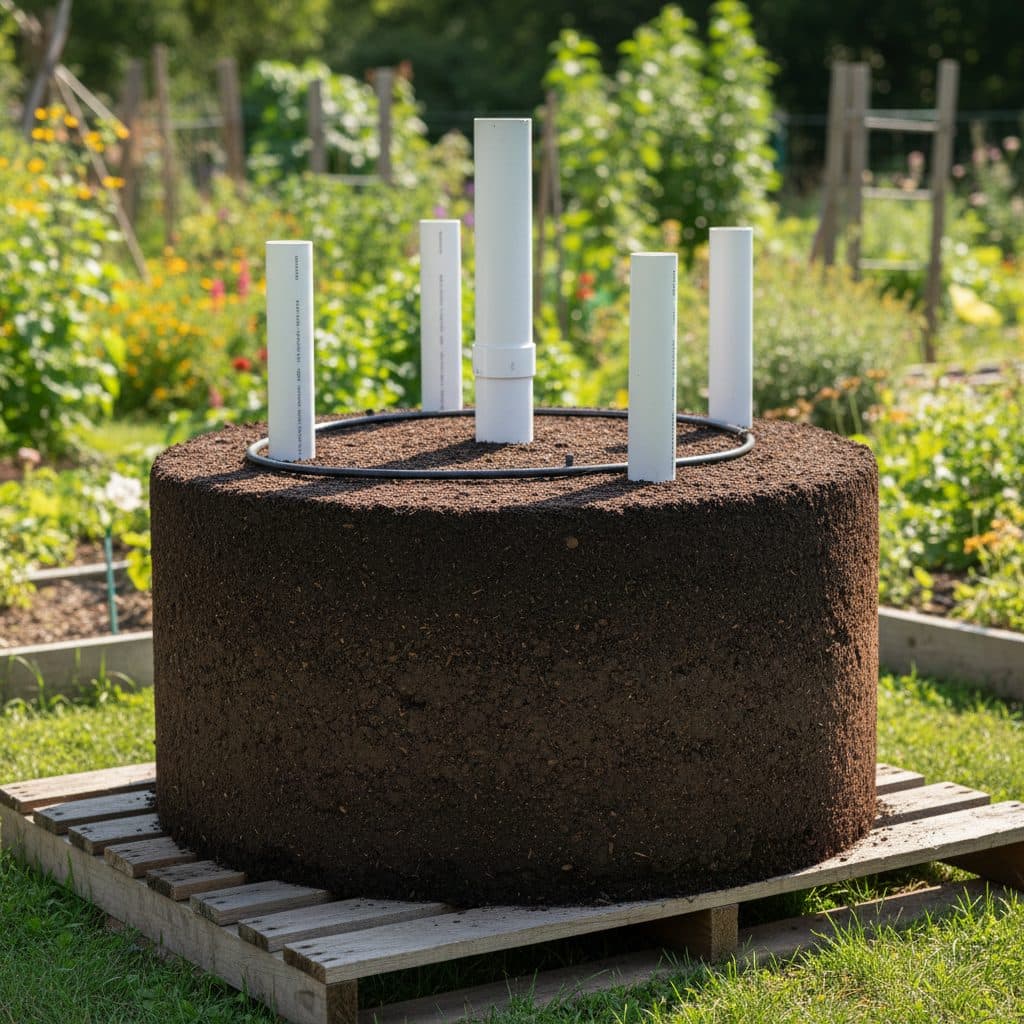
- Vertical air chimneys created by removable PVC pipes maintain aerobic conditions throughout the entire pile.
- A full 12-month maturation cycle allows delicate fungal hyphae, protozoa, and beneficial nematodes to proliferate.
- The finished material is a concentrated biological inoculant, applied as a liquid seed treatment or light soil drench.
Quick answer: A Johnson-Su bioreactor is a static, continuously aerated composting system designed to produce biologically complete, fungal-dominant compost. Built using a wire mesh cylinder on a pallet with six vertical aeration chimneys, the bioreactor is loaded once, kept consistently moist with daily micro-irrigation, and left unturned for a full 12 months to culture extraordinary microbial diversity.
Traditional thermal composting requires intensive physical labor, requiring regular pile turning to introduce oxygen and prevent anaerobic conditions. While turning successfully kills weed seeds and pathogens, the repeated mechanical disruption tears fragile fungal hyphae and prevents the establishment of the extended saprophytic fungal networks that dominate a mature pile. The johnson su bioreactor solves this dilemma through passive biological engineering.
Developed by molecular biologist Dr. David Johnson and his wife Hui-Chun Su at New Mexico State University, this static aerobic design eliminates the need for pile turning entirely. By integrating vertical aeration chimneys within a breathable wire enclosure, natural thermal convection draws fresh air through the entire material mass continuously.
The result of this year-long static process is not ordinary bulk organic matter, but a biologically rich microbial inoculant. When applied to agricultural soils or home garden beds, this fungal-dominant inoculant adds soil biology and supports nutrient cycling; the larger soil-carbon claims made for the system come from a small number of trials and are still debated.
What is a Johnson-Su bioreactor and how does it work?
The bioreactor operates on principles of passive aeration, continuous moisture retention, and extended biological succession:
+-------------------------------------------------------------+
|               HOW THE JOHNSON-SU BIOREACTOR WORKS           |
|                                                             |
|                    [ Daily Drip Irrigation ]                |
|                                v                            |
|             +------------------------------------+          |
|             |  === Breathable Mesh Cylinder ===  |          |
|             |   (O)    (O)    (O)    (O)   (O)   | <-- 6 Air|
|             |    |      |      |      |     |    |   Pipes  |
|             |    |      |      |      |     |    |  (Pulled |
|             |    |      |      |      |     |    |   after  |
|             |    v      v      v      v     v    |   24 hrs)|
|             |  [ Passive Thermal Air Convection] |          |
|             +------------------------------------+          |
|             ======================================          |
|                     [ Standard Wood Pallet ]                |
+-------------------------------------------------------------+
Static aerobic environment
In conventional compost piles, oxygen is depleted within 24 to 48 hours as thermophilic bacteria rapidly consume available carbon. When oxygen drops below 5 percent, anaerobic bacteria take over, generating unpleasant odors, methane, and toxic organic acids.
In a Johnson-Su bioreactor, no portion of the composting organic matter sits more than 12 inches (30 cm) from ambient air. Air enters from the sides through landscape fabric and rises through the internal vertical chimneys, creating a continuous convective chimney effect that keeps the entire pile fully aerobic without human intervention.
Fungal-dominant succession
Most compost is harvested after 60 to 90 days, when bacterial activity subsides. However, fungal communities require several months of uninterrupted stability to mature. By leaving the bioreactor undisturbed for a full 12 months, the ecosystem transitions through thermophilic, mesophilic, and fungal maturation stages, resulting in compost that is fungal-dominant rather than bacterial — the actual fungal-to-bacterial ratio depends on feedstock and moisture and varies a great deal between piles. Understanding these microbial dynamics, as detailed in our guide to the soil food web, reveals why fungal dominance is essential for soil restoration.
Materials and build plans for a DIY bioreactor
Constructing a standard Johnson-Su bioreactor requires basic, readily available agricultural materials and simple hand tools:
+-------------------------------------------------------------+
|                 BIOREACTOR HARDWARE LIST                    |
|                                                             |
|  - 1 Standard 40x48 inch wood pallet (rot-resistant)        |
|  - 10 feet of 5-foot-tall welded wire mesh (concrete mesh)  |
|  - 1 roll Non-woven breathable landscape fabric or shade net|
|  - 6 lengths of 4-inch perforated PVC or corrugated pipe    |
|  - Heavy-duty zip ties or tie wire                          |
|  - 1 Drip irrigation ring with micro-emitters & timer       |
|  - 1 Digital hose timer for daily automated moisture control|
+-------------------------------------------------------------+
Step-by-step assembly
- Prepare the pallet base: Place a sturdy, clean wooden pallet on level ground in a shaded or semi-shaded location. Staple landscape fabric over the top surface to prevent compost from falling through pallet slats while permitting bottom airflow.
- Form the wire cylinder: Cut a 10-foot (3 m) length of heavy-gauge welded wire mesh. Roll it into a cylinder roughly 3 feet (1 m) in diameter and 5 feet (1.5 m) tall. Secure the overlapping seam firmly with heavy-duty zip ties.
- Line the cylinder: Line the inside of the wire cylinder with breathable landscape fabric, fastening the top edges with plastic zip ties.
- Position the aeration guide: Drill six 4-inch holes into a wooden template board placed on the pallet base to hold six vertical PVC pipes equidistant from each other and the outer wall. Insert the six pipes vertically.
Sourcing and loading organic feedstocks
The quality and diversity of the biological inoculant depend directly on the diversity of organic feedstocks loaded into the cylinder.
+-------------------------------------------------------------+
|                 FEEDSTOCK DIVERSITY FORMULA                 |
|                                                             |
|  - 40% Woody Carbon: Wood chips, sawdust, fallen leaves     |
|- 30% Green Nitrogen: Garden trimmings, fresh grass clippings|
|  - 20% Aged Manure: Clean cow, horse, or poultry manure     |
|  - 10% Biological Starter: Finished vermicompost & soil     |
+-------------------------------------------------------------+
Pre-soaking and thorough wetting
Feedstocks must be completely saturated before loading. Dry carbon materials resist water penetration once packed into the cylinder. Submerge feedstocks in a stock tank or wheelbarrow filled with water for 12 to 24 hours prior to loading, or lay materials in a shallow pit and hose them down while mixing with a garden fork.
Always verify that animal manures and agricultural straw come from verified sources free from long-lasting synthetic pyridine herbicides; reviewing our guide on persistent herbicide compost contamination protects your bioreactor from persistent toxins. Adding an active biological starter using natural compost accelerators speeds initial bacterial colonization.
Loading and pipe extraction
- Shovel wet organic material evenly around the vertical PVC pipes in 6-inch (15 cm) layers, tamping lightly with a broom handle to eliminate large voids without over-compacting.
- Fill the cylinder completely to the top rim.
- Allow the packed material to rest for 24 hours while initial bacterial adhesion occurs.
- Carefully pull each of the six PVC pipes straight upward, leaving clean, open vertical air chimneys through the compacted material mass.
Moisture management and the 12-month maturation cycle
Maintaining precise moisture is the only ongoing maintenance requirement for the Johnson-Su bioreactor.
+-------------------------------------------------------------+
|               12-MONTH BIOREACTOR TIMELINE                  |
|                                                             |
|  DAYS 1-5: Thermophilic phase (130°F-155°F / 55°C-68°C)     |
|  DAYS 6-30: Mesophilic cooling phase                        |
|  WEEKS 4-5: Introduce red wiggler composting worms          |
|  MONTHS 2-12: Fungal propagation & humification             |
|  MONTH 12: Harvest biologically complete dark humus         |
+-------------------------------------------------------------+
Irrigation automation
The bioreactor requires approximately 70 percent moisture content throughout its lifespan. Install a circular drip ring or micro-sprinkler on top of the pile connected to an automatic digital hose timer. Start at a few minutes daily and adjust by feel — squeeze a handful from 15 cm down; it should feel like a wrung-out sponge and release a drop or two, with no steady runoff at the base.
Vermiculture integration
About four to five weeks in, once the core has cooled and core temperatures have dropped below about 77°F (25°C), introduce two cups of Eisenia fetida composting worms into the top of the pile. As detailed in our vermicomposting at home worm bin guide, worms travel throughout the cooling mass, ingesting bacteria and depositing enzyme-rich vermicast that enriches the microbial community.
Extracting and applying Johnson-Su biological inoculant
Because this process creates a biological inoculant rather than bulk fertilizer, only small quantities are needed to inoculate soils and seeds.
+-------------------------------------------------------------+
|               LIQUID BIOLOGICAL EXTRACT RECIPE              |
|                                                             |
|  1. Weigh: 1 to 2 lbs (0.5-1 kg) finished Johnson-Su compost|
|  2. Bag: Place into a 400-micron mesh paint strainer bag    |
|  3. Massage: Immerse in 5 gallons non-chlorinated water     |
|     and vigorously massage for 5 minutes                    |
|  4. Extract: Microbes dislodge into liquid, turning it brown|
|  5. Apply: Use within 4 hours as seed wash or soil spray    |
+-------------------------------------------------------------+
Application methods
- Seed inoculation: Coat seeds with liquid biological extract immediately prior to planting. The microbes coat the emerging radicle, putting saprophytic fungi, bacteria and their protozoan grazers in contact with the root from germination onward.
- In-furrow and root drench: Apply diluted liquid extract directly into seed furrows or around the root zones of vegetable transplants and fruit trees.
- Solid top-dressing: Apply a light dusting of solid compost (a few handfuls per garden bed) under organic mulch, allowing earthworms and rain to draw the biology downward.
By building a static Johnson-Su bioreactor, you create a low-labour nursery for soil microorganisms. At agripure, practical biological composting methods empower growers to regenerate living soil naturally.