Key takeaways
- For Douglas-fir, rooting hormone can increase success from 10% to a thriving 75%.
- Softwood cuttings from many common shrubs and perennials root readily without hormone, achieving 80% or higher success.
- The active ingredients in rooting hormones are auxins, primarily IBA and NAA, typically at concentrations from 0.1% to 3.0%.
- Environmental factors like humidity, temperature (70-75°F), and light are often more critical than hormone for easy-to-root species.
- Using hormone on easy-to-root plants can sometimes inhibit root development or cause stem rot if applied incorrectly.
- Dormant hardwood cuttings of species like cottonwood can root successfully in moist sand at 40°F over several weeks without hormone.
Quick answer: Rooting hormone significantly boosts success for hard-to-root species like mature hardwoods and conifers, often achieving 75% success rates. Easy-to-root softwood cuttings and herbaceous perennials typically root well without it, often exceeding 80% success.
In a small nursery operation in central Oregon, a grower might propagate hundreds of Douglas-fir seedlings each year. For these valuable conifers, a 1964 study found rooting hormone lifted success from 10% to 75% [1]. Understanding when to use rooting hormone and when to skip it is a fundamental skill for any grower looking to increase their propagation success and manage resources efficiently. It’s not a universal solution, but a targeted tool.
This guide will help you identify which plant cuttings truly benefit from a hormonal boost and which ones are perfectly capable of rooting on their own, often achieving 80-90% success rates without any chemical aid. We will explore the science behind these compounds, examine specific plant examples from USDA zones 3 through 9, and discuss the environmental factors that are often more critical than any chemical application.
The science behind rooting hormones: auxins and their effects
Rooting hormones are synthetic or naturally derived plant growth regulators, specifically auxins, that encourage the formation of adventitious roots on plant cuttings. The two most common active ingredients are indole-3-butyric acid (IBA) and naphthaleneacetic acid (NAA), often found in concentrations ranging from 0.1% to 3.0%. These auxins stimulate cell division and differentiation at the cut surface of the stem, leading to the development of new roots. For instance, research on mature Douglas-fir cuttings in the Pacific Northwest showed that treated cuttings achieved a 75% rooting success rate, a significant jump from the 10% observed in untreated cuttings [1].
how auxins work in plant tissue
When applied to a fresh cut, auxins are absorbed into the plant tissue, signaling cells to begin the complex process of root initiation. In most species adventitious roots arise from cells near the vascular tissue inside the stem. The callus that forms over the cut surface is a parallel wound response, not the source of the roots. Different plant species respond to varying concentrations; for example, some woody ornamentals might require a 0.8% IBA solution, while herbaceous plants often need only 0.1% IBA. The effectiveness also depends on the cutting type, with hardwood cuttings generally requiring higher concentrations than softwood cuttings. The USDA Natural Resources Conservation Service provides extensive resources on propagation techniques, including specific recommendations for various native plants across US regions [6].
- IBA (Indole-3-butyric acid): Most commonly used, effective for a wide range of plants.
- NAA (Naphthaleneacetic acid): Stronger auxin, often used in combination with IBA for difficult-to-root species.
- Powder formulations: Convenient, typically have concentrations like 0.1%, 0.3%, or 0.8% IBA.
- Liquid formulations: Allow for precise dilution, often used for dipping or soaking.
- Gel formulations: Adhere well to the cutting, providing sustained release of the hormone.
Hard-to-root species and mature plants that need a boost
Certain plant species and cuttings taken from mature parent plants are notoriously difficult to root without assistance. These are the prime candidates for rooting hormone application. Woody ornamental shrubs like rhododendrons, azaleas, and many conifers fall into this category. For example, research from 1958 showed that white pine cuttings from 10-year-old trees achieved a 65% rooting success rate when treated with a hormone, a significant improvement over untreated controls [4]. Similarly, tamarack cuttings, a common conifer in northern US states, rooted at 60% when treated with 8,000 ppm IBA, demonstrating the hormone’s critical role for these species [2].
improving success with older plant material
The age of the parent plant matters; cuttings from juvenile plants often root more easily than those from mature plants. This is because juvenile tissue typically contains higher levels of endogenous auxins and is more physiologically responsive. When propagating from older, established plants, especially those over 5 years old, a rooting hormone can overcome some of the physiological barriers to root formation. For instance, a grower in USDA zone 6 wanting an heirloom apple variety from a 20-year-old tree will still see very low rooting rates even at a strong 0.8% IBA concentration. Apple cultivars are almost always grafted onto rootstocks precisely because their cuttings root so poorly, and hormone does not change that. This is particularly true for deciduous hardwood cuttings taken in late fall or winter.
- Conifers: Douglas-fir, White Pine, Tamarack, spruce, fir.
- Broadleaf Evergreens: Rhododendron, azalea, camellia, holly.
- Deciduous Hardwoods: Older maples, oaks, some fruit trees.
- Mature Plants: Cuttings from parent plants over 5 years old.
- Species with low natural auxin levels: Plants that naturally produce fewer rooting compounds.
Easy rooters: when nature does the work for you
Not all cuttings need a hormonal boost. Many common garden plants, especially herbaceous perennials and softwood cuttings from certain shrubs and trees, root with remarkable ease without any chemical intervention. These plants typically have high levels of natural auxins or are simply more physiologically primed for root development. For instance, willow cuttings are famous for their ability to root in plain water, often achieving 90-95% success rates within 2-3 weeks. The same applies to many herbs like mint, rosemary, and basil, which can root in a glass of water or moist soil with 80% or higher success.
plants that thrive without extra help
Dormant hardwood cuttings of cottonwood, a common tree across many US states, demonstrated a 90% rooting success rate when simply placed in moist sand at 40°F over several weeks, without any hormone application [5]. This highlights that for some species, the right environmental conditions (consistent moisture and cool temperatures for dormant cuttings) are far more critical than exogenous hormones. Many annuals and fast-growing perennials like coleus, impatiens, and geraniums also fall into this category, often rooting within 10-14 days in a simple potting mix. For these plants, adding rooting hormone can sometimes be detrimental, potentially causing stem rot or inhibiting root development if applied too heavily. For more information on propagating herbs, see our article on starting a herb garden.
- Willow (Salix species): Roots readily in water or moist soil, often 90%+ success.
- Cottonwood (Populus species): Dormant cuttings root well without hormone [5].
- Soft-stemmed herbs: Mint and basil. Rosemary, lavender and sage are woody subshrubs and root as semi-hardwood cuttings, not herbaceous ones.
- Annuals: Coleus, impatiens, geranium, begonia.
- Succulents: Many varieties root easily from leaves or stem sections.
Optimizing conditions: more than just hormone
While rooting hormone can help, but its effectiveness is often secondary to providing the correct environmental conditions. Even the most potent hormone won’t compensate for poor moisture, incorrect temperature, or inadequate light. For example, maintaining high humidity around cuttings, typically between 80% and 90%, prevents desiccation. This can be achieved with a misting system, a humidity dome, or by placing cuttings in a clear plastic bag. Proper humidity ensures the cutting doesn’t dry out before roots can form.
critical environmental factors for rooting success
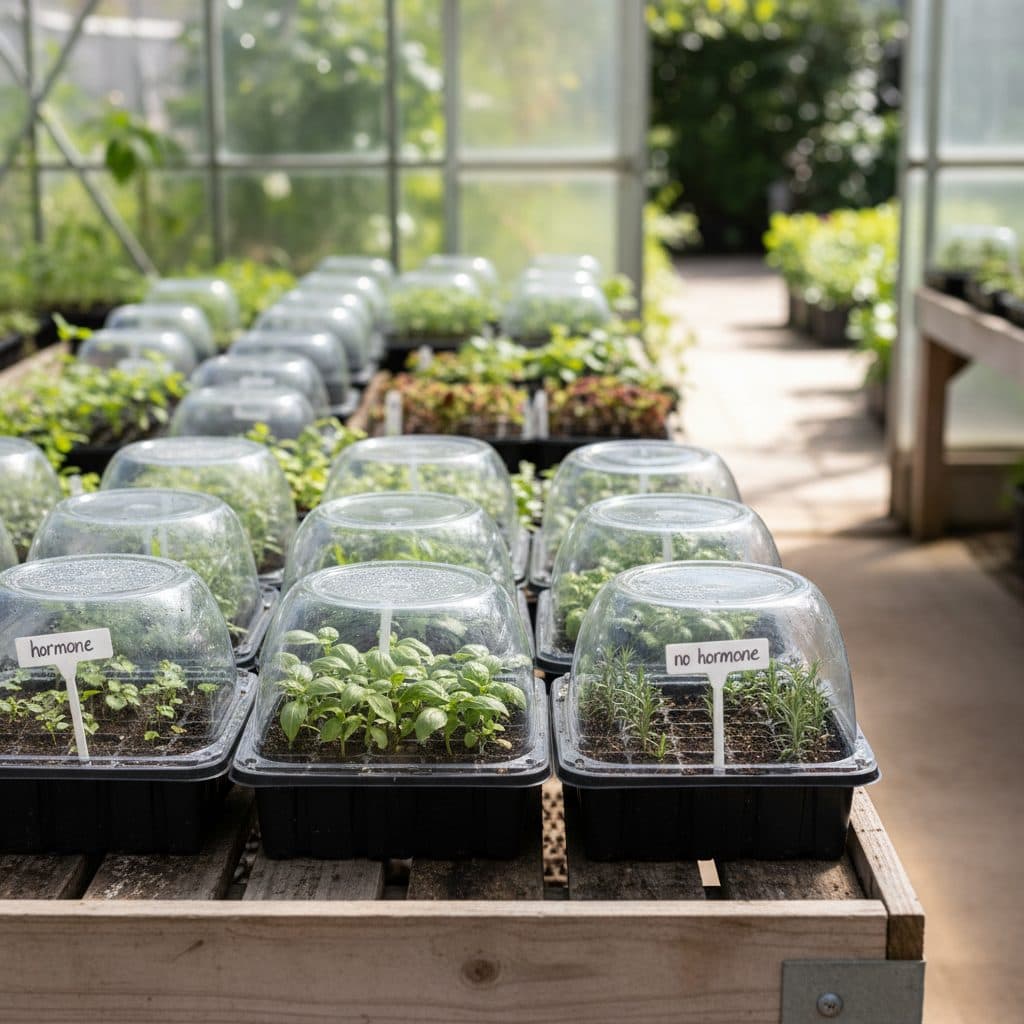
Bottom heat is another critical factor, especially for many woody and semi-hardwood cuttings. Maintaining the rooting medium temperature between 70°F and 75°F encourages faster root development, while the air temperature can be slightly cooler, around 65-70°F. This warmth stimulates metabolic activity in the basal part of the cutting. Adequate, but not excessive, light is also important; cuttings generally need bright, indirect light for 12-16 hours a day to support photosynthesis without causing stress. A sterile, well-draining rooting medium, such as a 50:50 mix of perlite and peat moss, provides the necessary aeration and moisture retention. Using a 24-cell seedling propagation tray with a dome can help maintain these ideal conditions. These factors, combined, matter more than the hormone for all but the most difficult species.
- Humidity: 80-90% relative humidity to prevent wilting.
- Temperature: 70-75°F for the rooting medium (bottom heat).
- Light: Bright, indirect light for 12-16 hours daily.
- Rooting Medium: Sterile, well-draining, e.g., perlite and peat moss mix.
- Air Circulation: Gentle air movement to prevent fungal issues, but not so much as to dry out cuttings.
When to skip the hormone: practical considerations and potential downsides
For many common garden plants, using rooting hormone is simply unnecessary and can even be counterproductive. If a plant species is known to root easily, such as most mint varieties, coleus, or even some fast-growing shade trees like certain poplars, applying hormone won’t significantly improve your 80-90% success rate and might introduce unnecessary cost and effort. For instance, a grower in USDA zone 7 propagating rosemary would likely achieve 85% success in moist perlite without any hormone, making the additional step redundant. Over-application or using too strong a concentration on easy-to-root plants can lead to phytotoxicity, where the hormone actually burns the stem tissue, causing rot or inhibiting root formation entirely. This is particularly true for concentrations above 1.0% IBA on sensitive herbaceous plants.
avoiding common pitfalls in propagation
Another consideration is the potential for stem rot. If the rooting medium is too wet, or if the hormone creates an overly dense callus that doesn’t quickly differentiate into roots, the cutting can become susceptible to fungal or bacterial infections. This is especially problematic in humid environments typical of propagation setups. For plants that root readily, focusing on optimal environmental conditions, like consistent moisture, proper temperature (70-75°F), and good air circulation, will yield better results than relying on hormone alone. For example, ensuring your seed starting mix is well-aerated can prevent many issues. Always observe your cuttings closely; signs of blackening at the base or lack of new growth after 2-3 weeks might indicate a problem that hormone cannot fix, or might even be exacerbated by it.
- Easy-to-root plants: Many herbs, annuals, and softwoods.
- Risk of phytotoxicity: Hormone burn or inhibition of root growth.
- Increased stem rot: If conditions are too wet or hormone is overused.
- Unnecessary cost: Hormones add to propagation expenses without benefit for some species.
- Environmental focus: Prioritize humidity, temperature, and sterile media over hormone.
Rooting Hormone Application Guide for Various Cuttings
Plant Type | Rooting Difficulty | Hormone Recommended | Typical Success Rate (without hormone) |
|---|---|---|---|
Douglas-fir (mature) | Hard | Yes (0.3-0.8% IBA) | 10% [1] |
Willow (softwood) | Easy | No | 90-95% |
Rosemary (semi-hardwood) | Easy to Moderate | Optional (0.1% IBA) | 80-85% |
White Pine (10-year-old) | Hard | Yes (0.3-0.8% IBA) | Not reported [4] |
Cottonwood (dormant hardwood) | Easy | No | 90% [5] |
Coleus (herbaceous) | Easy | No | 90-95% |
Douglas-fir success: Mature Douglas-fir cuttings showed a 75% rooting success rate with hormone compared to 10% without it [1].
Cottonwood ease: Dormant cottonwood cuttings rooted at 90% success in moist sand at 40°F without hormone [5].
Tamarack boost: Tamarack cuttings achieved 60% rooting when treated with 8,000 ppm (0.8%) IBA, a significant increase over untreated controls [2].
Frequently asked questions
Can I use too much rooting hormone?
Yes, excessive hormone can inhibit root growth or cause stem rot, especially with concentrations above 1.0% IBA on sensitive plants. Always follow product instructions carefully to avoid phytotoxicity.
What’s the best time of year to take cuttings for rooting?
For most plants, softwood cuttings are best taken in late spring or early summer when growth is active, typically achieving 70-85% success. Hardwood cuttings are usually taken in late fall or winter when dormant.
Do all plants need rooting hormone?
No, many plants like willow, mint, and coleus root readily from cuttings without any hormone, often reaching 90% success rates. For these, optimal environmental conditions are usually sufficient.
What’s the ideal temperature for rooting cuttings?
Most cuttings root best with bottom heat, maintaining a soil temperature between 70°F and 75°F for optimal cell division and root development. Air temperature can be slightly cooler, around 65-70°F.
Is liquid or powder rooting hormone better?
Both forms are effective, but liquid hormones offer more precise dilution for specific plant needs and can be used for soaking, while powder is convenient for quick application, often at 0.1% to 0.8% IBA. The choice depends on preference and plant type.
How long does it take for cuttings to root?
Rooting time varies significantly by species, from 10-14 days for easy-to-root herbaceous plants to 8-12 weeks or more for difficult woody cuttings. Consistent moisture and warmth (70-75°F) can accelerate the process.
References
- Rooting of Cuttings from Mature Douglas-Fir (1964). Rooting of Cuttings from Mature Douglas-Fir.
- Notes: Rooting of Tamarack Cuttings (1984). Notes: Rooting of Tamarack Cuttings.
- Figure 2: Rooting of cuttings (left is well-rooted, right is not well-rooted cuttings). (2023). Figure 2: Rooting of cuttings (left is well-rooted, right is not well-rooted cuttings)..
- Rooting Cuttings of White Pine (1958). Rooting Cuttings of White Pine.
- Rooting Dormant Cuttings of Mature Cottonwood (1966). Rooting Dormant Cuttings of Mature Cottonwood.
- USDA Natural Resources Conservation Service (2024). USDA Natural Resources Conservation Service.