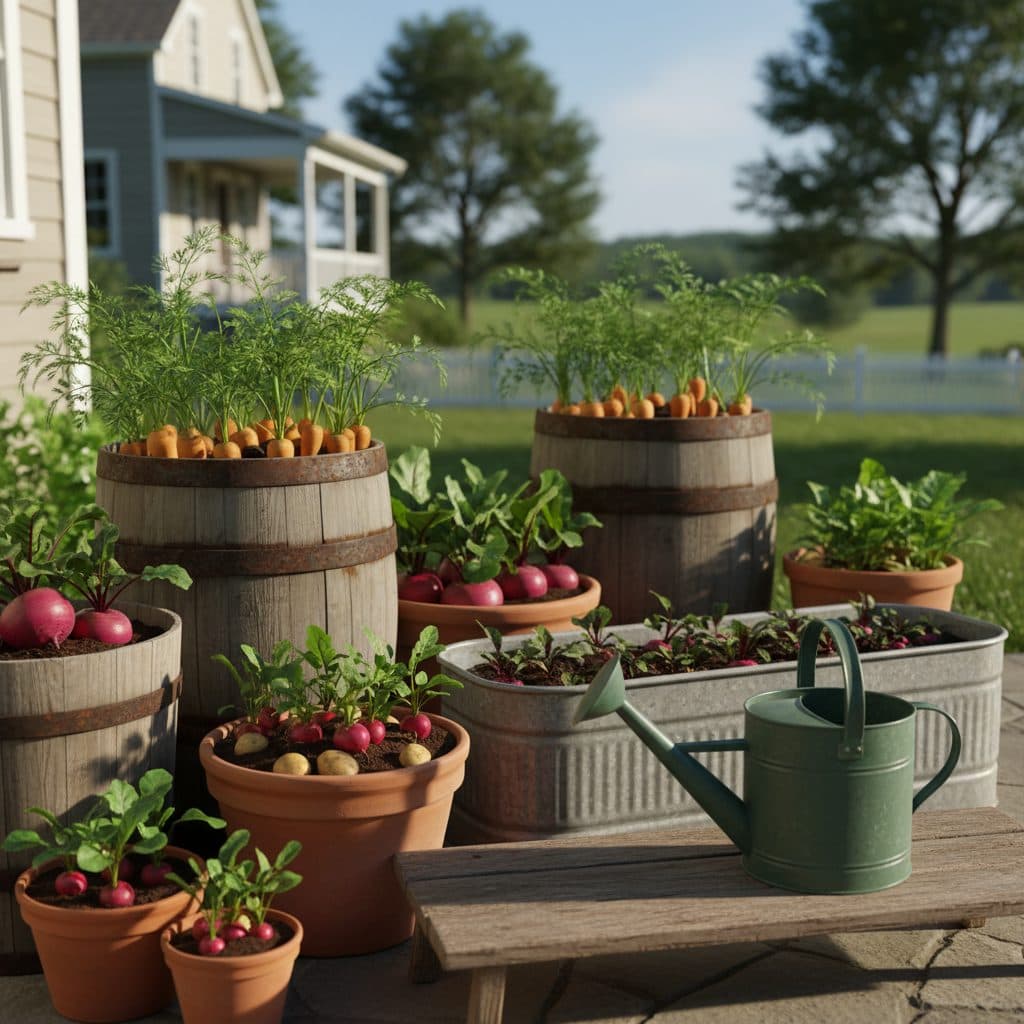
Key takeaways
- Radishes require a minimum of 6 inches of soil depth for proper root development and mature in 20-30 days.
- Turnips need 8-12 inches of soil depth to grow their roots effectively, offering both greens and edible roots.
- Beets are the deepest-rooted of these crops, demanding 10-12 inches of soil, or up to 14 inches for larger varieties.
- Container gardening for root crops needs loose, well-draining soil blended with finished compost at 10-20% by volume.
- Consistent watering, about 1 inch per week, and monitoring soil moisture with a meter are crucial for container success.
- Proper drainage holes and a suitable potting mix are more important than container material for healthy root growth.
Quick answer: For successful container root crop cultivation, radishes require a minimum of 6 inches of soil depth, turnips need 8-12 inches, and beets demand 10-14 inches for proper root development and good yields.
In places like urban Seattle, Washington, where garden space is often limited to patios and balconies, container gardening offers a viable path to fresh produce. Root crops, in particular, present a unique challenge: providing enough vertical space for their underground development. Understanding the specific depth requirements for different root vegetables is a fundamental principle for a successful harvest, preventing stunted growth and supporting good yields from your containers.
Many growers in compact spaces, from a rooftop in New York City to a small porch in Phoenix, Arizona, find success by carefully selecting containers. For instance, a 5-gallon bucket, typically 10-12 inches deep, can be repurposed effectively for many root crops. Ensuring proper drainage and using a high-quality potting mix are as critical as the container’s depth.
Understanding soil depth and container drainage
Successful container gardening for root crops begins with selecting the right vessel and filling it correctly. For any root vegetable, the soil must be loose and well-draining to allow roots to expand without resistance. A standard potting mix, often composed of peat moss, perlite, and compost, is generally suitable. When incorporating compost, use finished, crumbly compost rather than raw or half-rotted material — woody, uncomposted matter ties up nitrogen just when the roots need it.
choosing the right container material
While material choice — plastic, terracotta, or fabric — can affect soil temperature and moisture retention, the most critical factor is the presence of adequate drainage holes. A container without at least three 0.5-inch drainage holes will quickly lead to waterlogged soil, suffocating roots and inviting disease. For larger containers, such as those 15 gallons or more, four to six drainage holes are recommended to ensure efficient water runoff, especially in regions with heavy rainfall, like the Pacific Northwest, which can receive over 30 inches annually.
- Select containers with multiple drainage holes.
- Use a loose, well-draining potting mix.
- Consider container size for mature root development.
- Ensure soil pH is appropriate for the crop, typically 6.0-7.0.
- Avoid compacting the soil during planting.
Radishes: shallow roots, fast harvest
Radishes (Raphanus sativus) are the sprinters of the root crop world, often ready for harvest in as little as 20-30 days from seeding. Their rapid growth and relatively small root size make them an excellent choice for beginner gardeners or those with limited space. For most radish varieties, including ‘Cherry Belle’ and ‘French Breakfast,’ a minimum soil depth of 6 inches is sufficient. This allows the taproot to develop fully without hitting the container bottom, preventing malformed or stunted roots. You can learn more about growing these quick crops at How to grow radishes: the fastest crop from seed to harvest.
optimizing radish container conditions
While 6 inches is the minimum, providing 8 inches of depth can accommodate slightly larger varieties or offer a buffer for root development. A container with a diameter of 8-10 inches can comfortably hold 8-12 radish plants, spaced about 1 inch apart. Consistent moisture is crucial for radishes; uneven watering can lead to woody, hot-tasting roots. Aim for about 0.5 inch of water every two to three days in warm weather, ensuring the top 2 inches of soil remain consistently damp. In USDA Zone 5, radishes can be planted in early spring and again in late summer.
- Minimum soil depth: 6 inches.
- Days to harvest: 20-30 days.
- Spacing: 1 inch apart.
- Watering: Consistent, 0.5 inch every 2-3 days.
- Container diameter: 8-10 inches for 8-12 plants.
Turnips: a moderate depth for root and greens
Turnips (Brassica rapa subsp. rapa) are a versatile root crop, appreciated for both their tender greens and their mild, slightly peppery roots. Depending on the variety, turnips typically require a soil depth of 8-12 inches to develop fully. Varieties like ‘Purple Top White Globe’ can grow to 3-4 inches in diameter, needing adequate space to swell. In regions like the Mid-Atlantic, turnips are often planted in early spring or late summer, maturing in 35-60 days.
container size for turnip success
For a healthy harvest of turnip roots, a container that is at least 10 inches deep and 12 inches in diameter is ideal. This size can comfortably support 4-6 turnip plants, spaced 4-6 inches apart. If you are primarily interested in the greens, you can plant them closer, perhaps 2-3 inches apart, and harvest the outer leaves regularly. Turnips thrive in soil with a pH between 6.0 and 7.0. Ensuring consistent moisture, about 1 inch of water per week, is important, especially during root development to prevent cracking or bitterness.
- Minimum soil depth: 8 inches.
- Optimal soil depth: 10-12 inches.
- Days to harvest: 35-60 days.
- Spacing: 4-6 inches apart for roots.
- Container diameter: At least 12 inches for 4-6 plants.
Beets: requiring the most vertical space
Beets (Beta vulgaris) are perhaps the most demanding of these three root crops in terms of vertical space. Their spherical or cylindrical roots can grow significantly, necessitating a deeper container for optimal development. For most common beet varieties, such as ‘Detroit Dark Red’ or ‘Chioggia,’ a minimum soil depth of 10-12 inches is required. For larger heirloom varieties or those you wish to grow to their maximum potential, a depth of up to 14 inches can be beneficial. Beets typically mature in 50-70 days and thrive in cooler temperatures, making them suitable for spring and fall planting in USDA Zone 6.
providing optimal conditions for beets
A container that is at least 12 inches deep and 12-14 inches in diameter can comfortably house 3-5 beet plants, spaced 3-4 inches apart. Beets prefer a slightly acidic to neutral soil pH, ideally between 6.0 and 7.0. They are also heavy feeders, benefiting from a balanced fertilizer application every 3-4 weeks. Consistent watering, similar to turnips at about 1 inch per week, is crucial to prevent the roots from becoming tough or woody. Monitoring soil moisture with a tool like a Soil Moisture Meter can ensure optimal conditions.
- Minimum soil depth: 10 inches.
- Optimal soil depth: 10-12 inches, up to 14 inches for large varieties.
- Days to harvest: 50-70 days.
- Spacing: 3-4 inches apart.
- Container diameter: At least 12-14 inches for 3-5 plants.
Beyond depth: watering and nutrient management in containers
While container depth is a primary concern for root crops, successful container gardening also depends on careful watering and nutrient management. Container plants, especially those on a sunny balcony in a hot climate like Arizona, dry out much faster than garden beds. They may require daily watering, sometimes twice a day during peak summer, to maintain the consistent moisture levels that root crops demand. The old garden rule of thumb is about 1 inch of water per week, from rain or irrigation, but container plants need more frequent, smaller applications.
fertilization and soil health
Unlike in-ground gardens where soil life can cycle nutrients, container soil has a finite nutrient supply. Regular feeding with a balanced liquid fertilizer, perhaps every two to three weeks, is often necessary after the initial two weeks of growth. Organic matter, such as compost, can be incorporated into the potting mix at a rate of 10-20% by volume to provide a slow-release nutrient source and improve water retention. For a deeper dive into soil health, resources like those from SARE highlight the importance of diverse soil biology [3].
- Monitor soil moisture daily, especially in hot weather.
- Water until water drains from the bottom, indicating saturation.
- Fertilize every 2-3 weeks with a balanced liquid feed.
- Top-dress with compost annually for sustained soil health.
- Consider self-watering containers for consistent moisture.
Container Depth and Growth for Common Root Crops
Crop | Min. Depth (in) | Optimal Depth (in) | Days to Harvest | Spacing (in) |
|---|---|---|---|---|
Radish | 6 | 6-8 | 20-30 | 1 |
Turnip | 8 | 10-12 | 35-60 | 4-6 |
Beet | 10 | 10-14 | 50-70 | 3-4 |
Soil pH Range: Most root crops, including beets and turnips, thrive in a soil pH between 6.0 and 7.0 for optimal nutrient uptake.
Compost Quality: Use finished, crumbly compost at 10-20% of the mix by volume; raw or woody material ties up nitrogen.
Frequently asked questions
Can I grow large carrots in containers?
Yes, but large carrot varieties like ‘Danvers 126’ require a container at least 12-15 inches deep to prevent forking and ensure full development. Shorter varieties can manage with 8-10 inches of depth.
How often should I water container root crops?
Container root crops generally need consistent moisture. In warm climates, this could mean daily watering, ensuring the top 1-2 inches of soil remain damp.
What is the best soil mix for container root crops?
A good soil mix for container root crops should be loose and well-draining. A blend of high-quality potting mix with 10-20% finished compost works well.
Do container root crops need fertilizer?
Yes, container root crops benefit from regular fertilization. After about two weeks of growth, apply a balanced liquid fertilizer every two to three weeks, as nutrients in pots deplete faster than in garden beds.
Can I reuse potting soil for root crops next season?
It is generally not recommended to reuse potting soil for root crops. The soil can become depleted of nutrients and compacted, reducing yields. For best results, replenish with fresh potting mix and compost.
What size container is best for a mix of root crops?
For a mixed container, a large planter at least 14-16 inches deep and 18-24 inches in diameter would be suitable. This allows space for different root depths and plant spacing, accommodating 6-8 plants comfortably.
References
- USDA Natural Resources Conservation Service (2024). USDA Natural Resources Conservation Service.
- EPA — Soak Up the Rain (2024). EPA — Soak Up the Rain.
- SARE — Sustainable Agriculture Research & Education (2023). SARE — Sustainable Agriculture Research & Education.
- ATTRA / NCAT Sustainable Agriculture (2023). ATTRA / NCAT Sustainable Agriculture.
- USDA National Agroforestry Center (2023). USDA National Agroforestry Center.