Key takeaways
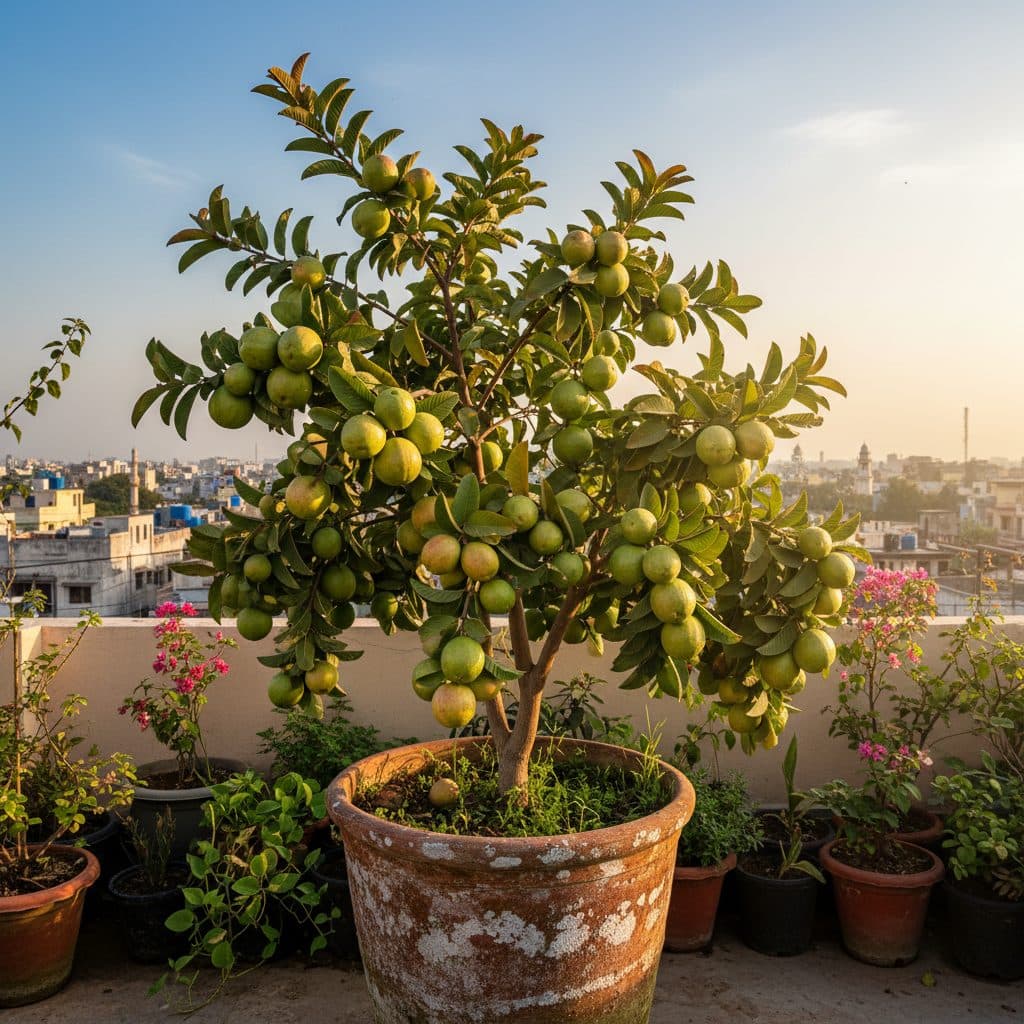
- Potted guava (Psidium guajava, or amrud) thrives on sunny Indian terraces in 45 to 60 litre containers.
- Grafted or air-layered saplings fruit within one to two years, whereas seed-grown trees take four to six years.
- Recommended container cultivars include Lucknow-49 (Sardar), Allahabad Safeda, Lalit, VNR Bihi, and Thai Pink.
- A free-draining potting mix of red garden soil, aged vermicompost, coco peat, and neem cake provides ideal root nutrition.
- Regular pinching and post-harvest pruning maintain a compact 1.5-metre bush canopy and stimulate fresh fruiting wood.
Quick answer: To grow a guava tree in a pot in India, choose a grafted sapling of a compact variety like Lucknow-49 or Allahabad Safeda and plant it into a 45 to 60 litre container with generous drainage holes. Use a fertile mix of red soil, compost, coco peat, and neem cake, provide at least six hours of direct sunlight, and prune branches after fruiting to trigger new flowering shoots.
Guava (known across India as amrud, peru, or koyya) is one of the most resilient, productive fruit trees for urban container gardens. Known for its vitamin C content, dietary fibre, and fragrance, guava adapts well to container culture on hot rooftop terraces. Learning how to grow a guava tree in a pot allows gardeners across Indian cities (from Delhi and Bengaluru to Mumbai and Hyderabad) to enjoy fresh fruit straight from the terrace.
Unlike delicate temperate fruit trees that struggle in intense tropical heat, potted guava trees withstand summer terrace temperatures exceeding 40°C once established. With proper container sizing, seasonal pruning, and consistent feeding, a single container guava tree will yield dozens of sweet, crisp fruit year after year.
Grafted vs seedling: choosing the best guava cultivars
When growing guava in a pot or terrace grow bag, selecting the correct planting material is essential.
+---------------------+-----------------------+---------------------------------------+
| Propagation Type    | Time to First Fruit   | Container Suitability                 |
+---------------------+-----------------------+---------------------------------------+
| Grafted / Layered   | 1 to 2 years          | Excellent (true-to-type, compact)     |
| Air-Layered (Gootie)| 1 to 2 years          | Excellent (fibrous shallow root system)|
| Seed-Grown          | 4 to 6 years          | Poor (variable fruit quality, leggy)  |
+---------------------+-----------------------+---------------------------------------+
Always buy a certified grafted or air-layered sapling from a reputable nursery. Seedling-grown guava trees take four to six years to flower, grow excessively tall, and often yield small, seed-heavy fruit.
Top Indian cultivars for terrace pots:
- Lucknow-49 (L-49 / Sardar): A reliable choice for container growing. L-49 is a medium-vigour, spreading tree that takes hard pruning well, which keeps it to a manageable size in a container instead of natural dwarfing. It has heavy fruiting capacity and large round fruit with creamy white, sweet pulp. Explore the cultivar profile for guava Lucknow-49.
- Allahabad Safeda: The classic Indian favourite known for round, smooth-skinned fruit with fragrant, melting white flesh and few seeds. See guava Allahabad Safeda.
- Lalit: A high-yielding variety with striking deep pink flesh, rich aroma, and high pectin content.
- Pant Prabhat: Known for high fruit set and sweet white pulp. Note that no common Indian cultivar is reliably resistant to guava wilt, which is why starting with clean nursery stock and fresh potting mix in a container is essential.
- VNR Bihi: An Indian selection carrying very large fruit, often 500 g or more, with crisp flesh and good shelf life.
- Thai Pink: A separate Thai variety with pink flesh and softer, sweeter pulp.
Pot selection and potting mix preparation
Guava trees have an extensive, fibrous root system that requires adequate root volume to sustain heavy fruit production.
Container specifications
- Start a young nursery sapling in a 30 to 35 cm (20-litre) pot.
- After 12 to 18 months, pot on into its permanent container: a heavy-duty UV-stabilised HDPE grow bag (45 x 45 cm or 60 x 60 cm), a 45 to 60 litre container or terracotta tub, or a recycled plastic drum.
- Ensure the container has at least four to six drainage holes at the base. Cover holes with terracotta pot shards or gravel to prevent soil clogging.
+---------------------+-----------------------+---------------------------------------+
| Potting Ingredient  | Ratio in Mix          | Horticultural Function                |
+---------------------+-----------------------+---------------------------------------+
| Good Red Soil / Loam| 40 percent            | Mineral body, structural stability    |
| Vermicompost / Gobar| 35 percent            | Organic matter, slow-release nitrogen |
| Coco Peat           | 25 percent            | Moisture retention, aeration          |
| Neem Cake (Khali)   | 100 to 200 g per pot  | Nematode suppression, slow nitrogen   |
| Bone Meal / Rock Phos| 2 tablespoons         | Phosphorus for deep root expansion    |
+---------------------+-----------------------+---------------------------------------+
Mix the neem cake in thoroughly a week or two before planting, and top-dress a similar amount twice a year instead of adding more at planting. Incorporate organic soil amendments to protect the root system; see our detailed breakdown on neem cake for plants.
Sun, water, and terrace heat management
Guava is a sun-worshipping tropical tree that demands full sun to produce sweet, dense fruit:
- Sunlight: Position the container where it receives at least six to eight hours of direct sunlight daily. In shaded balconies, plants become leggy and fail to produce flower buds.
- Summer heat (April to June): While guava tolerates 40°C+ summer heat on Indian concrete rooftops, container roots can overheat if black plastic pots are exposed to direct scorching sun. Wrap pots in burlap sacking, place pots on terracotta pot saucers, or group containers together to shade the root area.
- Watering strategy: Water deeply whenever the top 3 cm of soil feels dry. During hot summer months, potted guavas need daily watering, while in winter (rabi season), watering can be reduced to once every two to three days. Never allow the container to sit in stagnant waterlogging, which causes root rot.
For complementary terrace fruit management, explore how to grow strawberry in india.
Pruning and canopy training for container fruit
Pruning is essential for keeping a potted guava tree productive and manageable. Guava bears flowers and fruit exclusively on new, fresh vegetative shoots that emerge from mature branches.
+-----------------------------------------------------------------------------------+
|  [Canopy Shaping and Pruning Cycle]                                               |
|                                                                                   |
|  1. Central Leader Pinching: Pinch main shoot at 60 cm height to trigger 3-4 limbs|
|  2. Branch Head-Back: Shorten side scaffold branches by half after harvest        |
|  3. Fresh Lateral Growth: Fresh shoots emerge from dormant nodes within 3 weeks   |
|  4. Flower Bud Formation: Flower clusters form at the leaf axils of new shoots    |
+-----------------------------------------------------------------------------------+- Formative training: When the young tree reaches 60 cm in height, pinch out the growing tip. This encourages three to four lateral scaffold branches to develop, creating a balanced vase-shaped bush instead of a tall, spindly tree.
- Pinching growing tips: During active growth, pinch the green tips of non-flowering shoots once they have produced six to eight pairs of leaves. This stimulates new flower buds in the leaf axils.
- Annual post-harvest pruning: Immediately after harvesting a crop, cut back the fruited branches by approximately one-third to one-half. Remove dead, dry twigs, crossing branches, and root suckers emerging from below the graft union.
Managing flowering seasons in India (Bahar treatment)
In India, guava produces three distinct flowering flushes annually:
- Ambe Bahar: Flowers in February–March (spring), fruits in July–August (monsoon). Monsoon fruit is often watery and susceptible to fruit fly infestation.
- Mrig Bahar: Flowers in June–July (monsoon), fruits in November–January (winter). This is the highest quality harvest, producing sweet, crisp, worm-free fruit.
- Hasta Bahar: Flowers in October (autumn), fruits in March–April (spring).
To obtain the winter crop (Mrig Bahar), terrace gardeners practice light water regulation: withhold heavy watering for two weeks in May to induce leaf shedding and root rest. Resume watering in June with a generous dose of compost and neem cake, triggering a heavy flush of monsoon flowers that ripen into sweet winter guavas.
Organic pest management and fruit bagging
- Fruit fly (Bactrocera correcta): The most serious pest during warm, humid months. Female fruit flies lay eggs beneath the skin of developing fruit, causing maggot-infested, rotten fruit. The best organic solution is fruit bagging: when fruit reaches marble size, slip a small breathable foam netting, paper bag, or cotton cloth pouch over each fruit and tie it securely to the stem.
- Mealybugs and scale: Inspect the undersides of leaves and new shoots. Spray organic neem oil emulsion or drench with soapy water to dislodge clusters; see neem oil for plants.
- Nutrient feeding: Every month during active growth, top-dress the container with two handfuls of aged vermicompost or compost made through kitchen waste composting.