Key takeaways
- Apply an initial 10 cm to 15 cm compost layer when establishing new no-dig beds over cardboard, followed by an annual 2.5 cm to 5 cm maintenance top-dressing.
- Calculate bulk compost requirements in cubic metres: bed length (m) multiplied by width (m) multiplied by desired depth (m).
- Source bulk municipal green waste compost (PAS 100 certified), well-rotted farmyard manure, or spent mushroom compost for large-scale bed creation.
- Conduct a simple bioassay test using broad bean or tomato seedlings before using unfamiliar manure to check for persistent aminopyralid weedkillers.
- Apply annual compost mulches in autumn (October to November) to allow earthworms and winter rainfall to integrate nutrients into the root zone naturally.
Quick answer: Compost for no dig gardening is both the growing medium and the surface weed-suppressing mulch. When establishing new no-dig beds in the UK, apply a 10 cm to 15 cm layer of compost directly over saturated cardboard. For established beds, apply an annual top-dressing of 2.5 cm to 5 cm each autumn. Because no-dig avoids turning the soil, compost feeds soil biology from the surface downward, buries the existing weed-seed bank so far fewer seeds germinate, and creates an immediately plantable seedbed.
The foundation of successful no-dig gardening is surface mulching with rich, well-aerated organic compost. Rather than digging organic matter deep into subsoil horizons with a spade, which expends immense physical labor and disrupts mycorrhizal fungal networks, no-dig relies on earthworms, beetles, and soil microbes to incorporate surface carbon naturally.
For many UK gardeners, the primary practical challenge is sourcing sufficient compost volume economically and ensuring the material is free from persistent agricultural herbicides, plastic contamination, and weed seeds.
When you calculate volumes accurately, source quality compost, test for herbicide residues, and mulch at the right time, your no-dig beds stay fertile and far easier to maintain.
Calculating compost volume for no dig beds
Estimating your compost needs accurately prevents costly under-ordering or dealing with unwanted surplus piles.
+-------------------------------------------------------------------+
|               COMPOST VOLUME CALCULATION FORMULA                  |
+-------------------------------------------------------------------+
| Volume (Cubic Metres) = Length (m) x Width (m) x Depth (m)        |
|                                                                   |
| Example 1: New Bed Setup (15 cm Depth)                            |
| 3.0 m Length x 1.2 m Width x 0.15 m Depth = 0.54 cubic metres     |
| (Roughly 540 litres / approx. 11 standard 50L bags)               |
|                                                                   |
| Example 2: Annual Maintenance Mulch (3 cm Depth)                  |
| 3.0 m Length x 1.2 m Width x 0.03 m Depth = 0.11 cubic metres     |
| (Roughly 110 litres / approx. 2 standard 50L bags)                |
+-------------------------------------------------------------------+
+------------------------+-------------------+-------------------+-------------------------------+
| Bed Scenario | Target Depth | Volume per 10m² | Purpose |
+------------------------+-------------------+-------------------+-------------------------------+
| New Bed over Grass | 10 cm to 15 cm | 1.0 to 1.5 m³ | Smothers weeds, instant tilth |
| New Framed Raised Bed | 15 cm to 25 cm | 1.5 to 2.5 m³ | Full root depth above subsoil |
| Established Bed (Yr 2+)| 2.5 cm to 5.0 cm | 0.25 to 0.5 m³ | Annual biological recharge |
| Path Mulch Layer | 5 cm to 7 cm | 0.5 to 0.7 m³ | Woodchips/bark over cardboard |
+------------------------+-------------------+-------------------+-------------------------------+When building framed borders, integrate depth calculations with structural guidance from no-dig raised beds.
Sourcing quality compost in the UK: comparing options
Different compost types offer distinct nutrient profiles, textures, and price points.
+------------------------+-------------------+-------------------+-------------------------------+
| Compost Type           | Nutrient Density  | Weed Seed Risk    | Best Application              |
+------------------------+-------------------+-------------------+-------------------------------+
| Homemade Garden Compost| Variable (inputs) | Low (if hot)      | Prime vegetable seedbeds      |
| Municipal Green Waste  | Moderate (PAS 100)| Very Low (hot com)| Bulk bed filling, surface mul |
| Well-Rotted Manure     | Mod, slow-release | Moderate to High  | Heavy feeders (squash, brass) |
| Spent Mushroom Compost | Moderate (Alkaline| Low               | Clay soil loosening, brassicas|
| Peat-Free Bagged Potting| High (consistent) | Zero              | Delicate direct seed sowing   |
+------------------------+-------------------+-------------------+-------------------------------+
1. Municipal green waste compost (PAS 100 certified)
Council-collected green waste processed at commercial facilities reaches high thermophilic temperatures (above 65°C), killing weed seeds and plant pathogens. Always ensure the compost is certified to the British PAS 100 standard, which guarantees limits on heavy metals, physical plastics, and weed seeds. However, PAS 100 is not a guarantee against aminopyralid or clopyralid residues.
2. Well-rotted farmyard manure
Farm manure from horse stables or cattle yards provides rich organic fertility. However, it must be thoroughly aged for at least six to twelve months until it is dark, crumbly, and smells like forest soil. Fresh manure is too hot (high in ammonia) and will burn delicate seedling roots.
3. Spent mushroom compost
A blend of straw, peat, and aged manure used in commercial mushroom production. It is rich in organic matter and lime, giving it a slightly alkaline pH (7.0 to 7.8), which is ideal for brassicas and neutralizing acidic soils. Weather fresh spent mushroom compost outdoors for a few months before using it near seedlings, since it can be salty when fresh, and keep it away from blueberries and other acid-lovers.
Herbicide contamination: the bioassay test
One of the greatest hazards facing UK gardeners is manure or compost contaminated with persistent pyralid herbicides (aminopyralid and clopyralid). Used by farmers to control docks and thistles in livestock pastures, these synthetic chemicals pass through cattle and horse digestive systems undamaged and can persist in manure for years, causing severe cupping, twisting, and stunting in sensitive plants like tomatoes, beans, and potatoes.
+-------------------------------------------------------------------+
|               SIMPLE BEAN SEEDLING BIOASSAY TEST                  |
+-------------------------------------------------------------------+
| Step 1: Fill two small pots with clean, known-safe potting soil   |
|         (Control Pots).                                           |
| Step 2: Fill two identical pots with a 50/50 mix of the test     |
|         manure/compost and clean potting soil (Test Pots).        |
| Step 3: Plant two broad bean or tomato seeds in each pot.         |
| Step 4: Water and place on a warm, sunny windowsill.              |
| Step 5: Observe the first true leaves at 14 to 21 days:           |
|         - Normal, flat green leaves indicate safe compost.        |
|         - Cupped, curled, fern-like stunted leaves indicate       |
|           herbicide residue.                                      |
+-------------------------------------------------------------------+
Bioassay any bulk material you did not make yourself, including green-waste compost and bagged multipurpose, not just manure. PAS 100 sets limits on heavy metals, physical contaminants and weed propagules, but it is not a guarantee against aminopyralid or clopyralid residues, so test a sample from every new load.
Application timing and mulching techniques
Proper application ensures maximum biological benefit from your compost mulch.
The autumn mulch (October to November)
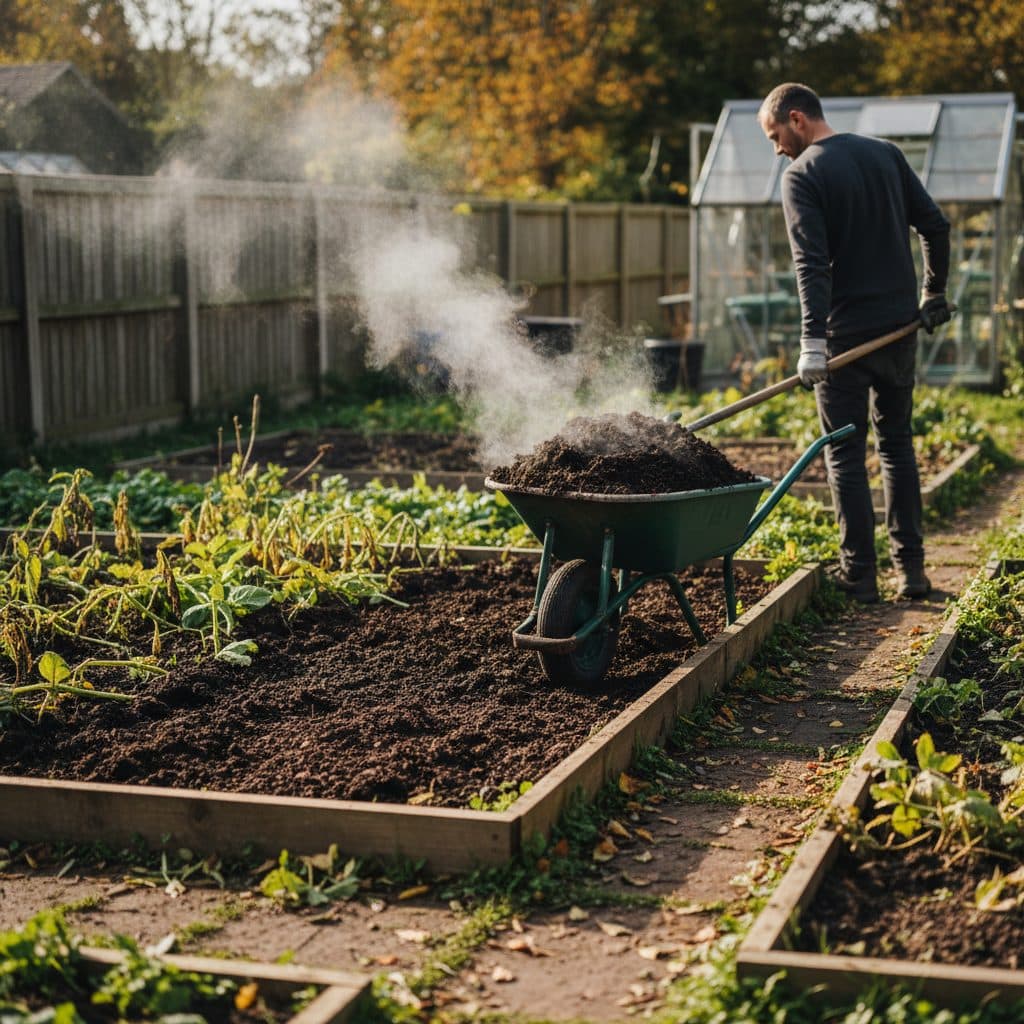
Autumn is the optimal time to apply maintenance compost mulches across UK plots. Applying 2.5 cm to 5 cm of compost after clearing spent summer crops protects bare soil from winter rain erosion, prevents nutrient leaching, and allows earthworms to draw organic matter down during mild winter spells. Come March, the compost surface has weathered into a fine, crumbly tilth ready for immediate seed sowing as part of your allotment first year plan.
Spring mulching (March to April)
If you miss the autumn window, apply compost in early spring before planting. Rake the compost surface completely flat, lightly tamping down any large air voids with the back of a rake. Seeds can be sown directly into the fine surface compost layer immediately.
For beds requiring biological fertility enhancement, integrate homemade vermicompost following methods in vermicompost vs regular compost worms win and review cover crop alternatives in winter green manure.
Source, test, and apply compost properly, and you build healthy soil that produces good harvests with less weeding.