Key takeaways
- Local ordinances often require permits for earthworks moving over 50 cubic yards of soil.
- Swales should maintain a minimum distance of 10 feet from building foundations to prevent water intrusion.
- A 1-2% grade for swale bottoms ensures proper water flow without erosion.
- Consulting local planning departments early can save significant time and resources.
- Regular inspection and maintenance prevent sediment buildup and maintain swale effectiveness for decades.
Quick answer: Proper swale design involves maintaining a 10-foot minimum distance from foundations and a 1-2% grade for water flow, often requiring permits for earthworks over 50 cubic yards. These practices ensure effective water management and prevent structural damage.
In regions like the Pacific Northwest, where annual rainfall can exceed 40 inches, or in the arid Southwest, where every drop counts, managing stormwater effectively matters for growers. Backyard swales offer a practical solution, directing runoff from impervious surfaces like roofs and driveways into the landscape, where it can slowly infiltrate the soil. This passive irrigation technique can significantly reduce water bills and support plant health, but it’s not always as simple as digging a ditch.
Before you break ground on a new swale project in your USDA zone 7 garden, understanding local permitting requirements and safe design principles is essential. Failing to secure the necessary permits or improperly constructing a swale can lead to costly fines, property damage, and even undermine your home’s foundation, turning a beneficial project into a significant liability. We’ll explore how to navigate these regulations and build effective, safe swales.
The role of swales in managing water and soil
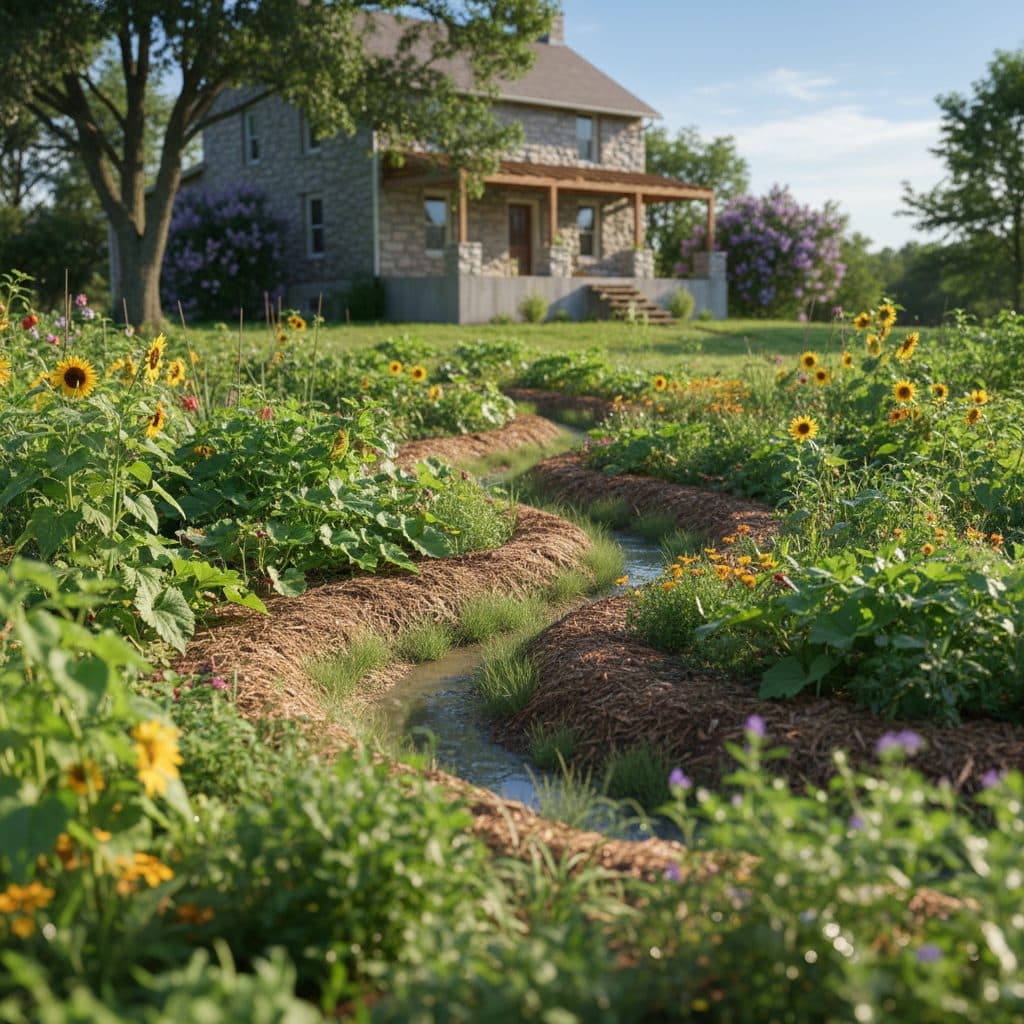
Swales are shallow,a 50-foot long swale, 2 feet deep and 4 feet wide, can hold 400 cubic feet of water
Benefits for water harvesting and plant health
Beyond simple drainage, swales are fundamental to passive irrigation systems, feeding water to adjacent planting areas. They can be integrated with other water-saving techniques like rainwater harvesting from rooftops, directing overflow into the swale. This setup can reduce a property’s potable water usage for irrigation by up to 35% during drier months. The sustained moisture in the swale’s infiltration zone creates a microclimate beneficial for a variety of plants, from fruit trees to water-loving herbs. The USDA Natural Resources Conservation Service (NRCS) reports that proper swale design can reduce stormwater runoff by up to 35% in residential areas [6].
- Reduces stormwater runoff by up to 35%.
- Increases soil moisture content, benefiting plant growth.
- Recharges local groundwater supplies.
- Filters pollutants from surface water before infiltration.
- Minimizes erosion on sloped properties.
Navigating local permitting requirements
Before any significant earthmoving project, including the construction of a substantial backyard swale, it is important to consult your local planning or building department. Many jurisdictions, from bustling cities in California to rural counties in Georgia, require a grading permit for earthmoving projects exceeding a certain volume, often 50 cubic yards of material [1]. This threshold is equivalent to roughly five standard dump truck loads, a volume easily reached when excavating a large swale system. Ignoring these regulations can lead to stop-work orders, fines ranging from $500 to several thousand dollars, and the potential requirement to restore the site to its original condition.
When a grading permit is necessary
The need for a permit often hinges on the scale of the project, the proximity to property lines or structures, and the potential impact on stormwater runoff patterns. For example, a minor 10-foot rain garden swale might not require a permit, but a 100-foot contour swale on a sloped property in Oregon likely will. The permitting process can take from 30 days to 6 months, depending on project complexity and local regulations [2]. Some areas also have specific requirements for projects near wetlands, floodplains, or critical habitats. Understanding these nuances early can save significant time and resources, preventing costly delays. Even if a full grading permit isn’t required, a simple drainage plan might need to be filed.
- Moving more than 50 cubic yards of soil.
- Altering natural drainage patterns significantly.
- Working within a specified distance of property lines or public infrastructure.
- Projects on steep slopes or in sensitive environmental areas.
- Construction near existing building foundations.
Safe swale design and foundation protection
The primary concern with any earthwork near a structure is protecting its foundation. Water is a powerful force, and if a swale is improperly designed or located, it can direct water towards, rather than away from, a building, leading to hydrostatic pressure, soil expansion, or erosion beneath the foundation. A minimum setback of 10 feet from building foundations is widely recommended for swales to prevent structural damage [6]. For homes with basements in areas like the Midwest, this distance might need to be even greater, perhaps 15 feet, especially in clay-rich soils that expand and contract significantly with moisture changes.
Maintaining proper distance and grade
Beyond setback, the grade of the swale is critical. A swale designed with a 1-2% grade ensures effective water movement without causing erosion or allowing water to pool indefinitely, which could lead to mosquito breeding or waterlogging of plants [6]. The bottom of the swale should be level across its width to encourage even infiltration. For example, a 20-foot wide swale should have a consistent grade across its entire width. Soil type also plays a significant role; sandy soils in Florida drain much faster than heavy clay soils in Texas, influencing the required depth and width of the swale to achieve optimal infiltration rates. Consider integrating passive irrigation methods like ollas within the swale for targeted water delivery to plants.
- Maintain a minimum 10-foot setback from foundations.
- Design swale bottoms with a 1-2% grade for flow.
- Ensure swale sides have gentle slopes, typically 3:1 (horizontal:vertical).
- Incorporate an overflow mechanism for extreme rain events.
- Select plants that tolerate both wet and dry conditions.
Construction, maintenance, and long-term success
Once permits are secured and the design finalized, construction can begin. Mark out the swale’s contours accurately using stakes and string to ensure the correct grade and dimensions. Excavation should be done carefully, removing rocks and debris, and compacting the sides and bottom slightly to prevent excessive erosion. For a typical backyard swale, a depth of 18-24 inches and a bottom width of 2-4 feet is common, with gently sloping sides at a 3:1 ratio (horizontal to vertical) for stability and ease of access. Consider planting native, deep-rooted vegetation along the swale to stabilize the soil and improve water infiltration.
Ongoing care for optimal performance
A swale is a living system that requires ongoing care to remain effective. Regular maintenance, including sediment removal, should occur every 6-12 months to maintain swale function [6]. After heavy rain events, inspect the swale for any signs of erosion, blockages, or areas where water is not infiltrating properly. Remove any accumulated leaves, trash, or excessive sediment that could impede water flow. Replant any areas where vegetation has died or been washed away. Using a flexible hose with a 7-pattern spray nozzle can help with targeted watering during establishment periods for new plantings. Over time, a well-maintained swale can become a resilient and productive feature of your landscape, providing benefits for decades.
- Mark contours precisely with stakes and string.
- Excavate carefully, maintaining specified depth and width.
- Plant appropriate native vegetation to stabilize soil.
- Inspect for erosion and blockages after heavy rains.
- Remove accumulated sediment and debris every 6-12 months.
Permit Likelihood for Different Swale Types
Swale Type | Primary Purpose | Typical Permit Requirement |
|---|---|---|
Small Rain Garden Swale | Local runoff management, aesthetics | Often no permit (under 50 cubic yards) |
Contour Swale (Terraced) | Water retention on slopes, erosion control | Permit likely (over 50 cubic yards, grading) |
Roadside Drainage Swale | Directing road runoff, infiltration | Permit almost always (public land, significant earthwork) |
Permit Threshold: Many jurisdictions require a grading permit for earthmoving projects exceeding 50 cubic yards of material [1].
Foundation Safety: A minimum setback of 10 feet from building foundations is recommended for swales to prevent structural damage [6].
Optimal Grade: Swales designed with a 1-2% grade ensure effective water movement without causing erosion [6].
Frequently asked questions
What is the typical cost of a grading permit for a backyard swale?
The cost of a grading permit varies widely by jurisdiction, from $50 to over $500, depending on the project’s scale and local fees. Some complex projects might also require additional engineering review fees, adding several hundred dollars to the total.
How far should a swale be from a septic system?
A swale should typically be at least 25 feet away from a septic drain field or tank to prevent waterlogging and potential contamination. Local health department regulations often specify minimum setback distances, sometimes up to 50 feet, which must be followed.
Can I build a swale on a steep slope?
Building swales on steep slopes, generally those exceeding 15% grade, is more complex and often requires professional engineering to ensure stability and prevent erosion. Terraced swale systems are often used, with individual swales spaced at specific intervals, typically 10-20 feet apart, to manage runoff effectively.
What plants are best for stabilizing a swale?
Native, deep-rooted plants that tolerate both wet and dry conditions are ideal for swales. Examples include switchgrass, sedges, and various native shrubs. In a USDA zone 5 climate, species like ‘Prairie Dropseed’ (Sporobolus heterolepis) or ‘Red Osier Dogwood’ (Cornus sericea) can provide excellent soil stabilization and habitat.
How long does it take for a newly built swale to become effective?
A newly built swale can begin collecting and infiltrating water immediately, but its full ecological benefits, such as strong plant growth and soil stabilization, typically take 1-2 years to establish. Regular watering during the first 6 months matters for plant establishment.
References
- Regulatory Requirements for Permitting (2018). Regulatory Requirements for Permitting.
- Permitting Strategy (2018). Permitting Strategy.
- Permitting, the Public and the Future of Animal Biosafety Facilities (1998). Permitting, the Public and the Future of Animal Biosafety Facilities.
- Permitting System Digitalization in the United States (2026). Permitting System Digitalization in the United States.
- Area- and site-specific geothermal leasing/permitting profiles; updated geothermal leasing/permitting performance assessment (1982). Area- and site-specific geothermal leasing/permitting profiles; updated geothermal leasing/permitting performance assessment.
- USDA Natural Resources Conservation Service (2024). USDA Natural Resources Conservation Service.