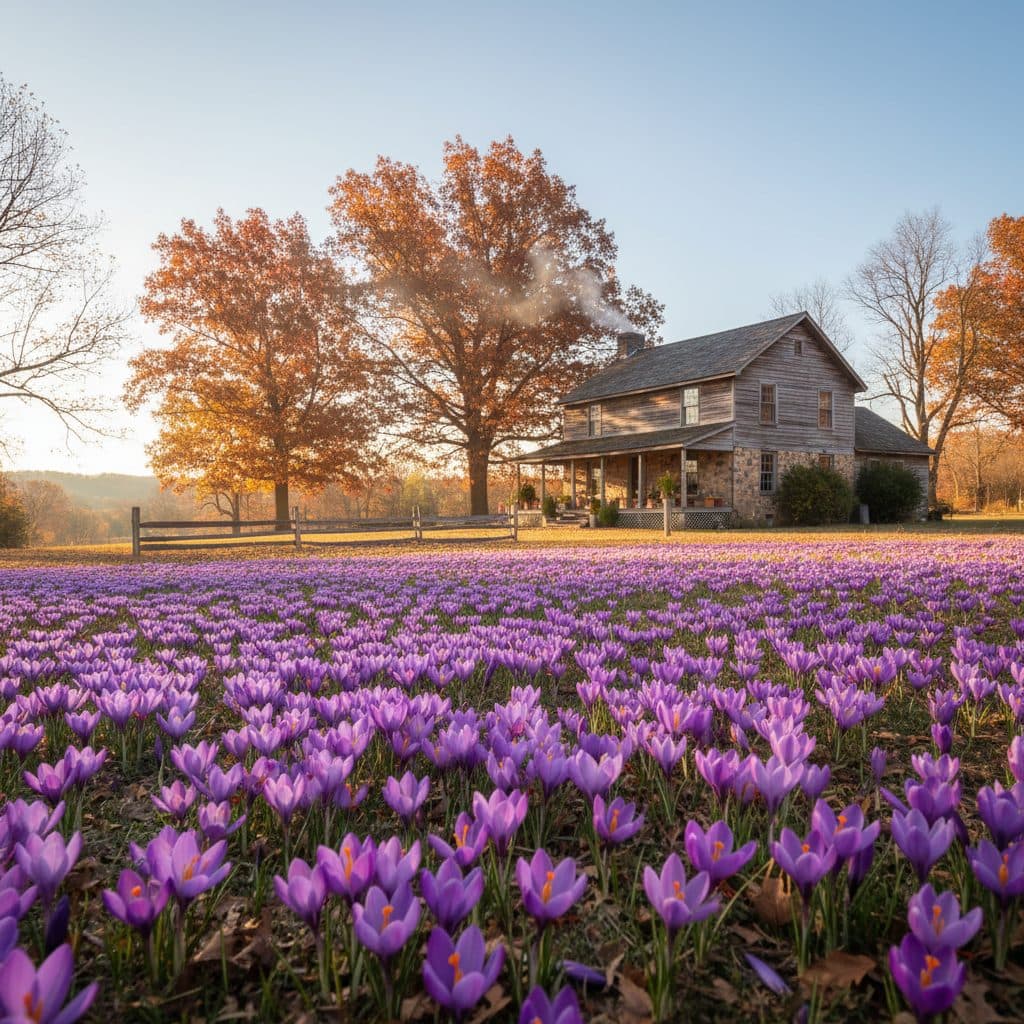
Key takeaways
- Saffron requires well-drained soil and full sun, thriving in USDA zones 6-9.
- Plant corms 4-6 inches deep and 4-6 inches apart in late summer for fall harvest.
- Harvest stigmas carefully in the morning, drying them quickly for best quality.
- A single crocus corm can produce 1-5 flowers, each yielding three red stigmas.
- Proper corm storage over summer dormancy is necessary for perennial production.
- Saffron can yield 0.5-1.0 pounds per acre, valued at $5,000-$10,000 per pound.
Quick answer: To grow saffron, plant Crocus sativus corms 4-6 inches deep and apart in well-drained, full-sun soil in late summer. Harvest the red stigmas carefully in the morning after fall flowering.
In states like Pennsylvania, Virginia, and California, growers are discovering the potential of saffron, a spice derived from the stigmas of Crocus sativus L. This ancient crop, known for its distinct flavor and red color, retails for thousands of dollars per pound, making it a high-value agricultural product (though growers selling wholesale or in bulk receive considerably less). While traditionally grown in Mediterranean climates, saffron can thrive in many US regions, particularly within USDA zones 6 through 9, offering a promising avenue for specialty crop diversification.
Cultivating saffron from corms (the bulb-like underground stems) is a practical approach for US growers looking to add a high-value crop to their farm or garden, covering corm selection, soil preparation, harvesting, and drying.
Why consider saffron for your US farm or garden?
Saffron stands out as a high-value crop that needs very little ground. At the yields quoted below (0.5 to 1.0 pounds per acre), a half-acre plot produces roughly 113 to 227 grams of dried saffron: a tiny harvest by weight, but a valuable one.
Market demand and climate suitability
The demand for saffron in the US market remains strong, fueled by culinary, medicinal, and cosmetic industries. Many US regions, particularly those in USDA zones 6, 7, 8, and 9, possess the necessary climate conditions for successful saffron cultivation, characterized by hot, dry summers and cold winters. States like New York, Virginia, and even parts of the Pacific Northwest have seen successful trials and commercial operations.
- High market value, often exceeding $5,000 per pound.
- Suitable for cultivation in USDA zones 6-9 across the US.
- Low input costs once corms are established, primarily labor for harvest.
- Perennial crop, though beds are normally lifted and the corms divided every few years as they multiply and crowd.
- Diversifies farm income and reduces reliance on single commodity crops.
Selecting and preparing your saffron growing site
Location is important for successful saffron cultivation. Saffron crocus (Crocus sativus L.) thrives in full sun, requiring at least 6-8 hours of direct sunlight daily to produce abundant flowers. A south-facing slope or an open field with no overhead tree canopy is ideal. The soil type is equally critical; saffron demands well-drained, loose soil, as corms are highly susceptible to rot in waterlogged conditions. A sandy loam or loamy soil with a pH between 6.0 and 7.0 provides good drainage for corm development.
Soil testing and amendment
Before planting, conduct a soil test to determine its composition, pH, and nutrient levels. This helps identify any deficiencies or excesses before planting. If your soil is heavy clay, amend it with 4-6 inches of organic matter (such as compost or well-rotted manure) and coarse sand to improve drainage and aeration. For example, adding 3-4 cubic yards of compost per 1,000 square feet can significantly improve soil structure. Ensure the planting bed is raised by 6-12 inches in areas prone to excessive moisture, further enhancing drainage. You can find more general advice on starting a herb garden, which often shares similar soil preparation principles, at agripure.org/articles/starting-a-herb-garden.
- Full sun exposure, minimum 6 hours daily.
- Well-drained, loose soil, ideally sandy loam.
- Soil pH between 6.0 and 7.0.
- Amend heavy soils with 4-6 inches of organic matter and sand.
- Consider raised beds in areas with poor drainage.
Planting saffron corms for optimal growth
The timing of planting saffron corms determines the fall bloom. Corms should be planted in late summer, typically from mid-July to early September, depending on your specific USDA zone. This timing allows the corms to establish roots before the cooler fall temperatures trigger flowering. When selecting corms, choose firm, healthy specimens that are 1-2 inches in diameter, and buy them labeled Crocus sativus from a named supplier. The superficially similar autumn crocus or meadow saffron (Colchicum autumnale), sold through many of the same bulb catalogs, is not saffron — it contains colchicine and every part of it is poisonous. Smaller corms, less than 1 inch, may not flower in their first year. Macropropagation techniques can be used to rapidly multiply saffron corms, ensuring a steady supply of planting material [1].
Planting depth and spacing
Plant saffron corms 4-6 inches deep and 4-6 inches apart, with the pointed side facing upwards. Deeper planting, up to 8 inches, can offer better protection against winter cold in colder USDA zones like 6a or 6b, but may delay emergence slightly. For larger plantings, consider creating furrows 4-6 inches deep and placing corms at the recommended spacing. Cover the corms with soil and gently tamp down to remove air pockets. After planting, water the area thoroughly to settle the soil around the corms. A single mother corm can produce 5-10 daughter corms over 2-3 years, increasing your planting stock by 100-200% annually. You can learn about maximizing yields in small spaces with square-foot gardening techniques, which can be adapted for saffron.
- Plant corms in late summer (mid-July to early September).
- Select healthy corms 1-2 inches in diameter.
- Plant 4-6 inches deep, pointed side up.
- Space corms 4-6 inches apart for optimal growth.
- Water thoroughly immediately after planting.
Care and maintenance throughout the saffron growing season
Once planted, saffron corms require relatively low maintenance, but consistent moisture supports good flowering. During the active growing season in fall, when flowers and leaves emerge, provide about 1 inch of water per week if rainfall is insufficient. Reduce watering significantly after flowering, and cease completely during the summer dormancy period to prevent corm rot. Saffron corms and flowers contain various nutrients and can accumulate heavy metals, so monitoring soil health is important for product quality [2].
Weed, pest, and disease management
Weed control is important, especially during the fall growing season, as weeds compete for nutrients and moisture. Hand-weeding is often preferred to avoid disturbing the shallow-rooted corms. Pests are generally not a major issue for saffron, but rodents like voles and squirrels may occasionally dig up corms. Consider using wire mesh or planting in raised beds to deter them. Diseases, particularly fungal and bacterial rots, can be problematic in poorly drained soils. Bacterial dry rot, caused by Burkholderia gladioli, has been identified as a significant threat to saffron corms in some regions [4]. Ensuring good air circulation and proper drainage is the best preventative measure. In colder USDA zones, a light layer of straw mulch, 1-2 inches thick, can protect corms from extreme winter temperatures below 10°F, but remove it in spring to prevent moisture buildup.
- Provide 1 inch of water weekly during active fall growth.
- Cease watering during summer dormancy.
- Hand-weed regularly to reduce competition.
- Monitor for rodent activity and implement deterrents.
- Ensure excellent drainage to prevent fungal and bacterial diseases.
Harvesting and processing saffron for quality and value
The saffron harvest is a delicate and labor-intensive process, typically occurring in late October through November, depending on your location and planting time. Flowers usually appear 6-8 weeks after planting. Each saffron crocus corm can produce 1-5 flowers over its first year, and more in subsequent years, with each flower containing three red stigmas. These stigmas are the prized spice. Harvest should be done in the early morning, just after the dew has dried but before the sun becomes too intense, as this preserves the stigmas’ color and aroma. Gently pluck the entire flower or carefully extract the three red stigmas using tweezers.
Drying and storage
After harvesting, the stigmas must be dried immediately to prevent spoilage and preserve their quality. Spread the fresh stigmas in a single layer on a fine mesh screen or paper towel in a warm, well-ventilated room, away from direct sunlight. Alternatively, a food dehydrator set to a low temperature (around 100-120°F) can be used for 20-30 minutes until the stigmas are brittle but not burnt. The goal is to reduce moisture content by 80-90%. Properly dried saffron will be dark red, slightly brittle, and highly aromatic. Store the dried saffron in an airtight container in a cool, dark place for up to 2 years.
- Harvest flowers in late October to November, once falling temperatures trigger bloom.
- Pick flowers or stigmas in the early morning.
- Each flower contains three red stigmas.
- Dry stigmas immediately on a mesh screen or in a dehydrator at 100-120°F.
- Store dried saffron in an airtight container in a cool, dark place.
Saffron vs. Common US Spice Crops
Crop | Typical US Value (per lb) | Primary Harvest Method |
|---|---|---|
Saffron | $5,000 – $10,000 | Hand-plucked stigmas |
Paprika (dried) | $5 – $15 | Machine/hand harvest, then drying |
Garlic Powder | $3 – $8 | Machine harvest, then processing |
Dried Oregano | $10 – $30 | Hand/machine harvest, then drying |
Corm multiplication: A single mother corm can produce 5-10 daughter corms over 2-3 years, potentially increasing planting stock by 100-200% annually.
Saffron yield: It takes approximately 75,000-100,000 flowers to produce one pound of dried saffron, reflecting the labor needed for harvest.
Frequently asked questions
What USDA zones are suitable for growing saffron?
Saffron (Crocus sativus L.) generally thrives in USDA Plant Hardiness Zones 6 through 9. These zones provide the necessary hot, dry summers for corm dormancy and cold winters for flower initiation, with temperatures typically not dropping below -10°F for extended periods.
How much saffron can one corm produce?
A single saffron corm can produce 1-5 flowers in its first year, with each flower yielding three red stigmas. Over 2-3 years, a mother corm will multiply, producing several daughter corms, significantly increasing overall flower and stigma production.
When is the best time to plant saffron corms?
The best time to plant saffron corms in the US is in late summer, typically from mid-July to early September. This timing allows the corms to establish a strong root system before the fall flowering season begins, usually 6-8 weeks after planting.
How long does it take to harvest saffron after planting?
Saffron flowers usually appear 6-8 weeks after planting the corms in late summer. The harvest window is typically short, lasting 2-3 weeks in late October or November, requiring daily collection of fresh blooms.
What are common pests or diseases for saffron?
Saffron is relatively pest-resistant, but rodents like voles can sometimes damage corms. The primary disease concern is corm rot, often caused by fungal or bacterial pathogens like Burkholderia gladioli [4], especially in poorly drained or waterlogged soils. Good drainage prevents rot.
Can saffron be grown in containers?
Yes, saffron can be successfully grown in containers, provided they are at least 8-10 inches deep and have excellent drainage holes. Plant corms 4-6 inches deep and 4 inches apart in a well-draining potting mix. Move containers to a protected, dry area during summer dormancy to prevent overwatering.
References
- Ex Vitro Macropropagation of Saffron (Crocus sativus L.) Corms (2020). Ex Vitro Macropropagation of Saffron (Crocus sativus L.) Corms.
- Nutrients and Heavy Metals in Flowers and Corms of the Saffron Crocus (Crocus sativus L.) (2016). Nutrients and Heavy Metals in Flowers and Corms of the Saffron Crocus (Crocus sativus L.).
- Catalytic Properties of Three L-Lactate Dehydrogenases From Saffron Corms (Crocus Sativus L.) (2002). Catalytic Properties of Three L-Lactate Dehydrogenases From Saffron Corms (Crocus Sativus L.).
- Prevalence and characterization of Burkholderia gladioli in Iran, from bacterial dry rot of saffron corms (Crocus sativus L.) (2024). Prevalence and characterization of Burkholderia gladioli in Iran, from bacterial dry rot of saffron corms (Crocus sativus L.).