Key takeaways
- Comfrey (Symphytum officinale / S. x uplandicum) is a long-lived, deep-rooted clumping perennial, while borage (Borago officinalis) is a fast-growing annual herb.
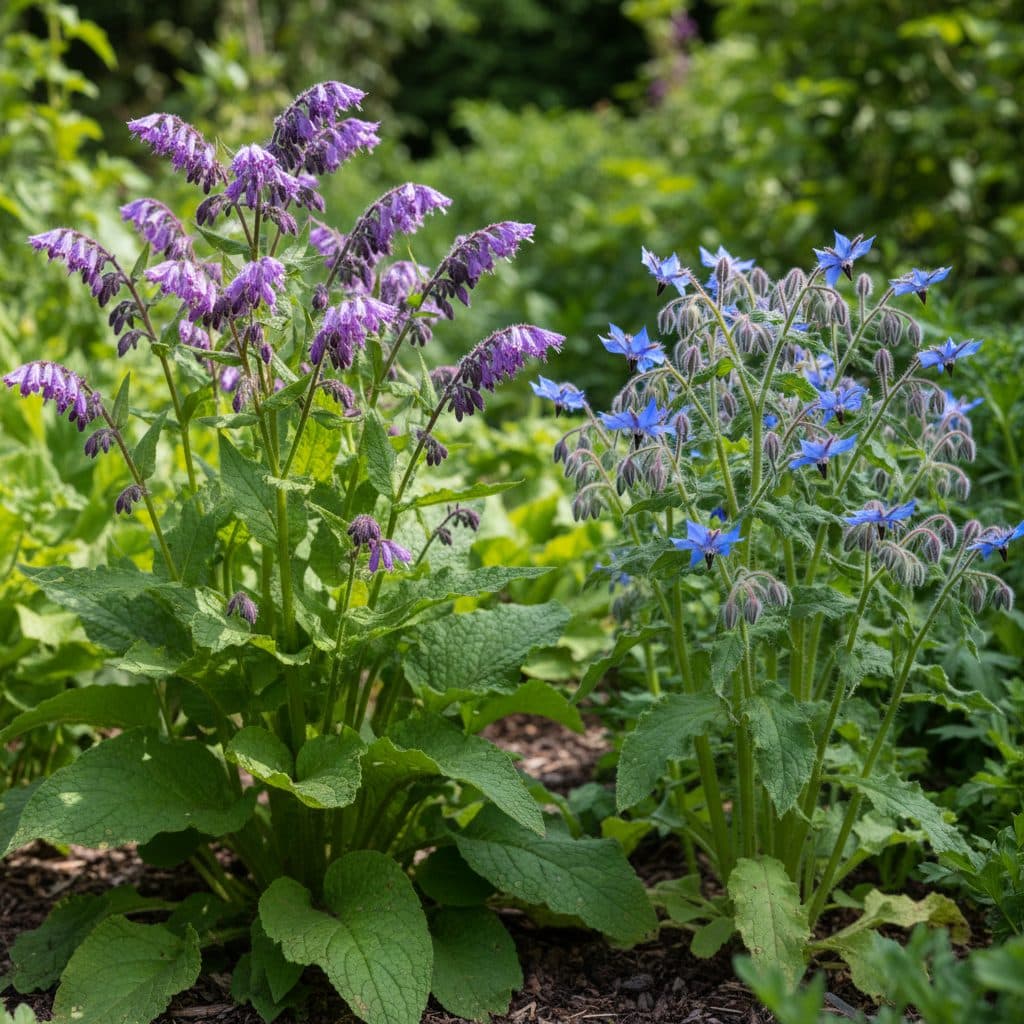
- Both plants belong to the Boraginaceae family and share bristly, hairy foliage, but exhibit distinct flower shapes: comfrey has tubular bell-shaped blooms, while borage displays five-pointed, star-shaped sky-blue blossoms.
- Comfrey is a heavy biomass producer and dynamic mineral accumulator, drawing subsoil potassium, calcium, and magnesium up through deep taproots for chop-and-drop mulch and liquid fertilizers.
- Borage excels as an annual pollinator magnet, continuously refilling nectar every few minutes to attract honeybees and bumblebees to vegetable patches.
- Borage flowers and young leaves are traditionally eaten, but borage also carries low levels of pyrrolizidine alkaloids; treat it as an occasional garnish instead of a bulk salad green, and avoid it in pregnancy, while breastfeeding, and for anyone with liver disease. Comfrey carries far higher levels and should not be eaten at all.
- Plant sterile Russian comfrey ('Bocking 14') from root cuttings to prevent rampant seed spread, while allowing annual borage to self-seed naturally in garden borders.
Quick answer: In the comparison of comfrey vs borage, comfrey is a perennial, deep-rooted dynamic accumulator grown for cut-and-drop nutrient mulch and liquid bio-fertilizer, whereas borage is an annual companion herb with star-shaped edible blue flowers that attracts pollinators and deters pests around tomatoes and brassicas.
Comfrey and borage are widely planted in organic gardening and permaculture systems. Because both belong to the borage family (Boraginaceae) and share coarse, hairy green leaves with nodding blue-purple blossoms, gardeners frequently confuse the two or wonder which species best fits their garden plans.
Evaluating comfrey vs borage comes down to understanding their distinct life cycles, root architectures, and primary ecological functions. While one plant provides perennial biomass for building soil fertility, the other produces rapid annual pollinator forage and edible culinary blossoms.
Whether you are designing multi-layered food forest understories or planting companion borders in vegetable beds, this guide outlines botanical distinctions, nutrient accumulation profiles, and cultivation best practices.
+---------------------------------------------------------------------+
|                  COMFREY VS BORAGE: AT A GLANCE                     |
|                                                                     |
|   CHARACTERISTIC    RUSSIAN COMFREY       ANNUAL BORAGE             |
|   --------------    ---------------       -------------             |
|   Botanical Name    *Symphytum x upland.* *Borago officin.*         |
|   Life Cycle        Perennial (20+ yrs)   Annual (Self-seed)        |
|   Root Depth        2 to 3 m (6 to 10 ft) Taproot to roughly        |
|                                           30-60 cm with fibrous     |
|                                           laterals                  |
|   Flower Shape      Bell-shaped (Tubular) Star-shaped (Flat)        |
|   Flower Colour     Purple, pink, cream   Sky-blue to pink          |
|   Primary Role      Biomass & K-Mulch     Pollinator Magnet         |
|   Human Edibility   Toxic (Do not eat)    Occasional garnish (low PA|
+---------------------------------------------------------------------+
How do you distinguish comfrey and borage botanically?
While young seedlings look similar, mature plants display clear anatomical differences in growth habit, root structure, and flower morphology:
+---------------------------------------------------------------------+
|                 FLOWER & ROOT ANATOMY COMPARISON                    |
|                                                                     |
|   COMFREY (Symphytum)               BORAGE (Borago)                 |
|                                                                     |
|        (   )   (Drooping Tubular         \ | /  (5-Pointed          |
|       (     )   Bell Clusters)          -- * --  Star-Shaped        |
|        ___/                             / | \   Sky-Blue)          |
|          |                                 |                        |
|       ===|=== Soil Level =============== ===|=== Soil Level         |
|          |                                 |                        |
|          | (Deep 2-3 m Taproot)           / \ (Taproot to roughly   |
|          |                                     30-60 cm with        |
|          |                                     fibrous laterals)    |
+---------------------------------------------------------------------+
1. Growth habit and foliage
- Russian Comfrey ('Bocking 14'): An upright, dense clumping herbaceous perennial growing 90 to 120 cm (3 to 4 ft) tall and wide. It forms thick rosettes of large, dark green, lance-shaped leaves that can reach 45 cm (18 in) in length. Leaves are rough with stiff, scratchy hairs.
- Borage: A branching annual herb growing 60 to 90 cm (2 to 3 ft) tall with hollow, succulent, heavily bristled stems. The leaves are oval to oblong, dull green, and covered in prickly whitish hairs that release a fresh cucumber scent when crushed.
2. Flower structure
- Comfrey flowers: Form nodding, curled clusters (scorpioid cymes) of cylindrical, tubular, bell-shaped blossoms ranging from deep purple and violet to dusky pink and off-white.
- Borage flowers: Produce five-pointed star-shaped blossoms facing outwards with prominent black central anthers, opening in intense sky-blue (occasionally pinkish-purple upon initial opening).
Guild planning is covered in food forest vs orchard.
What are the ecological and soil roles of comfrey?
Comfrey is a dynamic accumulator of plant macro- and micro-nutrients:
+-------------------------------------------------------------+
|                 COMFREY NUTRIENT & MULCH VALUE              |
|                                                             |
|   NUTRIENT          FUNCTION IN SOIL / PLANT                |
|   --------          ------------------------                |
|   Potassium (K)     Fuels flower, fruit, and root set       |
|   Nitrogen (N)      Drives vegetative leaf development      |
|   Calcium (Ca)      Strengthens plant cell wall integrity   |
|   Magnesium (Mg)    Forms core of chlorophyll molecule      |
+-------------------------------------------------------------+
1. Dynamic mineral mining
Comfrey drives deep, massive vertical taproots 2 to 3 metres (6 to 10 feet) into the subsoil, accessing mineral reserves beyond the reach of shallow-rooted annuals. It concentrates subsoil potassium in its lush foliage, with a C:N ratio around 10:1 (lower than well-rotted farmyard manure), which is why the leaves break down so quickly.
2. Chop-and-drop mulching
A single established comfrey clump can be cut back to 5 cm (2 in) above ground level four to five times per season:
- Lay the wilted green leaves directly around heavy-fruiting crops like tomatoes, peppers, and fruit trees as a potassium-rich mulch.
- The fleshy leaves break down rapidly without tying up soil nitrogen, releasing bioavailable nutrients straight to the root zone.
3. Liquid bio-fertilizer tea ("Liquid Gold")
Pack freshly harvested comfrey leaves into a lidded bucket with a bottom spigot. Weigh the leaves down with a brick and rest the lid on top without clamping it down, so gas can escape. Over three to four weeks, the leaves break down anaerobically into a concentrated, dark brown liquid extract. Dilute one part comfrey extract with fifteen parts water to create an organic liquid feed for flowering and fruiting vegetables.
+-------------------------------------------------------------+
|                 ANAEROBIC COMFREY TEA EXTRACTOR             |
|                                                             |
|               [ Lidded Bucket (Gas Escape) ]                |
|               [ Heavy Brick Press          ]                |
|               [ Packed Comfrey Leaf        ]                |
|               [ Anaerobic Digestion        ]                |
|               =======================                       |
|               \  (Drain Spigot) ---> [ Concentrated NPK Tea]|
+-------------------------------------------------------------+
To compare comfrey with tropical nitrogen-fixing woody legumes, see leucaena vs gliricidia (check declared-weed status first; Leucaena leucocephala is a declared weed across much of the tropics).
What are the companion planting and pollinator benefits of borage?
While comfrey builds soil fertility, borage serves as an insectary plant:
+-------------------------------------------------------------+
|                 BORAGE COMPANION BENEFIT MATRIX             |
|                                                             |
|   TARGET BENEFIT    MECHANISM               COMPANION CROPS |
|   --------------    ---------               --------------- |
|   Pollinator Draw   Rapid nectar recharge   Tomatoes, beans,|
|                     (every 2-5 minutes)     squash, berries |
|   Pest Confusion    Strong aromatic masking Brassicas, corn |
|   Trace Minerals    Accumulates potassium   Strawberries    |
|   Culinary Edible   Cucumber-taste petals   Salads, drinks  |
+-------------------------------------------------------------+- Rapid nectar recharge: Borage blossoms produce copious amounts of high-sugar nectar that replenishes within two to five minutes of a bee visit. Honeybees, native solitary bees, and bumblebees frequent borage patches continuously from late spring through autumn.
- Companion protection: Interplanting borage around tomatoes, strawberries, and squash improves fruit set through increased pollination and is traditionally reported to deter tomato hornworms and cabbage worms through aromatic masking. Companion strategies are covered in trap cropping with nasturtiums, squash, and mustard.
- Culinary blossoms: Borage flowers and young leaves are traditionally eaten, but borage also carries low levels of pyrrolizidine alkaloids — treat it as an occasional garnish rather than a bulk salad green, and avoid it in pregnancy, while breastfeeding, and for anyone with liver disease. Comfrey carries far higher levels and should not be eaten at all.
How do you plant, propagate, and manage both species?
Cultivation and propagation techniques differ completely between the two plants:
+-------------------------------------------------------------+
|                 PROPAGATION & MANAGEMENT PROTOCOLS          |
|                                                             |
|   PRACTICE          COMFREY (Bocking 14)    BORAGE          |
|   --------          --------------------    ------          |
|   Propagation       Root cuttings / crowns  Direct seed     |
|   Sowing Depth      5 cm (2 in) deep        1 cm (0.5 in)   |
|   Spacing           90 cm (3 ft) apart      45 cm (18 in)   |
|   Invasiveness      Zero seed spread (cuts) High self-seed  |
|   Sun Exposure      Full sun to part shade  Full direct sun |
+-------------------------------------------------------------+
Propagating Russian Comfrey ('Bocking 14')
Always plant the sterile Russian hybrid cultivar 'Bocking 14'. Wild common comfrey (Symphytum officinale) produces viable seeds that spread aggressively throughout garden beds.
- Plant 5 cm (2 in) root cuttings horizontally 5 cm (2 in) deep in early spring or autumn.
- Caution: Plant comfrey only in its permanent position. Any root fragments broken during future digging will sprout into new plants, making comfrey nearly impossible to eradicate once established.
Check your national or state declared-plant list before planting comfrey; it is restricted in some jurisdictions (Western Australia among them), and oral comfrey preparations are restricted in several countries.
Propagating Borage
- Direct sow borage seeds outdoors in mid-spring once soil temperatures exceed 15°C (60°F). Learn soil temperature cues in soil temperature for planting.
- Thin emerging seedlings to 30 to 45 cm (12 to 18 in) apart.
- Borage self-seeds freely. Hoe surplus seedlings off while they are small, and deadhead before seed drop if you garden near bushland or waterways.
How do regional climates shape comfrey and borage care?
Climate considerations dictate how both plants perform across different zones:
In cool temperate climates: Comfrey dies back completely
to underground root crowns during winter freezes, withstanding sub-zero temperatures beneath snow before re-emerging with vigorous spring growth. For cold-hardy perennial comparisons, review perennial vegetables for Canada. Borage behaves as a true annual, with parent plants perishing in the first autumn frost while dropped seeds lie dormant in the soil over winter.
In subtropical and tropical climates: Comfrey can remain semi-evergreen
throughout mild, frost-free winters, providing year-round mulch material if irrigated during dry spells. Borage performs best during the cooler, drier winter and spring months, as high summer humidity and heavy monsoon rains cause stem rot and fungal collapse.