Key takeaways
- New Mexico is well suited for off-grid living in the United States, offering over 300 days of annual sunshine, affordable land, and supportive solar policies.
- Rainwater harvesting is completely legal across the state and explicitly promoted by the New Mexico Office of the State Engineer.
- Domestic well permits (Section 72-12-1) are strictly capped at 1.0 acre-foot per household per year, with tighter 0.25 to 0.5 acre-foot caps in water-stressed basins.
- Traditional communal gravity canals (acequias) govern surface irrigation in historic valleys, operating under independent community water councils.
- Alternative building techniques (including Earthships, adobe, compressed earth block, and straw bale) are legally permitted under the New Mexico Earthen Building Materials Code.
- Arid food production relies on ancient indigenous water-harvesting methods such as sunken waffle beds, buried clay ollas, and 40% summer shade netting.
Quick answer: Off-grid living in New Mexico requires securing water rights through state-permitted domestic wells or large-scale rainwater cisterns, installing high-efficiency off-grid solar arrays, and complying with New Mexico Environment Department septic rules. Build passive solar earthen structures (adobe or Earthships) to regulate desert temperature swings and use sunken beds for food production.
From the Earthship communities of Taos to Catron County and the high plains of Torrance County, New Mexico offers established off-grid building traditions and rural acreage.
However, off grid living in New Mexico demands absolute respect for arid ecosystems. Rainfall averages only 8 to 15 inches annually, water rights are strictly regulated, and high-altitude desert environments bring intense daytime solar radiation followed by freezing sub-zero winter nights.
Planning an off-grid homestead in New Mexico requires understanding legal requirements, water management systems, building methods, and desert food production.
+-------------------------------------------------------------+
|              NEW MEXICO OFF-GRID REGIONAL MATRIX            |
|                                                             |
|   REGION             ELEVATION       WATER & SOLAR PROFILE  |
|   ------             ---------       ---------------------  |
|   Northern Mesas     7,000 - 8,500ft 12-15 in rain; cold win|
|   (Taos / Rio Arriba)                Earthship heartland    |
|   Central Plains     6,000 - 7,000ft 10-12 in rain; windy   |
|   (Torrance/Valencia)                Affordable flat acreage|
|   Southern Desert    3,800 - 5,000ft 8-10 in rain; mild win |
|   (Catron / Sierra)                  Year-round solar heat  |
+-------------------------------------------------------------+
How do water rights, wells, and rainwater catchment work in New Mexico?
In an arid state receiving minimal precipitation, water is the primary limiting resource for any off-grid homestead.
+-------------------------------------------------------------+
|              NEW MEXICO WATER GOVERNANCE PROFILE            |
|                                                             |
|   1. Rainwater Catchment:   100% Legal & Explicitly Promoted|
|   2. Domestic Well (72-12-1)Permitted by State Engineer;    |
|                             1.0 acre-ft/year standard limit |
|   3. Critical Basins:       Restricted to 0.25 - 0.5 acre-ft|
|   4. Acequia Canals:        Autonomous Community Water Trust|
|   5. Surface Water:         Cannot divert without deeded rts|
+-------------------------------------------------------------+
1. Rainwater harvesting laws
- Unlike some western states that historically restricted rainwater collection, rainwater harvesting is 100% legal throughout New Mexico.
- The New Mexico Office of the State Engineer (OSE) explicitly encourages rooftop rainwater collection to reduce strain on underground aquifers. Municipalities like Santa Fe even require rainwater catchment systems on large new residential developments.
- A 1,500 sq ft roof in a 10-inch rainfall zone catches roughly 7,500 to 8,000 gallons of usable water a year once you factor in first-flush diversion, evaporation, and collection efficiency (the theoretical gross yield is about 9,350 gallons). Pair collection with durable, food-grade above-ground polyethylene or underground concrete cisterns.
2. Domestic well permits (Section 72-12-1)
- Underground water extraction is permitted through the New Mexico Office of the State Engineer:
- Standard domestic well permits are limited to a maximum diversion of 1.0 acre-foot (325,851 gallons) per year per household for indoor domestic use and non-commercial irrigation of up to one acre of lawn or garden.
- In designated "critical management basins" or water-stressed underground basins (such as parts of the Estancia Basin or Santa Fe County), the OSE caps new domestic permits at 0.25 to 0.50 acre-foot annually and mandates totalizing water meters.
3. Historical acequia systems
- In northern New Mexico valleys, irrigation water flows through ancient gravity-fed dirt canals called acequias, established by Spanish and Indigenous communities in the 1600s.
- Acequias operate under independent community governance led by an elected watermaster (Mayordomo). If you purchase land with acequia rights, you must pay annual ditch dues, participate in annual spring ditch cleaning (la limpia), and irrigate strictly on your allocated schedule.
To assess raw acreage water potential thoroughly, consult our guide to evaluating land for homesteading.
What are the building codes and alternative housing laws?
New Mexico is recognized as one of the most progressive states for natural and off-grid architecture, yet builders must still comply with basic health, safety, and wastewater standards.
+-------------------------------------------------------------+
|              EARTHEN & NATURAL BUILDING STANDARDS           |
|                                                             |
|   BUILDING SYSTEM         STATE CODE STATUS                 |
|   ---------------         -----------------                 |
|   Traditional Adobe       Fully Recognized (NMAC 14.7.4)    |
|   Compressed Earth Block  Fully Permitted Engineered Code   |
|   Rammed Earth / Tires    Permitted (Taos County standard)  |
|   Straw Bale Construction Permitted with Stamped Engineering|
+-------------------------------------------------------------+- New Mexico Earthen Building Materials Code: Under the New Mexico Construction Industries Division (CID), the state maintains explicit building codes (NMAC 14.7.4) governing Adobe, Compressed Earth Block (CEB), Rammed Earth, and Straw Bale construction.
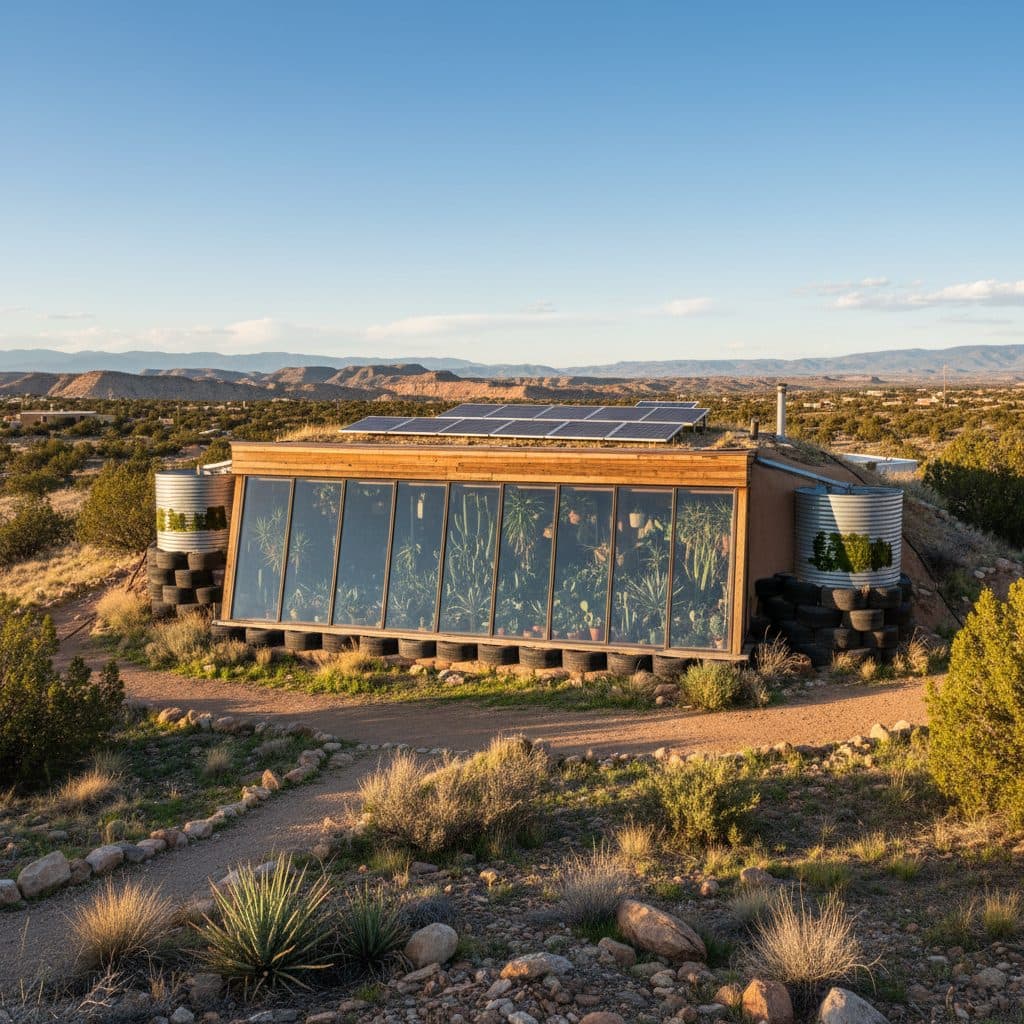
- Earthships and thermal mass: Pioneered in the high desert of Taos by architect Michael Reynolds, Earthships utilize discarded automobile tires packed with dense earth to create massive thermal mass walls. Glazed south-facing greenhouse atriums capture passive solar heat in winter, regulate indoor temperatures, and recycle domestic greywater through indoor botanical planter cells. One county-level exception of note is Taos County's Earthship ordinance and its designated sustainable development communities, where alternative off-grid building techniques operate under specific experimental-code allowances that do not apply across the rest of the state.
- Septic and liquid waste permits: In New Mexico, onsite liquid waste systems are regulated by the New Mexico Environment Department (NMED) under 20.7.3 NMAC, not CID. Conventional septic systems require an NMED permit and must be installed by an NMED-licensed contractor or by a property owner who has passed the NMED installer exam. DIY unpermitted trenches, cesspools, or discharging untreated blackwater directly onto desert soil are illegal and subject to heavy fines.
For foundational definitions and self-reliance skills, see what is homesteading and our comprehensive homesteading skills overview.
Why is solar energy so effective in New Mexico?
New Mexico ranks second in the United States for solar resource potential, receiving over 300 cloudless, sunny days per year and an average of 5.5 to 6.5 peak sun hours daily.
+-------------------------------------------------------------+
|              OFF-GRID HIGH-DESERT SOLAR SIZING              |
|                                                             |
|   [ Photovoltaic Panels ]  South-facing, tilt-adjusted      |
|                                     |                       |
|                                     v                       |
|   [ Charge Controller ]    MPPT Controller (handles cold V) |
|                                     |                       |
|                                     v                       |
|   [ Battery Storage ]      Lithium Iron Phosphate (LiFePO4) |
|                            *Must be in insulated room (32°F)|
|                                     |                       |
|                                     v                       |
|   [ Inverter / Charger ]   Pure Sine Wave Output (120/240V) |
+-------------------------------------------------------------+- Cold weather solar boost: Photovoltaic solar panels operate more efficiently in cool temperatures. New Mexico's combination of cold, crisp winter mountain air and intense high-altitude sunlight produces exceptional solar electricity generation.
- Battery insulation requirement: While lead-acid batteries tolerate cool temperatures with capacity loss, modern Lithium Iron Phosphate (LiFePO4) batteries cannot be safely charged below freezing (32°F / 0°C). All off-grid battery banks must be housed inside an insulated, temperature-regulated utility room or subterranean battery bunker.
How do you grow food in the New Mexico high desert?
Growing food in New Mexico requires adopting ancient arid agricultural principles designed to conserve every drop of soil moisture.
+-------------------------------------------------------------+
|              SUNKEN WAFFLE BED GEOMETRY                     |
|                                                             |
|       +---------------------------------------------+       |
|       | Berm Edge |   Sunken Cell   | Berm Edge     |       |
|       | (Raised)  | (15 cm Sunken)  | (Raised)      |       |
|       |   ---     |  - Plant Root * |   ---         |       |
|       |  /   \    |  - Water Pools* |  /   \        |       |
|       +---------------------------------------------+       |
+-------------------------------------------------------------+- Sunken waffle beds: Pioneered by the Zuni and Pueblo peoples, sunken waffle gardens reverse traditional raised beds. Beds are dug 10 to 15 cm below ground level and surrounded by raised earthen berms. Water pools directly over root zones without evaporating or running off.
- Sub-surface clay ollas: Bury unglazed terracotta clay pots up to their necks in garden beds and fill them with water. Soil moisture tension draws water out through the microporous clay walls directly into surrounding plant roots with zero evaporative loss.
- Agro-shade netting (30% to 50%): Desert sunlight at 7,000 feet elevation is intensely strong. Erecting 30% to 50% shade cloth over vegetable beds lowers midday leaf temperatures, prevents blossom drop in tomatoes and peppers, and reduces transpiration.
- Drought-tolerant perennial crops: Integrate resilient crops such as pinyon pine (Pinus edulis), prickly pear cactus (Opuntia), tepary beans, native amaranth, and drought-hardy fruit trees. Explore dryland polycultures in our guide on xeriscaping a productive food garden.
Combining solar generation, rooftop rainwater catchment, and passive solar earthen construction allows an off-grid homestead in New Mexico to operate reliably in an arid climate.