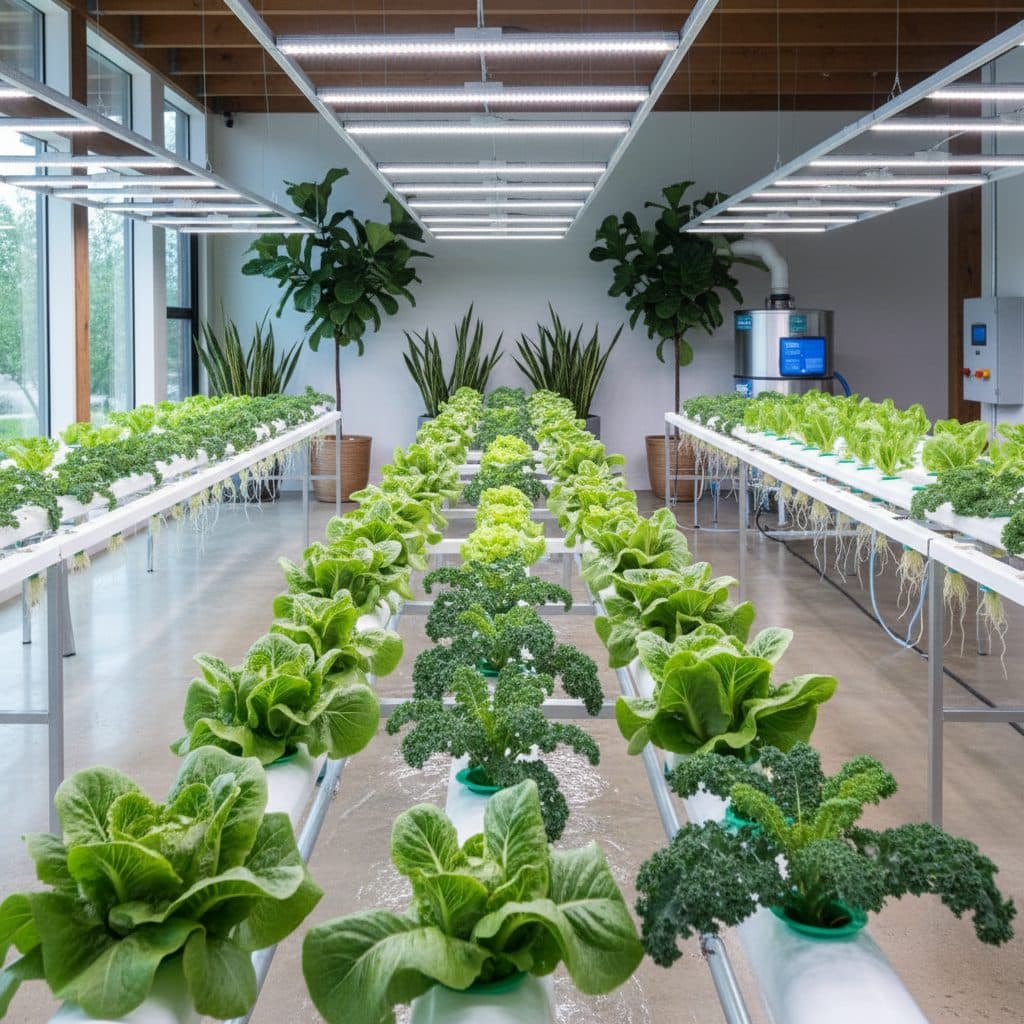
Key takeaways
- Hydroponic systems allow year-round leafy green production regardless of the climate outside.
- Choosing the right system (DWC, NFT, Wick) depends on your space, budget, and experience level.
- Precise control over light (14-18 hours), temperature (65-75°F), and humidity (50-70%) is critical for success.
- Maintaining nutrient solution pH between 5.5-6.5 and EC levels (1.2-1.8 mS/cm) ensures optimal plant health.
- Many leafy greens, including lettuce, spinach, and mustard, thrive in indoor hydroponic setups, maturing in 30-45 days.
- Hydroponics can significantly reduce water usage, using up to 90% less than traditional soil farming.
Quick answer: You can grow fresh lettuce and greens indoors year-round in USDA Zone 5 using hydroponic systems, which allow for precise control over light, temperature, humidity, and nutrients. This method significantly reduces water usage and pest issues, providing consistent harvests.
In states like Minnesota, where winter temperatures can drop to -20°F in USDA zone 4, fresh, local produce is often scarce for half the year. Yet, with a well-designed indoor hydroponic system, you can harvest crisp lettuce and leafy greens every month, regardless of the weather outside. This approach offers a consistent supply of food, reducing your reliance on seasonal availability and long-distance transport.
Hydroponic growing (cultivating plants without soil, using mineral nutrient solutions in water) is a practical method for home growers across the United States. It allows for precise control over the growing environment, often leading to faster growth rates and higher yields compared to traditional gardening. A modest home setup can keep a household in cutting greens right through the winter.
The case for indoor hydroponics
Moving your leafy green cultivation indoors and into a hydroponic system offers several distinct advantages, particularly for those living in regions with short growing seasons or limited outdoor space. For instance, in northern Maine, where the frost-free period might only span 120 days, indoor hydroponics extends your growing calendar to 365 days. One significant benefit is high water efficiency; hydroponic systems can use up to 90% less water than traditional soil farming, an important consideration in drought-prone areas like California’s Central Valley.
Consistent harvests and reduced pest pressure
With a controlled indoor environment, you can maintain optimal conditions year-round, leading to more predictable and often faster growth cycles. Many lettuce varieties mature in just 30-45 days in hydroponics, compared to 50-70 days in soil. This consistent environment also drastically reduces pest and disease pressure, as the plants are isolated from many common outdoor threats. Furthermore, hydroponic systems inherently reduce weed competition, a major advantage over soil-based cultivation which often requires extensive weed control measures [4]. This means less time spent weeding and more time harvesting.
- Year-round production, whatever the winter is doing outside.
- Up to 90% reduction in water usage.
- Faster growth cycles, often 30-45 days for lettuce.
- Significantly reduced pest and disease issues.
- No weeding, and no carry-over of soil-borne disease from last season’s bed.
Choosing your hydroponic system
Selecting the right hydroponic system is a foundational step, influencing your setup’s complexity, cost, and yield. For beginners in a small apartment in Portland, Oregon, a simple Deep Water Culture (DWC) system is often a good fit, with few parts and steady growth for lettuce. A DWC system involves suspending plants with their roots directly in a nutrient-rich water solution, often aerated by an air pump and stone, and can cost as little as $50 to start.
Popular system types for leafy greens
The Nutrient Film Technique (NFT) is another popular choice, especially for larger operations or those aiming for higher plant density. NFT systems typically use shallow channels, often 4-6 inches wide, where a thin film of nutrient solution flows over the roots. This method is efficient and well-suited for growing tropical leafy vegetables in controlled greenhouse environments, as noted in 2002 research [5]. Wick systems are simple and passive, drawing nutrient solution up to the roots via a wick, making them suitable for small-scale setups or educational projects. Aeroponics, while more complex, mists nutrient solution directly onto suspended roots, potentially leading to faster growth but requiring more precise equipment. Consider your available space: a reflective indoor grow tent measuring 4×4 feet can comfortably house a 30-plant NFT system.
- Deep Water Culture (DWC): Simple, low cost, good for beginners, typically uses a 5-gallon bucket per plant.
- Nutrient Film Technique (NFT): Efficient, scalable, uses shallow channels, ideal for 20-50 plants in a home setup.
- Wick System: Passive, very low maintenance, suitable for a few plants, uses 1-2 wicks per plant.
- Aeroponics: Fastest growth, uses fine mist, higher initial cost, requires precise timers.
Essential environmental controls
Achieving consistent, high-quality yields in hydroponics hinges on careful environmental control. For leafy greens like lettuce, maintaining a stable temperature between 65-75°F (18-24°C) is necessary for healthy growth and prevents bolting. In a basement grow room in Cleveland, Ohio, where ambient temperatures might fluctuate, a small space heater or fan can help regulate this range. Humidity levels should ideally be kept between 50-70%, which can be managed with a humidifier or dehumidifier depending on your local climate.
Lighting and air circulation
Light is the most critical factor after water and nutrients. Leafy greens require 14-18 hours of light per day, followed by a dark period. LED grow lights are highly efficient, providing the necessary Photosynthetic Photon Flux Density (PPFD) of 150-300 µmol/m²/s without excessive heat. For a 2×4 foot grow area, a 100-watt LED light is often sufficient. Proper air circulation, achieved with a small oscillating fan, is also vital. It strengthens plant stems, helps regulate temperature and humidity, and ensures adequate CO2 exchange, which can be depleted in a sealed indoor space within a few hours without replenishment.
- Temperature: Maintain 65-75°F (18-24°C) for most leafy greens.
- Humidity: Target 50-70% relative humidity.
- Light Cycle: Provide 14-18 hours of light daily, followed by 6-10 hours of darkness.
- Light Intensity: Aim for 150-300 µmol/m²/s PPFD for leafy greens.
- Air Circulation: Use a small fan to prevent stagnant air and strengthen plants.
Nutrients and pH management
In hydroponics, plants receive all their essential minerals directly from the nutrient solution, making its composition and balance paramount. Unlike soil, which can buffer changes, hydroponic solutions require precise management. For leafy greens, a balanced nutrient formula specifically designed for hydroponics is necessary, containing macro-nutrients like nitrogen, phosphorus, and potassium, and micro-nutrients such as iron and zinc. These solutions are typically mixed from two or three parts according to manufacturer instructions, often at a ratio of 10-20 milliliters per gallon of water.
Monitoring pH and electrical conductivity (EC)
The pH of your nutrient solution directly impacts nutrient availability. For optimal uptake by most leafy greens, the pH should be maintained between 5.5 and 6.5. Regular testing with a pH meter, at least every 2-3 days, is essential. If the pH drifts, use pH Up or pH Down solutions to adjust it. Electrical Conductivity (EC) or Total Dissolved Solids (TDS) meters measure the concentration of nutrients in the solution. For leafy greens, an EC range of 1.2-1.8 mS/cm (or 600-900 ppm TDS on a 0.5 conversion factor) is generally effective. The entire nutrient solution should be changed every 7-14 days to prevent nutrient imbalances and pathogen buildup, especially in larger systems holding 20-30 gallons of water.
- Use hydroponic-specific nutrient solutions, not soil fertilizers.
- Monitor pH daily or every other day, keeping it between 5.5-6.5.
- Check EC/TDS levels regularly, aiming for 1.2-1.8 mS/cm.
- Change the entire nutrient reservoir every 7-14 days.
- Test your tap water first — if it is very hard or its EC is already high, filtered or reverse osmosis water gives you a cleaner baseline to build on.
Planting, care, and harvest
Starting your hydroponic leafy greens from seed is a cost-effective and rewarding approach. Begin by germinating seeds in rockwool cubes, coco coir, or specialized hydroponic sponges. These inert media provide support and retain moisture while roots develop. Place 2-3 seeds per cube and keep them moist in a propagation dome under a low-intensity light for 5-7 days until seedlings emerge. Once they are up, snip all but the strongest seedling in each cube at the base — pulling the extras disturbs the roots of the one you are keeping. Once seedlings have developed 2-3 true leaves and roots begin to show through the bottom of the cube, they are ready for transplanting into your main hydroponic system.
Transplanting and harvesting techniques
When transplanting, gently place the seedling cube into the net pot of your chosen system, ensuring the roots are in contact with the nutrient solution. Maintain adequate spacing between plants: for most lettuce varieties, 6-8 inches between plants is sufficient to allow for full growth without overcrowding. For continuous harvests, a technique called ‘cut and come again’ works well for loose-leaf varieties; simply snip off the outer leaves, leaving the inner ones to continue growing. This allows for multiple harvests from a single plant over 20-30 days. For head lettuce, you’ll typically harvest the entire plant once it reaches maturity, usually within 30-45 days from transplant. Consider saving seeds from your best plants for future generations, a practice detailed in our seed saving guide.
- Germinate seeds in rockwool or coco coir for 5-7 days.
- Transplant seedlings with 2-3 true leaves into net pots.
- Space plants 6-8 inches apart for optimal growth.
- Use ‘cut and come again’ for continuous harvests of loose-leaf varieties.
- Harvest head lettuce when fully mature, typically 30-45 days.
Beyond lettuce: other leafy greens
While lettuce is a popular starting point for many hydroponic growers, a wide array of other leafy greens also thrive in soilless systems, offering diverse flavors and nutritional profiles. Spinach, for example, is an excellent choice, preferring slightly cooler temperatures between 60-70°F (15-21°C) and a pH range of 6.0-7.0. It can be harvested multiple times using the ‘cut and come again’ method, yielding fresh leaves for 3-4 weeks from a single plant.
Exploring diverse greens
Kale, another highly nutritious option, grows quickly in hydroponics, often reaching full size in 45-60 days. Varieties like ‘Dwarf Blue Curled’ are well-suited for indoor systems, requiring about 8-10 inches of spacing per plant. Arugula and mustard greens (Brassica juncea) are fast-growing, spicy additions that can be ready for harvest in as little as 20-30 days from seed. Nutrient analysis studies, such as those focusing on Trigonella foenum, indicate the potential for hydroponically grown leafy greens to offer complete nutritional profiles [2]. Experimenting with different greens can add variety to your diet and optimize your system’s output. Many of these greens, like Swiss chard, can produce for 60-90 days before needing replacement.
- Spinach: Prefers 60-70°F, pH 6.0-7.0, multiple harvests over 3-4 weeks.
- Kale: Robust grower, matures in 45-60 days, needs 8-10 inches spacing.
- Arugula: Fast-growing, spicy, ready in 20-30 days.
- Mustard Greens: Quick growth, adds peppery flavor, similar to arugula.
- Swiss Chard: Long-producing, bright colors, can yield for 60-90 days.
Comparison of common hydroponic systems for leafy greens
System type | Pros | Cons | Best for |
|---|---|---|---|
Deep Water Culture (DWC) | Simple to set up, low cost, robust growth, good for beginners. | Requires aeration, can be prone to root rot if not managed, plants are fixed. | Single plants or small batches of lettuce, herbs. |
Nutrient Film Technique (NFT) | Efficient use of water/nutrients, good oxygenation, scalable, continuous harvest. | Requires consistent power, vulnerable to pump failure, can clog easily. | Commercial operations, high-density leafy green production (20+ plants). |
Wick System | Very simple, no pumps or electricity needed, low maintenance. | Slower growth, less efficient nutrient delivery, limited to smaller plants. | Beginners, small home setups, educational projects (1-4 plants). |
Water Savings: Hydroponic systems use up to 90% less water than traditional soil farming, conserving significant resources in regions like the arid Southwest.
Faster Growth: Lettuce typically reaches harvest 30-45 days after it goes into the system, which beats the same crop in a bed — though a seed packet's days-to-maturity figure counts from sowing, so add your propagation time before you compare the two.
Frequently asked questions
What is the ideal temperature for growing hydroponic lettuce?
For optimal growth, hydroponic lettuce thrives in temperatures between 65-75°F (18-24°C). Maintaining this range helps prevent bolting and encourages healthy leaf development, typically leading to harvest in 30-45 days.
How often should I change the hydroponic nutrient solution?
You should change the entire nutrient solution every 7-14 days. This prevents nutrient imbalances and the buildup of pathogens so plants receive a fresh, balanced supply of minerals for consistent growth across a 20-gallon system.
Can I grow different types of leafy greens together in one hydroponic system?
Yes, you can grow different leafy greens together, provided they have similar environmental and nutrient requirements. Most lettuce varieties, spinach, and some mustards thrive with a pH of 5.5-6.5 and similar light cycles, allowing for a diverse harvest from a single 4×4 foot system.
What kind of light is best for indoor hydroponic leafy greens?
LED grow lights are highly recommended for indoor hydroponic leafy greens due to their efficiency and spectrum control. They should provide 14-18 hours of light daily with a PPFD of 150-300 µmol/m²/s, which is sufficient for healthy growth in a typical 2×4 foot grow tent.
How much space do I need for a small home hydroponic system?
A small home hydroponic system for leafy greens can be quite compact, requiring as little as 2-4 square feet of space. A simple Deep Water Culture (DWC) setup with a 5-gallon bucket can grow one large lettuce plant, while a small NFT system might fit 6-10 plants in a similar footprint.
References
- Improving Food Safety of Hydroponic Leafy Greens (2025). Improving Food Safety of Hydroponic Leafy Greens.
- Enhancing and investigating hydroponic cultivation of leafy greens in urban areas – a study on nutritive analysis of hydroponic leafy greens -Trigonella foenum- (2025). Enhancing and investigating hydroponic cultivation of leafy greens in urban areas – a study on nutritive analysis of hydroponic leafy greens -Trigonella foenum-.
- Use of Co-Composted Poultry Carcasses as Growing Media for Leafy Greens (2023). Use of Co-Composted Poultry Carcasses as Growing Media for Leafy Greens.
- Weed Control in Leafy Greens (Lettuce, Endive, Escarole, and Spinach) (2010). Weed Control in Leafy Greens (Lettuce, Endive, Escarole, and Spinach).
- APPROPRIATE HYDROPONIC SYSTEMS FOR GROWING TROPICAL LEAFY VEGETABLES IN GREENHOUSES (2002). APPROPRIATE HYDROPONIC SYSTEMS FOR GROWING TROPICAL LEAFY VEGETABLES IN GREENHOUSES.
- USDA Natural Resources Conservation Service (2024). USDA Natural Resources Conservation Service.